

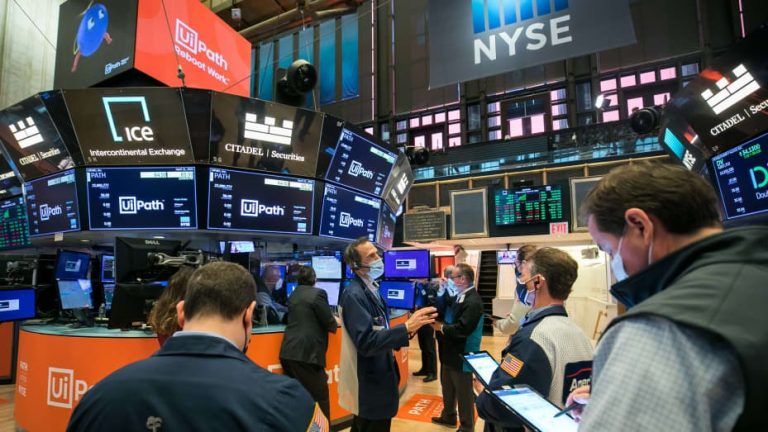
U.S. stocks ended Thursday on an uneasy footing as disappointing earnings from key technology companies sharpened investor doubts over whether the tens of billions of dollars being poured into artificial intelligence will deliver returns quickly enough to justify today’s valuations.
While major indexes clawed back some of their intraday losses, the session laid bare a growing fault line in the market: enthusiasm for AI remains intact, but tolerance for near-term underperformance is thinning fast.
The S&P 500 slipped 0.13% to 6,969.01, retreating from earlier, steeper losses. The Nasdaq Composite fell 0.72% to 23,685.12, dragged lower by a broad selloff in software and cloud stocks. The Dow Jones Industrial Average, more insulated from technology volatility, eked out a 0.11% gain to 49,071.56.
Register for Tekedia Mini-MBA edition 20 (June 8 – Sept 5, 2026).
Register for Tekedia AI in Business Masterclass.
Join Tekedia Capital Syndicate and co-invest in great global startups.
Register for Tekedia AI Lab.
Microsoft Becomes the Epicenter
At the center of the market’s anxiety was Microsoft, whose shares plunged 10%, wiping out hundreds of billions of dollars in market value in a single session. The selloff followed quarterly results that showed cloud revenue growth slowing more than investors had anticipated, reigniting questions about how long it will take for Microsoft’s massive AI investments—particularly those tied to OpenAI—to materially boost profits.
Microsoft’s earnings landed at a sensitive moment. The company is widely seen as the bellwether for enterprise AI monetization, given its deep integration of generative AI into Azure, Office, and developer tools. Any sign of hesitation in cloud growth, therefore, reverberates far beyond the company itself.
“Microsoft disappointed and there are some genuine concerns that AI investments will eat the software companies’ lunches,” said John Praveen, managing director and co-CIO at Paleo Leon in Princeton, New Jersey.

The reaction underscored a broader recalibration underway in markets. For much of the past two years, investors rewarded companies simply for committing capital to AI. Now, those same companies are being pressed to demonstrate how quickly spending can be translated into revenue, margins, and cash flow.
Microsoft’s stumble triggered a cascade across the software industry. SAP’s U.S.-listed shares sank 15% after the company issued a cautious cloud outlook, while ServiceNow slid 9.9%, amplifying fears that enterprise customers may slow spending amid economic and political uncertainty.
Other major software names were swept into the selloff. Salesforce fell 6%, Oracle dropped 2.2%, Adobe declined 2.6%, and cloud security firm Datadog tumbled 8.8%.

For some companies, the worry goes beyond cyclical spending slowdowns. Investors are increasingly debating whether AI could eventually erode parts of the software business model itself.
“For some software companies, such as ServiceNow and Salesforce, the fear is that AI is going to disrupt their business a little bit,” said Jay Hatfield, CEO and CIO of Infrastructure Capital Advisors in New York. “If AI can be used to supplant some of their services, that’s a structural concern. Whether that happens or not, those stocks are getting hit pretty hard.”
Technology was the worst-performing sector in the S&P 500, down 1.9%, reflecting how concentrated the day’s losses were.
The selloff was compounded by a backdrop of broader uncertainty. Investors are navigating unresolved questions about U.S. monetary policy, including who will eventually lead the Federal Reserve and how aggressive future interest-rate cuts might be. Political risks also linger, from tensions surrounding Washington’s stance toward Iran and Greenland to the renewed threat of a U.S. government shutdown.
Against that backdrop, earnings disappointments are proving harder for markets to shrug off.
“Investors are trying to reduce exposure and play it safe,” Praveen said. “There are all sorts of storm clouds in the background.”
Pockets of Resilience
Not all of Wall Street was under pressure. Meta Platforms surged 10.4%, lifting the communications services sector, which rose 2.9% to lead the market. Investors welcomed Meta’s stronger-than-expected revenue outlook, even as the company disclosed plans for a 73% jump in capital expenditures this year, largely tied to AI infrastructure.
The reaction highlighted a subtle but important distinction emerging in markets: investors appear more forgiving of heavy AI spending when advertising demand is strong, and cash generation remains robust.
Apple traded choppily after the bell but held onto modest gains after beating quarterly revenue estimates. CEO Tim Cook told Reuters that demand for the company’s latest iPhone was “staggering,” pointing to a sharp rebound in China that helped ease concerns about the company’s growth trajectory.
Among other megacaps, Tesla fell 3.5% after outlining plans to more than double capital expenditures to a record level, reinforcing investor caution toward companies committing large sums of capital without near-term payoff visibility.
Outside the tech sector, earnings painted a more constructive picture. IBM shares rose 5% after the company beat fourth-quarter earnings estimates, offering reassurance that some legacy technology firms are navigating the AI transition more smoothly.
Industrial and consumer-facing names also drew buying interest. Caterpillar climbed 3.4% after reporting higher profit, while Mastercard jumped 4.3% after beating Wall Street expectations and announcing plans to cut about 4% of its global workforce as it reallocates investment.
Defense contractor Lockheed Martin advanced 4% after forecasting 2026 earnings above analyst estimates. Southwest Airlines surged 18.7%, the top percentage gainer in the S&P 500, after projecting stronger-than-expected annual profit.
The energy sector gained 1%, supported by a rally in oil prices. Brent crude rose to a near six-month high on rising concerns about a potential U.S. military confrontation with Iran.
Market Internals Signal Fragility
Market breadth reflected the session’s mixed tone. Advancers narrowly outnumbered decliners on the NYSE, but declining stocks led on the Nasdaq, underscoring persistent pressure on growth-oriented names.
Trading volume was elevated, with 23.36 billion shares changing hands across U.S. exchanges, well above the recent 20-day average—often a sign of heightened conviction and repositioning by investors.
Rare-earth and critical mineral stocks slid after reports that President Donald Trump’s administration may step back from price floor mechanisms for strategic materials, weighing on companies such as MP Materials, USA Rare Earth, and Critical Metals.
Put together, Thursday’s market action reinforced a shift that has been quietly building for months. Artificial intelligence remains a central investment theme, but Wall Street is becoming more discriminating. Companies are no longer being rewarded simply for ambition or scale; investors want clearer evidence that AI spending can generate sustainable profits without overwhelming balance sheets.
But analysts believe the AI trade is not collapsing—but it is maturing. And as earnings season progresses, markets are expected to remain volatile as investors reassess which companies can truly turn the promise of AI into durable financial performance.