

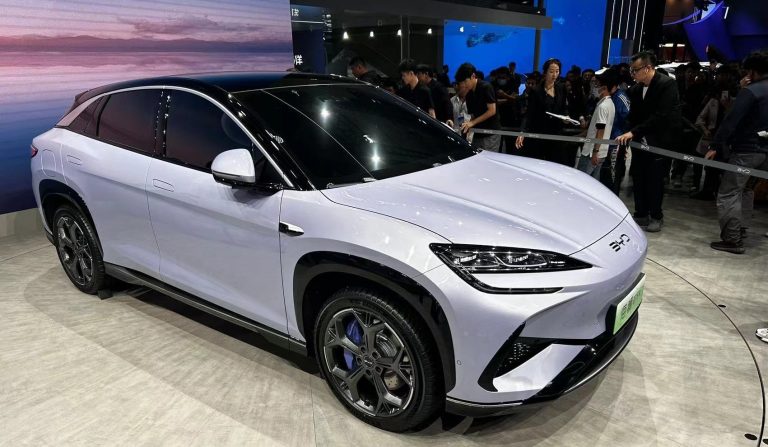
A spike in fuel prices triggered by the Iran war is accelerating a shift already underway in the global auto industry, pushing more consumers toward electric vehicles and giving Chinese manufacturers fresh momentum in overseas markets.
BYD, which overtook Tesla last year as the world’s largest EV seller and is now struggling to keep up with demand outside China, has been at the center of the surge.
“We survive and are successful without the US market today,” BBC quoted BYD executive vice president Stella Li as saying at the Beijing Auto Show, making clear that the company’s expansion strategy is no longer tied to breaking into the United States.
Register for the next Tekedia Mini-MBA.
Register for Tekedia AI in Business Masterclass.
Join Tekedia Capital Syndicate and co-invest in great global startups.
Consumers feel the daily savings when oil prices increase. EVs help them save money every day,” she said. “Actually, we are now suffering [insufficient] capacity. Our demand is much higher than what we can supply.”
The current surge in demand underscores how quickly energy shocks are translating into structural changes in consumer behavior. While EV adoption has typically been driven by policy incentives and environmental considerations, the latest shift is being led by immediate cost pressures. Rising petrol prices are making the economic case for EVs more tangible, particularly in markets where subsidies have been scaled back.
For Chinese automakers, the timing is advantageous. Years of state-backed investment have created an industrial base that spans batteries, semiconductors, software, and final vehicle assembly. That vertical integration is now enabling companies like BYD to scale production more rapidly than many global competitors, even as supply chains remain tight.

BYD’s challenge is no longer demand generation but capacity expansion. The company’s admission that it cannot meet current orders points to a broader bottleneck across the industry: manufacturing, rather than technology, is emerging as the limiting factor in the next phase of EV growth.
The company is attempting to address another key constraint, charging time, through its “flash charging” technology. Li described it as a “game-changer,” capable of delivering hundreds of kilometers of range in minutes. If widely deployed, such systems could narrow one of the final usability gaps between electric and combustion vehicles, particularly for long-distance travel.
The emphasis on charging points to a deeper shift in competition. Chinese EV makers are no longer relying primarily on price advantages. Instead, they are moving up the value chain, competing on battery efficiency, charging infrastructure, and integrated software ecosystems.

“We are not just a car company. We produce one-third of global smartphone components, we are a leading player in battery storage, solar panels, buses, and trucks. So BYD is an ecosystem,” Li said.
That ecosystem approach is becoming a defining feature of China’s auto industry. Companies are positioning themselves not just as vehicle manufacturers but as energy and mobility platforms, linking cars with power storage, grid systems, and digital services. This model allows them to capture value across multiple layers of the transition to electrification.
The global expansion of Chinese EV makers is also reshaping trade dynamics. While the United States remains largely closed due to tariffs and regulatory scrutiny, other regions are becoming more accessible. Europe, Latin America, and parts of Asia are seeing increased penetration by Chinese brands, often driven by competitive pricing and faster product cycles.
BYD’s sales figures illustrate this. Domestic deliveries have declined for seven consecutive months amid intense price competition, while European sales rose 156% in the first quarter. The contrast highlights a broader rebalancing, with overseas markets becoming critical to sustaining growth.
Geopolitics continues to shape the trajectory. Western governments have raised concerns over subsidies, data security, and industrial policy, creating barriers that limit market access. Yet these constraints are also accelerating China’s push to build alternative trade corridors and deepen ties with emerging markets.
At the same time, legacy automakers are being forced into strategic adjustments. Companies such as Volkswagen, Toyota, and Ford are increasingly entering partnerships with Chinese firms to access battery technology and software capabilities.
BMW has aligned with CATL, while Audi is incorporating systems from Huawei. Volkswagen’s collaboration with XPeng reflects a broader recognition that competing independently in the EV transition is becoming more difficult.
Meanwhile, Chinese firms are expanding into adjacent technologies that could redefine mobility. XPeng’s plans for humanoid robots and flying cars point to an industry that is no longer confined to traditional automotive boundaries, but is increasingly intertwined with automation, robotics, and aerospace.
Within China, however, the intensity of competition remains a constraint. Price wars are compressing margins, and rapid product turnover is forcing companies to innovate continuously. Even dominant players face pressure, raising the likelihood of consolidation.
“History suggests not all will survive,” Li said, drawing parallels with earlier waves of global competition that saw Japanese and South Korean automakers emerge as dominant exporters.
The current phase appears to be following a similar pattern, but at a faster pace. Energy shocks, technological advances, and geopolitical fragmentation are converging to accelerate the transition.