

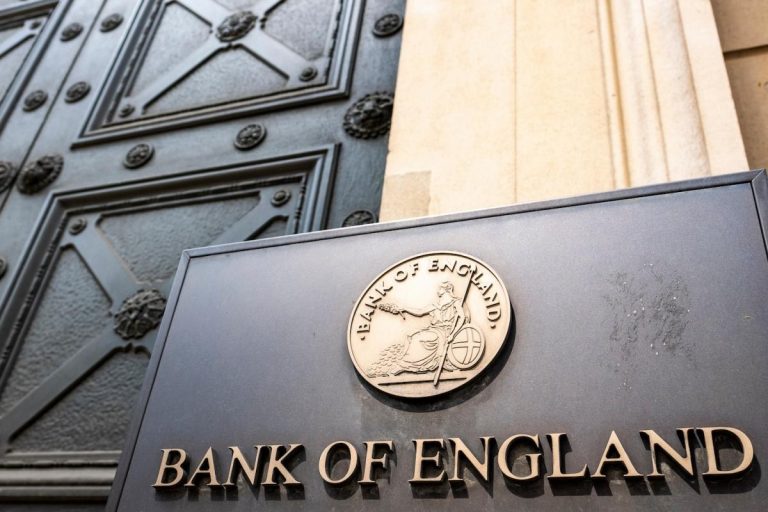
A senior policymaker at the Bank of England has issued an unusually direct warning that global equity markets may be underpricing a convergence of risks, raising the prospect of a sharp correction even as major indices hover near record highs.
Sarah Breeden, the central bank’s deputy governor for financial stability, said asset prices appear disconnected from underlying macroeconomic threats.
“There’s a lot of risk out there and yet asset prices are at all-time highs,” she told the BBC. “We expect there will be an adjustment at some point.”
Register for the next Tekedia Mini-MBA.
Register for Tekedia AI in Business Masterclass.
Join Tekedia Capital Syndicate and co-invest in great global startups.
The remarks stand out for their candor. Central bank officials typically avoid explicit commentary on equity valuations, preferring to signal risk through broader financial stability assessments. Breeden’s intervention suggests growing unease within policy circles that markets may be relying too heavily on optimistic scenarios around growth, earnings, and geopolitical outcomes.
Her concerns are not limited to valuations alone but to the possibility of multiple shocks occurring simultaneously.
“The thing that really keeps me awake at night is the likelihood of a number of risks crystallizing at the same time, a major macroeconomic shock, confidence in private credit goes, AI and other risky valuations readjust, what happens in that environment and are we prepared for it?” she said.

The warning comes at a moment of apparent market resilience. The S&P 500 and Nasdaq Composite recently closed at record highs, recovering losses tied to the Iran conflict, while the MSCI World ex-U.S. Index has gained more than 5% this year. The rebound has been driven by strong corporate earnings, continued investment in artificial intelligence, and expectations that geopolitical tensions will not escalate into sustained economic disruption.
Breeden’s intervention introduces a counter-narrative: that markets may be extrapolating best-case outcomes while discounting tail risks.
One area of particular concern is private credit — a rapidly expanding segment of global finance that has grown into a multi-trillion-dollar market outside traditional banking channels.

“Private credit has gone from nothing to two-and-a-half trillion dollars in the last 15 to 20 years. It hasn’t been tested at this scale with the degree of complexity and interconnections it has with the rest of the financial system so far,” Breeden said.
She added, “It’s a private credit crunch, rather than a banking-driven credit crunch, that we’re worried about.”
Unlike the global financial crisis, where stress originated in the banking system, a disruption in private credit could emerge in less transparent parts of the market, where leverage, liquidity mismatches, and interconnected exposures are harder to monitor. That raises the risk of sudden repricing if defaults rise or investor confidence weakens.
The geopolitical backdrop adds another layer of fragility. The Iran conflict has already introduced volatility into energy markets, with oil prices remaining elevated and supply routes such as the Strait of Hormuz under scrutiny. While equities have largely absorbed these shocks, Breeden’s comments are indications that policymakers are concerned about second-order effects, particularly if energy inflation feeds into broader macro instability.
Not all market participants share that level of caution. Mark Haefele of UBS acknowledged energy risks but maintained a constructive outlook, writing, “Absent a prolonged shock, we believe the backdrop for the economy and corporate earnings remains solid, supporting equities.”
Similarly, Daniel Casali of Evelyn Partners argued that corporate performance will remain the dominant driver.
“If companies deliver on earnings expectations and geopolitical tensions ease even slightly, there is a clear pathway for equities to move higher,” he said, adding that “earnings rather than energy may be the dominant market driver for the rest of the year.”
A more structural counterargument comes from Nigel Green of deVere Group, who challenged the premise that current valuations are inherently excessive. He said Breeden was right to highlight elevated pricing but argued that traditional valuation frameworks may no longer apply.
“We have never had AI before at this scale,” Green said. “There’s no clean historical benchmark for what markets should pay for companies leading a once-in-a-generation productivity, infrastructure and earnings cycle.”
This divergence in views reflects a deeper tension in global markets. There is a policy-driven concern that financial conditions may be too loose relative to underlying risks. There is also a market narrative that structural shifts, particularly the rise of AI, justify higher valuations and sustained capital inflows into equities.
Even some policymakers and corporate leaders have expressed surprise at the market’s strength. Goldman Sachs boss David Solomon and U.S. President Donald Trump have both commented on the strength of equities amid geopolitical uncertainty, underscoring how disconnected market performance can appear from headline risks.
The underlying issue may not be whether markets are overvalued in a traditional sense, but whether they are sufficiently pricing the probability of adverse scenarios. Breeden’s warning points to a scenario where multiple stress points, geopolitical shocks, credit market disruptions, and a reassessment of AI-driven valuations could interact in ways that amplify volatility.
For now, liquidity, earnings growth, and investor positioning continue to support equity markets. But the Bank of England’s intervention indicates that, from a financial stability perspective, the margin for error may be narrowing. The timing of any adjustment remains uncertain. The risk, as Breeden frames it, is not a single trigger but a convergence, a scenario where markets are forced to reprice several assumptions at once.