

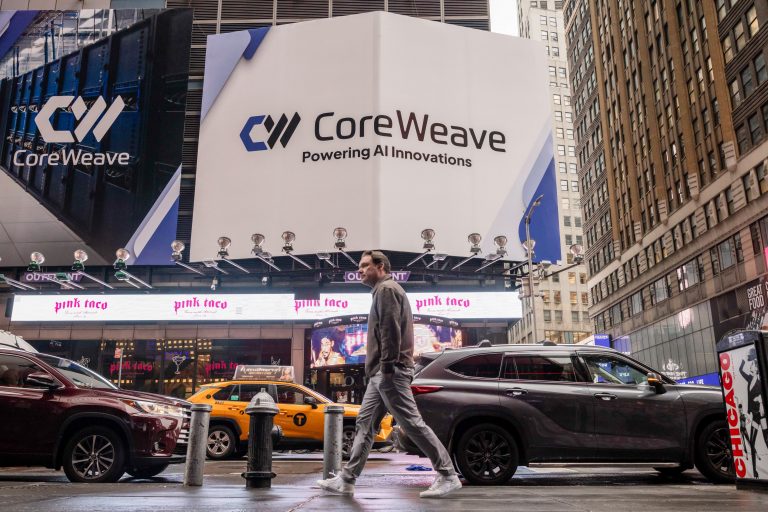
CoreWeave has announced a $1.5 billion private offering of senior unsecured notes due 2031 as it doubles down on infrastructure expansion, even as analysts raise alarms over its ballooning debt and operational risks.
The debt raise comes just days after the AI cloud infrastructure company unveiled plans to invest over $6 billion in a new purpose-built data center campus in Lancaster County, Pennsylvania—its largest project to date.
The company, which went public earlier this year, said the funds from the note offering would go toward refinancing existing debt, covering related issuance costs, and for general corporate purposes. The offering, expected to close this week, is backed by guarantees from its subsidiaries.
Register for Tekedia Mini-MBA edition 20 (June 8 – Sept 5, 2026).
Register for Tekedia AI in Business Masterclass.
Join Tekedia Capital Syndicate and co-invest in great global startups.
Register for Tekedia AI Lab.
The move is widely seen as an attempt to stabilize CoreWeave’s balance sheet as the company ramps up capital expenditures to support surging AI demand. CoreWeave, which has grown into one of the largest AI-focused GPU cloud providers in the United States, is racing to build the physical and compute infrastructure needed to support next-generation AI workloads.
At the center of this expansion is its $6 billion commitment to the Lancaster facility, which will initially deliver 100 megawatts of capacity, scalable up to 300 megawatts. CoreWeave says the site will create between 600 and 1,000 construction jobs during its build-out phase and around 70 to 175 permanent jobs once operational.
The project was announced last week during the Pennsylvania Energy & Innovation Summit, which featured high-level participation including President Trump, and was positioned as part of a broader national push to keep the U.S. ahead in AI infrastructure development.

The site will be outfitted with cutting-edge Nvidia GPUs and other custom accelerators, tailored to support large AI agents and workloads that exceed the capacity of conventional data centers.
Yet the bold expansion is not without major risks. HSBC analysts, in a rare move last week, initiated coverage on CoreWeave with a “Reduce” rating, citing concerns over the company’s financial health. According to HSBC, CoreWeave’s current ratio is just 0.44, indicating potential short-term liquidity pressure. Even more alarming, net debt to equity could hit a staggering 10× once the $1.5 billion notes are factored in. That level of leverage could trip financial covenants and limit the company’s flexibility to raise further capital or refinance in the future.
Operating costs are also a mounting concern. HSBC estimates that maintenance capex could reach 35% of revenue by 2030, and power costs alone could erode margins across CoreWeave’s hyperscale AI offerings. Energy demands from the Pennsylvania site could exacerbate these risks. Just days before CoreWeave’s announcement, Pennsylvania Governor Josh Shapiro warned of potential strain on the state’s electrical grid due to surging AI-related demand.

Meanwhile, analysts also flagged that CoreWeave’s client base is dangerously concentrated. Microsoft accounted for more than 60% of CoreWeave’s revenue in 2024, exposing the company to sudden changes in demand or contract restructuring. This comes despite growing partnerships with other tech giants like Nvidia, Amazon, and OpenAI, and the launch of W&B Weave—CoreWeave’s new platform-as-a-service product—on the AWS Marketplace via its Weights & Biases division.
Shares of CoreWeave surged as much as 8% following the Pennsylvania announcement, reflecting market optimism around the company’s AI infrastructure play. But the enthusiasm has not erased broader investor anxiety. JPMorgan analysts are urging caution, pointing out that the $59 billion company’s rapid capital deployment could outpace its actual earnings potential, especially if AI growth slows or power shortages worsen.
With this aggressive expansion strategy, CoreWeave is positioning itself as a critical pillar of the U.S. AI ecosystem. But as the company leans heavily on debt to fund its ambitions, it’s walking a financial tightrope. Whether the bet on AI infrastructure pays off—or collapses under its own weight—will depend on its ability to balance capital discipline with technical execution.