

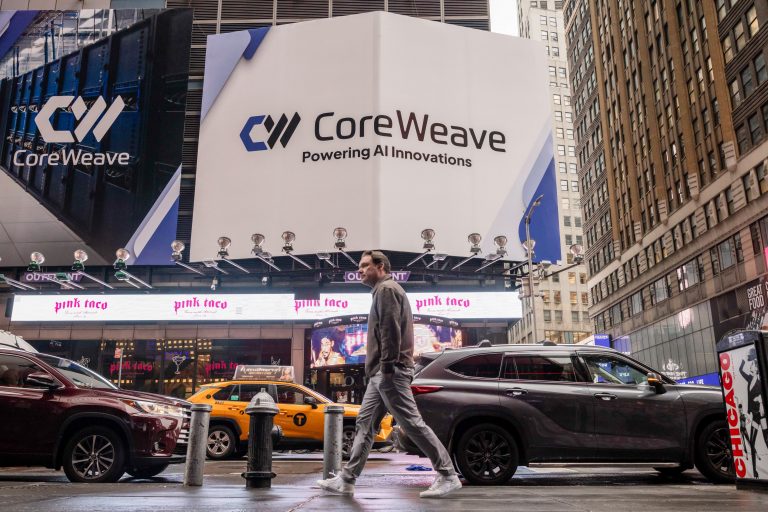
CoreWeave shares jumped 11% in extended trading on Tuesday after the artificial intelligence infrastructure provider reported quarterly revenue above Wall Street expectations, highlighting continued demand for computing capacity even as the company carries a heavy debt burden to fund its rapid expansion.
CoreWeave reported revenue of $2.58 billion for the quarter, compared with the $2.56 billion expected by analysts surveyed by LSEG. Revenue more than doubled from a year earlier, rising 112%.
The company reported an adjusted loss of $1.14 per share. Its net loss widened sharply to $626 million, or 60 cents per share, from $290 million, or 60 cents per share, a year earlier.
Register for the next Tekedia Mini-MBA.
Register for Tekedia AI in Business Masterclass.
Join Tekedia Capital Syndicate and co-invest in great global startups.
The revenue growth underscores the scale of spending on AI infrastructure as technology companies race to secure access to powerful graphics processing units needed to train and run sophisticated AI models.
CoreWeave’s revenue backlog, a key measure of contracted future business, reached $104 billion by the end of the quarter. The company had 1.5 gigawatts of active power supporting its infrastructure.
The backlog provides CoreWeave with substantial visibility into future revenue, but it also reflects the enormous investment required to fulfill those contracts. The company has been borrowing heavily to purchase Nvidia GPUs, data-center equipment, and other infrastructure needed to expand its capacity.

CoreWeave had about $35 billion of debt on its balance sheet at the end of the quarter, making its ability to convert its rapidly growing revenue and backlog into sustainable cash flow particularly important for investors. The company is competing directly with much larger cloud providers such as Amazon Web Services, Google Cloud and Microsoft Azure, which have substantially greater financial resources and established data-center networks.
CoreWeave’s strategy has been to focus heavily on AI computing rather than compete across the broader cloud-services market. That specialization has helped the company secure major contracts as AI developers and technology companies seek additional computing capacity amid shortages of advanced chips and data-center infrastructure.
Meta Platforms committed an additional $21 billion of spending with CoreWeave during the quarter. CoreWeave also announced a multiyear agreement with Anthropic and a $6 billion commitment from quantitative trading firm Jane Street.

Those deals have helped propel CoreWeave’s contracted backlog to levels far beyond its current annual revenue, suggesting that demand for specialized AI infrastructure remains strong.
But the challenge is turning that demand into profits.
CoreWeave’s net loss more than doubled from a year earlier even as revenue more than doubled. The discrepancy illustrates the capital-intensive nature of the AI infrastructure business. Building data centers, securing electricity, purchasing GPUs and financing those assets can require billions of dollars before the associated computing contracts generate sufficient returns.
The company’s debt load therefore remains one of the most important issues for investors. Higher borrowing costs or delays in bringing new data centers online could put pressure on margins and cash flow, particularly if GPU economics deteriorate or customers reduce their AI infrastructure spending.
Competition is also expanding beyond traditional cloud providers.
SpaceX has begun offering excess computing capacity, potentially adding another source of AI infrastructure supply. Meta has also considered launching its own cloud business, which could eventually give one of CoreWeave’s major customers an alternative way to obtain computing capacity.
But the competitive environment could become more challenging as the world’s largest technology companies continue to build their own AI data centers and develop increasingly specialized computing infrastructure. CoreWeave’s business is therefore closely tied to the broader AI capital-spending cycle.
So far, major technology companies have shown little willingness to materially slow investments in AI infrastructure, supporting demand for companies that can provide additional computing capacity.
CoreWeave’s $104 billion backlog offers a substantial cushion against a near-term slowdown in demand, but fulfilling those contracts will require continued investment. Its $35 billion debt burden makes execution necessary because the company must expand capacity while generating enough cash to service its obligations.
CoreWeave shares had gained about 26% this year through Tuesday’s close, compared with a gain of almost 13% for the S&P 500. The stock began trading on the Nasdaq in March 2025.
The company’s latest results give investors another indication of the extraordinary scale of the AI infrastructure buildout. Revenue growth of 112% and a $104 billion backlog show that demand remains powerful, but the widening loss and massive debt load underline the financial risks involved in trying to capture that growth.