

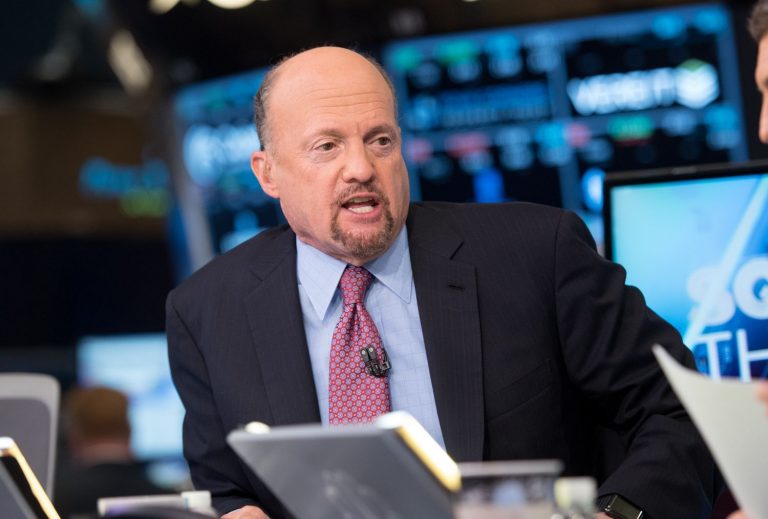
CNBC’s Jim Cramer on Tuesday argued that Oracle may be nearing a financial and market-imposed limit in the artificial intelligence arms race, positioning the software giant as a potential catalyst for a broader slowdown in hyperscalers’ spending.
His comments come as Oracle’s stock and credit profile have become focal points for growing investor unease about whether today’s AI investments can realistically pay for themselves.
Cramer said Oracle’s balance sheet is now under sharper scrutiny after the company committed to an unprecedented expansion of its data center footprint to support AI workloads, particularly for OpenAI. While Oracle has leaned heavily into AI infrastructure as a growth engine, Wall Street’s reaction suggests investors are increasingly concerned about leverage, execution risk, and the long wait before returns materialize.
Register for Tekedia Mini-MBA edition 20 (June 8 – Sept 5, 2026).
Register for Tekedia AI in Business Masterclass.
Join Tekedia Capital Syndicate and co-invest in great global startups.
Register for Tekedia AI Lab.
“Oracle already has a huge amount of debt. Their balance sheet’s not that good,” Cramer said on CNBC. “At some point, they’ll heed the warning of the bond market and slow things down. These data centers cost a fortune and even the best builders stumble. Oracle can’t risk blowing up its balance sheet for Sam Altman.”
Those warnings intensified after Oracle’s recent earnings report, which, like Broadcom’s, showed strong demand for AI services but failed to reassure investors about financing and profitability. Oracle beat earnings expectations but missed on revenue, and management offered limited clarity on how it plans to fund its rapidly expanding AI commitments without further stretching its balance sheet.
Since early September, Oracle’s stock has been under sustained pressure, losing nearly half its value from a peak triggered by optimism over a massive AI backlog. Over just a few trading days last week, the shares fell sharply again, reflecting a broader reassessment of AI-linked infrastructure stocks. Investors who once rewarded aggressive expansion are now questioning whether the pace of spending has outstripped realistic cash flow generation.

The pressure is not confined to equities. Oracle’s growing reliance on debt markets has amplified concerns. The company recently issued $18 billion in bonds, a move that drew intense scrutiny from credit investors. According to Cramer, demand for credit default swaps tied to Oracle surged after the issuance, a signal that bondholders are increasingly hedging against the risk that the company’s leverage could become problematic if AI economics disappoint.
Oracle has also disclosed massive long-term obligations tied to its cloud and data center strategy. As of late November, the company reported hundreds of billions of dollars in lease commitments for data centers and cloud capacity, many stretching 15 to 19 years into the future. That scale of fixed obligation has unsettled investors at a time when pricing, utilization rates, and long-term demand for AI services remain uncertain.
Cramer argued that Oracle’s position makes it the weakest link in what he described as a spending standoff among five major players: Amazon, Microsoft, Google, Meta, and OpenAI, which relies heavily on Oracle as a core infrastructure partner. These companies, he said, are locked in a race to outspend one another, building data centers wherever power and land are available, while trying to prevent rivals from encroaching on their core businesses.

“This reckless, imprudent data center spending has crushed these stocks,” Cramer said, adding that OpenAI’s spending posture is particularly aggressive.
He described the ChatGPT maker as venture-funded and unusually willing to absorb losses in pursuit of scale, committing more than $300 billion over five years to Oracle’s technology alone, with total commitments across partners approaching $1.4 trillion.
In that context, Oracle’s market performance has become a warning sign. Equity investors have punished the stock, while credit markets are demanding higher compensation for risk. Cramer suggested that if Oracle responds by slowing its AI buildout, it could give other hyperscalers political and financial cover to do the same.
“If Oracle pumps the brakes on spending, competitors could follow suit and see their stocks climb,” he said, arguing that restraint could ease fears of runaway capital expenditure and restore confidence in valuations.
He also said a slowdown would force OpenAI to prioritize its ambitions rather than trying to dominate every segment of the AI economy simultaneously.
“This way Oracle stays alive, and OpenAI is forced to choose which businesses it truly wants to target,” Cramer said. “Because he who defends everything defends nothing.”
Oracle’s recent market performance has become emblematic of a broader shift in sentiment for Wall Street. The AI trade is no longer being judged solely on growth narratives and demand projections. Investors are now focused on debt levels, long-term obligations, and the credibility of returns.