

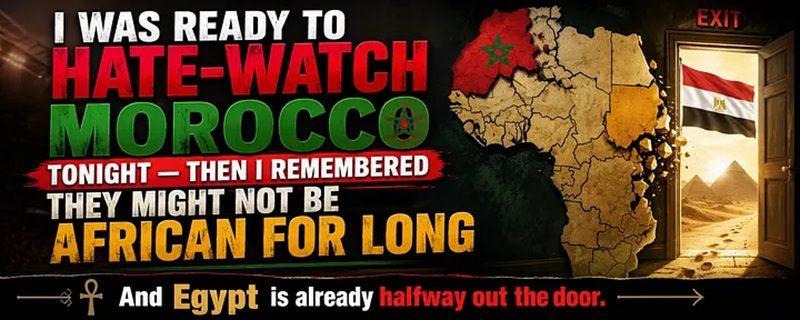
And Egypt is already halfway out the door.
There’s something almost absurd about watching a football match and suddenly spiraling into a geopolitical existential crisis. But here I was, popcorn in hand, ready to root against Morocco with the full theatrical commitment of a sport-fan rivalry — and then a thought stopped me cold.
In thirty years, Morocco might not even be part of Africa anymore. At least, not in any meaningful geopolitical sense.
Register for the next Tekedia Mini-MBA.
Register for Tekedia AI in Business Masterclass.
Join Tekedia Capital Syndicate and co-invest in great global startups.
And Egypt? Egypt is already knocking on the Middle East’s door — and the region might just let them in.
The Sand Is Literally Shifting
Let’s start with the physical reality before we get to the political one.
North Africa has always occupied an awkward liminal space — geographically African, but culturally, linguistically, and historically entangled with the Arab world, the Mediterranean, and the ancient Near East. This was always a tension. But what’s happening now is something more structural, more permanent.

Morocco is actively repositioning itself. Not through some dramatic declaration, but through the slow, deliberate architecture of trade agreements, diplomatic alignments, and strategic partnerships that are orienting the country away from sub-Saharan Africa and toward Europe, the Gulf states, and the broader MENA (Middle East and North Africa) economic bloc.
The Abraham Accords normalization with Israel in 2020 was a seismic signal — Morocco wasn’t just making peace, it was signaling which geopolitical neighborhood it wanted to be seen in. It was sitting down at a table that had nothing to do with the African Union’s agenda.
Morocco’s Quiet Exit Strategy
Morocco has had a complicated relationship with the African Union for decades. It only rejoined the AU in 2017 after a 33-year absence — and even that return was strategic, not sentimental. The country has been pouring billions into infrastructure projects across West and Central Africa, positioning itself as a gateway between Europe and the continent.

But a gateway is not the same as a neighbor. A gateway faces outward.
Morocco’s economic gravity is increasingly European and Gulf-oriented. Its largest trading partners are Spain, France, and India. It hosts European manufacturing hubs. Its tourism industry, financial services, and renewable energy ambitions (some of the world’s largest solar installations are in the Sahara) are all calibrated to attract Western and Gulf capital, not intra-African integration.
By 2050, if current trajectories hold, Morocco could find itself in a peculiar position: geographically African, but functionally operating as a southern European or northern MENA economy — more analogous to Turkey than to Senegal.
Egypt: One Foot Already Over the Line
If Morocco is inching toward the door, Egypt has had one foot over the threshold for decades.
Egypt joined the Arab League in 1945. It was a founding member. And while the Arab League is not a replacement for African identity, it represents where Egypt has historically invested its diplomatic energy, its foreign policy narratives, and its sense of regional leadership.
The recent whispers — and they are more than whispers — about Egypt being formally recognized or integrated into Middle Eastern geopolitical frameworks is not as radical as it sounds. Egypt already participates in Gulf economic initiatives. It has deepened security ties with the Gulf Cooperation Council (GCC) states. The Saudi-led development funds that poured into Egypt after 2013 created financial dependencies that shifted the country’s economic orientation dramatically eastward.
There is now serious discourse among regional analysts about whether Egypt’s future lies more in an expanded Middle Eastern economic community than in an African one — particularly as the Abraham Accords reshaped the geopolitical map of the Eastern Mediterranean and the Red Sea corridor.
Egypt’s participation in BRICS, its relationship with the UAE, and its role in brokering Gaza ceasefire talks all underscore that Cairo functions, in many ways, as a Middle Eastern capital that happens to sit on African soil.
What Does “Africa” Even Mean Anymore?
This is the question that the football match was never going to ask, but maybe it should.
The African Union has 55 member states. It spans a continent of extraordinary diversity — from the Maghreb to the Cape, from the Atlantic coast to the Indian Ocean. But the internal cohesion of that project has always been challenged by the gravitational pull of external blocs: the Arab world, the European Union, the Gulf states, and now the BRICS framework.
When Morocco builds a gas pipeline to Europe, when Egypt negotiates billion-dollar investment deals with Riyadh, when both nations increasingly conduct their diplomatic lives in Arabic and French rather than in the lingua franca of African Union summits, they are not abandoning Africa. But they are demonstrating that “Africa” as a geopolitical identity competes against other identities that, frankly, offer more immediate economic and strategic returns.
This is not a moral failing. It is geography meeting history meeting pragmatism.
The 2030 World Cup Is Already Telling the Story
Here’s the most visible symbol of this realignment: Morocco is co-hosting the 2030 FIFA World Cup — alongside Spain and Portugal.
Not alongside South Africa. Not alongside Nigeria or Kenya. Alongside two European nations, in a tournament that will literally straddle two continents.
That is not an accident. It is a statement of where Morocco sees itself in the world. It is a country that has one eye on the Atlas Mountains and another firmly fixed on the Strait of Gibraltar, looking north.
So Should I Still Hate-Watch Them?
Look — the original instinct was about football tribalism, the kind of petty, joyful antagonism that makes sport worth watching. But somewhere between kickoff and halftime, it became impossible to ignore what Morocco and Egypt actually represent on the world stage right now: nations in the middle of a slow, unannounced, but very real identity transition.
They are not leaving Africa. But they may be leaving African geopolitics — the summits, the trade blocs, the continental solidarity project — for arrangements that serve their national interests more directly.
Whether that is a loss for the African project, or simply the inevitable logic of a multipolar world where geography no longer dictates alliance, is a question worth sitting with.
The match is still on. But I’m watching it differently now.
What do you think — is North Africa’s gradual drift toward the MENA geopolitical sphere a natural evolution or a loss for continental African solidarity? Drop your thoughts in the comments.