

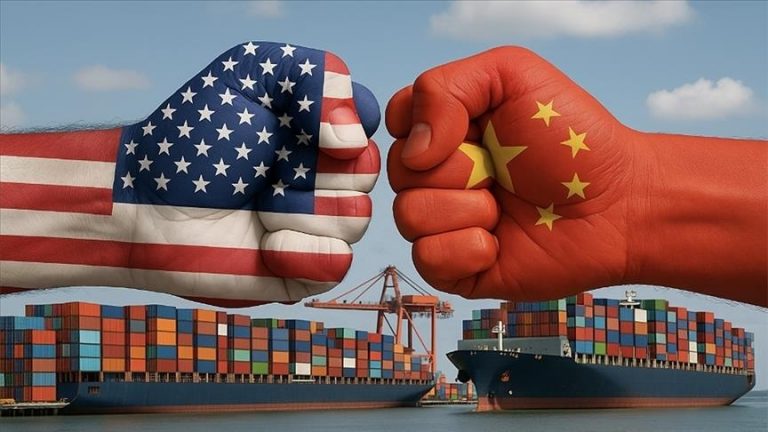
Recent developments have contributed to a cooling in both cryptocurrency and equities markets, driven by escalating geopolitical tensions and trade uncertainties. The U.S.-China trade war has intensified, with President Trump imposing 145% tariffs on Chinese goods, prompting Beijing to respond with retaliatory duties and restrictions on critical mineral exports.
China has denied claims of ongoing trade negotiations with the U.S., rejecting Trump’s assertions of progress and calling high tariffs “meaningless.” This has heightened market uncertainty, as investors had briefly rallied on hopes of de-escalation after U.S. Treasury Secretary Scott Bessent suggested tariffs were unsustainable. U.S. and global stock markets, which had rallied for three days on optimism about easing trade tensions, faced renewed pressure after China’s pushback. The mixed signals—White House optimism countered by China’s firm stance—have kept risk assets volatile.
Cryptocurrencies, often seen as a risk-off asset, have also been affected. Bitcoin (BTC) saw a surge as investors sought safe havens amid tariff-related volatility, but other major altcoins like Ethereum (ETH) have not followed suit, reflecting uneven market sentiment. Gold prices, another safe-haven asset, have continued to climb, briefly surpassing $3,500 per ounce, driven by trade war fears and broader economic uncertainty.
Register for Tekedia Mini-MBA edition 20 (June 8 – Sept 5, 2026).
Register for Tekedia AI in Business Masterclass.
Join Tekedia Capital Syndicate and co-invest in great global startups.
Register for Tekedia AI Lab.
Pakistan-India Tensions
A deadly militant attack in Indian-administered Kashmir, killing 26 tourists (mostly Indian), has escalated tensions between India and Pakistan. India has blamed Pakistan, leading to diplomatic measures like visa cancellations, suspension of a water-sharing treaty, and Pakistan’s suspension of the Simla Agreement, which established the Line of Control (LoC). These developments have raised fears of further military escalation between the nuclear-armed neighbors, adding to global geopolitical uncertainty.
Pakistan Stock Exchange (PSX): Negative sentiment has hit the PSX, with the KSE-100 index reflecting investor concerns over the Kashmir attack and broader regional instability, compounded by global trade war fears. Indian equity benchmarks (Sensex and Nifty) have shown resilience, gaining over 4.5% recently, supported by foreign inflows and a stronger rupee (85.37/USD). However, the escalating tensions could introduce volatility if the situation worsens.
While not directly tied to South Asian tensions, the broader geopolitical uncertainty reinforces crypto’s appeal as a hedge, though market cooling suggests investors are cautious. The combination of U.S.-China trade war escalation and India-Pakistan tensions has created a risk-off environment. Investors are grappling with mixed signals—Trump’s tariff backtracking and China’s hardline response—alongside fears of regional conflict in South Asia.

Both gold and Bitcoin have seen inflows, reflecting investor flight to safety. However, equities and non-BTC cryptocurrencies remain under pressure due to uncertainty. The cooling of crypto and equities markets stems from heightened uncertainty driven by China’s denial of trade progress with the U.S. and escalating India-Pakistan tensions following the Kashmir attack. While safe-haven assets like gold and Bitcoin are benefiting, broader markets remain volatile as investors navigate these dual geopolitical and economic risks.
Global stock markets, particularly in the U.S., China, and South Asia, are likely to experience heightened volatility. Investors face uncertainty from the U.S.-China trade war and potential military escalation in South Asia, leading to choppy trading conditions. Bitcoin may continue to see inflows as a safe-haven asset, but altcoins could lag due to risk-off sentiment, creating a divergence in crypto performance.
Assets like gold (already above $3,500/oz) and Bitcoin are likely to see sustained demand as investors hedge against trade and geopolitical risks. U.S. Treasuries may also attract inflows, potentially lowering yields. Tech and consumer goods sectors, heavily exposed to U.S.-China trade, may underperform due to tariff-related cost increases. Defense stocks in India and Pakistan could see gains amid rising tensions.

Projects tied to decentralized finance (DeFi) or store-of-value narratives may outperform speculative tokens in a risk-averse environment. The U.S. dollar could strengthen as a safe-haven currency, while the Indian rupee (despite recent gains) and Pakistani rupee may face pressure if tensions escalate further. Persistent U.S.-China tariffs (145% on Chinese goods) and China’s retaliatory measures, including restrictions on critical minerals, could disrupt global supply chains, particularly for electronics, EVs, and renewable energy sectors.
Higher costs and supply shortages may fuel inflation, challenging central banks’ efforts to manage price stability. The suspension of trade and water-sharing agreements with India, combined with global trade war fallout, could exacerbate Pakistan’s economic challenges, including high inflation and currency depreciation. While India’s economy remains relatively resilient, prolonged tensions could deter foreign investment and disrupt growth in border regions like Kashmir.
The trade war and geopolitical instability may dampen global economic growth forecasts, as businesses delay investments and consumers curb spending amid uncertainty. China’s rejection of trade talks and Trump’s aggressive tariff stance signal a prolonged trade war, potentially escalating into broader economic decoupling. This could reshape global alliances and trade blocs.
India-Pakistan Conflict Risk
The Kashmir attack and subsequent diplomatic fallout (visa cancellations, treaty suspensions) raise the risk of localized military skirmishes along the Line of Control. While full-scale war is unlikely due to nuclear deterrence, heightened tensions could destabilize the region. International mediators (e.g., the U.S., UN) may face pressure to intervene, complicating global diplomatic efforts.
Tensions could spill over to neighboring countries (e.g., Afghanistan, China) or involve external powers (e.g., U.S. support for India, China’s ties with Pakistan), amplifying geopolitical risks. Investors may prioritize safe-haven assets (gold, Bitcoin, Treasuries) and defensive stocks (utilities, healthcare) to mitigate risks.
Increased use of options and futures to hedge against market swings, particularly in trade-sensitive sectors. The Federal Reserve and others may face pressure to adjust monetary policy if inflation spikes or growth slows. Rate cuts could be considered to support markets, though inflationary pressures may limit room to maneuver.
India and Pakistan may boost defense spending, straining budgets. China and the U.S. could double down on protectionist policies, further fragmenting global trade. Geopolitical uncertainty may accelerate calls for clearer crypto regulations, as governments seek to monitor capital flows amid market instability. Prolonged U.S.-China trade tensions could accelerate the shift toward regionalized supply chains and economic blocs, reducing globalization’s benefits. India-Pakistan tensions and U.S.-China rivalry may reshape alliances, with countries forced to pick sides or navigate neutral stances.
Persistent market uncertainty could bolster crypto’s role as a hedge, though regulatory crackdowns in response to capital flight risks could temper growth. The interplay of U.S.-China trade war escalation and India-Pakistan tensions creates a complex risk environment, driving market volatility, safe-haven demand, and economic uncertainty. Investors should brace for short-term turbulence and consider diversified, defensive strategies, while policymakers face challenges in balancing growth, inflation, and geopolitical stability.