

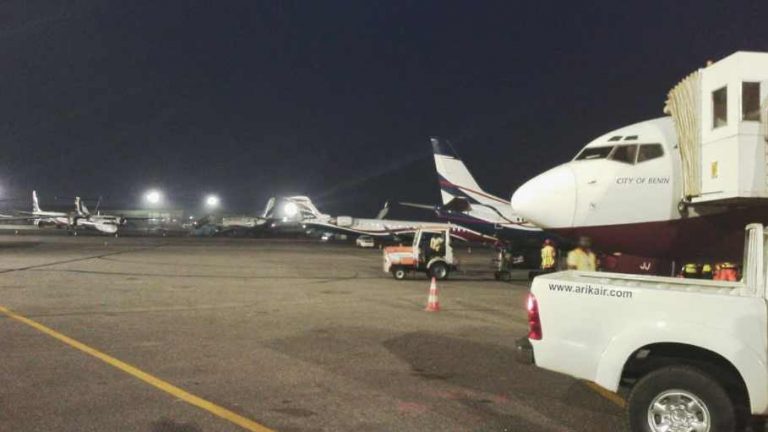
Nigeria’s domestic aviation market closed 2025 on a weaker footing, with available airline seats falling sharply in December amid persistent structural and financial challenges confronting local carriers.
Data from OAG’s Africa Aviation Market Monthly Airline Data Updates for December 2025 shows that total domestic seat capacity in Nigeria declined to 850,420 seats, down from 919,400 seats in December 2024. The 7.5% year-on-year drop places Nigeria among the worst-performing major domestic aviation markets on the continent during the period.
The figures underline a broader slowdown in activity across Nigeria’s domestic air travel sector at a time when several African peers are expanding capacity and rebuilding momentum after years of disruption.
Register for Tekedia Mini-MBA edition 20 (June 8 – Sept 5, 2026).
Register for Tekedia AI in Business Masterclass.
Join Tekedia Capital Syndicate and co-invest in great global startups.
Register for Tekedia AI Lab.
By contrast, South Africa consolidated its position as Africa’s largest domestic aviation market. Available seats there rose to 1,803,097 in December 2025 from 1,686,956 a year earlier, representing growth of nearly 7%. Kenya also posted solid gains, increasing domestic capacity by 8.6% to 456,500 seats, while Tanzania recorded one of the strongest expansions on the continent, surging 27% to 415,130 seats.
North African markets largely moved in the opposite direction from Nigeria. Egypt recorded modest growth of 2.5%, while Algeria expanded capacity by more than 26%. Morocco grew its domestic seat count by almost 12%, and Cape Verde posted the fastest percentage growth among surveyed markets, with capacity jumping nearly 34%.
Not all markets fared well. Ethiopia experienced a contraction, while the Democratic Republic of Congo recorded one of the sharpest declines, shedding close to 29% of its domestic seat capacity year on year.

For Nigeria, the decline reflects deep-rooted challenges that have constrained airline operations for years. A major factor has been limited access to dry-lease aircraft, which restricted fleet expansion and replacement. For a long period, Nigeria was blacklisted by the Aviation Working Group over non-compliance with the Cape Town Convention, following past aircraft defaults by local carriers. That status effectively shut Nigerian airlines out of global leasing markets.
Although Nigeria has since made progress, raising its Cape Town Convention compliance score from 49% to 75.5% and securing removal from the AWG watchlist in October 2024, the recovery has been slow. According to government disclosures, only one airline has so far qualified for a dry-lease aircraft, which the Minister of Aviation said would arrive in October 2025. Most carriers continue to rely on wet leases or outright purchases, with aircraft prices reaching as high as $80 million.
Dry leasing remains critical to restoring domestic capacity because it allows airlines to operate aircraft under their own crews and schedules, giving them full control over routes and costs. Without it, fleet planning becomes more expensive and less flexible, limiting the ability of airlines to add seats consistently.

Financing conditions have further compounded the problem. High interest rates and limited access to affordable credit continue to restrict aircraft acquisition. At the same time, Nigeria’s lack of functional wide-body maintenance, repair, and overhaul facilities has forced airlines to ferry aircraft overseas for servicing. Air Peace chief executive Allen Onyema has said a single ferry trip can cost as much as $400,000, with aircraft sometimes grounded for months, shrinking available capacity, and disrupting schedules.
Pressure on the sector is also intensifying ahead of proposed fiscal changes. Onyema has warned that provisions in the tax reform package scheduled to take effect in January 2026 could significantly raise operating costs. Central to his concern is the reintroduction of value added tax on aircraft, spare parts, and air tickets — items that were exempted under the 2020 Finance Act to stabilize the aviation industry.
According to Onyema, importing an aircraft valued at around $80 million would immediately attract 7.5% VAT under the new rules, translating into billions of naira at current exchange rates. He has argued that airlines lack the financial buffers to absorb such costs, especially in an environment where borrowing rates can climb as high as 35%.
“By the time you bring these things in, at the end of the day, the cost of operation will be huge,” Onyema said. “Your ticket fares will hit N1.something million soon.”
He warned that pushing additional taxes onto already stretched operators could have devastating consequences.
“If we implement that tax reform, Nigerian airlines could go down within three months,” he said.
While several local carriers, including Air Peace and Ibom Air, are developing maintenance facilities, these projects are not yet operational. Until they come on stream, aircraft downtime will remain a drag on capacity and reliability.
Taken together, the December figures paint a picture of a domestic aviation market struggling to regain altitude. Without faster access to leasing, cheaper financing, operational infrastructure, and regulatory stability, Nigeria risks falling further behind regional peers that are steadily rebuilding and expanding their domestic air networks.