

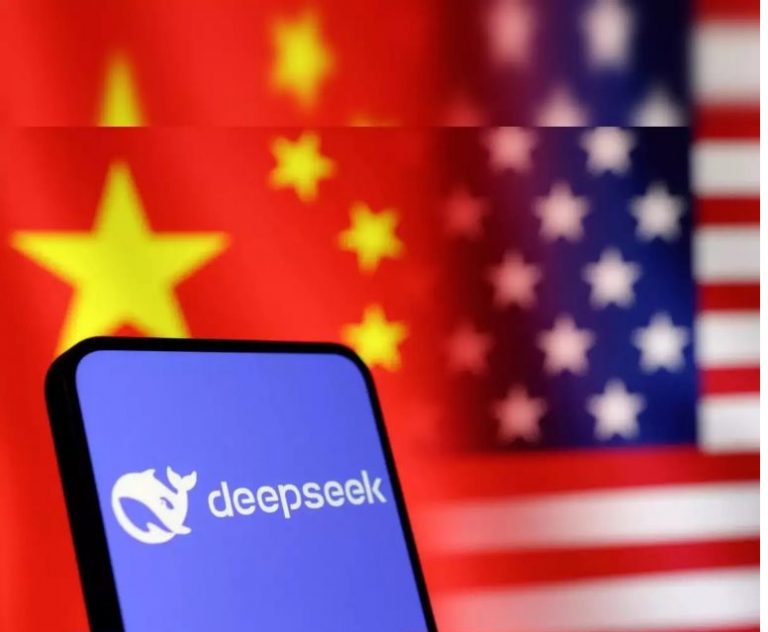
In a policy proposal submitted to the Trump administration’s “AI Action Plan” initiative, OpenAI has called for a ban on AI models developed by Chinese lab DeepSeek and other firms it claims are backed by the People’s Republic of China (PRC).
The move comes as DeepSeek rapidly gains traction in the AI industry, raising speculation that OpenAI’s push may be driven more by competitive concerns than security risks.
OpenAI describes DeepSeek as “state-subsidized” and “state-controlled,” warning that the lab is subject to Chinese regulations that could compel it to share user data with the government. It argues that allowing “PRC-produced” AI models to operate in key U.S. markets poses a significant risk, citing privacy concerns and potential intellectual property (IP) theft.
Register for Tekedia Mini-MBA edition 20 (June 8 – Sept 5, 2026).
Register for Tekedia AI in Business Masterclass.
Join Tekedia Capital Syndicate and co-invest in great global startups.
Register for Tekedia AI Lab.
However, many in the industry see OpenAI’s actions as an attempt to curb a fast-rising competitor—one that is making significant technological strides at a fraction of the cost of its American counterparts.
The Rise of DeepSeek: A Growing Threat to OpenAI?
DeepSeek, a relatively new entrant in the AI race, has quickly emerged as a formidable rival to OpenAI. The lab’s R1 “reasoning” model has received praise for its efficiency, and its open-source models have been adopted by major firms, including Microsoft, Amazon, and Perplexity. Unlike OpenAI, which operates under a closed-source model, DeepSeek has taken a different approach—offering powerful AI tools for free, making them accessible to a wider range of developers and businesses.
What makes DeepSeek particularly disruptive is its cost-efficiency. The Chinese firm is reportedly operating on a budget significantly smaller than that of U.S. giants like OpenAI, Google DeepMind, and Anthropic. While OpenAI has spent billions training and fine-tuning its models, DeepSeek has leveraged China’s AI infrastructure and aggressive R&D strategies to produce competitive models at a fraction of the cost. This efficiency has not gone unnoticed in Silicon Valley, where concerns are growing that DeepSeek’s rise could reshape the AI industry.

OpenAI’s Security Concerns—or Competitive Fears?
DeepSeek’s ingenuity has supported the belief that OpenAI’s call for a DeepSeek ban is also an effort to stifle competition. While OpenAI has cited potential security vulnerabilities due to China’s strict data-sharing laws, DeepSeek’s open models do not contain built-in mechanisms that would allow the Chinese government to extract user data.
Furthermore, OpenAI’s proposal comes at a time when the company has been increasingly vocal about its own financial struggles. Reports indicate that OpenAI is burning through cash at an unsustainable rate, raising concerns about its long-term viability. In contrast, DeepSeek’s lower-cost operations could give it a crucial advantage in the race for AI supremacy.
Beijing’s Interest in DeepSeek Gives A Cause for Alarm
While OpenAI’s proposal may have competitive undertones, it’s also true that Beijing has shown increased interest in DeepSeek’s success. The Chinese government has long viewed AI as a strategic industry, and DeepSeek’s rise aligns with its broader ambitions to establish global leadership in artificial intelligence.

In a sign of DeepSeek’s growing importance, its founder, Liang Wenfeng, recently met with Chinese President Xi Jinping. While no details of the meeting have been disclosed, the move has fueled speculation that the PRC sees DeepSeek as a critical player in China’s AI future.
Given Washington’s ongoing efforts to restrict China’s access to advanced AI technologies—such as the Biden administration’s sweeping semiconductor export bans—OpenAI’s proposal fits within a broader U.S. strategy to curb China’s AI progress.
Following initial backlash over its proposal, OpenAI spokesperson Liz Bourgeois released a statement clarifying the company’s position.
“We’re not advocating for restrictions on people using models like DeepSeek,” Bourgeois said. “What we’re proposing are changes to U.S. export rules that would allow additional countries to access U.S. compute on the condition that their datacenters don’t rely on PRC technology that presents security risks—instead of restricting their access to chips based on the assumption that they will divert technology to the PRC.”
Despite this attempt at damage control, OpenAI’s own AI-powered deep research tool described Bourgeois’ statement as “equivocal, employing deflective and softening language that partially contradicts the stronger stance documented in [the company’s] original submission.”
Many in the industry remain skeptical of OpenAI’s motives. While national security concerns over China’s AI development are valid, the timing of OpenAI’s proposal—coming just as DeepSeek is gaining global traction—raises questions about whether the push is more about eliminating competition than protecting user data.
Removing OpenAI from all of my devices. They are spending time and resources to hobble their betters which shows that they are scared. I have no desire to deal with an entity that is running scared.