Home Blog Page 12

Takaichi Says Growth Push Will Restore Yen Confidence as Japan’s Fiscal Plans Test Bond Market

0

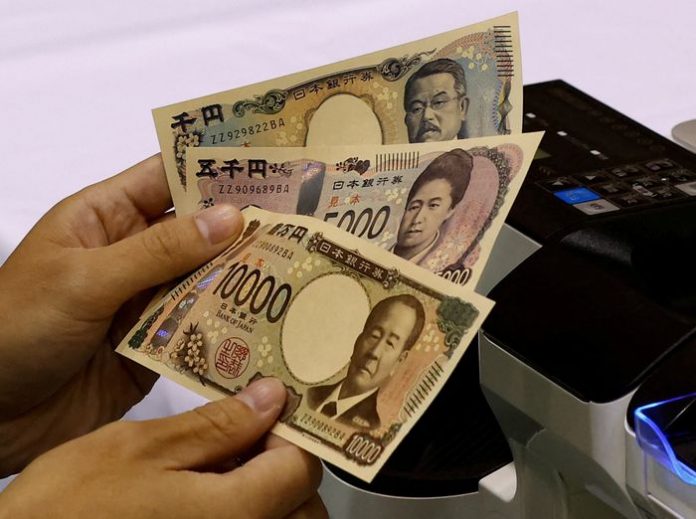
Japanese Prime Minister Sanae Takaichi has defended her government’s spending and investment agenda, saying efforts to strengthen Japan’s economic competitiveness will ultimately support confidence in the yen, even as the currency remains weak and investors remain concerned about the country’s fiscal trajectory.

In a recorded interview aired by Nippon Television on Thursday, Takaichi said her government was not pursuing policies aimed at manipulating the exchange rate and had instead focused on increasing Japan’s economic supply capacity through investment in crisis management and growth industries.

“Our economic policy is not aimed at manipulating exchange rates,” Takaichi said.

“My administration aims to boost Japan’s growth potential by increasing the economy’s supply capacity through bold investment in crisis management and growth areas,” she said. “Such efforts would strengthen Japan’s global competitiveness, thereby helping ensure market confidence in the yen.”

Takaichi also said she had raised the yen’s undervaluation with U.S. President Donald Trump when the two met last month. The disclosure comes after Trump himself expressed concern about the weak yen during their recent summit, while U.S. Treasury Secretary Scott Bessent has also signaled support for a stronger yen consistent with Japan’s economic fundamentals.

The currency issue has become complicated for Tokyo. The Bank of Japan has raised its policy rate to 1.25%, a 31-year high, yet the yen has continued to weaken against the dollar. The currency moved beyond ¥158 per dollar on Thursday after the latest BOJ meeting summary showed disagreement over the pace of further tightening.

That divergence reveals the difficulty facing Japanese policymakers: higher interest rates are intended to support the yen and contain inflation, but faster monetary tightening could also raise government borrowing costs and weigh on an economy that Takaichi wants to support through higher investment.

The government’s fiscal plans are at the center of that tension.

Budget requests for the fiscal year beginning next April have reached about ¥143 trillion ($903 billion), close to pandemic-era levels. The figure does not necessarily represent the final budget because ministries submitted requests before the government determines which programs will ultimately receive funding.

Takaichi sought to reassure investors that the record requests would not automatically translate into a similarly large final budget.

“We will set clear priorities,” she said. “This is part of our broader effort to reform the budget process. Within that framework, we will review both spending and revenues, while keeping a close eye on tax revenue trends.”

She said the government would set spending in line with its objective of steadily reducing Japan’s debt-to-GDP ratio and would “appropriately manage” the volume of new bond issuance.

“Let me be clear,” she added. “We will secure funding in responding to fiscal needs.”

The problem for the bond market is that the government’s growth agenda is arriving at the same time as borrowing costs are rising.

Japan’s 10-year government bond yield recently reached 3% for the first time in three decades, while the Finance Ministry is preparing for a sharp increase in debt-servicing costs. The ministry has requested ¥36.6 trillion for debt servicing in fiscal 2027, up 17% from the current year’s ¥31.28 trillion, using an assumed interest rate of 3.8%.

That has created a feedback problem for policymakers. Higher yields increase the cost of servicing Japan’s enormous public debt, while concerns about larger deficits and additional bond issuance can themselves push yields higher.

The market is already sensitive to that possibility. Takaichi’s government has faced scrutiny over plans to temporarily reduce the consumption tax on food and increase defense spending, with investors seeking greater clarity over how those measures would be financed.

Takaichi did not repeat a pledge she made last month to target a cap of ¥40 trillion on new bond issuance next fiscal year, adding another element of uncertainty around the eventual financing mix.

Yen Weakness Exposes The Policy Trade-Off

The yen’s weakness is particularly problematic because Japan remains heavily exposed to imported costs. A weaker currency raises the yen value of energy, food, and other imported goods, feeding into domestic inflation and reducing the purchasing power of households.

At the same time, allowing the yen to strengthen through more aggressive BOJ tightening could conflict with Takaichi’s emphasis on investment-led growth.

The latest BOJ meeting summary illustrates that tension. Several policymakers argued that rates should move higher or closer to the bank’s estimated neutral level because of upside inflation risks. But two board members dissented from September’s rate increase, while a Cabinet Office representative urged the BOJ to consider the cumulative effects of previous hikes on economic activity.

Markets interpreted those comments as evidence that further rate increases could face resistance from the government, contributing to renewed yen weakness.

The development leaves fiscal policy and monetary policy pulling in different directions. Takaichi wants to increase investment and expand Japan’s productive capacity, while the BOJ is trying to normalize interest rates after years of ultra-loose monetary policy. Meanwhile, the government needs to reassure bond investors that higher spending will not produce an uncontrolled increase in borrowing.

Takaichi’s argument is that stronger growth can ultimately provide the foundation for a stronger currency. Her government is also trying to reduce reliance on supplementary budgets by incorporating more spending into the regular annual budget process, a move intended to improve transparency around fiscal policy.

But investors are likely to focus on the numbers that emerge from that process rather than the stated objective alone. The ¥143 trillion in requests is only a starting point, while the eventual size of the budget, new bond issuance, tax revenue, and the government’s response to higher interest costs will determine how markets assess Japan’s fiscal position.

The distinction is expected to be equally important for the yen. Takaichi’s message is that competitiveness and productive investment, rather than direct currency management, should provide the basis for restoring confidence. The immediate market test, however, will be whether Japan can pursue that growth agenda while convincing investors that debt issuance and inflation will remain under control.

With the yen still under pressure and bond yields at multi-decade highs, Japan’s attempt to combine faster growth with fiscal restraint is becoming a driver of both domestic markets and the broader global rates.

Metaplex Vantage Beta Expands, Coinbase Launches Anthropic Pre-IPO Perps, and DogeOS Opens EVM Testnet

0

The crypto industry is increasingly moving beyond the simple question of whether digital assets can attract users. The more consequential question is what infrastructure will support the next generation of applications, markets and financial instruments.

Three recent developments — Metaplex expanding access to its Vantage beta, Coinbase introducing Anthropic pre-IPO perpetual futures for eligible non-U.S. users, and DogeOS opening its public testnet — highlight how quickly that infrastructure is diversifying.

Metaplex’s decision to open more seats on the Vantage beta points toward a broader evolution in the Solana ecosystem. Metaplex has long been associated with NFT infrastructure, but the significance of Vantage is tied to how creators.

Developers and digital-asset projects can build and manage products at greater scale. Expanding beta access allows more participants to test the platform, generate feedback and potentially accelerate the transition from experimental infrastructure to a more mature production environment.

The development is important because NFTs themselves are changing. They are increasingly being treated not simply as collectibles, but as programmable assets that can represent ownership, access, identity, credentials, intellectual property and financial rights.

Infrastructure capable of supporting those use cases could become increasingly valuable as tokenization expands. Coinbase’s launch of Anthropic pre-IPO perpetual futures introduces a different kind of experiment. Eligible non-U.S. users can gain exposure to the anticipated value of Anthropic through a derivatives market without directly owning shares of the private company.

This is significant because private-company equity has traditionally been difficult for ordinary market participants to access. Perpetual futures can create liquidity around assets that are otherwise difficult to trade, but they also introduce substantial risks.

Unlike owning an actual equity stake, a derivative contract provides price exposure rather than ownership, voting rights or conventional shareholder protections. Leverage can magnify both gains and losses, while the price of a private-company-linked derivative may diverge significantly from any eventual valuation established in a financing round or public offering.

The product therefore reflects a broader trend: crypto exchanges are becoming venues for markets that extend beyond traditional cryptocurrencies. The boundary between digital-asset markets and conventional financial markets continues to blur, particularly as tokenized securities, private-market exposure and derivatives become more accessible.

Meanwhile, DogeOS is taking Dogecoin in another direction. Its public testnet brings Ethereum Virtual Machine-compatible smart contracts to the Dogecoin ecosystem, potentially allowing developers familiar with Ethereum tooling to build applications around Dogecoin.

That matters because Dogecoin has historically been recognized primarily as a payment-oriented cryptocurrency and cultural phenomenon. EVM compatibility could expand its utility by giving developers access to familiar programming frameworks and decentralized-application infrastructure.

If the network eventually attracts developers, liquidity and users, Dogecoin could become more than a transactional asset. These developments reveal an industry increasingly focused on infrastructure rather than speculation alone.

Metaplex is expanding the tools surrounding digital assets, Coinbase is experimenting with new forms of market access, and DogeOS is attempting to transform an established cryptocurrency into a programmable ecosystem.

The next stage of crypto may therefore be defined less by the launch of another token and more by what can be built around existing networks. Infrastructure determines what markets can exist, who can participate and how quickly new applications can scale.

These three developments offer different answers to that same question: how far can blockchain technology move beyond its original boundaries?

North Korean Hackers Move $3.8M in ZEC Into Ironwood Pool as 133K ETH Wallet Transfer Raises Questions

0
North Korean leader Kim Jong Un and his daughter Kim Ju Ae visit the Ministry of National Defense on the occasion of the 76th anniversary of the founding of the Korean People's Army in Pyongyang, North Korea in this picture released on February 9, 2024 by the Korean Central News Agency. KCNA via REUTERS

The latest developments in the cryptocurrency market highlight two very different but connected realities of digital assets: the growing sophistication of illicit fund movements and the extraordinary scale at which major crypto holders can shift capital.

Reports involving North Korean attackers and a wallet linked to Ethereum co-founder Joseph Lubin show how blockchain transparency can expose enormous transactions while privacy infrastructure can make tracing those funds increasingly difficult.

Blockchain investigator ZachXBT reported that North Korean attackers moved approximately 2,700 ZEC, worth about $3.8 million, into the Ironwood privacy pool. The movement is significant because Zcash is designed to provide enhanced transaction privacy, allowing users to shield transaction details through its privacy technology.

When assets associated with a suspected hacking operation enter such infrastructure, investigators can face a substantially more difficult tracing environment. The reported transaction also illustrates an evolving challenge for cryptocurrency compliance.

Blockchain networks are inherently transparent, but transparency does not necessarily mean every movement can be followed indefinitely. Privacy pools, mixers, bridges and cross-chain transactions can introduce additional layers between the original source of funds and their eventual destination.

For investigators, this creates an ongoing technological race. Analytics companies and independent researchers continuously develop methods to identify suspicious patterns, cluster addresses and follow funds across networks.

Attackers have strong incentives to use increasingly sophisticated methods to obscure their financial trails. North Korean-linked cyber operations have previously attracted international attention because cryptocurrency theft has become an important source of revenue for the country’s sanctioned ecosystem.

A completely different kind of blockchain event has emerged around a wallet linked to Joseph Lubin. The wallet reportedly moved 133,298 ETH, valued at approximately $356 million. Such a transaction immediately attracts attention because of its size.

But the movement of a large amount of cryptocurrency does not, by itself, establish whether the holder intends to sell, transfer custody, reorganize assets or execute another strategic transaction. This distinction matters.

On-chain observers often interpret large wallet movements as potential market signals, yet a transfer is not equivalent to a sale. Ethereum can move between personal wallets, institutional custodians, staking arrangements, decentralized finance protocols or other forms of storage without creating immediate selling pressure.

Transactions of this magnitude demonstrate the unusual transparency of blockchain markets. A traditional financial institution can move hundreds of millions of dollars internally without the public necessarily seeing the transaction in real time.

On a public blockchain anyone with the appropriate tools can observe the movement of assets between addresses. The developments reveal the contradictory nature of crypto’s financial infrastructure. Blockchain technology can provide unprecedented visibility into large-scale capital movements while privacy technologies can simultaneously create powerful barriers to attribution and tracing.

The lesson is not simply that large transactions are bullish or bearish, nor that privacy technology is inherently suspicious. Instead, these events demonstrate that crypto is becoming a more sophisticated financial ecosystem where surveillance, privacy, custody and capital mobility increasingly intersect.

As digital assets mature, the central debate will likely move beyond whether transactions are visible. The harder question will be determining who controls the assets, why they are moving, and what ultimately happens after the transaction disappears from the most visible part of the blockchain trail.

US Core PCE Inflation Cools to 0.2% as 10-Year Treasury Yield Hits 5.304%

0

The U.S. economy is sending investors two messages at once: inflation may be cooling, but financial conditions remain exceptionally tight. Core personal consumption expenditures.

The Federal Reserve’s preferred measure of underlying inflation, rose 0.2% in August, below the 0.3% increase economists had expected. Yet the 10-year Treasury yield climbed to 5.304%, its highest level since May 2002. The figures capture a growing tension in financial markets.

The softer core PCE reading provides some relief for policymakers. A 0.2% monthly increase suggests underlying price pressures were not accelerating as quickly as anticipated. That can strengthen the argument that inflation is gradually moving toward a more manageable trajectory.

Potentially giving the Federal Reserve greater flexibility over interest-rate policy. But bond markets are telling a more complicated story. A 10-year Treasury yield above 5.3% represents a major increase in the cost of borrowing across the American economy.

Treasury yields influence mortgage rates, corporate financing, consumer credit and the valuation of financial assets. When long-term yields rise, the discount rate applied to future earnings also increases, placing pressure on equities and other risk-sensitive investments.

That creates an unusual contrast. Inflation data is offering evidence of moderation, while the bond market is demanding a higher return to hold long-duration U.S. government debt.

Several forces can drive long-term Treasury yields higher even when inflation is cooling. Investors may be demanding greater compensation for holding long-duration bonds because of concerns about fiscal deficits.

Treasury supply, economic growth or the possibility that interest rates will remain elevated for longer than previously expected. The market can also reprice the term premium—the additional yield investors require for taking on interest-rate and duration risk.

A cooling PCE reading does not automatically translate into lower borrowing costs. The Federal Reserve directly controls short-term policy rates, but the 10-year Treasury yield is determined by market expectations and the balance between bond supply and demand.

If investors believe inflation will remain structurally higher, economic growth will stay resilient, or government borrowing will remain heavy, long-term yields can rise even as individual inflation reports become more encouraging.

The consequences extend into technology and crypto markets. Higher Treasury yields increase the opportunity cost of holding assets that do not generate traditional cash flows.

Growth stocks, speculative technology companies and cryptocurrencies can therefore become more sensitive to movements in long-term yields. For Bitcoin, the relationship is particularly important.

The cryptocurrency has increasingly traded as part of a broader macro liquidity environment. When Treasury yields rise sharply, investors can become more selective with capital, potentially reducing appetite for volatile assets.

Conversely, if cooling inflation eventually produces expectations of easier monetary policy and lower real yields, liquidity conditions could become more supportive. The current data therefore presents no simple market signal.

The 0.2% core PCE increase is encouraging from an inflation perspective, but the 5.304% 10-year yield demonstrates that investors remain concerned about the longer-term cost of money.

The broader question is whether the inflation slowdown can become durable enough to pull long-term yields lower. Until that happens, markets may continue to face an unusual combination: cooler inflation at the consumer level and increasingly expensive capital in the bond market.

That tension could become one of the defining macroeconomic forces shaping stocks, bonds and crypto through the next phase of the cycle.

Bitcoin Gains 43% in Q3 as ETF Inflows Surge $6B in Strongest Quarter Since 2024

0

Bitcoin closed the third quarter with a powerful 43% gain, marking its strongest quarterly performance since 2024 and underscoring how quickly institutional demand can reshape the cryptocurrency market.

The rally was accompanied by a major reversal in exchange-traded fund flows, with Bitcoin ETFs recording roughly $6 billion in net inflows during the quarter. The price appreciation and renewed institutional buying point to a market increasingly influenced by traditional financial infrastructure.

The significance of the 43% quarterly gain extends beyond the headline number. Bitcoin entered the period facing uncertainty over interest rates, economic growth and the direction of global liquidity. Yet instead of remaining trapped in a defensive trading range.

The asset attracted fresh capital as investors increasingly treated it as an alternative macro asset and a portfolio exposure rather than simply a speculative cryptocurrency. The ETF market was particularly important.

Spot Bitcoin ETFs have created a bridge between Bitcoin and investors who may not want to manage private keys, cryptocurrency exchanges or self-custody infrastructure.

The return of approximately $6 billion in positive ETF flows suggests that institutional and wealth-management demand strengthened considerably during the quarter.

When those flows persist, they can create a more durable source of buying pressure because capital enters through regulated investment products rather than relying exclusively on retail trading activity.

The shift also changes the psychology of the market. During periods of weak ETF demand, Bitcoin’s price can become heavily dependent on leverage, derivatives positioning and short-term speculation.

Positive ETF flows provide another layer of demand, potentially reducing the market’s dependence on leveraged traders to sustain momentum. That does not eliminate volatility, but it can alter the composition of buyers supporting the market.

Bitcoin’s quarterly performance also arrives at a time when investors are reassessing the relationship between digital assets and traditional markets. Inflation, Treasury yields, monetary policy and geopolitical risks remain central to portfolio decisions.

Bitcoin’s growing presence in regulated financial products means that its price increasingly responds to the same capital-allocation decisions affecting equities, commodities and other macro assets.

However, a strong quarter does not guarantee that the rally will continue at the same pace. A 43% quarterly increase creates a substantially higher valuation base, while profit-taking can intensify after large gains.

ETF flows can also reverse quickly if investors become more cautious. Rising yields, tighter financial conditions or a deterioration in risk appetite could reduce demand for Bitcoin even if its longer-term institutional adoption remains intact.

The $6 billion ETF inflow figure therefore deserves attention not simply as a measure of money entering Bitcoin, but as evidence of changing market infrastructure. The cryptocurrency is increasingly connected to mainstream investment channels capable of directing large pools of capital into the asset.

Bitcoin’s third-quarter performance ultimately illustrates the interaction between momentum and institutional adoption. A 43% gain made the quarter exceptional, but the more consequential development may be the return of substantial ETF demand.

If those flows remain resilient, Bitcoin’s market structure could continue evolving toward one driven increasingly by institutional allocation, regulated products and broader participation in global capital markets.