DD
MM
YYYY

PAGES

DD
MM
YYYY

spot_img

PAGES

Home Blog Page 1441

Klaus Schwab’s Resignation Signal a Symbolic Turning Point for Globalization

0

According to Reuters, Klaus Schwab, the founder of the World Economic Forum (WEF), has informed the organization’s board of trustees that he will “start the process” of stepping down as chair. A WEF spokesperson confirmed this to Reuters, though no specific timeline for his departure was provided beyond the WEF’s earlier statement to the Financial Times, which suggested the process should be completed by January 2027. Schwab will remain in his role until a successor is appointed.

This follows his earlier transition in May 2024, when he stepped back from executive duties to become Chairman of the Board of Trustees, a shift completed by January 2025 as part of a planned governance evolution. The Reuters report aligns with these developments, marking another step in Schwab’s gradual exit from leadership after over five decades with the organization he founded in 1971.

Klaus Schwab’s resignation as chair of the World Economic Forum (WEF) could have nuanced implications for globalization, though the extent depends on how his departure shifts the organization’s direction and influence. Schwab has been a pivotal figure in shaping the WEF into a key platform for global elites—business leaders, policymakers, and intellectuals—to coordinate on economic and political issues. His vision of “stakeholder capitalism” and initiatives like the “Great Reset” have positioned the WEF as a driver of interconnected markets, cross-border collaboration, and supranational agendas, all hallmarks of modern globalization.

With his exit, several possibilities emerge. First, the WEF’s influence might wane if his successor lacks the same charisma, network, or ideological drive. Schwab’s personal gravitas—built over 50+ years—turned Davos into a global power hub. A less prominent leader could dilute its role as a convener of the world’s decision-makers, potentially slowing momentum on globalist projects like climate agreements or trade liberalization. Alternatively, a new chair might pivot the WEF toward a fresher agenda, either doubling down on globalization (e.g., pushing digital trade or green policies) or responding to its critics by emphasizing local sovereignty and equity, which could reshape how globalization is framed.

The timing matters too. As of April 2025, globalization faces headwinds: rising nationalism, supply chain decoupling (e.g., U.S.-China tensions), and skepticism toward multinational institutions. Schwab’s departure could amplify this fragmentation if the WEF stumbles in addressing these challenges. His “Great Reset” already drew backlash for being elitist; a leadership vacuum might weaken its ability to counter such narratives, letting anti-globalization voices—like populist movements—gain ground.

On the flip side, the WEF’s machinery is bigger than one man. Its staff, funding (over $400 million annually), and entrenched relationships with corporations and governments suggest continuity. Schwab’s succession has been telegraphed since 2024, with his son Olivier and figures like Børge Brende already steering day-to-day operations. If this transition is smooth, the WEF could maintain its role as a globalization cheerleader, adapting Schwab’s ideas to new realities—like AI-driven economies or regional trade blocs—without missing a beat.

Schwab’s departure could offer indirect relief to the U.S. economy, though it’s not a straight line. The WEF, under his leadership, has pushed agendas—think “Great Reset” or ESG (environmental, social, governance) standards—that some U.S. businesses and policymakers see as burdensome. His vision often leaned hard into global coordination, like climate regulations or corporate tax harmonization, which can clash with American economic priorities favoring deregulation and national interest. For instance, the WEF’s advocacy for net-zero policies has pressured U.S. firms, especially in energy and manufacturing, to adopt costly green tech or face global scrutiny.

A 2023 McKinsey report pegged the cost of transitioning U.S. industry to net-zero by 2050 at over $1 trillion annually real money that could strain growth if fully enforced. If his exit weakens the WEF’s influence or shifts its focus away from such mandates, U.S. companies might catch a break. A less aggressive push on ESG could ease compliance costs for firms like Exxon or Ford, letting them prioritize profit over global optics. Small and mid-sized businesses, often hit hardest by regulatory creep, might also breathe easier if the WEF dials back its moralizing tone. Plus, with Schwab gone, the “Davos elite” stigma—fair or not—might lose some steam, reducing political pressure on D.C. to align with WEF-style globalism over domestic needs like jobs or energy independence.

That said, don’t expect a windfall. The U.S. economy—$27 trillion GDP as of late 2024—doesn’t hinge on one man or even the WEF. Schwab’s ideas were influential but not binding; U.S. policy has always cherry-picked what it likes (e.g., trade deals) and ignored what it doesn’t (e.g., tax hikes). His resignation might cool some anti-globalization rhetoric—say, from figures like Trump or Vance, who’ve bashed the WEF as a boogeyman—but the Fed, Congress, and market forces dwarf the WEF’s sway. And if his successor keeps the same script, any relief could be a mirage.

The real wildcard is perception. Markets hate uncertainty, and a messy WEF transition could spook investors if it signals broader instability among global institutions. But if it’s smooth, and the U.S. sees a chance to flex more autonomy—say, in trade or tech policy—it might quietly boost confidence. Think modest tailwinds—lower regulatory noise, a bit more room for “America First”—not a game-changer. Data’s thin since this is fresh, but the U.S. Chamber of Commerce has long griped about global overreach; they’d likely cheer a weaker WEF. Relief? Maybe. Revolution? Not quite.

U.S. Markets Sink as China Hits Back with 34% Tariffs, Intensifying Fears of Global Recession

0

Global financial markets plummeted on Friday after China announced retaliatory tariffs of 34% on all U.S. goods, marking a dramatic escalation in the trade war triggered by President Donald Trump.

The aggressive response from Beijing has intensified fears of a looming U.S. and global recession, with economic analysts warning that sustained tariffs could push the world’s largest economy into a downturn.

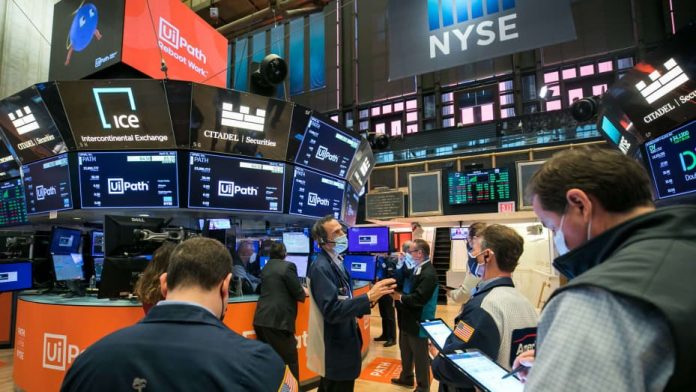
The shock announcement from Beijing sent U.S. stock markets into a tailspin, with the Dow Jones Industrial Average falling over 800 points in early trading, reflecting investor anxiety. The Nasdaq Composite slid more than 3%, with semiconductor and tech giants, including Apple, Qualcomm, and NVIDIA, taking major hits due to their dependence on Chinese supply chains. The S&P 500 lost 2.5%, erasing weekly gains as traders pulled back from risky assets.

The U.S. agriculture sector, which has already suffered from previous rounds of tariffs, saw futures for corn, soybeans, and wheat tumble as China imposed an immediate suspension on imports of sorghum, poultry, and bonemeal from American exporters. Asian and European markets also reacted negatively, with the Hang Seng Index in Hong Kong dropping 2.7% and Japan’s Nikkei 225 falling 1.9%.

“This is a severe repricing of risk,” said Kristina Hooper, Chief Global Market Strategist at Invesco. “Markets had been holding out hope for de-escalation, but these latest tariffs make it clear that the trade war is only getting worse.”

The escalating trade war has put the global economy on shaky ground, with economists warning that continued retaliation from affected nations could trigger a full-blown recession. On Friday, Mohamed El-Erian, Chief Economic Advisor at Allianz, cautioned that the extensive raft of tariffs is “putting the U.S. economy at risk” of a downturn. Speaking at the Ambrosetti Forum in Cernobbio, Italy, El-Erian told CNBC that the probability of a U.S. recession has surged to 50% due to the growing impact of trade restrictions.

He added that inflation expectations have risen to 3.5%, compounding the economic risks. While he did not believe a U.S. recession was inevitable, he warned that the risk had become uncomfortably high.

Many analysts have argued that Trump’s aggressive use of tariffs, particularly against China, could backfire on American businesses and consumers by driving up costs and reducing corporate profits. The automotive, consumer electronics and manufacturing sectors are especially vulnerable, as higher import costs will inevitably be passed down to consumers, exacerbating inflation.

Beijing’s countermeasures go beyond tariffs, with China imposing new export controls on rare earth minerals, a critical component in the production of semiconductors, electric vehicles, and military hardware. The Chinese government announced it would restrict exports of medium and heavy rare earths, including samarium, gadolinium, terbium, dysprosium, lutetium, scandium, and yttrium—all essential to U.S. defense and technology industries.

“The purpose of the Chinese government’s implementation of export controls on relevant items in accordance with the law is to better safeguard national security and interests, and to fulfil international obligations such as non-proliferation,” the commerce ministry said in a statement.

The export controls will take effect on April 4, posing a direct threat to American manufacturers and defense contractors that rely on these materials.

In addition, China blacklisted 16 U.S. firms by adding them to its export control list, prohibiting the sale of dual-use (civilian and military) items to these companies. Another 11 American firms, including drone makers Skydio Inc. and BRINC Drones, were added to China’s “unreliable entities” list, restricting their ability to invest or operate in China. China’s Ministry of Commerce justified the moves by accusing the targeted firms of “seriously undermining China’s national sovereignty, security, and development interests.”

American business leaders have raised concerns that the tariff war will have long-term negative consequences for the economy, even if China eventually caves to U.S. demands. The U.S. Chamber of Commerce warned that American manufacturers will suffer the most, as supply chains become more expensive and production costs rise.

Tesla and General Motors, both reliant on Chinese-made batteries and components, have already signaled that further tariffs could force them to raise prices on electric vehicles.

Despite growing concerns from economists and business leaders, Trump remains defiant, insisting that his tariff strategy is necessary to force China into fair trade practices. Speaking at a rally in Scranton, Pennsylvania, Trump dismissed concerns of an economic downturn saying “my policies will never change.” And that “America will not be taken advantage of anymore.”

His administration has signaled that more tariffs could be on the way if China continues to retaliate, raising fears of a prolonged standoff that could further rattle global markets.

With neither side willing to back down, the trade war appears far from over. Analysts warn that if tariffs remain in place for the next six months, businesses will be forced to cut investments, slow hiring, and even lay off workers—increasing the likelihood of a recession.

Amazon’s Satellite Project Kuiper Set for First Major Launch, But Can It Challenge SpaceX’s Starlink?

0

Amazon is preparing to launch the first batch of 27 operational satellites for its Project Kuiper internet service, marking a crucial step in its long-term ambition to compete with SpaceX’s Starlink.

The KA-01 mission — short for Kuiper Atlas 1 — is scheduled for liftoff on Wednesday, April 9, aboard a United Launch Alliance (ULA) Atlas V rocket from Cape Canaveral Space Force Station in Florida.

This launch is just the beginning of Amazon’s massive deployment plan, with 80 confirmed launches over the coming years, designed to build a vast low-earth orbit (LEO) satellite constellation. The company expects to begin offering high-speed, low-latency internet service “later this year.”

Taking on a Dominant Player

While Amazon’s entry into the satellite internet business brings the promise of competition, challenging Starlink’s dominance will be a monumental task. Starlink, operated by Elon Musk’s SpaceX, is already the undisputed leader in the sector, with an operational presence in more than 100 countries.

As of March 28, 2025, Starlink has deployed a staggering 7,135 satellites into orbit, with 7,105 currently operational, according to Astronomer Jonathan McDowell, who tracks satellite constellations. In contrast, Amazon’s first-generation Kuiper constellation will consist of just over 3,200 satellites at full deployment—less than half the size of Starlink’s existing fleet.

To gain market share, Amazon is relying on a combination of pricing, global coverage, and technology innovation. The company has unveiled three different user terminal designs, including a compact seven-inch-square antenna weighing just one pound, capable of delivering speeds up to 100Mbps. This lightweight, cost-effective option serves as Amazon’s answer to Starlink Mini.

Amazon will also offer larger terminals designed for residential and enterprise use, capable of reaching speeds of up to 1Gbps—comparable to Starlink’s high-performance service. The company has committed to manufacturing these terminals for under $400, though it remains unclear whether it will subsidize them to lower prices further.

While Amazon is promising competitive pricing, Starlink already has a well-established base of over 2.6 million subscribers worldwide, giving SpaceX a significant head start. Starlink’s growing presence in rural and underserved areas has made it the go-to provider for satellite broadband, with thousands of customers willing to pay $599 for a standard kit.

Launch and Deployment Challenges

The upcoming KA-01 mission will be a crucial test for Amazon’s satellite deployment strategy. Although the company successfully launched two prototype satellites for testing in 2023, this will be the first time Amazon deploys multiple operational satellites in a single mission.

“We’ve done extensive testing on the ground to prepare for this first mission, but there are some things you can only learn in flight,” said Rajeev Badyal, vice president of Project Kuiper. “This will be the first time we’ve flown our final satellite design and the first time we’ve deployed so many satellites at once.”

The full Kuiper constellation will orbit at an altitude of 392 miles (630km), with satellites traveling at 17,000 mph (27,359 km/h). The goal is to provide seamless global coverage, but Starlink’s existing network already delivers robust service across vast regions, making it difficult for Amazon to gain an early foothold.

Interestingly, while Amazon has partnered with launch providers such as Arianespace, Blue Origin, and United Launch Alliance, it has also signed launch contracts with SpaceX. Despite being a direct competitor, SpaceX’s Falcon 9 remains one of the most reliable and cost-effective launch vehicles available, underscoring SpaceX’s dominance in the space industry.

Addressing Astronomical Concerns

Amazon has attempted to mitigate concerns about the visibility of its satellites, an issue that has plagued Starlink. The company has designed Kuiper satellites with a special dielectric mirror film to scatter reflected sunlight, making them less visible from the ground.

While this move may reduce interference with astronomical observations, the real impact remains to be seen. Starlink, which has faced criticism for bright satellite trails affecting telescopes, has already implemented some measures to reduce reflectivity. However, with thousands more satellites planned for both Starlink and Kuiper, the issue is far from resolved.

However, Amazon’s Project Kuiper is entering a market dominated by a well-established competitor. While the company has deep financial backing and a well-structured deployment plan, overcoming SpaceX’s first-mover advantage will require aggressive expansion and innovation.

“No matter how the mission unfolds, this is just the start of our journey,” Badyal said. “We have all the pieces in place to learn and adapt as we prepare to launch again and again over the coming years.”

With billions of dollars in investment and a massive launch schedule, Project Kuiper has the potential to become a significant player in satellite broadband. However, Starlink’s unmatched scale and global reach ensure that the competition will be anything but easy.

Paul Atkins Cleared the Senate Banking Committee by 13/11 Votes

0

Paul Atkins, President Donald Trump’s nominee for SEC Chair, cleared the Senate Banking Committee with a 13-11 vote, advancing his nomination to a full Senate floor vote. The vote was split along party lines, with all Democrats opposing and Republicans securing the majority in the Republican-controlled committee. Atkins, a former SEC commissioner from 2002 to 2008 and current CEO of Patomak Global Partners, is poised to replace Acting Chair Mark Uyeda if confirmed by the full Senate, where Republicans hold a 53-47 majority, needing only 51 votes for confirmation.

Atkins’ pro-crypto stance could influence how such events are perceived and regulated. During his March 27 confirmation hearing, he emphasized providing “a firm regulatory foundation for digital assets through a rational, coherent, and principled approach,” signaling a shift from the enforcement-heavy tenure of former Chair Gary Gensler. Committee Chair Tim Scott praised Atkins for bringing “much-needed clarity for digital assets,” which could stabilize markets post-unlock by fostering innovation and reducing regulatory uncertainty—potentially softening the supply shock from the 1.79 million SOL release.

However, Senator Elizabeth Warren, the ranking Democrat, criticized Atkins, citing his past deregulation votes before the 2008 financial crisis and his firm’s advisory role with the collapsed FTX exchange, raising concerns about conflicts of interest. Despite this opposition, Atkins’ confirmation appears likely given the Senate’s composition, with a full vote expected soon, possibly within weeks, barring scheduling delays. His leadership could reshape SEC priorities, impacting crypto markets, including Solana, by prioritizing capital formation over aggressive enforcement.

A more permissive SEC might bolster confidence, potentially offsetting some of the bearish pressure from today’s 1.79 million SOL unlock by encouraging long-term holding over panic selling. The crypto market often reacts positively to regulatory clarity. Atkins’ confirmation could amplify optimism tied to recent developments, like the SEC acknowledging Fidelity’s Solana ETF filing. If he greenlights ETF approvals or streamlines token classifications, SOL’s price could see upside momentum, countering the short-term supply shock (currently testing $115-120 support). Posts on X already highlight hopes of SOL hitting $300-500 by year-end under a friendlier SEC, though this hinges on broader altcoin trends and Bitcoin’s stability above $82k.

Large unlocks like today’s $200M SOL event (2% of market cap) often spark volatility due to fears of dumping. Atkins’ leadership might introduce policies to mitigate such risks—perhaps guidelines for phased sales or transparency requirements for staked token releases. This could stabilize future unlocks (e.g., Solana’s next big one in 2028), reducing the kind of whale sell-offs seen recently ($46.3M in SOL dumped pre-unlock). In the immediate term, his nomination alone might not sway today’s market reaction, but confirmation could set a precedent for calmer responses to supply events.

Atkins’ prior tenure as an SEC commissioner (2002-2008) and his current role at Patomak Global Partners suggest a focus on capital formation. A pro-business SEC could accelerate institutional entry into crypto, including Solana’s ecosystem, known for high-speed transactions and DeFi growth. This might attract more ETF filings or staking products, increasing demand to absorb unlocked supply over time. However, critics like Senator Warren point to his FTX ties as a risk, potentially undermining trust if conflicts emerge. While Atkins cleared the committee 13-11, the full Senate vote (needing 51 of 100) isn’t guaranteed, though likely with a 53-47 Republican edge.

Delays or unexpected opposition could prolong uncertainty, leaving markets under Acting Chair Mark Uyeda’s interim guidance—less crypto-friendly than Atkins but more so than Gensler. If confirmed soon, Atkins could assume the role by mid-2025, influencing SEC priorities during a critical altcoin recovery phase. Atkins’ tenure could ease enforcement actions against exchanges and projects, fostering innovation across DeFi, NFTs, and layer-1 chains. This might indirectly benefit SOL by strengthening its competitive position against Ethereum and newer rivals, though his deregulation history raises concerns about investor protections, as Warren noted, potentially inviting volatility if oversight weakens too much.

AI Boom Could Disrupt 40% of Jobs, Calls For Proactive Labour Policies – UN Warns

0

The United Nations has disclosed that Artificial Intelligence is on track to reach a staggering $4.8 trillion in market value by 2033, comparable to the size of Germany’s economy, yet its benefits remain unequally distributed.

Furthermore, it notes that leading tech giants, such as Apple, Nvidia, and Microsoft, that stand to benefit from the AI boom have a market value that rivals the gross domestic product of the entire African continent.

According to a new report by the United Nations Conference on Trade and Development (UNCTAD), it disclosed that AI is transforming economies, creating opportunities but also posing risks of greater inequality.

Part of the report reads,

“Artificial intelligence (AI) is transforming economies, creating opportunities but also posing risks of greater inequality. UNCTAD warns that while AI can be a powerful tool for progress, it is not inherently inclusive. Countries should act now by investing in digital infrastructure, building capabilities, and strengthening AI governance to harness the AI potential for sustainable development.”

UNCTAD Secretary-General Rebeca Grynspan underlined the importance of ensuring people are at the center of AI development, calling for stronger international cooperation to “shift the focus from technology to people, enabling countries to co-create a global artificial intelligence framework.

Notably, the UNCTAD estimates that AI could impact up to 40% of jobs globally, raising the specter of widespread job displacement. This displacement is not limited to traditional blue-collar roles but is increasingly shifting toward white-collar professions as AI systems grow more sophisticated.

The UN highlights that this transformation could exacerbate economic inequality, particularly between nations. Wealthier countries with the resources to invest in AI infrastructure may see substantial economic gains, potentially creating markets rivaling the size of major economies by the early 2030s. In contrast, developing nations, lacking similar access to technology and training, risk falling further behind, deepening global disparities. To address these challenges, the UN is calling for proactive labor policies.

To set up effective AI policies, the UN noted that countries should consider three key leverage points; infrastructure, data, and skills. It emphasized that strategic positioning in these areas will determine whether nations can adopt AI effectively, foster local innovation, and align AI development with their socioeconomic needs.

The UNCTAD further noted that it provides expertise to help developing countries assess their strengths and design policies that build resilient innovation systems.

To bridge the widening AI divide, UNCTAD outlines several recommendations for inclusive global growth. These include:

  • Establishing AI public disclosure mechanisms
  • Promoting shared AI infrastructure
  • Supporting the development and adoption of open-source AI models
  • Creating platforms to share AI knowledge and resources

AI is shaping the world’s economic future, yet 118 countries, mostly in the Global South are absent from major AI governance discussions. As AI regulation and ethical frameworks take shape, the UN posits that developing nations must have a seat at the table to ensure AI serves global progress, not just the interests of a few.

Aside from the displacement of jobs by AI, the UN noted that the advanced technology is not just about replacing jobs, but will also create new industries and empower workers. However, it disclosed that investing in reskilling, upskilling, and workforce adaptation is essential to ensure AI enhances employment opportunities rather than eliminating them.

The UN summarised the report by stating that AI can be a catalyst for progress, innovation, and shared prosperity but only if countries actively shape its trajectory. This means shifting the focus from technology to people, putting people at the center of AI development. Strategic investments, inclusive governance, and international cooperation are key to ensuring that AI benefits all, rather than reinforcing existing divides.