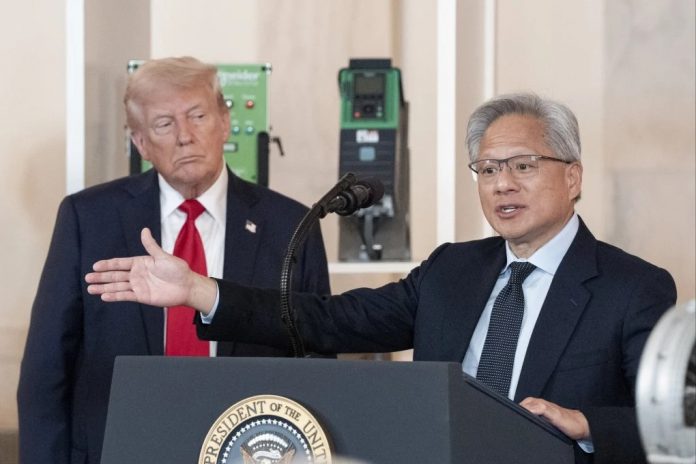
Nvidia chief executive Jensen Huang has called on Super Micro Computer to strengthen compliance controls after Taiwanese authorities detained three individuals over alleged fraudulent declarations tied to artificial intelligence servers assembled for the US chipmaker’s ecosystem.
The case, which prosecutors say involves the suspected misrepresentation of AI server shipments for export, marks Taiwan’s first known enforcement action specifically targeting semiconductor-related smuggling. It comes against the backdrop of escalating global restrictions on advanced chips, including US limits on the export of high-end Nvidia accelerators to China, which have reshaped supply chains across the AI hardware sector.
Speaking to reporters in Taipei on Saturday, Huang said Nvidia maintains strict guidance for its partners but drew a clear line on responsibility.
“Nvidia is rigorous in explaining regulations to all of its partners,” he said. “Ultimately Super Micro has to run their own company. I hope that they will enhance and improve their regulation compliance and avoid that from happening in the future.”
The unusually direct intervention underscores the pressure building across Nvidia’s manufacturing and distribution network, where server makers such as Super Micro play a central role in assembling GPU-based systems used in data centers for training large-scale AI models.
Super Micro has not commented publicly on the Taiwan detentions.
The detained individuals are alleged to have been involved in purchasing servers in Taiwan and exporting them using falsified documentation, according to local prosecutors. A court has approved their continued detention as investigations proceed. Authorities have not indicated whether Nvidia chips inside the systems were part of the suspected diversion, but the probe is being closely watched, given the sensitivity of AI-grade hardware flows across Asia.
The case adds to a widening enforcement pattern around Nvidia-linked hardware. In the United States, federal prosecutors have already pursued a separate high-profile case involving allegations that Super Micro systems were used to reroute Nvidia chips to restricted markets. That case, which includes charges against a company co-founder, remains unresolved, with the defendant pleading not guilty.
Together, the two investigations in the US and Taiwan are feeding a broader regulatory tightening across jurisdictions that sit at the center of AI infrastructure manufacturing. While Taiwanese prosecutors have said their case is independent of the US proceedings, they have not ruled out possible overlap in supply chain actors or methods, noting that further investigation is required.
Nvidia does not directly control the server-level export pathways through which its chips ultimately move. Instead, compliance enforcement depends heavily on partners operating across multiple jurisdictions, often under divergent export control regimes.
This episode emerges when Washington’s export restrictions on advanced semiconductors to China have created incentives for rerouting, reclassification, and intermediary shipping structures across Southeast Asia. That dynamic has placed manufacturers and system integrators under closer scrutiny, particularly those handling high-density AI servers capable of hosting large clusters of Nvidia accelerators.
Super Micro, one of the key builders of such systems, sits at the center of that ecosystem. Its machines are widely deployed in hyperscale data centers used by companies developing frontier AI models, including generative systems such as OpenAI’s ChatGPT.
The Taiwan case is also emerging at a moment when Nvidia is attempting to stabilize its global supply chain relationships amid rapid demand growth for AI compute infrastructure. Huang’s decision to publicly press a partner on compliance is unusual for a company that typically avoids direct commentary on third-party enforcement matters, suggesting heightened sensitivity around potential reputational spillovers.
The broader industry context remains defined by tightening export controls, rising scrutiny of AI hardware flows, and increasing coordination between regulators in the US, Europe, and Asia over semiconductor governance. In that environment, even isolated enforcement actions are being read as indicators of a more structured global crackdown on AI-era chip distribution networks.