DD
MM
YYYY

PAGES

DD
MM
YYYY

spot_img

PAGES

Home Blog Page 19

Russia Moves to Shield China From Energy Shock as Hormuz Blockade Opens a Dangerous New U.S.-China Fault Line

0

As the Middle East war continues to convulse global energy markets, Russia has stepped forward with an offer to help China mitigate any potential supply disruptions. The move is expected to strengthen the Moscow-Beijing strategic axis as it highlights a fast-emerging geopolitical flashpoint between China and the United States.

The U.S.-led blockade of the Strait of Hormuz, a maritime chokepoint through which a substantial share of the world’s oil and liquefied natural gas flows, has created a fresh tension. The blockade directly threatens China’s energy security, industrial supply chains, and economic stability. China remains Iran’s largest oil customer, reportedly taking more than 80% of Tehran’s sanctioned crude exports in 2025

For Washington, the blockade has become a pressure tool aimed at Iran and, by extension, China’s continued access to Iranian crude. The result is a new and potentially more combustible layer of friction in an already fragile U.S.-China relationship. Trump on Sunday threatened to impose a sweeping 50% tariff on Chinese goods if Washington confirms reports that China is preparing to supply air defense weapons to Iran.

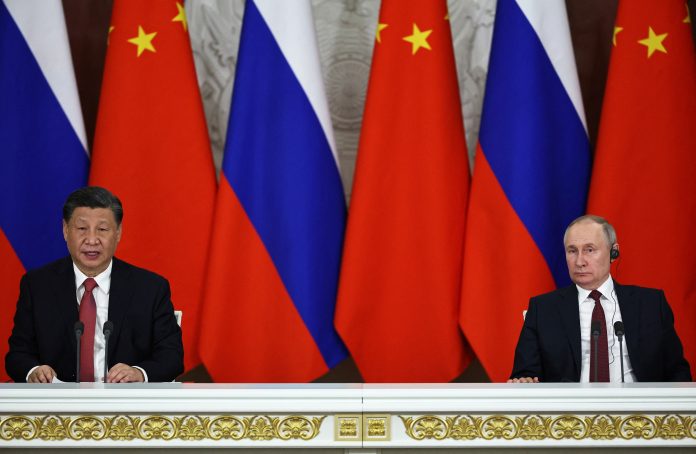
Against this backdrop, Russian Foreign Minister Sergei Lavrov, speaking in Beijing after meeting President Xi Jinping, offered Moscow as an alternative energy supplier should the disruption worsen.

“Russia can certainly fill the resource gap that has arisen in China and other countries interested in working with us on an equal and mutually beneficial basis,” Lavrov said Wednesday, according to Interfax.

The Strait of Hormuz is one of the most critical arteries in global commodity trade. Its prolonged disruption has raised freight costs, insurance premiums, and the risk of physical shortages for energy-intensive sectors ranging from petrochemicals to heavy manufacturing.

More importantly, the blockade has introduced a fresh source of distrust between Beijing and Washington at a time when both sides had been trying to stabilize ties ahead of a planned meeting between President Donald Trump and President Xi Jinping in mid-May.

U.S. Treasury Secretary Scott Bessent escalated the rhetoric on Tuesday, accusing China of worsening the global energy crunch. He said China had been an “unreliable global partner” during the Middle East war by hoarding oil supplies and limiting exports of some goods, drawing comparisons to Beijing’s handling of medical supplies during the COVID-19 pandemic.

This accusation is highly consequential diplomatically. From Washington’s perspective, China’s stockpiling behavior compounds market stress by removing additional supply from circulation at a moment of severe disruption. From Beijing’s perspective, however, strategic stockpiling is a rational response to a blockade that directly threatens one of its most important import routes.

That divergence in interpretation is precisely what makes this episode dangerous. The Strait of Hormuz blockade has now evolved from an Iran-focused military measure into a broader U.S.-China geopolitical dispute centered on energy access, trade reliability, and strategic intent. In effect, energy security is becoming the newest front in the U.S.-China rivalry. Beijing has already condemned the blockade in unusually direct terms.

China’s foreign ministry described the move as a threat to the free flow of international commerce, noting that the Strait is “an important international trade route for goods and energy” and that maintaining its “security, stability and unimpeded flow” is in the common interest of the international community.

This language signals that China sees the blockade not only as a commercial disruption but as a challenge to freedom of navigation and its long-term energy resilience.

Lavrov used the moment to sharpen Moscow’s criticism of Washington.

“Thank God, we and China have all the capabilities, both those already in use and those in reserve, and those planned, to avoid being dependent on this kind of aggressive adventure [the situation in the Middle East], which undermines the global economy and global energy,” he said at a press conference in Beijing.

The language from both Moscow and Beijing points to a coordinated diplomatic posture: resisting U.S. pressure while deepening bilateral economic cooperation.

After the meeting, both sides reaffirmed that their relationship remains “unshakable amid any storms,” a phrase that carries added significance as the crisis drives them closer together.

The conflict is producing both opportunity and economic windfall for Russia. Higher oil prices have sharply boosted export revenues, while increased purchases from China and India continue to redirect Russia’s energy trade eastward. This makes Moscow’s offer to China more than symbolic. It is backed by a rapidly expanding export corridor that has become central to Russia’s post-sanctions economic strategy.

Still, both China and Russia have strong reasons to want the conflict contained. Iran remains a key regional partner for Moscow, while China’s manufacturing economy depends on stable commodity inflows. Data released this week already showed that China’s crude oil and gas imports fell in March from a year earlier, suggesting that the supply shock is beginning to show up in physical trade flows.

The larger implication is that the Hormuz blockade may become a defining issue in near-term U.S.-China diplomacy. Even if Trump and Xi proceed with their planned summit, this episode has introduced a fresh grievance into an already sensitive relationship shaped by trade disputes, technology controls, Taiwan tensions, and military rivalry in the Indo-Pacific.

S&P 500, Crude Oil, Bitcoin and Ethereum Shown Impressive Resilience

0

Markets have shown impressive resilience in the face of the U.S.-Iran conflict that kicked off in late February 2026. The S&P 500 has fully or nearly fully erased its war-related losses. It dipped as much as ~7-8% from pre-conflict levels amid the initial shocks, oil spikes, and uncertainty around the Strait of Hormuz.

By April 13-14, it rebounded strongly—closing around 6,886 to 6,967 on optimism around de-escalation talks, a temporary ceasefire, cooler inflation data (PPI), and solid Q1 earnings from banks and tech. It’s now back to or slightly above its late February levels and flirting with record highs again. Tech and financials led the charge, with names like Oracle and Microsoft contributing big gains.

The index even turned nominally positive for the year in some sessions. Classic buy the dip on hopes that the worst is behind us geopolitically. Bitcoin has been relatively steady, anchoring above the $70K psychological level despite volatility. Recent prices have hovered in the $70K–$74K range around $74K in some sessions, with dips testing $70K support.

It took some hits during peak tensions but recovered quickly, showing its digital gold narrative holding up better than some expected amid risk-off periods. ETF inflows and institutional interest have helped provide a floor. Ethereum has indeed been one of the stronger performers on a relative basis since the conflict started. It initially dropped hard like everything else but staged a solid recovery—outpacing the S&P 500 and even gold in some stretches, with reports of ETH gaining ~17% relative to the S&P at points in March.

Recent prices have been in the $2,100–$2,400 zone, with bounces on ceasefire news and derivatives activity. Its higher-beta nature means bigger swings, but it has shown resilience here. The rebound seems driven by: Hopes for further U.S.-Iran diplomacy though talks have had fits and starts, with a U.S. blockade of Iranian ports adding tension.

Strong corporate earnings helping offset macro worries. Oil prices not exploding as badly as feared; WTI staying under $100 in some reports despite disruptions. That said, it’s still a tense backdrop—geopolitical headline risk remains high, with potential for volatility if negotiations stall or escalation resumes. Markets are pricing in a merely bad outcome rather than full-blown disaster.

Risk assets like stocks and crypto love certainty, and the current mix of earnings optimism + de-escalation hopes is fueling the sprint back up. Stock markets hit sharp decline of ~7-8% in the early weeks due to geopolitical uncertainty, oil price spikes, and fears of supply disruptions via the Strait of Hormuz.

Nearly all losses erased by mid-April. The index has rebounded strongly, recently closing around 6,900–6,967 flirting with prior highs again. Optimism from de-escalation signals, temporary ceasefires, solid corporate earnings especially tech and banks, and cooler inflation data in spots. Volatility remains elevated on headline risk. Bitcoin held relatively steady as a digital gold hedge in parts of the conflict. Dipped initially but recovered faster than many risk assets in some phases.

Current level trading firmly above $70K, recently in the $73K–$74K+ range around $73,982–$74,484 in recent sessions. Outperformed stocks and even gold at times during tensions; up ~7-12% relative in early stretches for some metrics. ETF inflows and institutional positioning provided support. Ceasefire hopes have fueled further upside.

Ethereum is one of the stronger relative performers since the conflict started, thanks to its higher-beta nature and crypto market rebounds on de-escalation news.

Current level hovering in the $2,200–$2,370 zone around $2,331–$2,370 recently. Ethereum saw sharp swings but staged solid recoveries, occasionally outpacing the S&P 500 on a relative basis during recovery phases. Major spike early on Brent briefly over $100–$120/bbl at peaks due to Hormuz disruptions and supply fears.

Has since moderated but remains elevated recently around $100–$103+, contributing to higher gasoline and diesel costs and inflationary pressures. Ceasefire news triggered sharp pullbacks in some sessions. Risk-off early; stocks and some commodities down, safe-havens mixed. Shifted to relief rallies on diplomacy hopes. Prolonged conflict risks included higher inflation, tighter Fed policy, and recession fears, but markets are currently pricing in a contained scenario.

Crypto showed mixed but resilient behavior compared to traditional assets in spots; gold had safe-haven flows but wasn’t the standout. Global volatility persists, with potential for renewed swings if talks stall. Markets have demonstrated resilience via buy the dip on de-escalation optimism and earnings strength, but headline risk from the region keeps things twitchy.

Meta Expands Broadcom Partnership, Marking a Multi-Billion-Dollar Bet on Custom AI Silicon

0

As the global contest for artificial intelligence supremacy shifts from software models to the infrastructure that powers them, Meta has made one of its clearest long-term bets yet: owning more of the silicon stack behind its AI future.

In a sweeping expansion of its partnership with Broadcom, the Facebook and Instagram parent said it will co-develop several generations of custom AI processors through 2029, committing an initial more than one gigawatt of computing capacity in what it described as the first phase of a sustained, multi-gigawatt rollout.

The scale of the commitment underscores the intensity of the capital race among Big Tech firms as they seek to reduce reliance on Nvidia’s costly and supply-constrained processors while building proprietary infrastructure for next-generation AI services.

To put the size of the deployment into perspective, the initial one-gigawatt commitment is enough to power roughly 750,000 U.S. homes on average, making this one of the most significant disclosed custom silicon deployments in the consumer technology sector.

The announcement marks more than a supply agreement. It reflects Meta’s accelerating transition toward a vertically integrated AI infrastructure strategy, one in which the company designs increasingly specialized hardware for its own workloads rather than depending primarily on third-party GPUs.

Meta founder and chief executive Mark Zuckerberg framed the partnership in precisely those strategic terms.

“Meta is partnering with Broadcom across chip design, packaging, and networking to build out the massive computing foundation we need to deliver personal superintelligence to billions of people,” Zuckerberg said. “As we roll out more than 1GW of our custom silicon to start and then multiple gigawatts over time, this partnership will give us greater performance and efficiency for everything we’re building.”

The move ties Meta’s hardware roadmap directly to its broader AI ambition: delivering real-time intelligent experiences across Facebook, Instagram, WhatsApp, Threads, and its growing suite of generative AI products.

Meta has centered the collaboration on Meta Training and Inference Accelerator (MTIA) program, the company’s in-house chip initiative designed to support both recommendation systems and generative AI inference workloads. The first chip in the lineup, the MTIA 300, is already being used to power Meta’s ranking and recommendation systems, while three additional generations are scheduled through 2027.

These later generations are being optimized specifically for inference, the computationally intensive process through which AI systems respond to prompts, rank content, personalize feeds, and generate outputs in real time.

Training models is capital-intensive, but inference at Meta’s scale, serving billions of users daily, may ultimately become the more commercially consequential cost center. Every AI-generated response, recommendation, or ranking event carries an infrastructure cost. Custom chips tailored for Meta’s specific workloads can materially lower cost per inference and improve latency.

That is one of the clearest reasons hyperscalers are increasingly moving toward ASICs, or application-specific integrated circuits. Unlike general-purpose GPUs, ASICs are designed for narrower tasks but often deliver better power efficiency and lower total cost of ownership for those workloads.

Other companies, such as Alphabet and Amazon, have also expanded their custom silicon programs as AI demand pushes infrastructure spending to record levels. The broader industry trend is that Big Tech is moving aggressively to reduce dependence on Nvidia’s dominant GPU ecosystem.

That trend has made Broadcom one of the biggest winners of the AI infrastructure boom. The chipmaker has positioned itself as a critical enabler for hyperscalers seeking custom accelerators, advanced packaging, and high-performance networking. In Meta’s case, Broadcom’s Ethernet networking technology will connect the company’s rapidly expanding AI clusters, addressing one of the most important bottlenecks in large-scale AI systems: data movement across thousands of accelerators.

As AI clusters scale into the hundreds of thousands of chips, networking throughput becomes nearly as important as raw compute power. This is where Broadcom’s role extends beyond chip design. The company said the partnership is built on its XPU platform, which is specifically designed for custom AI accelerators and optimized for large-scale deployments.

Broadcom chief executive Hock Tan emphasized the long-term scope of the collaboration.

“We are pleased to expand our strategic collaboration with Meta as they pioneer the next frontier of artificial intelligence,” Tan said. “This initial MTIA deployment is just the beginning of a sustained, multi-generation roadmap to serve the trajectory of massive growth over the next few years that highlights Broadcom’s unmatched leadership in AI networking and the power of our foundational XPU custom accelerator platform.”

Another important element of the announcement is the governance shift. As part of the deal, Hock Tan will leave Meta’s board and transition into an advisory role focused on the company’s custom chip strategy. That move suggests the relationship is becoming deeper and more operationally embedded, with Broadcom’s leadership directly influencing Meta’s long-term silicon roadmap.

Wall Street responded positively.

Broadcom shares rose about 3.5% in extended trading, while Meta’s stock was little changed, a signal that investors view Broadcom as a major beneficiary of sustained hyperscaler AI capital expenditure.

Separately, Meta also disclosed a boardroom development unrelated to the Broadcom deal: Tracey Travis, who has served on the board since 2020, will not stand for re-election at the annual shareholder meeting.

Errol Musk’s Sons Elon and Kimbal Hold 23,400 Bitcoin

0

Errol Musk, the 79-year-old South African engineer stated that his sons Elon and Kimbal Musk jointly hold 23,400 BTC, which he described as sounding astronomical. At current Bitcoin prices around $70,000–$75,000 per BTC in mid-April 2026 that holding would be worth roughly $1.6–1.75 billion.

He positioned this as part of a broader view that cryptocurrencies represent the future of finance and that the old financial model is finished. Errol criticized the difficulty of international bank transfers and contrasted it with the speed and practicality of crypto payments. He mentioned the family once received payment in Solana (SOL) and sold it profitably.

This figure refers to personal holdings of Elon and Kimbal combined. For comparison: Tesla publicly disclosed its holds about 11,509 BTC. SpaceX holds around 8,285 BTC per reports. The brothers’ claimed personal stack would exceed the two companies’ combined corporate Bitcoin. Errol also noted interactions with crypto industry figures, including founders of Binance and Bybit.

Neither Elon nor Kimbal has publicly confirmed these numbers. Elon has previously said he owns some Bitcoin personally and has been vocal about crypto and Dogecoin, but he has never disclosed specific quantities. Corporate holdings (Tesla/SpaceX) are separate and subject to regulatory disclosures where applicable. Claims from family members aren’t official financial statements.

Errol has been involved in crypto-related projects before e.g., a meme coin called Musk It in 2025, which some observers view skeptically as leveraging the family name. Errol’s comments align with a pro-crypto stance that views decentralized finance as superior for global transfers, efficiency, and as a hedge against legacy systems.

Bitcoin’s appeal here ties into its fixed supply, borderless nature, and growing institutional acceptance—though volatility remains a reality. Whether the exact 23,400 BTC figure holds up or not, it underscores ongoing interest from prominent figures in digital assets as an alternative to traditional banking rails. Bitcoin’s price action and corporate and individual disclosures will continue to be the best verifiable signals on actual holdings.

Bitcoin showed little to no significant volatility directly tied to the comments. BTC traded in a relatively stable range around the $70k–$75k level with minimal bounce or dip attributable to the story. High-profile Musk-family crypto mentions often spark short-term sentiment shifts, but this one lacked the direct punch of past Elon tweets.

Bullish narrative boost in crypto circles: Many viewed it as a strong smart money conviction signal — the world’s most prominent tech family quietly stacking large personal BTC holdings. Discussions highlighted it as bigger than Tesla and SpaceX corporate treasuries combined.

Excitement around long-term HODLing and crypto as future of finance, reinforcing anti-traditional-banking themes. Some called the number crazier than the finance-is-dead take, while others downplayed Errol’s statements as carrying less weight than Elon’s.

Highlights growing high-net-worth and tech-elite interest in Bitcoin as a hedge and store of value, separate from corporate holdings. Renewed debate on crypto vs. legacy banking: Errol’s points on slow international transfers and successful Solana payments fueled pro-crypto efficiency arguments.

Media amplification: Quick pickup across crypto news sites, but mainstream financial outlets remained cautious due to the lack of verification. The story generated more conversation and validation-seeking than direct market disruption. It adds to the pro-crypto cultural momentum around the Musk name without triggering a major rally or sell-off.

Long-term, if any portion of the claim proves directionally accurate, it could encourage further institutional ans family allocation talk — but right now, it’s largely narrative fuel with a healthy dose of wait for confirmation. Bitcoin’s price will likely be driven more by macro factors, ETF flows, and verifiable corporate moves than unconfirmed family anecdotes.

Goldman Sachs Files with US SEC for Goldman Sachs Bitcoin Premium Income ETF

0

Goldman Sachs filed with the U.S. Securities and Exchange Commission (SEC) on April 14, 2026, for the Goldman Sachs Bitcoin Premium Income ETF. This marks the Wall Street giant’s first direct foray into issuing its own Bitcoin-linked exchange-traded fund.

The fund will not hold Bitcoin directly. Instead, it plans to invest at least 80% of its net assets in instruments providing Bitcoin exposure, primarily shares of existing spot Bitcoin ETFs such as those from BlackRock or Fidelity and related derivatives.

The Premium Income part comes from an options-based approach — specifically, selling (writing) call options on Bitcoin ETFs or related holdings. This generates monthly income from the premiums collected, appealing to investors seeking yield rather than pure capital appreciation.

Trade-off covered call strategies like this typically cap upside potential in strong Bitcoin rallies since the calls may be exercised, while providing downside buffering from the premium income. Volatility in Bitcoin could still lead to significant losses. Up to 25% of assets may be allocated to a Cayman Islands subsidiary for certain exposures.

The filing is a Form 485APOS (post-effective amendment) under the Goldman Sachs ETF Trust. A potential launch could occur around late June 2026, following the standard ~75-day SEC review period though approvals can vary. Goldman Sachs, with roughly $3.5–3.65 trillion in assets under management, has historically been cautious or critical of Bitcoin but has built substantial exposure through third-party spot Bitcoin ETFs over $1 billion reported in some holdings.

This filing represents a shift toward manufacturing its own crypto products for clients. It follows similar moves by other institutions: BlackRock has pursued or launched comparable premium income Bitcoin strategies. Morgan Stanley recently debuted its own spot Bitcoin ETF. This reflects broader Wall Street integration of Bitcoin as an asset class, with a focus on structured yield products suitable for more conservative or income-oriented investors via retirement accounts.

In major Bitcoin bull runs, the ETF may underperform pure spot Bitcoin ETFs due to the call-selling strategy. Bitcoin’s price swings remain high; the income component doesn’t eliminate downside risk. As with all new ETFs, final approval isn’t guaranteed, and fees and expenses aren’t fully detailed yet in preliminary filings.

This development adds to the growing list of Bitcoin ETF innovations, potentially attracting more institutional and retail capital through familiar brokerage channels. Offers Bitcoin exposure plus monthly yield from selling call options. Attractive for conservative or retirement accounts seeking steady distributions rather than pure price upside.

Often called boomer candy for traditional investors wary of raw BTC volatility. Caps upside in strong Bitcoin rallies; if BTC surges above strike prices, gains are limited. Premiums help buffer mild declines but won’t fully protect against sharp drops. Performs best in sideways or moderately volatile markets.

Easier entry via familiar brokerage platforms; indirect exposure via spot BTC ETFs + derivatives may suit those avoiding direct crypto custody. Signals a clear shift: From cautious observer and large holder of third-party BTC ETFs to active issuer of crypto products. Follows Morgan Stanley’s recent spot BTC ETF launch and competes with BlackRock’s similar premium income filing.

Leverages Goldman’s massive scale ~$3.6T AUM to capture flows from clients wanting Bitcoin lite with income. Positions the firm in the growing structured crypto ETF space. Another major bank endorsing Bitcoin as an asset class via regulated products ? potential for increased institutional and retail inflows, especially from yield-hungry allocators.

Accelerates differentiation beyond plain spot ETFs toward yield-generating strategies. Could pressure other issuers to launch similar covered-call Bitcoin vehicles. Synthetic exposure means modest immediate buying pressure on spot Bitcoin, but signals confidence that may support sentiment. Launch possible ~late June 2026.

Highlights ongoing volatility and regulatory and operational hurdles; distributions may sometimes be treated as return of capital for tax purposes. This reflects deepening Wall Street integration of Bitcoin while catering to demand for lower-volatility, income-oriented exposure. It broadens the investor base without fully replacing spot BTC ETFs for those seeking uncapped upside.