

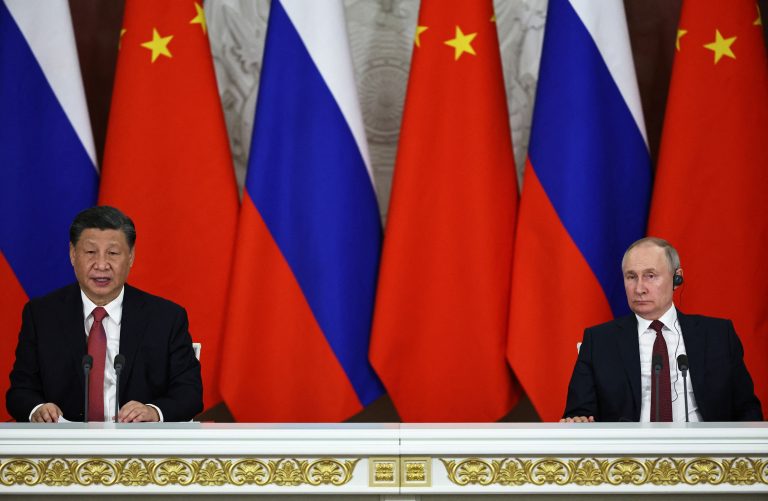
As the Middle East war continues to convulse global energy markets, Russia has stepped forward with an offer to help China mitigate any potential supply disruptions. The move is expected to strengthen the Moscow-Beijing strategic axis as it highlights a fast-emerging geopolitical flashpoint between China and the United States.
The U.S.-led blockade of the Strait of Hormuz, a maritime chokepoint through which a substantial share of the world’s oil and liquefied natural gas flows, has created a fresh tension. The blockade directly threatens China’s energy security, industrial supply chains, and economic stability. China remains Iran’s largest oil customer, reportedly taking more than 80% of Tehran’s sanctioned crude exports in 2025
For Washington, the blockade has become a pressure tool aimed at Iran and, by extension, China’s continued access to Iranian crude. The result is a new and potentially more combustible layer of friction in an already fragile U.S.-China relationship. Trump on Sunday threatened to impose a sweeping 50% tariff on Chinese goods if Washington confirms reports that China is preparing to supply air defense weapons to Iran.
Register for the next Tekedia Mini-MBA.
Register for Tekedia AI in Business Masterclass.
Join Tekedia Capital Syndicate and co-invest in great global startups.
Against this backdrop, Russian Foreign Minister Sergei Lavrov, speaking in Beijing after meeting President Xi Jinping, offered Moscow as an alternative energy supplier should the disruption worsen.
“Russia can certainly fill the resource gap that has arisen in China and other countries interested in working with us on an equal and mutually beneficial basis,” Lavrov said Wednesday, according to Interfax.
The Strait of Hormuz is one of the most critical arteries in global commodity trade. Its prolonged disruption has raised freight costs, insurance premiums, and the risk of physical shortages for energy-intensive sectors ranging from petrochemicals to heavy manufacturing.

More importantly, the blockade has introduced a fresh source of distrust between Beijing and Washington at a time when both sides had been trying to stabilize ties ahead of a planned meeting between President Donald Trump and President Xi Jinping in mid-May.
U.S. Treasury Secretary Scott Bessent escalated the rhetoric on Tuesday, accusing China of worsening the global energy crunch. He said China had been an “unreliable global partner” during the Middle East war by hoarding oil supplies and limiting exports of some goods, drawing comparisons to Beijing’s handling of medical supplies during the COVID-19 pandemic.
This accusation is highly consequential diplomatically. From Washington’s perspective, China’s stockpiling behavior compounds market stress by removing additional supply from circulation at a moment of severe disruption. From Beijing’s perspective, however, strategic stockpiling is a rational response to a blockade that directly threatens one of its most important import routes.

That divergence in interpretation is precisely what makes this episode dangerous. The Strait of Hormuz blockade has now evolved from an Iran-focused military measure into a broader U.S.-China geopolitical dispute centered on energy access, trade reliability, and strategic intent. In effect, energy security is becoming the newest front in the U.S.-China rivalry. Beijing has already condemned the blockade in unusually direct terms.
China’s foreign ministry described the move as a threat to the free flow of international commerce, noting that the Strait is “an important international trade route for goods and energy” and that maintaining its “security, stability and unimpeded flow” is in the common interest of the international community.
This language signals that China sees the blockade not only as a commercial disruption but as a challenge to freedom of navigation and its long-term energy resilience.
Lavrov used the moment to sharpen Moscow’s criticism of Washington.
“Thank God, we and China have all the capabilities, both those already in use and those in reserve, and those planned, to avoid being dependent on this kind of aggressive adventure [the situation in the Middle East], which undermines the global economy and global energy,” he said at a press conference in Beijing.
The language from both Moscow and Beijing points to a coordinated diplomatic posture: resisting U.S. pressure while deepening bilateral economic cooperation.
After the meeting, both sides reaffirmed that their relationship remains “unshakable amid any storms,” a phrase that carries added significance as the crisis drives them closer together.
The conflict is producing both opportunity and economic windfall for Russia. Higher oil prices have sharply boosted export revenues, while increased purchases from China and India continue to redirect Russia’s energy trade eastward. This makes Moscow’s offer to China more than symbolic. It is backed by a rapidly expanding export corridor that has become central to Russia’s post-sanctions economic strategy.
Still, both China and Russia have strong reasons to want the conflict contained. Iran remains a key regional partner for Moscow, while China’s manufacturing economy depends on stable commodity inflows. Data released this week already showed that China’s crude oil and gas imports fell in March from a year earlier, suggesting that the supply shock is beginning to show up in physical trade flows.
The larger implication is that the Hormuz blockade may become a defining issue in near-term U.S.-China diplomacy. Even if Trump and Xi proceed with their planned summit, this episode has introduced a fresh grievance into an already sensitive relationship shaped by trade disputes, technology controls, Taiwan tensions, and military rivalry in the Indo-Pacific.