DD
MM
YYYY

PAGES

DD
MM
YYYY

spot_img

PAGES

Home Blog Page 201

OpenAI Signs $38bn Cloud Deal with Amazon in Massive AI Power Play, Shooting eCommerce Giant’s Shares to Record High

0

OpenAI has struck a landmark seven-year, $38 billion agreement with Amazon.com Inc. to purchase cloud services, marking its first major infrastructure move since last week’s restructuring that granted the ChatGPT maker greater operational and financial independence.

The deal cements Amazon Web Services (AWS) as a central player in OpenAI’s bid to expand computing power for the next generation of artificial intelligence models.

Under the agreement, OpenAI will gain access to hundreds of thousands of Nvidia GPUs through AWS to train and deploy its frontier AI systems — a move that underscores the industry’s growing hunger for computing resources. OpenAI CEO Sam Altman said the deal represents a significant step toward achieving the company’s ambitious target of developing 30 gigawatts of computing power, roughly enough to power 25 million U.S. homes.

“This is a hugely significant deal and clearly a strong endorsement of AWS compute capabilities to deliver the scale needed to support OpenAI,” said Paolo Pescatore, analyst at PP Foresight.

Altman echoed that sentiment, emphasizing reliability and scale as critical to AI advancement.

“Scaling frontier AI requires massive, reliable compute,” he said. “Our partnership with AWS strengthens the broad compute ecosystem that will power this next era and bring advanced AI to everyone.”

AWS will begin provisioning capacity immediately, with all systems expected to go live by the end of 2026, and more expansions planned through 2027. Amazon will deploy Nvidia’s newest GB200 and GB300 AI accelerators across vast data centers to power OpenAI’s training workloads and the conversational capabilities behind ChatGPT.

The announcement comes as Amazon’s cloud unit regains investor confidence following strong growth in the September quarter. AWS had faced concerns that it was losing ground to Microsoft Azure and Google Cloud in the AI infrastructure race, but Monday’s deal pushed Amazon shares to a record high, adding nearly $140 billion to its market capitalization. The stock surged 5% during trading, following a 10% rally the previous Friday.

The partnership also highlights OpenAI’s diversification strategy. Despite its long-standing alliance with Microsoft — which began in 2019 and saw the software giant take a multibillion-dollar stake — OpenAI has increasingly sought to reduce dependence on a single provider. In addition to AWS, the company has inked a $300 billion cloud supply deal with Oracle and is working with Google Cloud to expand its compute network.

The new arrangement effectively sidelines Microsoft’s exclusive cloud rights, which were removed during last week’s restructuring. OpenAI’s revised governance framework allows the company to seek external investors and explore an initial public offering, which puts the value of the AI leader at up to $1 trillion, according to a Reuters report.

However, the eye-popping spending commitments, estimated at over $1 trillion in total compute investments, have fueled concerns on Wall Street that the AI sector is edging toward a financial bubble. Analysts warn that the enormous infrastructure costs could weigh heavily on OpenAI’s profitability, even as its annualized revenue run rate is projected to reach $20 billion by year-end.

OpenAI’s partnerships with Amazon, Microsoft, Oracle, and Google now make it one of the most cloud-diversified AI firms in the world. Yet, questions remain about how the company will finance such extraordinary expansion. The firm is still loss-making, and its capital demands — including Altman’s ambition to add 1 gigawatt of compute capacity per week — are unprecedented in tech history.

The OpenAI deal is seen as a symbolic and financial victory for Amazon, solidifying AWS’s relevance in a hyper-competitive AI arms race. It positions the e-commerce giant’s cloud business as a foundational layer for the most advanced AI systems in development, reaffirming that even as AI models grow more sophisticated, cloud infrastructure remains the backbone of the intelligence revolution.


Last Chance to Buy Ozak AI at $0.012 — Phase 6 Ending Soon Before $0.014 Launch

0

The clock is ticking for investors eyeing one of 2025’s fastest-growing AI crypto presales. Ozak AI ($OZ) is about to close Phase 6 at $0.012, with the next phase price set to jump to $0.014. With over 976 million tokens sold and $4.11 million raised, this marks the final opportunity to buy before the price increases — and before latecomers pay more for the same token supply.

Ozak AI’s Presale Momentum Is Heating Up

Ozak AI is now trending across crypto communities for combining artificial intelligence and blockchain into a unified platform for predictive analytics, real-time data processing, and AI-powered automation. The project’s Phase 6 presale has seen remarkable participation, attracting both retail investors and early adopters of AI-driven DeFi tools.

The upcoming price jump represents a 16.6% immediate increase, meaning every investor who enters now will automatically gain that margin before the next phase even starts.

Ozak AI isn’t another meme coin riding a trend — it’s a project rooted in data and technology. Its ecosystem is designed to merge AI agents, machine learning models, and blockchain transparency into a single infrastructure that can power predictive financial tools, decentralized AI applications, and next-gen Web3 analytics.

The project’s foundation is strengthened by partnerships with industry players, including:

  • SINT
  • HIVE Intel
  • Weblume
  • Pyth Network

Blending all these makes Ozak AI be at the place of the intersection of AI utility and blockchain performance, a quickly emerging niche that has captivated more than $4.11 million in presale funding.

Why Investors Are Paying Attention

  1. AI + Blockchain Integration – Ozak AI delivers real-world utility through predictive modeling, data automation, and decentralized AI tools.
  2. Strategic Partnerships – Collaborations with SINT, HIVE Intel, Weblume, and Pyth Network strengthen its infrastructure and data capabilities.
  3. Strong Presale Metrics – Nearly 1 billion tokens sold and $4M raised confirm strong investor trust.
  4. Upcoming Price Increase – The shift from $0.012 to $0.014 means early buyers instantly gain before market listing.

Final Call Before the Price Moves

With Phase 6 nearing its close, this is the last chance to grab Ozak AI at $0.012 before the next price milestone. Once Phase 7 launches at $0.014, new investors will pay more for the same tokens — cutting into early profit potential.

The AI + crypto narrative continues to dominate 2025’s investment cycle, and Ozak AI stands out for its clear data-driven goals, expanding partnerships, and growing investor momentum.

For investors looking to diversify a portion of their ETH or stablecoin holdings into an AI-powered project before the next jump, this may be the final window to enter at the ground floor.


For more information about Ozak AI, visit the links below:

Website: https://ozak.ai/

Twitter/X: https://x.com/OzakAGI

Telegram: https://t.me/OzakAGI

The Folly of Austerity and the Power of Productive Spending

1

Analysis: OpenAI’s Trillion-Dollar Data Center Ambition

OpenAI is embarking on an unprecedented technological build-out. Through extensive partnerships and deals with tech giants like Nvidia, Oracle, AMD, Broadcom, Amazon, and CoreWeave, the company is committing to a massive expansion of its data center and computing capacity. The estimated total investment for this infrastructure is projected to exceed $1 trillion. This staggering figure underscores the modern imperative for huge, foundational investments to drive future economic and technological dominance.


Commentary: The Folly of Austerity and the Power of Productive Spending

The idea that governments should prioritize austerity is a flawed and outdated governing philosophy. I am a firm believer in the Keynesian principle that governments must actively spend money to enable growth. When done correctly, with a focus on high-impact, productive investments, this approach yields tremendous societal benefits.

Historically, major world powers have embraced this model. The United States, for instance, chose a strategy of continuous borrowing and spending to build the world’s largest consumer market. This conscious decision to not prioritize a balanced budget but instead focus on being the central hub for global commerce has been fundamental to its enduring global influence. The strategy was simple: make the country the place where all nations must do business, and you control the world.

The Universal Recipe for Economic Growth

Across various political systems—from autocracy to democracy—the core ingredients for economic success remain remarkably consistent:

  1. Embrace Merit: Ensure that systems reward competence and talent.
  2. Be Pragmatic: Adopt processes that are practical and effective, not just ideological.
  3. Ensure Decent Leadership: Appoint/elect leaders who can execute a vision effectively.

When these three tenets are followed, and governments implement productive spending and subsidies (as seen in China, Russia, and the US), economic growth inevitably follows. The recent economic struggles in nations attempting severe austerity (like the initial model in Argentina) show the limitations of cutting expenditures to the bone; even if statistical improvements are claimed, human poverty can worsen, often requiring massive external aid to stabilize.

A Vision for Nigeria: Spending for Transformational Infrastructure

For a nation like Nigeria, this principle should be the blueprint for progress. Imagine the transformative impact of a targeted, large-scale investment plan:

  • Infrastructure Spine: Building a deep seaport in Akwa Ibom and connecting it via a dedicated rail line to major commercial hubs like Aba, Onitsha, Maiduguri, etc, in the Nigerian eastern shore.
  • Energy Security: Committing to connecting and providing every home and business in Nigeria with natural gas and electricity within a tight five-year deadline that works.

Even if this required borrowing from the IMF or other sources, the resulting economic activity, job creation, and productivity gains would quickly propel the nation forward. We need to move beyond small-scale budgets and embrace a transformative vision.

Good People, I would like to see a $100 billion Nigerian national budget engineered for PRODUCTIVE spending, from the paltry sub-$40b

Trump on Nigeria: Big Issue, Big Polarised Interest

0

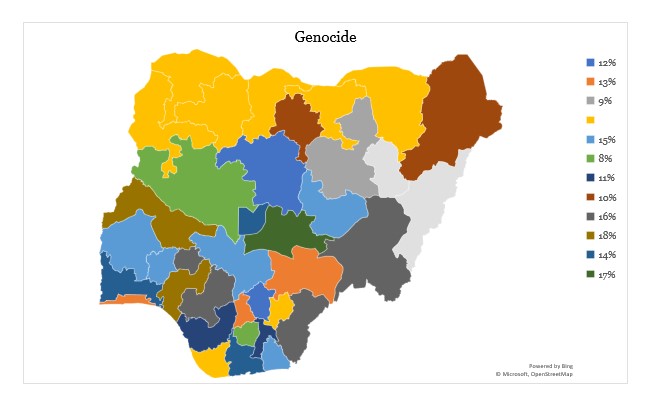
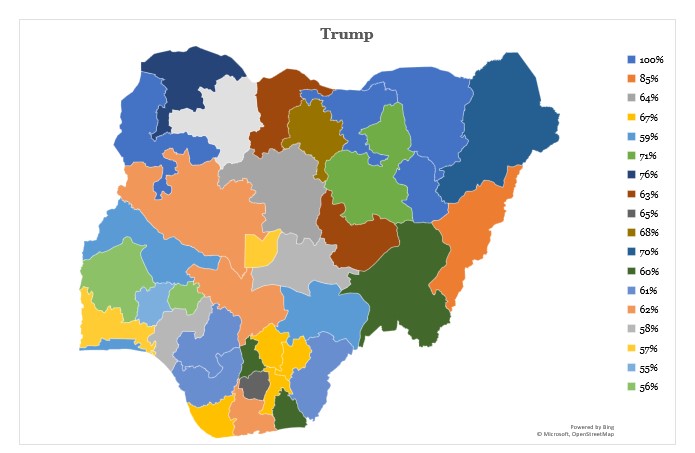
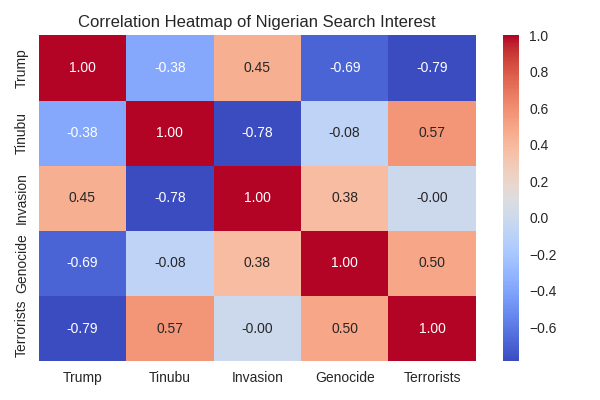
When former U.S. President Donald Trump declared that he would invade Nigeria because of what he called a genocide against Christians, the statement sent shockwaves across the country. It was not only a diplomatic controversy but also a moment that revealed how deeply global politics and local realities can intertwine. Within hours, Nigerians turned to Google, searching for “Trump,” “genocide,” “terrorists,” and “invasion.”  Our analyst notes searches between November 2 and November 4, 2025 indicate a powerful story about curiosity, fear, faith, and division in the country.

Across most Nigerian states, search interest in Trump’s name soared. This was more than mere fascination with a foreign leader. It showed how global figures can command attention when their words strike at the heart of local concerns. Trump’s name carried emotional weight—admiration for some, anger and disbelief for others. In a country already marked by political and religious divides, his statement became a spark that reignited old conversations about identity, insecurity, and international perception. Nigerians were not just watching global news; they were reacting to it through the lens of their lived experiences.

The data reveal that interest in Trump was high even in states far from the country’s traditional power centers. This suggests that Nigerians are keenly aware of global political developments, especially when those developments seem to validate or challenge their beliefs. The internet has made the world smaller, but it has also made emotions bigger. Trump’s comments transformed from foreign rhetoric into local debate, pulling global politics into Nigerian living rooms, churches, and WhatsApp groups.

But the more revealing story lies in “genocide,” “terrorists,” and “invasion.” These terms appeared in clusters, especially in states that have lived through violence and insecurity. Kaduna, Benue, and Plateau, for example, recorded heightened search interest. These are states that have faced recurring communal and religious conflicts. For people living there, Trump’s words were not abstract political talk; they touched raw nerves. Searching for those terms may have been an attempt to make sense of personal or community trauma. It was a digital way of asking: “Is the world finally paying attention to what we are going through?”

These searches reveal something important about how Nigerians use technology in moments of uncertainty. The internet becomes both a window and a mirror, a space to see how others perceive them and a tool to reflect on their own realities. When citizens in conflict-prone areas searched for “genocide,” they were not simply echoing Trump’s language. They were seeking recognition, understanding, and perhaps validation for their pain.

Interestingly, the term “invasion” did not attract much attention. While Trump’s threat was dramatic, Nigerians seemed more concerned with the moral and emotional implications than the political theater. This focus shows that public interest was driven by issues of justice and belonging, not by fear of an actual military intervention. People were less interested in whether Trump could invade and more interested in why he made such a claim and what it said about Nigeria’s reputation.

The event also highlights how emotions shape online engagement. Trump is a polarising figure globally, and in Nigeria, his comments deepened existing divides. Some viewed him as a truth-teller who finally acknowledged Christian suffering. Others saw his words as reckless and offensive, a reminder of how outsiders often oversimplify Nigeria’s complex security challenges. In this way, the digital reaction reflected a nation emotionally split, united in attention, but divided in interpretation.

This moment offers lessons about how Nigerians interact with both local and global politics. It shows that the country’s citizens are not passive consumers of international news. They actively seek information, context, and meaning. It also reminds leaders that statements made abroad can have powerful emotional consequences at home.

Pony AI Sets Final Hong Kong Listing Price at HK$139 per Share, to Raise $864m

0

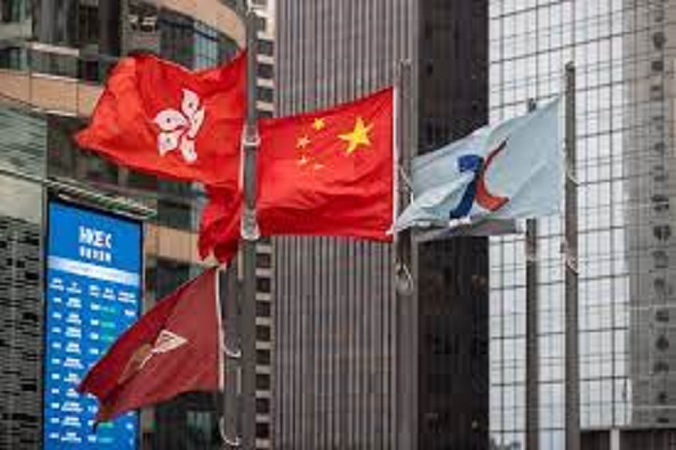
Chinese autonomous driving startup Pony AI has finalized the pricing for its Hong Kong secondary listing at HK$139 ($17.90) per share, according to a filing with the Hong Kong Stock Exchange on Monday.

The move marks a key step for the company as it strengthens its footing in both U.S. and Chinese capital markets amid accelerating global interest in self-driving technologies.

The offering price, which had been earlier reported by Reuters, citing sources familiar with the matter, represents a 4.2 percent discount to Pony AI’s Friday close of $18.68 per share on the Nasdaq. The company’s dual listing underscores its strategy to attract a broader investor base and increase liquidity for its shares, as Chinese technology firms continue to balance listings between U.S. and Hong Kong exchanges due to regulatory complexities.

Pony AI confirmed in the filing that it had exercised an option to allot and issue an additional 6.3 million new shares, expanding the size of the offering. In total, the company expects to raise gross proceeds of about HK$6.71 billion ($863.86 million). The listing involves roughly 42 million shares, priced well below the maximum offer price of HK$180 indicated in the firm’s earlier prospectus.

Trading in Pony AI’s shares on the Hong Kong Stock Exchange is scheduled to commence on November 6, marking one of the most closely watched tech listings in Asia this quarter. The listing also comes at a time when Hong Kong’s capital markets are seeing a revival of large technology offerings, following a period of subdued investor sentiment due to global economic uncertainty.

Founded in 2016 by former Baidu and Google engineers, Pony AI has emerged as one of China’s leading autonomous vehicle developers, competing with rivals such as Baidu’s Apollo Go and AutoX. The company, backed by Toyota Motor Corporation, is developing Level 4 autonomous driving systems — technology capable of operating vehicles without human intervention under specific conditions.

Pony AI has already conducted extensive trials of its self-driving cars in major Chinese cities, including Beijing, Guangzhou, and Shanghai, as well as in parts of California. Earlier this year, the company announced that it had received a permit to operate fully driverless robotaxis in Beijing’s Yizhuang district, making it one of the first firms to achieve this milestone.

In its prospectus, Pony AI said the proceeds from the Hong Kong listing will be used to advance research and development, expand its commercial robotaxi fleet, and accelerate deployment of its autonomous driving technology in logistics and ride-hailing services.

The listing also reflects the growing investor appetite for artificial intelligence and autonomous mobility firms, as global automakers and technology companies race to commercialize self-driving technology. According to Pony AI’s filing, the company sees its technology as “the foundation for the next generation of intelligent transportation systems,” positioning itself as a key player in China’s push toward smart mobility infrastructure.

Pony AI’s decision to list in Hong Kong mirrors similar moves by other Chinese AI and electric vehicle startups that are seeking to hedge against geopolitical and regulatory risks tied to their U.S. listings. Analysts say the Hong Kong debut could help stabilize the company’s valuation while allowing more Chinese investors to participate in its growth story.

With trading set to begin on November 6, Pony AI’s Hong Kong listing will be a major test of market confidence in the autonomous driving sector. The sector has been both highly promising and capital-intensive, as firms navigate the path to commercialization through technological, regulatory, and safety hurdles.