DD
MM
YYYY

PAGES

DD
MM
YYYY

spot_img

PAGES

Home Blog Page 230

Modest XLM and DOGE Gains Rivaled by $TAP’s 55% Surge – This Could be the Next 50X DeFi Gem, Claim Experts

0

The crypto market seems to be finally starting a steady rebound. As a result, tokens like XLM and DOGE are seeing healthy price gains. Meanwhile, while the top 10 altcoins try to recover, a newcomer is speeding past them.

Namely, Digitap ($TAP) has been on an upward ride since its presale began, and experts see it as the best ICO of 2025, one that could also be the market’s next 50x DeFi gem. So, the presale success might only be the start for $TAP.

The XLM Price Seems to be Pushing to $0.38 Soon

Like the rest of the market, XLM has also been suffering for weeks now. The recent market downturn caused even the best altcoins to lose significant momentum, but they might finally be seeing a rebound.

XLM, in particular, has been climbing in price steadily, currently at $0.3311. This marks a 4.02% rise for the XLM price in the past week, and both its market cap and trading volume are also up.

Analysts are also bullish, which could help XLM’s price rise even more. Namely, Ali Martinez recently stated that the $0.30 was a great spot to buy XLM. And now, since XLM is above this level, he believes that its price could soon go to $0.37.

The DOGE Price Is Holding Strong Even With A Recent Whale Sell-Off

DOGE has been on the back burner even before the recent market dump. Many thought that DOGE’s momentum had finally come to an end, especially since Elon Musk hasn’t spoken about it in quite some time. However, as memecoins do, DOGE managed to surprise many nonbelievers.

Namely, the DOGE price seems to be recovering steadily now, and experts believe that it might get some renewed momentum. At the moment, DOGE’s price is at $0.2017, up by 0.21% in one week. This doesn’t look like much, but when even the best altcoins are bleeding, it’s definitely something.

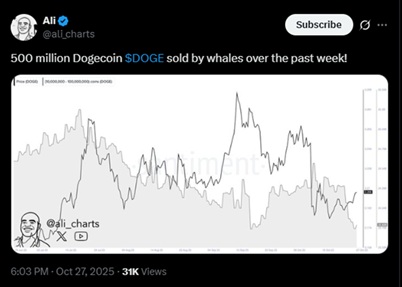
As for the sell-off, it was reported that Dogecoin whales recently sold over 500 million DOGE tokens in the span of one week.
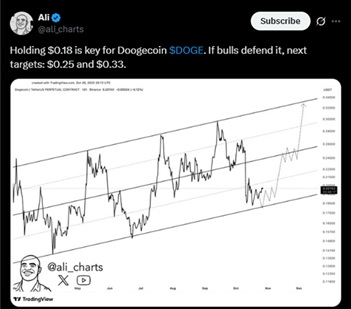
Also, according to Ali Martinez, it’s crucial for the DOGE price to now hold $0.18. If this happens, it might lead to the DOGE price rising to $0.25 and maybe even $0.33. With this in mind, DOGE might finally be a part of experts’ best crypto to invest in 2025 lists.
Why Digitap Can Still Perform Better Than Both XLM and DOGE

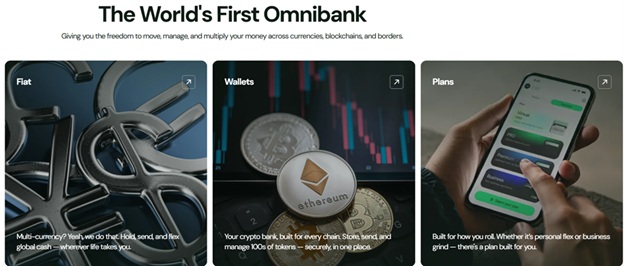
Even though both XLM and DOGE have their own bullish narratives right now, experts believe they can’t compare to Digitap. That’s because, as the world’s first omni-bank, Digitap offers utility unlike anything available before, and experts believe that it could completely change the way people manage their finances.

Namely, via its already live app, Digitap allows people to hold, store, spend, and send both crypto and fiat from one place. So, it has finally merged the two sectors, giving even non-crypto users the chance to finally enjoy the perks crypto offers without having to do anything.

Since the app is easily accessible via the Google Play Store and the Apple App Store, Digitap is also in the running to become the market’s best crypto for beginners.

Furthermore, Digitap offers crypto cards backed by Visa, which can be used anywhere Visa is accepted. Users will get instant conversions and settlements, using fiat or crypto as they please. Cross-border payments will also be cheaper with Digitap, as, via its AI-powered routing system, Digitap slashes them from the industry average of 6.2% to under 1%.

So, with a play on three multi-billion-dollar markets, as well as a utility that no other project has been able to bring before, Digitap is seen by many as the best crypto to invest in 2025.
USE THE CODE “MILLION30” FOR 30% OFF FIRST-TIME PURCHASES

The $TAP Presale: An Early Opportunity for Possibly Life-Changing Utility

In addition to offering a never-before-seen utility that can be beneficial to both crypto and non-crypto users, Digitap also offers investors a very early opportunity to enter. Namely, $TAP is currently in presale, selling for $0.0194. It has already raised over $1 million, selling more than 76 million tokens so far.

The success Digitap has seen so far shows just how ready the market is for what it offers, and how confident investors are. And since Digitap has a much bigger room for growth compared to XLM and DOGE, experts believe that 50x gains might be on the table by year-end.

Metric Details
Stage Price $0.0194
Next Stage Price $0.0268
Tokens Sold Over 76 million
Capital Raised Over $1 million
Fundraising Goal $10 million

The Next Financial Revolution Might Be Nearer Than Expected

Many have tried and failed to merge crypto and fiat into one unified project, and the feat looked impossible until now. Since Digitap has finally achieved it, experts believe it will usher in a whole new era in finance —one that gives people the chance to enjoy the best of both crypto and fiat.

Because of this, they see Digitap potentially becoming a top 5 cryptocurrency and at the forefront of financial innovation in the next few years.

Discover how Digitap is unifying cash and crypto by checking out their project here:

Presale: https://presale.digitap.app

Website: https://digitap.app

Social: https://linktr.ee/digitap.app

Pump.fun Acquires Padre Trading Platform, as Subscribers Oversubcribe MegaETH Public Sale

0

Pump.fun—a leading Solana-based memecoin launchpad—announced the acquisition of Padre, a multichain trading terminal popular among professional retail traders.

The deal, for an undisclosed amount, aims to integrate Padre’s advanced tools into Pump.fun’s ecosystem to enhance trading speed, data analytics, and liquidity across chains like Solana, Ethereum, BNB Chain, and Base.

This marks Pump.fun’s second major acquisition, following a Solana wallet-tracking tool in July 2025. Pump.fun, which holds about 44% of Solana’s memecoin launchpad market share down from a 75% peak earlier in 2025, is expanding beyond token launches into full-stack trading infrastructure.

Padre, launched relatively recently, has processed over $500 million in volume and serves 35,000+ wallets with features like low-latency routing, real-time data, competitive fees, cashback rewards, and dedicated trader support.

Core functions remain intact, but upgrades will focus on better user experience, multi-DEX liquidity discovery, and earlier access to new memecoin listings. Pump.fun’s co-founder Alon Cohen highlighted Padre’s strengths in UX and technology, stating it will become the “#1 pro trading terminal” with dedicated resources.

This vertical integration allows Pump.fun to control more of the memecoin lifecycle—from creation to trading—potentially boosting volume amid a market cooldown its monthly revenue dropped 80% from January 2025 peaks to under $25 million in July.

Pump.fun’s native token ($PUMP) surged 10% to around $0.0040 immediately after the announcement, reflecting optimism about ecosystem growth. The $PADRE token, previously used for platform utility, was stripped of all functions with “no further plans,” causing an 80% price crash to ~$0.0139.

This sparked backlash, with holders accusing Pump.fun of a “rug pull” and demanding compensation like airdrops or snapshots. Traders praised the integration for faster memecoin execution and potential $PUMP airdrops for Padre users. One post called it a “no-brainer” for liquidity.

Frustration over $PADRE’s devaluation dominated, with calls for fairness toward long-term holders. Broader critiques tied into Pump.fun’s controversies, like UK user bans and U.S. lawsuits over securities violations.

Pump.fun has teased a snapshot for $PADRE holders to receive equivalent $PUMP tokens, which could ease tensions. This move comes as Solana’s memecoin sector cools, with Pump.fun facing competition from platforms like LetsBonk.fun.

It positions Pump.fun to “tokenize the world’s highest-potential opportunities” by blending launchpad ease with pro-grade trading. However, ongoing scrutiny— including FCA warnings and class-action suits—could temper growth. For traders, it’s a net positive: expect seamless Solana/EVM bridging and enhanced tools soon.

LetsBonk.fun vs. Pump.fun

LetsBonk.fun often stylized as LetsBONK.fun or bonk.fun—a community-backed Solana memecoin launchpad tied to the $BONK ecosystem—has emerged as Pump.fun’s fiercest rival since its April 2025 debut.

While Pump.fun pioneered no-code token launches in January 2024, LetsBonk disrupted the space by emphasizing ecosystem reinvestment, lower fees, and BONK buybacks/burns. This “launchpad war” has driven innovation but also volatility, with market share flipping multiple times in 2025.

By mid-2025, LetsBonk briefly dominated peaking at 78% market share in July, fueled by hype around $BONK’s resurgence. Pump.fun countered with revenue-sharing updates, the Glass Full Foundation for liquidity injections, and aggressive $PUMP buybacks.

As of now, Pump.fun holds ~75-80% share, but LetsBonk’s ~15-20% reflects sustained pressure—total Solana memecoin launches hit 3M+ YTD, with daily volumes ~$120M.

LetsBonk launches with Raydium partnership, captures 2-18% share via creator incentives (e.g., $5K USDC rewards). Pump.fun at 100% dominance but revenue dips 80% from Jan peaks.

Jun-Jul 2025: LetsBonk flips Pump.fun—first in history—for 24h launches (18K vs. 13K) and revenue ($1.04M vs. $0.53M). Market share hits 64-78%; $BONK +72% amid hype.

Aug 2025: Pump.fun rebounds with 73.6% share, $13.48M weekly revenue highest in 6 months. Introduces revenue-sharing for creators and Glass Full Foundation for “diehard cults.”

Sep-Oct 2025: Duopoly stabilizes; Pump.fun at 80% graduated tokens, but LetsBonk leads in trader mindshare (e.g., international adoption in China). $PUMP +32% weekly; $LETSBONK volatile but +300% spikes.

Hype peaks around flips (e.g., “Historic trench takeover!”), with traders hedging both via $PUMP/$BONK. LetsBonk’s “Junk Fun” teases revival for “dead memecoins,” tying into $BONK’s “Make Memes Great Again” campaign.

LetsBonk’s higher graduation rate 2x Pump’s means better odds for “graduating” to DEXs like Raydium—ideal for quality plays. Pump.fun’s scale suits viral pumps but risks bot saturation. $PUMP $0.0040, +10% post-Padre benefits from buybacks; $BONK ($0.00003) gains from LetsBonk fees up 75% in Jul surges. $LETSBONK (~$0.17) volatile but ecosystem-aligned.

Competition boosts volumes 162M daily txns H1 2025 but raises rugs 98% fail rate. Regulatory heat on Pump.fun FCA/SEC suits could push flow to LetsBonk. Bots dominate both Coinbase est. majority launches; market cooldown could hit revenues 80%+ as in early 2025.

MegaETH Public Sale Massively Oversubscribed

The public sale for MegaETH’s $MEGA token is live and runs for a full 72 hours until October 30. This is a community-driven English auction hosted on Sonar by Echo, offering 5% of the total $MEGA supply 500 million tokens out of 10 billion to accredited investors worldwide.

It’s designed to be fair, transparent, and capped to keep valuations grounded.Quick Sale MechanicsBidding Window: Open now through October 30, 1 PM UTC. You can place, adjust, or withdraw bids in real-time.

Bid Range: Minimum $2,650 USDT, maximum $186,282 USDT per wallet (paid on Ethereum mainnet). Starts at a $1 million FDV $0.0001 per token and caps at $999 million FDV $0.0999 per token. It’s a uniform clearing price—everyone pays the same final rate based on total demand.

Non-U.S. bidders can opt for a 1-year lockup for a 10% discount and allocation priority. U.S. accredited investors get a mandatory lockup. If oversubscribed (which it is), prorated based on “Allo Criteria” like on-chain history, social engagement (e.g., Ethos scores), Kaito AI activity, and NFT holdings (Yapybara or Fluffle). Refunds for excess bids happen post-auction.

Up to ~$50 million, but demand has shattered that. Head to the official sale page at sale.megaeth.com. You’ll need to KYC over 100,000 users already have and connect your wallet. Over 70,000 Twitter users are eligible.

9x+ Oversubscribed, $450M+ Committed. The sale “sold out” its cap within minutes of launch, but since it’s an auction, bidding continues to determine the final price. As of this morning total Commitments is over $457 million from 17,000+ unique bidders 9.1x–9.9x oversubscription.

1,289 wallets at the max $186K bid accounting for ~$240M alone ~$27K per wallet. 7.7% of bids opted for the discounted lockup. $MEGA perpetuals on Hyperliquid are implying a $5B–$7B FDV up from a $6B peak, with Polymarket odds at 89% for >$2B FDV post-launch.

This level of demand is wild—it’s already one of the hottest ICOs of 2025, outpacing many L2 launches. Early stats from Dune dashboards show it hit 3x oversub in 30 minutes, 5x in 2 hours, and it’s climbing. Non-winners still qualify for mainnet rewards, so even partial allocations build ecosystem loyalty.Metric

MegaETH isn’t just another Ethereum L2—it’s built for “real-time” performance, targeting 100,000+ TPS with sub-10ms latency and full EVM compatibility. Think high-frequency DeFi, perps trading, or on-chain games without the lag.

Tech Stack: 20,000+ TPS on testnet already vs. Arbitrum’s ~40K cap; real-time APIs, Chainlink oracles every 2.4ms, and Ethena’s USDM for yield-aligned sequencing up to 10% APY. Total supply 10B $MEGA. Breakdown: 53% KPI staking rewards tied to TVL/TPS milestones, 31.7% VC/team/eco, 5% public sale, 5% mainnet campaigns, rest liquidity/community.

$43.5M pre-ICO from Dragonfly, Figment, Vitalik Buterin, Joseph Lubin. Recent buyback of early warrants to align incentives. “MegaMafia” includes Noise, Cap Money, GTE; community tools like MegaETH Punks NFTs and regional chapters.

High oversub means tiny allocations for non-prioritized bidders; U.S. regs add friction; no big airdrop—focus on stakers/builders. Gas fees on ETH could bite during peaks.

If you’re eyeing this as an asymmetric bet, pre-market signals scream upside like the $7B+ FDV potential, but DYOR—crypto’s volatile, and this is a high-conviction play on Ethereum’s speed upgrade and MegaETH positions Ethereum as a fast pace platform for development.

US Reaches $80bn Deal With Westinghouse Electric, Cameco, Brookfield Asset Management For New Nuclear Power Plants

0

The United States is set for one of its most significant nuclear energy expansions in decades, as three companies — Westinghouse Electric, Cameco, and Brookfield Asset Management — announced a sweeping $80 billion plan to build a new fleet of nuclear reactors across the country in partnership with the U.S. government.

The initiative marks a bold step under President Donald Trump’s “energy dominance” agenda, which emphasizes a renewed focus on oil, gas, coal, and nuclear energy.

The plan comes amid surging electricity demand in the United States, the first such sustained increase in two decades, driven largely by the explosion of artificial intelligence data centers that require massive, constant power supplies to sustain machine learning and cloud computing operations. Officials and some business leaders believe nuclear energy, long neglected and controversial, could play a vital role in powering the next wave of AI-driven digital infrastructure while maintaining low-carbon output.

Under the agreement, the U.S. government will help finance the construction of reactors using Westinghouse’s advanced nuclear technology and will also assist with permits and regulatory clearances. In return, Washington will obtain a participation interest that allows it to collect 20 percent of any cash distributions exceeding $17.5 billion once the projects are operational. However, the government’s equity interest will only take effect after a final investment decision and completion of key construction milestones.

While this partnership represents a major policy shift toward atomic power, it also revives long-standing concerns about the economics of new nuclear projects. The industry’s recent record has been marred by delays and massive cost overruns. The Vogtle nuclear expansion in Georgia, completed between 2023 and 2024, took seven years longer than expected and cost roughly $35 billion — more than double its initial $14 billion estimate. No other large-scale nuclear reactor is currently under construction in the United States, underscoring the financial and logistical hurdles the new initiative faces.

Critics have also renewed concerns about nuclear waste management, a persistent issue that remains unresolved. The U.S. still lacks a permanent repository for radioactive waste, forcing plant operators to store spent fuel on-site in cooling pools before transferring it into hardened casks. Environmental groups have noted that without a clear disposal plan, expanding the nation’s reactor fleet could pose long-term safety and storage challenges.

However, optimism is returning to the nuclear sector, largely fueled by the technological needs of the AI and cloud computing industries. Major technology companies, including Google, Microsoft, and Amazon, have begun securing long-term power contracts generated by next-generation nuclear systems, such as small modular reactors and even fusion-based facilities. These energy partnerships are seen as essential to maintaining consistent, carbon-free power for hyperscale data centers that operate around the clock.

Just this week, NextEra Energy and Google reached an agreement to restart an idle nuclear plant in Iowa, marking a symbolic shift toward nuclear’s reemergence as a cornerstone of digital-era energy planning. Similarly, Microsoft has partnered with Constellation Energy to revive one unit of the Three Mile Island nuclear station in Pennsylvania, which will directly power the company’s data centers.

The deal between Westinghouse, Cameco, and Brookfield also includes a clause that could see Westinghouse go public in the coming years. If the U.S. government’s participation interest vests and the company’s valuation exceeds $30 billion by January 2029, Westinghouse would be required to make a public share offering — a move that could reshape the global nuclear supply chain and attract institutional investors into the sector.

Cameco and Brookfield Renewable Partners acquired Westinghouse in 2023 for $7.9 billion, including debt, from Brookfield Business Partners, which had rescued the company from Toshiba’s bankruptcy in 2018 for $4.6 billion. Following Tuesday’s announcement, Cameco’s shares surged more than 15% in premarket trading, indicating strong investor confidence in the renewed U.S. nuclear drive.

The plan also aligns with President Trump’s May executive order promoting nuclear energy, which targets an additional 5 gigawatts of reactor capacity by 2030 — part of a broader push to secure energy independence and sustain industrial competitiveness amid growing AI-related power consumption.

Investors Push Mono Protocol to $2.8M as Stage 15 Opens

0

Mono Protocol’s crypto presale continues to attract strong investor demand, now surpassing $2.8 million in total funds raised. The milestone coincides with the opening of Stage 15, reinforcing its position as one of 2025’s most promising Web3 crypto presales.

Built to simplify cross-chain complexity and deliver real Web3 utility, Mono Protocol stands out for its transparent roadmap, performance-focused design, and recently launched Rewards Hub that rewards active users with $MONO tokens.

Early Success in the Presale

Mono Protocol’s presale crypto stage has achieved significant traction among retail and institutional investors. With Stage 15 now live, the minimum contribution remains $10, keeping the project accessible to a wide audience.

Half of the total 141,252,439 token supply is allocated to this pre sale cryptocurrency, with claimable tokens available after the Token Generation Event. At the current price of $0.0450 and a launch price of $0.50, early investors could see a 1,011% potential profit as outlined in the official roadmap.

Roadmap Priorities

Mono Protocol’s roadmap details a clear transition from presale fundraising to full protocol deployment. The project has finalized its core architecture and is expanding partnerships with major blockchain infrastructure providers such as Chainlink and Celestia.

These partnerships strengthen scalability and developer adoption, setting this presale coin apart from hype-driven offerings. Investors can track ongoing progress toward key milestones through the dashboard.

Beta Launch and Core Upgrades

The next milestone is the Beta release in Q4 2025, introducing unified balances across EVM Layer-2 networks and initial Solana integration. Mono Protocol will also roll out Liquidity Locks, preventing failed transactions, and MEV-resilient routing for improved reliability.

These upgrades make the project one of the few cryptocurrency presales where technology is advancing in tandem with fundraising, proving its focus on real adoption and execution efficiency.

Rewards Hub and Token Roles Across the Ecosystem

Mono Protocol’s launch introduced the Rewards Hub, allowing users to earn $MONO through staking, referrals, and participation in network tasks. This initiative encourages long-term engagement and community growth.

The presale crypto coin also powers universal gas fees, network staking, and cross-chain settlements. Future stages will add governance, insurance pools, and incentives that expand $MONO’s role across the ecosystem, rewarding both users and developers.

Growth Plans Beyond Beta

Looking ahead to 2026, Mono Protocol plans to extend governance tools, integrate more networks like Avalanche and Linea, and launch builder incentive programs to attract developers.

By maintaining a long-term approach, this new crypto presale stands apart from short-term speculative projects. Its structure ensures that every development phase strengthens usability, reliability, and value for investors.

A Structured Path for the Future

With $2.8 million raised and Stage 15 now open, Mono Protocol has cemented its reputation as one of the most credible crypto presales of 2025. Its roadmap links token utility to tangible outcomes, from Liquidity Locks to multi-chain integration.

Investors can participate via monoprotocol.com or track live data on the dashboard. As the Web3 crypto presale moves toward Beta, Mono Protocol continues to prove that structured, utility-focused growth is the key to Web3 scalability.


Learn More about Mono Protocol

Website: https://www.monoprotocol.com/

X: https://x.com/mono_protocol

Telegram: https://t.me/monoprotocol_official

LinkedIn: https://www.linkedin.com/company/monoprotocol/

Register for Tekedia AI Lab And Learn Practical Skills on AI Agent Creation [video]

0

Good People, the age of intelligent systems is here, and Tekedia is teaching how to build them. At Tekedia AI Technical Lab, we take learners deep into the fabrics of AI agent construction, from code-level architecture to system integration. You will design AI agents for customer support (WinSupport.zenvus.com), a learning companion (WinLearn.zenvus.com), career and hiring portal (WinJob.zenvus.com), and more. You will also learn how to summarize webpages, classify data, and determine web SEO and keywords, all right from your personal computer.

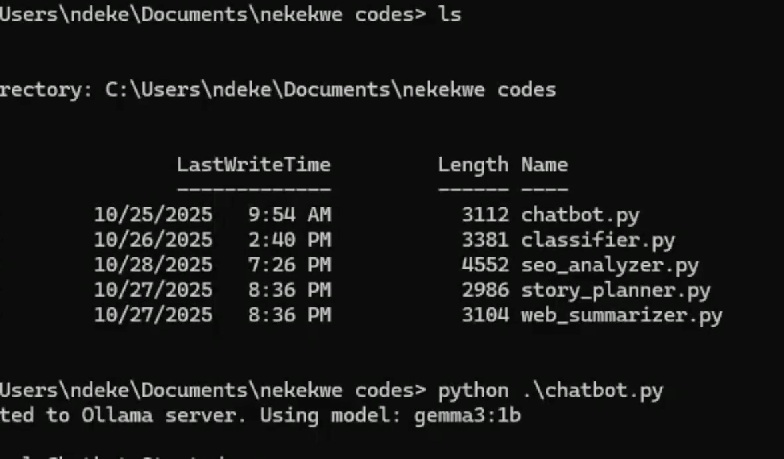
And you can have your own chatbot on your laptop (see video) [I used Gemma 3:1B model but you can edit the Python codes which I share with co-learners to use higher AI models and those will deliver better results]

We have made this simple and accessible. To reduce costs, we use open-source foundational models like DeepSeek, Google Gemma 3, etc, so you pay zero license fees. Yet, for those who prefer a no-code, vibecoding experience, Tekedia AI in Business Masterclass comes at no extra cost if you enroll for Tekedia AI Lab. There, you’ll create AI agents using drag-and-drop workflows, business prompts, and no programming. Tekedia offers a full-cycle path, from zero code to deep code, from beginner to builder.

You do not need a university degree; a secondary school education is enough. This is how we democratize AI capability, one learner, one builder, one dreamer at a time.

Join us at Tekedia AI Lab as the next edition begins on Nov 15. Let’s build the future, one AI agent at a time. Register here