DD
MM
YYYY

PAGES

DD
MM
YYYY

spot_img

PAGES

Home Blog Page 257

Cryptocurrency Transactions Volume Surged By 50% In the United States in First Half of 2025

0

A recent report from blockchain intelligence firm TRM Labs confirms that cryptocurrency transaction volume in the US surged by approximately 50% in the first half of 2025 compared to the same period in 2024, reaching over $1 trillion.

This marks the US as the world’s largest crypto market by absolute volume, driven by a combination of retail investor enthusiasm and institutional momentum. The growth reflects a multi-year trend, with stablecoin transactions which account for about 30% of total crypto volume jumping 83% year-over-year to a record $4 trillion by August 2025.

Several policy and market shifts under the Trump administration have fueled this boom. The SEC launched “Project Crypto” in August 2025 to position the US as the “crypto capital of the world,” ending prior enforcement actions.

In April, the Department of Justice scaled back crypto prosecutions. The GENIUS Act, signed in July, established stablecoin reserve requirements. Exchange web traffic rose 30% in late 2024 and early 2025, signaling strong professional interest.

Individual-led transactions grew over 125% from January to September 2025, with memecoins playing a key role in onboarding new users. While the US leads in total volume, grassroots adoption is hotter elsewhere: India: Fastest-growing region in South Asia, with higher per-capita usage rates.

Egypt, Morocco, Algeria, and Tunisia rank in the global top 50 for crypto usage, despite bans. Europe: Ownership jumped sharply, e.g., UK from 18% to 24% and France from 18% to 21% of adults.

The $1 trillion transaction volume underscores crypto’s growing role in the US economy. Institutional inflows and retail enthusiasm 125% growth in individual-led transactions signal increased liquidity and market maturity, potentially attracting more traditional investors and boosting related industries like blockchain tech and fintech.

With stablecoins driving 30% of volume and growing 83% year-over-year, they’re becoming a backbone for practical applications like remittances, cross-border payments, and DeFi. This could challenge traditional financial systems, especially for dollar-based transactions.

While retail participation is up, the concentration of crypto wealth may exacerbate wealth gaps if speculative gains favor early adopters or high-risk investors. The Trump administration’s moves—SEC’s “Project Crypto,” DOJ’s reduced enforcement, and the GENIUS Act—signal a friendlier regulatory environment.

This could sustain growth but risks oversight gaps, potentially leading to fraud or market manipulation if not balanced with consumer protections. The US’s push to be the “crypto capital” may pressure other nations to clarify their regulations, fostering a global race for crypto-friendly policies.

However, this could also spark tensions with jurisdictions like the EU, which prioritize stricter oversight. Surging transaction volumes complicate tax reporting and anti-money laundering (AML) enforcement, requiring updated frameworks to track and regulate high-frequency crypto activity.

Rising ownership from 20% to 22% of US adults and a 30% spike in exchange traffic reflect crypto’s shift from niche to mainstream. Memecoins, despite volatility, are onboarding younger and less crypto-savvy users, reshaping financial literacy and investment culture.

While the US leads in volume, grassroots adoption is stronger in regions like India and North Africa. This highlights a divide where developing nations use crypto for necessity (e.g., remittances, inflation hedges), while US growth leans speculative, potentially influencing global perceptions of crypto’s utility.

The retail surge, particularly in memecoins, raises concerns about speculative bubbles, which could erode trust if crashes occur, especially among new investors drawn by hype. Crypto’s growth offers inclusion for underbanked populations but also exposes users to volatility and scams, especially without robust education or regulation.

Increased adoption could accelerate blockchain innovation, from DeFi to tokenized assets, but may strain infrastructure. The US’s crypto embrace could strengthen its financial dominance but risks alienating allies with stricter policies, impacting global trade and sanctions enforcement.

These implications suggest a transformative moment for crypto in the US, with benefits tied to innovation and access but tempered by risks of instability and regulatory challenges.

Other 2025 reports align on modest US ownership gains from 20% to 22% of adults, but TRM’s volume metric highlights the scale of activity. Overall, crypto’s mainstreaming continues, with stablecoins enabling practical uses like remittances and payments.

Wall Street Edges Higher as Tesla Misses Estimates, Trade Tensions with China Cloud Outlook

0

U.S. stocks rose slightly on Thursday, with cautious gains across major indexes as disappointing quarterly results from Tesla and IBM tempered optimism from other megacap tech firms, while simmering U.S.-China trade tensions kept risk appetite subdued.

At 11:31 a.m., the Dow Jones Industrial Average gained 70.69 points, or 0.15%, to 46,661.10. The S&P 500 advanced 25.17 points, or 0.38%, to 6,724.57, while the Nasdaq Composite climbed 152.12 points, or 0.67%, to 22,892.52.

Tesla’s shares fell as much as 5% after the company missed third-quarter profit estimates, even though it slightly beat revenue expectations. The report marked the start of the so-called “Magnificent Seven” earnings parade, setting the tone for a closely watched tech reporting season. Analysts said the revenue beat did little to offset concerns about shrinking automotive margins amid rising production costs and growing competition from Chinese electric vehicle makers.

But as Tesla stumbled, other technology giants moved higher, led by bargain-hunting in megacap names. Nvidia, Alphabet, Amazon, and Meta each rose about 1%, while Broadcom gained 1.4%. Together, the “Magnificent Seven” group — which represents nearly 35% of the S&P 500’s total weight — helped buoy the broader market.

Honeywell rose 7% after raising its 2025 profit forecast, even as it prepares to spin off its advanced materials division. The upbeat projection helped keep the Dow positive. However, IBM weighed on the index, slipping 2.5% after reporting a slowdown in its key cloud software unit, suggesting weaker demand in enterprise spending.

Market analysts said that while most companies have exceeded analysts’ earnings expectations so far this quarter, their cautious forward guidance has kept equity gains restrained. Investors, still wary of elevated valuations, are looking for stronger confirmation that corporate earnings can sustain momentum through the year’s end.

“Earnings data this quarter to this point has probably been even a little bit more valuable than it might be in other quarters, simply because of the lack of other data on the state of the U.S. economy,” said Jim Baird, chief investment officer at Plante Moran Financial Advisors.

That “data drought” has been deepened by the ongoing U.S. government shutdown, now in its 23rd day, which has frozen several key economic reports, including the latest jobless claims. The absence of real-time data has left investors “flying blind,” according to analysts, increasing the focus on Friday’s core CPI report — expected to hold steady at 3.1% — as the clearest signal for the Federal Reserve ahead of its policy meeting next week.

Markets are already pricing in a 25-basis-point rate cut, with traders expecting another reduction in December as inflation pressures cool. The Fed’s recent guidance suggests policymakers are leaning toward maintaining flexibility amid lingering uncertainty about the pace of economic slowdown.

Geopolitical jitters also weighed on sentiment after Reuters reported that the Trump administration was considering sweeping new restrictions on high-tech exports to China, in response to Beijing’s latest curbs on rare-earth shipments. The report reignited concerns of an escalation in the trade dispute between Washington and Beijing, which investors fear could disrupt supply chains and dampen global growth.

Energy stocks climbed 1.4% after oil prices rose following new U.S. sanctions targeting Russia’s energy exports. Chevron, Exxon Mobil, and Halliburton each gained between 1% and 2%, providing another lift to the S&P 500.

Meanwhile, the quantum computing sector rallied sharply after the Wall Street Journal reported that the Trump administration was in talks with several companies to take equity stakes in exchange for federal funding. IonQ jumped 12%, D-Wave Quantum surged 18%, and Rigetti Computing gained 13%, marking one of the day’s most active segments.

The day’s biggest decliner was Molina Healthcare, whose shares plunged 21.4% after the insurer slashed its annual profit forecast, citing higher medical costs. Peer Centene fell 6.9%, dragging down the broader healthcare sector.

On market breadth, advancing issues outnumbered decliners by a 1.48-to-1 ratio on the New York Stock Exchange and by 1.53-to-1 on the Nasdaq. The S&P 500 posted 10 new 52-week highs and four new lows, while the Nasdaq recorded 45 new highs and 62 new lows.

Traders described the session as one defined by “measured optimism,” where gains were underpinned by selective buying rather than broad enthusiasm. With U.S. economic data frozen, geopolitical risks mounting, and the Fed poised to decide on another rate cut, investors are treading carefully — waiting for the next clear signal that the rally still has room to run.

Validating Your Business Idea with a Minimum Viable Product

0

Software development is a complex process that requires a thorough understanding of the needs of prospective users. Experience shows that the viewpoints of industry experts may differ from those of end users, underscoring the importance of obtaining authentic insights into customer requirements. In this regard, the concept of a Minimum Viable Product (MVP) offers an effective approach. It enables development teams to evaluate the product’s relevance and usefulness, collect valuable user feedback, and identify areas for enhancement.

Start with MVP

MVP is an abbreviation for Minimum Viable Product. In software development, it is recommended to create a version of the application that includes all essential functionalities while maintaining a simplified user interface. This version can be launched to gather initial user feedback. While feedback may include both positive and constructive criticism, analyzing user responses allows for targeted improvements, enabling the development of a more refined paid version.

Creating an MVP also makes finding investors as easy as possible. No matter how good your circuit board business is, people in business invest more effectively in projects that are well visualized. If an investor can try out your product, they are much more likely to invest.

Why is MVP popular?

The popularity of MVP is rapidly increasing due to its demonstrated effectiveness. However, there is a lack of widespread understanding regarding its importance and proper application.

There are 3 main dangers for an aspiring entrepreneur:

  1. Building an MVP in a form that is unnecessarily complex and expensive.
  2. The belief that one “MVP fits all” or that an MVP is always needed.
  3. Too long a development process that loses the core idea of ??the MVP.

MVP is an experiment that must be developed purposefully and well thought out at its core.

Common Pitfalls in Development MVP

One of the biggest mistakes founders make is confusing an MVP with a half-baked or buggy product. An MVP should be minimal but still viable—meaning it solves a real problem for users in a usable, reliable way. If your MVP crashes constantly or lacks basic functionality, users won’t see its potential; they’ll just assume your product is bad. Remember, the goal isn’t to cut corners on quality, but to focus only on the core features that deliver value.

Another common trap is launching an MVP without a clear hypothesis or success metric. Too many teams build something “simple,” throw it out into the world, and then wonder what to do with the feedback or worse, ignore it altogether. An effective MVP is part of a learning loop: you test a specific assumption (e.g., “Users will pay $10/month for this feature”), measure real behavior, and use those insights to decide whether to pivot, persevere, or scrap the idea. Without that focus, your MVP is just a guess in disguise.

The MVP Methodology

One of the QA testing agencies states that in the last year, interest in MVP has increased many times over. It leads to the fact that more and more researchers and scientists are starting to work on this issue. So, the minimum viable product can:

  • Help potential users understand what the final product will look like. There is a saying, “It is better to see once than hear 100 times”. No matter how well you advertise your product or how bright your presentation is, users will be more willing to buy a program they have already used.
  • Assess genuine interest in your product. So, even if your product is not yet ready for release, you can try to sell it. You can count the number of clicks on the “buy” or “download” button. Thus, you can visually assess how well your business plan is designed.
  • Give users a free trial of your product in exchange for a review. Here it is necessary to consider the study itself, which the user will leave, and the time the person spent using it.
  • Test the ability of the team to work and the entrepreneur’s ability to bring the best people into the business.

Before starting software development, entrepreneurs create various hypotheses. The main goal of the MVP is to confirm or refute them.

The average cost of website development depends on what functions it should perform. Thanks to the MVP, you will be able to understand which of them are essential and which ones can be abandoned.

Metrics to Measure MVP Success

When launching an MVP, it is important to move beyond simply monitoring download or sign-up numbers. While these figures can be encouraging, they do not provide insight into whether the product effectively meets users’ needs. Instead, focus on user behavior—are users completing the primary actions the product is designed to facilitate? This metric, known as the activation rate, is significantly more meaningful than superficial metrics.

Also, pay attention to retention. Do people come back after their first use? If not, your MVP might solve a problem nobody cares enough about. Track day-1 and day-7 retention to spot early warning signs. And if you’re asking for payment eventually, watch your conversion rate even from a free trial. These signals show whether you’re onto something real or just building something that looks good on paper.

Manifestations of the MVP

Experiments allow you to understand how viable your business concept is. They are of different types:

  • prototypes,
  • valorization,
  • pilot projects,
  • test sites,
  • concierge service,
  • demo and dummy landing pages.

The above tests are different types of MVPs needed to understand your project’s viability.

If you wish, you can choose the best software outsourcing models that will allow you to test your hypotheses in the best possible way.

Is it really effective?

Experience demonstrates that regardless of the type of software you develop (such as a comprehensive website, a mobile application, or specialized tools for particular professionals) a minimum viable product (MVP) will serve as a valuable asset in your project.

With this, you can predict the behavior of potential customers and investors based on actual numbers and research, and not just your desires or guesses. It is crucial to assess the possible risks here. Typically, MVPs are created when user behavior is fundamental to the growth of your business.

However, there are a few times when you can get by without an MVP. So, for example, if you know that your main competitor is planning to release a similar product shortly and will win the race, the one who finishes the work earlier, then you can refuse to create a prototype. That is why, before you start doing a project, you must carefully study the market and understand which programs are already on the market and which are soon announced for release.

DOGE and SHIB May Rally, But Ozak AI Price Prediction Is Creating Real Momentum

0

Dogecoin and Shiba Inu are building bullish momentum, fueling renewed meme coin enthusiasm, but it’s Ozak AI that’s generating real excitement among whales and early movers. While DOGE and SHIB rely on community strength and viral hype, Ozak AI combines early-stage upside with tangible AI infrastructure, integrating 700,000+ AI nodes through partnerships with Perceptron Network and SINT.

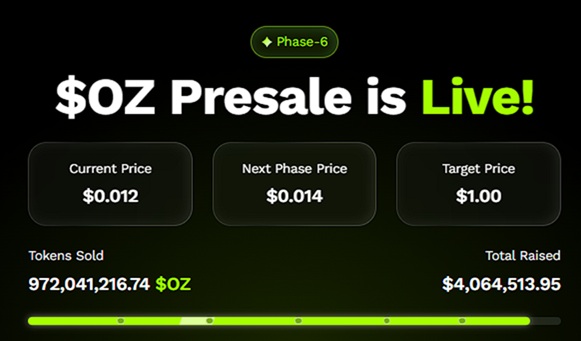
Having raised over $4 million and sold more than 970 million tokens, it’s attracting strategic capital rotation from meme coin traders who see AI + blockchain as the next major narrative, making Ozak AI a standout 100x opportunity heading into the bull run.

DOGE and SHIB Are Heating Up the Market

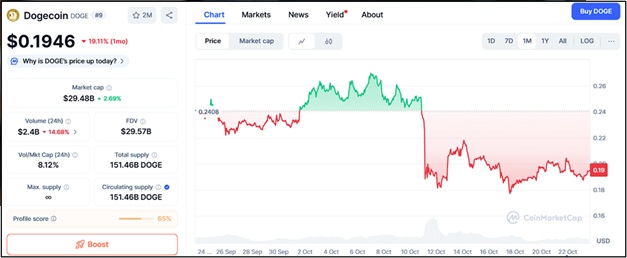
Dogecoin and Shiba Inu remain two of the most closely watched meme projects in the crypto market, with investors awaiting renewed upside as the following bull leg builds. DOGE presently trades around $0.1946, with guide stages at $0.14, $0.11, and $0.09, and resistance ranges at $0.25, $0.33, and $0.45—a shape that indicates room for similarly upward motion if market sentiment remains robust.

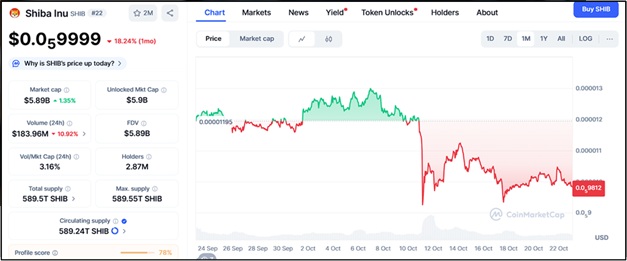
SHIB sits at $0.00000999, with help at $0.0000080, $0.0000065, and $0.0000052, and resistance at $0.000012, $0.000016, and $0.000022, additionally showing technical energy and developing momentum among retail buyers.

Both DOGE and SHIB have records of turning in effective rallies; however, even as meme coin enthusiasm is excessive, Ozak AI is rising as the project riding real market momentum amongst whales and early investors.

Why Traders Are Looking Beyond DOGE and SHIB

DOGE and SHIB thrive on community strength, meme culture, and viral waves of retail interest. They’re excellent vehicles for short-term rallies, but experienced traders know that explosive long-term upside often comes from early-stage tokens tied to strong narratives. This is why capital is increasingly rotating into Ozak AI—a project positioned at the intersection of AI and blockchain, two of the most powerful themes of this cycle.

Ozak AI has already raised over $4 million and sold more than 970 million tokens in the OZ presale, signaling accelerating momentum. As traders bank profits or diversify beyond meme coin rallies, Ozak AI is quickly becoming a top rotation play.

Ozak AI’s AI Infrastructure Sets It Apart

Unlike meme tokens that rely purely on hype, Ozak AI has tangible utility behind its narrative. The project integrates more than 700,000 AI nodes through partnerships with Perceptron Network and SINT, enabling predictive intelligence, real-time market signals, and agent-driven systems.

This makes Ozak AI more than a short-term trade—it’s a functional intelligence layer for blockchain ecosystems, attracting not only meme coin flippers but also whales and strategic investors looking to front-run the AI + blockchain narrative.

Whale Accumulation Is Building Momentum

Whales typically lead major rotations in crypto markets, entering promising projects before retail arrives. In previous cycles, they moved early on Ethereum during the ICO boom, DeFi in 2020, and meme tokens like SHIB in 2021. Now, that same accumulation trend is forming around Ozak AI, with early entries signaling growing confidence in its upside potential.

This early whale activity often sets the stage for significant rallies once liquidity deepens and exchange listings bring broader exposure.

Ozak AI Could Be the Standout Play of the Cycle

DOGE and SHIB may rally strongly as the bull run intensifies, but Ozak AI represents a new generation of high-upside opportunities. With its AI + blockchain narrative, real infrastructure, whale accumulation, and surging presale traction, it’s positioning itself as one of the most compelling plays of 2025.

For traders who profited from meme coins—or those looking to get ahead of the next major narrative—Ozak AI is more than just hype. It’s real momentum with 100x potential, stealing attention from even the biggest meme coins in the market.


About Ozak AI

Ozak AI is a blockchain-based crypto project that provides a technology platform that specializes in predictive AI and advanced data analytics for financial markets. Through machine learning algorithms and decentralized network technologies, Ozak AI enables real-time, accurate, and actionable insights to help crypto enthusiasts and businesses make the correct decisions.


For more, visit:

Website: https://ozak.ai/

Telegram: https://t.me/OzakAGI

Twitter: https://x.com/ozakagi

Fetch.ai-Ocean Protocol Dispute Could Reshape How Decentralized AI Projects Manage Tokens and Governance Alliances

0

Humayun Sheikh, CEO of Fetch.ai, publicly offered a $250,000 bounty to anyone who can identify the signatories of OceanDAO’s multisignature (multisig) wallet and reveal their connections to the Ocean Protocol Foundation.

This move escalates an ongoing feud between Fetch.ai and Ocean Protocol, centered on allegations of token mismanagement ahead of their 2024 merger into the Artificial Superintelligence (ASI) Alliance.

The alliance, which also included SingularityNET, aimed to consolidate decentralized AI projects under a unified token framework (primarily FET). Ocean Protocol withdrew from the alliance on October 9, 2025, citing unspecified reasons, but Sheikh claims their pre-merger actions amounted to a “rug pull” on FET holders.

Sheikh has accused Ocean Protocol of diverting community funds intended for the alliance, calling it a violation of trust. He has also pledged to fund class-action lawsuits in multiple jurisdictions and urged exchanges like Binance and market makers like GSR to investigate the transactions.

According to on-chain analytics from Bubblemaps, an Ocean Protocol-linked multisig wallet converted approximately 661 million OCEAN tokens minted in 2023 into 286 million FET tokens in July 2025—before the ASI merger fully took effect.

Of these, about 270 million FET valued at roughly $80–120 million at the time were transferred to exchanges: 160 million to Binance and 109 million to GSR Markets. Sheikh alleges these were alliance funds meant for community incentives and data farming, but were instead liquidated without disclosure, harming FET holders.

He described it as “funds intended for the community were diverted.” The conversions and dumps occurred amid the merger process, contributing to a 9% drop in FET’s price to around $0.25 shortly after the allegations surfaced. The ASI Alliance was once valued over $7 billion, but this dispute has strained investor confidence in AI-crypto collaborations.

Ocean Protocol’s Response

Ocean Protocol has denied the allegations as “unfounded claims and harmful rumors,” stating they are preparing a formal legal response while respecting applicable laws. They have not yet detailed the purpose of the transfers (e.g., claiming they were for legitimate incentives), but emphasized compliance with merger terms.

FET has seen volatility, while OCEAN support on Binance ended amid the pressure. The bounty may encourage on-chain sleuths to dig deeper into wallet activities. Undisclosed dump of 286M FET (~$80–120M) from community funds Legitimate conversions; details forthcoming in formal response

Violated trust, harmed FET holders; basis for lawsuits. Withdrew due to internal disagreements; denies wrongdoing. $250K bounty + funded class-actions; calls for exchange probes. Legal response in preparation; claims are “unfounded”.

The public dispute undermines trust in the Artificial Superintelligence (ASI) Alliance, which aimed to unify Fetch.ai, Ocean Protocol, and SingularityNET. The accusation of a “rug pull” suggests mismanagement of community funds, potentially deterring investors and developers from similar collaborative projects.

Both Fetch.ai and Ocean Protocol risk reputational harm. Ocean’s withdrawal and alleged token dumps could paint it as untrustworthy, while Fetch.ai’s aggressive response may be seen as divisive or vindictive by some in the community.

The allegations have already contributed to a 9% drop in FET’s price to ~$0.25, reflecting market sensitivity to governance disputes. Further revelations from the bounty could exacerbate volatility in FET and related tokens.

The scandal may dampen enthusiasm for AI-focused crypto projects, which rely on community trust and speculative investment. Investors may hesitate to back similar token-driven alliances, fearing mismanagement.

The focus on Ocean Protocol’s multisig wallet highlights vulnerabilities in decentralized governance. Multisigs, meant to ensure collective control, can obscure accountability if signatories are anonymous or act unilaterally. This could push projects toward stricter transparency protocols.

Sheikh’s call for exchange investigations and class-action lawsuits may invite regulatory scrutiny into token conversions and fund management, especially if the $80–120 million transfer is deemed manipulative or fraudulent.

Developers building on Fetch.ai or Ocean Protocol’s ecosystems may pause or shift focus, uncertain about the platforms’ stability or future funding since community incentives were allegedly misused. Sheikh’s pledge to fund lawsuits in multiple jurisdictions could set a precedent for legal accountability in crypto mergers.

If successful, it might encourage similar actions against other projects with opaque token practices. The $250,000 bounty is a novel approach to crowdsource accountability in crypto. If effective (e.g., identifying wallet signatories), it could inspire other projects to use bounties to resolve disputes, but it also risks escalating conflicts publicly.

GSR’s involvement as a recipient of 109 million FET raises questions about market makers’ roles in handling potentially contentious funds, possibly leading to tighter due diligence. The collapse of the ASI Alliance and Ocean’s exit highlight risks in crypto mergers, particularly around token conversions and fund allocation. Future alliances may face stricter pre-merger agreements or audits.

The dispute underscores the tension between rapid innovation in AI-crypto projects and the need for robust governance. Projects may need to prioritize transparent smart contract mechanisms to prevent similar conflicts. The bounty’s outcome—whether it exposes Ocean’s signatories or backfires on Fetch.ai—will likely influence investor trust, regulatory approaches, and the viability of large-scale crypto collaborations.