DD
MM
YYYY

PAGES

DD
MM
YYYY

spot_img

PAGES

Home Blog Page 28

CME Launches Nearly 24-Hour Single-Stock Futures, Expanding Access to High-Profile AI and Tech Stocks

0

Investors seeking around-the-clock exposure to some of the world’s most closely watched companies now have a new way to trade, as CME Group has launched a suite of single-stock futures covering 55 U.S. equities.

The Chicago-based exchange on Monday introduced cash-settled single-stock futures, alongside micro-sized contracts on 22 companies, allowing investors to take leveraged bullish or bearish positions on individual stocks for nearly 24 hours a day. The contracts trade on CME’s Globex platform from Sunday evening through Friday afternoon, pausing only for a one-hour daily maintenance window.

The launch represents one of CME’s most significant retail-focused product expansions in recent years and comes as demand grows for markets that operate beyond traditional U.S. trading hours, particularly as earnings announcements, geopolitical developments and macroeconomic events increasingly occur when equity markets are closed.

Among the companies included are SpaceX, whose highly anticipated public listing has attracted enormous investor interest, as well as AI and semiconductor leaders including Nvidia and Micron Technology, alongside Tesla and Apple. Standard contracts represent 100 shares of the underlying stock, while micro contracts cover 10 shares, offering lower-capital access for smaller investors.

Morgan Stanley analyst Michael Cyprys described the rollout as a major catalyst for retail participation.

“Retail brokers have characterized the launch as the year’s largest retail growth catalyst, with more than 35 retail partners targeting day one/week one readiness,” Cyprys wrote in a research note.

The introduction comes as investors increasingly seek ways to hedge risk or react instantly to market-moving developments outside regular trading hours. Quarterly earnings from major technology companies, Federal Reserve decisions, geopolitical conflicts and overnight developments in Asia and Europe frequently trigger sharp price moves before U.S. exchanges open.

Unlike traditional stock ownership, the new contracts are cash settled, meaning investors receive or pay the difference in price at expiration rather than taking delivery of shares. CME said settlement will be based on each stock’s official closing price.

The exchange also argues the products provide a simpler alternative to listed options. Options pricing is influenced by factors such as implied volatility and time decay, which can complicate trading strategies. Single-stock futures eliminate those variables while still providing leveraged exposure through margin requirements, allowing traders to control larger positions with a smaller upfront capital commitment.

The launch is believed to have been inspired by broader structural changes in financial markets, where investors increasingly expect continuous access to trading. Cryptocurrency markets operate around the clock, while futures markets have long offered extended trading sessions. Bringing nearly continuous trading to individual equities narrows the gap between traditional financial markets and digital asset platforms.

The move also strengthens CME’s competitive position at a time when exchanges face mounting pressure from overseas venues offering perpetual futures, or “perps,” which have become increasingly popular among retail traders. Perpetual futures differ from traditional futures because they have no expiration date, allowing investors to maintain leveraged positions indefinitely as long as margin requirements are met.

Although equity perpetual futures remain largely unavailable within the United States, international platforms have aggressively expanded the products. Interest intensified ahead of SpaceX’s public listing, with offshore exchanges such as Hyperliquid already offering perpetual futures tied to the aerospace company before its official stock market debut.

Regulatory momentum has also shifted in favor of broader derivatives offerings. Earlier this year, the U.S. Commodity Futures Trading Commission cleared Kalshi and Coinbase to offer cryptocurrency perpetual futures, a move widely viewed by market participants as laying the groundwork for broader innovation across other asset classes.

Against that backdrop, CME’s new contracts are seen as an effort to capture growing investor demand while defending its position in an increasingly competitive derivatives landscape.

The products are also expected to benefit from enduring enthusiasm surrounding artificial intelligence and semiconductor companies. Nvidia and Micron remain among the biggest beneficiaries of the global AI infrastructure buildout, while Tesla continues to attract heavy speculative trading tied to autonomous driving, robotics and artificial intelligence initiatives.

CME said it intends to expand beyond the initial list of 55 stocks if customer demand supports additional listings and the securities meet the exchange’s eligibility standards.

For institutional investors, hedge funds and sophisticated retail traders, the new futures provide another instrument for hedging concentrated equity exposure, expressing directional views and responding immediately to overnight developments without waiting for U.S. stock exchanges to open.

The launch also signals that traditional exchanges are adapting to a market where continuous trading, greater leverage and faster access to high-profile growth companies are becoming increasingly important competitive differentiators.

Amazon Seeks Approval For 5,105 Satellites To Expand Direct-To-Device Service, Intensifying Race With SpaceX

0

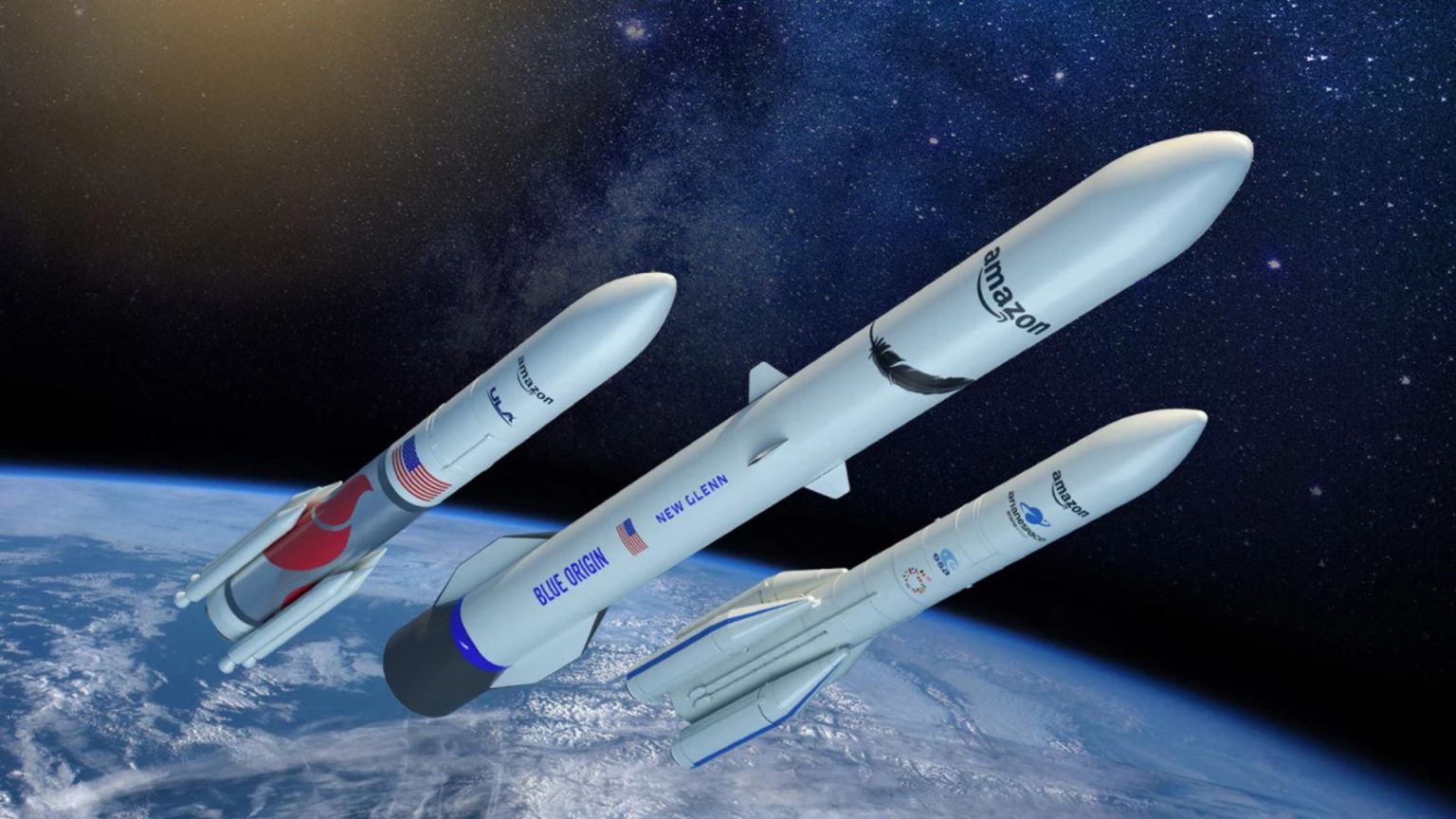
Amazon has asked U.S. regulators for permission to deploy up to 5,105 internet satellites to power a direct-to-device (D2D) communications network, marking a major expansion of its ambitions in the fast-growing satellite connectivity market and setting up a more direct challenge to SpaceX’s Starlink.

In a filing submitted Saturday to the Federal Communications Commission (FCC), Amazon said the proposed satellite constellation would combine its existing Project Kuiper infrastructure with the satellites and wireless spectrum of Globalstar, the satellite operator it agreed to acquire in a deal valued at approximately $11.6 billion.

The filing, which comes more than a year after SpaceX’s, represents Amazon’s first formal regulatory step toward building a satellite network capable of connecting directly to smartphones and other mobile devices without relying on traditional cellular towers.

If approved, the project would significantly broaden Amazon’s role in the space communications industry, moving beyond broadband internet services into the emerging direct-to-device market, where technology companies and satellite operators see strong demand for expanding mobile coverage to remote regions and improving emergency communications.

Direct-to-device technology enables ordinary smartphones and connected devices to communicate with satellites using licensed cellular spectrum, allowing users to send messages, make calls, or access data in areas where terrestrial mobile networks are unavailable.

Amazon said the network is intended to serve consumers and businesses that remain beyond the reach of conventional wireless infrastructure.

“Amazon looks forward to delivering on the promise of D2D connectivity, including to the millions of people living, traveling and working in places beyond the reach of existing networks today,” the company said in its FCC application.

According to the filing, the service will target users who are “unserved or underserved” by existing wireless providers while also supporting emergency response operations, including search-and-rescue missions, disaster recovery efforts and communications for remote industrial sites, transportation fleets and supply chains.

The proposal builds on Amazon’s announcement in April that it would acquire Globalstar, a move widely viewed as an effort to secure the spectrum rights necessary to compete in satellite-enabled mobile communications. The company expects the acquisition to close in 2027, with deployment of the direct-to-device network scheduled to begin in 2028.

The initiative also complements Amazon’s broader Project Kuiper program, its low-Earth orbit satellite broadband network designed to compete with SpaceX’s Starlink. Project Kuiper has accelerated deployment over the past year. Amazon now has more than 390 satellites in orbit, a milestone the company recently said is sufficient to begin offering initial broadband service later this year.

Although that figure represents meaningful progress, Amazon still trails Starlink by a wide margin. SpaceX operates more than 10,000 satellites, giving it by far the world’s largest low-Earth orbit satellite constellation and a substantial first-mover advantage in satellite broadband and direct-to-cell services.

Amazon also continues to face an aggressive deployment schedule imposed by regulators.

Last month, the FCC granted the company a waiver from a deadline requiring it to deploy 1,600 first-generation Kuiper satellites by July 30, acknowledging delays related to satellite manufacturing and launch availability. However, Amazon remains obligated to deploy its full first-generation constellation of 3,232 satellites by July 2029, a requirement intended to ensure efficient use of licensed spectrum.

The proposed direct-to-device constellation would operate alongside, rather than replace, Amazon’s existing Kuiper network, substantially increasing the company’s overall satellite footprint.

Competition in the direct-to-device market has intensified as satellite operators seek new revenue streams beyond traditional broadband internet access.

SpaceX has already begun rolling out Starlink Mobile, its direct-to-cell service developed in partnership with T-Mobile in the United States. The company strengthened its position by acquiring wireless spectrum licenses from EchoStar, allowing compatible smartphones to connect directly to Starlink satellites without requiring specialized satellite hardware.

The broader industry is moving rapidly toward satellite-enabled mobile connectivity as advances in satellite technology, antenna design and spectrum sharing make it increasingly feasible for conventional smartphones to communicate directly with orbiting satellites.

Analysts view direct-to-device services as one of the most promising growth segments in the satellite communications industry because they address coverage gaps in rural areas, maritime routes, aviation corridors and disaster zones where conventional mobile infrastructure is either unavailable or vulnerable to outages.

For Amazon, integrating Globalstar’s spectrum assets with Project Kuiper could provide an advantage by enabling the company to offer a broader suite of connectivity services spanning broadband internet, enterprise communications and direct smartphone connectivity.

Peak UHT Milk: When Consumers Rewrite Recipes

0

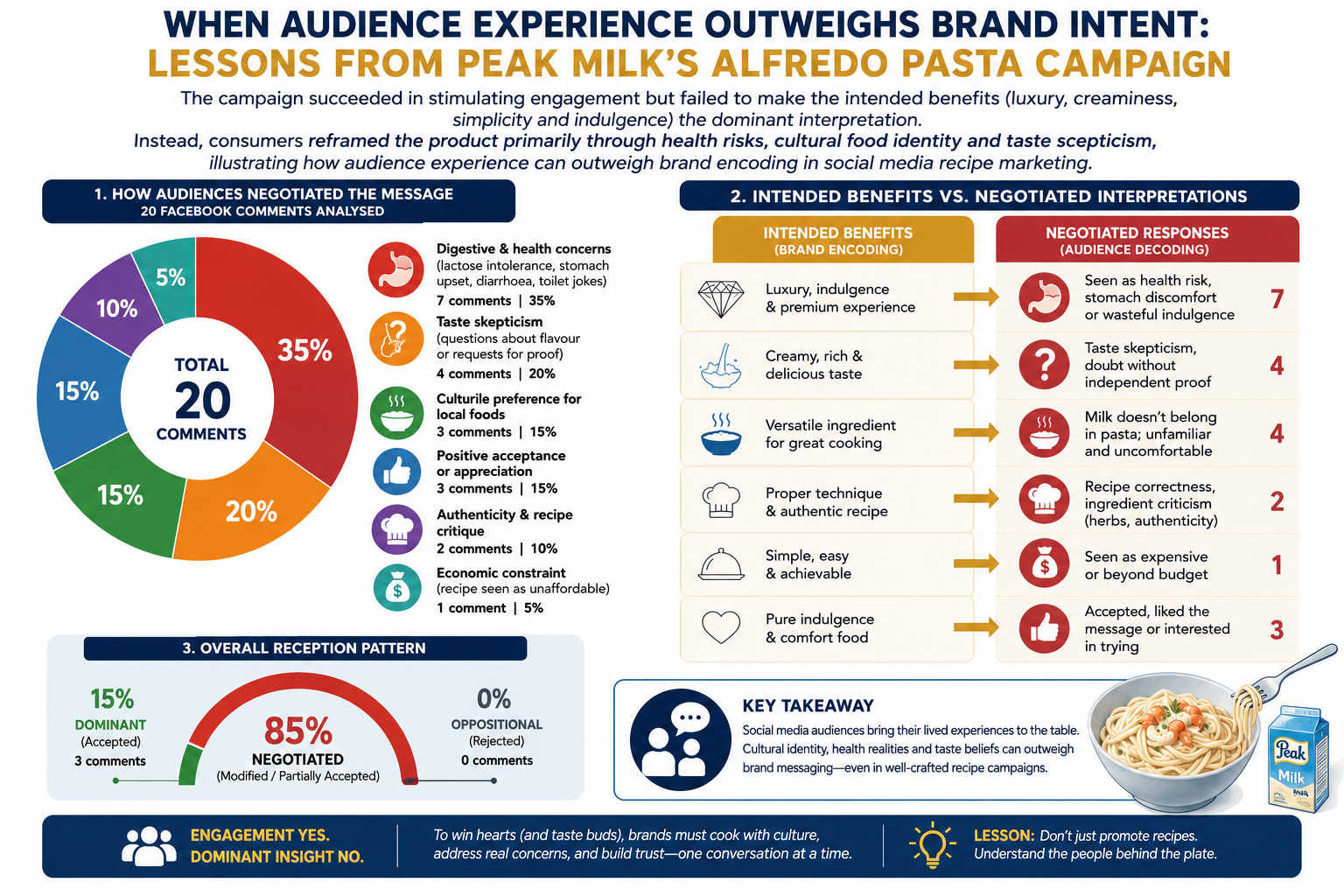
Brands often assume that a good recipe sells itself. Show consumers an attractive meal, explain why it tastes great, and position the featured product as the secret ingredient. Yet digital conversations show that recipes are not simply followed. They are interpreted, questioned, modified, and sometimes rejected. A recent Facebook campaign by Peak Milk promoting Alfredo pasta made with Peak UHT Full Cream Milk illustrates this reality.

The campaign presented Alfredo as “real luxury” achieved through simplicity. Butter, garlic, herbs, parmesan, shrimp, and Peak UHT Full Cream Milk were positioned as the right combination for creating a smooth, creamy, and indulgent sauce. The message was carefully constructed to communicate versatility, premium quality, and culinary sophistication. However, the audience’s responses reveal that consumers evaluate recipe marketing through cultural identity, health experiences, affordability, and trust rather than through the product benefits alone.

The discussion demonstrates an important lesson for food marketers. Consumers do not simply decode advertising messages as brands intend. They negotiate them.

One of the strongest themes in the public responses was cultural negotiation. Many commenters compared Alfredo pasta with familiar Nigerian dishes, asking why anyone would replace stew-based pasta or traditional meals such as fufu and vegetable soup with a milk-based recipe. Others questioned why foreign recipes should receive attention when indigenous foods remain popular and meaningful. These reactions were not merely about taste. They reflected how food represents identity, tradition, and everyday culture.

This result suggests that introducing international recipes into local markets requires more than showcasing attractive food photography. Consumers need help understanding where the recipe fits within their existing culinary practices. Without this bridge, the product risks being perceived as culturally distant rather than exciting.

Health concerns formed another dominant interpretation. Peak Milk promoted creaminess as the defining characteristic of the recipe. Yet many Facebook users associated that same creaminess with digestive discomfort. Comments about lactose intolerance, stomach upset, diarrhoea, and repeated visits to the toilet appeared throughout the discussion. Some users even joked that the recipe would guarantee digestive problems before anyone could enjoy the meal.

These responses illustrate how consumers often evaluate food products through personal health experiences instead of advertised taste benefits. What the brand framed as indulgence was reinterpreted by some audiences as potential physical discomfort. This gap highlights the importance of recognising dietary diversity when promoting dairy-based recipes. Addressing common concerns or providing alternatives for lactose-sensitive consumers may reduce resistance and improve message credibility.

Authenticity also became a point of negotiation. While the campaign emphasised proper technique and the right ingredients, some commenters challenged the recipe itself, arguing that traditional Alfredo sauce contains only cheese, butter, and pasta water. Others questioned ingredient preparation, including the use of herbs with their stems.

These responses demonstrate that digital audiences increasingly possess culinary knowledge and are willing to challenge brand authority. Consumers no longer accept branded recipes as unquestionable expertise. Instead, they compare marketing claims with their own knowledge, online information, and lived experiences.

Economic realities further shaped audience interpretations. Although the campaign suggested that luxury comes from using quality ingredients rather than complicated cooking, one commenter admitted that financial constraints prevented them from experimenting with such recipes despite wanting to do so. The recipe therefore became symbolic of aspiration rather than accessibility.

This highlights an important consideration for premium food marketing in emerging markets. Consumers may admire a product while simultaneously recognising that it falls outside their current spending priorities. Aspirational marketing remains valuable, but it should acknowledge economic realities instead of assuming universal purchasing power.

Perhaps the most striking feature of the conversation was the role of humour. Rather than expressing outright hostility, many users relied on jokes, sarcasm, and playful exaggeration to communicate scepticism. Humour became a socially acceptable way to question unfamiliar ingredients, anticipated digestive effects, and the overall appeal of the recipe.

For marketers, humorous resistance should not be dismissed as meaningless entertainment. It offers valuable insight into the emotional and cultural barriers preventing message acceptance. In many cases, jokes reveal genuine concerns that consumers may hesitate to express directly.

The broader lesson extends beyond one advertising campaign. Social media has transformed consumers from passive recipients of marketing into active interpreters of brand messages. Every campaign enters a public conversation where audiences negotiate meaning according to their cultural values, health beliefs, financial circumstances, and everyday experiences. The intended message is only one version of reality. The audience ultimately decides whether to accept, modify, or reject it.

For brands operating in culturally diverse markets such as Nigeria, successful recipe marketing requires more than presenting visually appealing meals. It demands cultural sensitivity, nutritional awareness, authentic storytelling, and an understanding that consumers actively reshape promotional messages through their own lived realities.

Peak Milk’s Alfredo campaign demonstrates that the real challenge is not convincing people that a recipe tastes good. It is convincing them that the recipe belongs in their kitchens, aligns with their lifestyles, respects their cultural preferences, and addresses their practical concerns. In today’s digital environment, consumers do not merely consume recipes. They rewrite them, and in doing so, they also rewrite the meaning of the brand itself.

China Accuses U.S. Of ‘AI Hegemonism,’ Vows Retaliation As Dispute Over Moonshot AI Intensifies

0

China has sharply escalated its dispute with the United States over artificial intelligence, accusing Washington of practicing “AI hegemonism” and warning it will take retaliatory measures if Chinese technology companies are sanctioned over allegations of intellectual property theft.

The statement from China’s Ministry of Commerce comes after senior U.S. officials signaled that Chinese AI developers, including Moonshot AI, could face sanctions, export restrictions and placement on the U.S. Commerce Department’s Entity List over claims they unlawfully copied advanced American AI models.

The exchange marks another escalation in the technology rivalry between the world’s two largest economies, extending a battle that has already included export controls on advanced semiconductors, restrictions on chipmaking equipment and tighter oversight of AI technologies.

In a statement issued Monday, China’s commerce ministry accused Washington of threatening Chinese firms without sufficient legal or factual justification.

The ministry said U.S. officials were attempting to punish Chinese companies based on allegations that they used model distillation, a machine learning technique commonly employed throughout the AI industry to improve or train new models using outputs from more capable systems.

Chinese authorities said that the United States was politicizing the issue to suppress China’s AI industry.

“For any action that causes substantive harm to Chinese interests, China will take all necessary measures to firmly safeguard its legitimate rights and interests,” a ministry spokesperson said.

The ministry also characterized Washington’s approach as “AI hegemonism,” suggesting the U.S. is attempting to preserve its technological dominance by restricting Chinese competitors rather than allowing fair market competition.

The latest tensions center on Beijing-based Moonshot AI, whose recently launched Kimi K3 model has emerged as one of China’s strongest challengers to leading American AI systems. Kimi K3 has attracted significant attention for its coding performance and reasoning capabilities while offering an open-weight architecture that allows developers greater flexibility than many proprietary Western models.

Its rapid progress has fueled debate in Washington over whether Chinese AI firms are benefiting primarily from original research or from distilling the capabilities of frontier U.S. models.

The controversy mirrors the intense scrutiny that surrounded DeepSeek earlier, when its competitive performance raised questions about China’s pace of AI development.

U.S. Signals Tougher Enforcement

The diplomatic clash follows forceful comments from senior U.S. officials. Last week, White House Office of Science and Technology Policy Director Michael Kratsios said the U.S. government possesses information indicating that Moonshot distilled Anthropic’s Claude Fable 5 model during development of Kimi K3.

Kratsios alleged the company operated a sophisticated internal infrastructure capable of conducting large-scale model distillation while rotating multiple methods of accessing American AI systems to avoid detection. He also claimed Moonshot acquired servers equipped with Nvidia GB300 AI processors and accessed computing resources in Thailand to support model training.

Neither allegation has been independently verified.

U.S. Treasury Secretary Scott Bessent subsequently warned that companies found to have crossed the line into intellectual property theft could face financial sanctions or inclusion on the Commerce Department’s Entity List, a trade blacklist that limits access to U.S. semiconductors, software and other advanced technologies.

“We support open-source AI and the innovation it unlocks. But open source is not open season on American IP,” Bessent wrote on X.

“When PRC firms conduct covert, industrial-scale distillation attacks that cross the line into IP theft, sanctions and Entity List designations will be on the table.”

Moonshot AI has rejected the accusations.

The company told China’s National Business Daily that Kimi K3’s advances stem from original architectural innovations rather than distillation of American models. The denial comes as Moonshot seeks fresh funding and reportedly prepares for a potential Hong Kong initial public offering, making the dispute particularly significant for its future expansion.

If the company were added to the Entity List, it could face severe restrictions on acquiring advanced U.S. semiconductors, cloud computing services and critical software, potentially slowing its ability to train future AI models.

The Entity List has previously been used against Chinese technology firms including Huawei, dramatically limiting their access to U.S. technology since 2019.

Anthropic has previously disclosed evidence suggesting attempts to extract information from its models. In February, the company said it identified more than 3.4 million interactions with Claude models linked to Moonshot AI. According to Anthropic, hundreds of fraudulent accounts were used to probe capabilities including reasoning, coding, computer vision, data analysis, tool use and computer operation.

While Anthropic has cited the activity as evidence of systematic model extraction efforts, Moonshot has consistently denied that distillation was responsible for Kimi K3’s capabilities.

Distillation Becoming The Next AI Battleground

The dispute highlights an emerging fault line in the AI industry over model distillation, a technique widely used by researchers and companies worldwide.

Distillation itself is generally considered a legitimate machine learning method. However, U.S. officials increasingly distinguish between conventional distillation conducted with authorization and what they describe as industrial-scale extraction of proprietary models without permission.

That distinction remains contentious.

Several AI researchers argue that distillation is only one component of model development and note that Chinese AI firms have built sophisticated research teams capable of independently advancing frontier AI systems.

After years of restricting China’s access to advanced AI chips and semiconductor manufacturing equipment, Washington is now signaling that AI models themselves may become a new focus of export controls, sanctions and national security policy.

Beijing’s response suggests China is prepared to retaliate if such measures target its leading AI companies, raising the prospect that the technological rivalry between the two countries will now extend beyond hardware into the algorithms and models that underpin the next generation of artificial intelligence.

Google’s AI Search Becomes The Default As AI Overviews Reshape Web Traffic, Similarweb Says

0

Artificial intelligence is rapidly becoming the primary way people search the internet, with Google’s AI-generated search summaries now appearing in nearly half of all searches, accelerating a fundamental shift in how users discover information and posing growing challenges for online publishers.

According to a new report from market intelligence firm Similarweb, Google’s AI Overviews appeared in 43% of searches by May 2026, up sharply from 15% a year earlier. The findings suggest Google’s integration of generative AI into Search has moved from an experimental feature to a central component of the search experience.

The rapid expansion reveals Google’s determination to defend its dominance in online search as competition intensifies from AI-native services such as ChatGPT, Claude, Perplexity and other conversational search platforms. Rather than simply presenting users with a list of hyperlinks, Google’s search engine is increasingly providing synthesized answers generated by artificial intelligence, allowing users to continue asking follow-up questions through AI Mode without leaving Google’s ecosystem.

Last year, Google denied that its overview undercuts publishers traffic as debate over its impact accelerated. Last September, Penske Media Corporation (PMC), filed a lawsuit accusing the tech giant of illegally repurposing news content to generate AI summaries that undercut publishers’ business models.

Similarweb’s report indicates that AI Mode usage has grown rapidly alongside the broader rollout of AI-powered search.

Visits to AI Mode increased from 126 million in June 2025 to 279 million by May 2026, highlighting growing consumer acceptance of conversational search experiences.

The figures illustrate a profound transformation in internet search behavior. For more than two decades, Google’s search engine functioned primarily as a gateway to the web, directing users to external websites where they consumed information.

That model is changing.

Increasingly, Google itself is becoming the destination, compiling information from across the internet and presenting AI-generated summaries directly within search results, reducing the need for users to click through to publishers’ websites.

The change is also influencing how people formulate search queries. According to Similarweb, the average length of Google searches has increased over the past year, suggesting users are replacing short keyword searches with longer, more conversational prompts designed to obtain comprehensive AI-generated responses.

Instead of entering fragmented phrases such as “best electric cars 2026,” users are increasingly asking complete questions or describing complex scenarios, reflecting habits that have become common on chatbot platforms.

The shift mirrors broader changes across the AI industry, where natural language interaction is replacing traditional keyword-based search.

For publishers, however, the transformation presents significant commercial challenges.

News organizations, educational websites and content publishers have complained that AI-generated summaries reduce referral traffic by answering users’ questions directly within search results rather than encouraging visits to sources.

Last year, Similarweb identified declining referral traffic as one of the most significant consequences of Google’s AI search rollout, particularly for news publishers whose advertising and subscription businesses depend heavily on website visits.

The issue extends beyond Google.

As AI assistants increasingly summarize information from across the web, publishers have lamented that technology companies are benefiting from their content without generating corresponding traffic or revenue. Those concerns have prompted parts of the publishing industry to seek new ways of protecting digital content.

Cloudflare recently introduced tools allowing website owners to block AI crawlers unless AI companies agree to compensate publishers through a licensing marketplace, reflecting growing efforts to establish commercial frameworks for AI content access.

Even as AI-generated responses become more common, citation practices continue to evolve. Similarweb found that the proportion of AI-generated answers containing citations has increased more than fivefold during the past year, suggesting AI platforms are becoming more transparent about the sources used to generate responses.

Even so, referrals remain relatively limited.

As of May 2026, only 6.8% of U.S. desktop ChatGPT queries included citations that directed users to external websites.

Citation frequency also varies considerably across industries. Travel, retail and sports-related searches are more likely to include links to external sources than many other categories, reflecting the greater need for users to access booking platforms, product listings or live information.

There are signs that referral traffic may be improving. Following a search update introduced on May 7, ChatGPT significantly increased the prominence of clickable links within responses.

According to Similarweb, the proportion of U.S. desktop ChatGPT searches resulting in visits to external webpages more than doubled, rising from 25% in March 2026 to nearly 60% by May 30.

The improvement suggests users are more willing to visit original sources when AI-generated responses include clearly visible citations and links.

Even so, the broader direction of travel appears clear.

AI is steadily changing the economics of search by shifting value from website discovery toward direct answer generation. Rather than acting solely as intermediaries that connect users with publishers, AI-powered search engines now synthesize information themselves, keeping users engaged within their own platforms for longer periods.

The strategy strengthens Google’s user engagement, increases opportunities to monetize search through advertising, and reinforces its position against emerging AI competitors. For publishers, however, the transition represents one of the most significant structural changes since the emergence of search engines themselves.

AI-generated answers becoming the default interface for accessing information means media companies and other content creators now face growing pressure to develop new business models that are less dependent on referral traffic from traditional search.