DD
MM
YYYY

PAGES

DD
MM
YYYY

spot_img

PAGES

Home Blog Page 3194

Luxuries at Work: Do They Encourage Return to Office?

0

In the wake of the COVID-19 pandemic, the work industry has undergone a seismic shift. Remote work became the norm for many industries, with employees trading in office cubicles for home offices. As the world re-emerged from lockdowns and restrictions, employers are grappling with the challenge of enticing employees back into physical workspaces. Most employees, having seen that they work from the comfort of their homes, are not eager to rush back to the offices, and now employers are seeking ways to entice them.

One tactic gaining traction is the introduction of in-office luxuries aimed at making the return to the office more appealing.

But do these perks truly encourage employees to leave the comfort of their home offices?

Let’s see how this has turned out and its implications for employers and employees.

The concept of in-office luxuries isn’t new, but its significance has been amplified in the current scenario. Employers are pulling out all the stops to create environments that rival the comfort and convenience of remote work setups. From gourmet coffee bars and on-site gyms to free lunch and nap pods, the offerings vary widely but share a common goal: to entice employees back into the office fold.

On the surface, these luxuries may seem like a surefire way to boost morale and productivity. After all, who wouldn’t want to work in an environment that offers such perks?

However, the reality is more nuanced. Employers who have tested it confirm that while flashy amenities may initially pique interest, their long-term impact on employee satisfaction and retention is not as clear-cut.Some see their employees eventually leave to take another job that lets them work remotely, even when it comes with the same or slightly less pay.

One of the primary arguments in favor of in-office luxuries is their potential to foster a sense of community and belonging among employees. By providing spaces for socializing and relaxation, employers hope to recreate the camaraderie and spontaneous interactions often cited as perks of office life.

Additionally, amenities like fitness centers and wellness programs signal a commitment to employee well-being, which can contribute to a positive company culture.

However, the effectiveness of these luxuries hinges on several factors, including the preferences and priorities of individual employees. For some, the allure of in-office perks may outweigh the convenience of remote work, especially if they value social interaction and a separation between work and home life. Others, however, may prioritize flexibility and autonomy, viewing remote work as essential to their work-life balance.

Moreover, the sustainability of in-office luxuries must be considered. While flashy amenities may attract attention in the short term, their novelty can quickly wear off without meaningful changes to the work environment and company policies.

Employers must ensure that these perks are not mere window dressing but are integrated into a broader strategy for fostering employee engagement and well-being.

Another crucial aspect is the impact of in-office luxuries on diversity and inclusion. While these perks may appeal to some employees, they may inadvertently create barriers for others, particularly those with disabilities that may not allow them to enjoy the perks. Employers must strive to create inclusive work environments that accommodate the needs of all employees, regardless of their preferences for remote or on-site work.

Ultimately, the success of in-office luxuries in encouraging a return to the office will depend largely on how well they align with the values and priorities of both employers and employees. While flashy amenities may grab headlines, they are not a one-size-fits-all solution to the complex challenges of hybrid work models.

Employers must listen to the needs of their workforce and adapt their strategies accordingly, whether that means investing in state-of-the-art facilities or doubling down on remote work policies.

Even though the health crisis has passed, employees and employers know they can effectively work, collaborate, and connect without coming into the office. Employees’ decision to return to the office should be based on carefully considering the trade-offs involved.

While in-office luxuries may offer certain perks, they may also come with sacrifices regarding flexibility and autonomy. Employees must weigh these factors against their personal and professional goals, making informed decisions about where and how they work best.

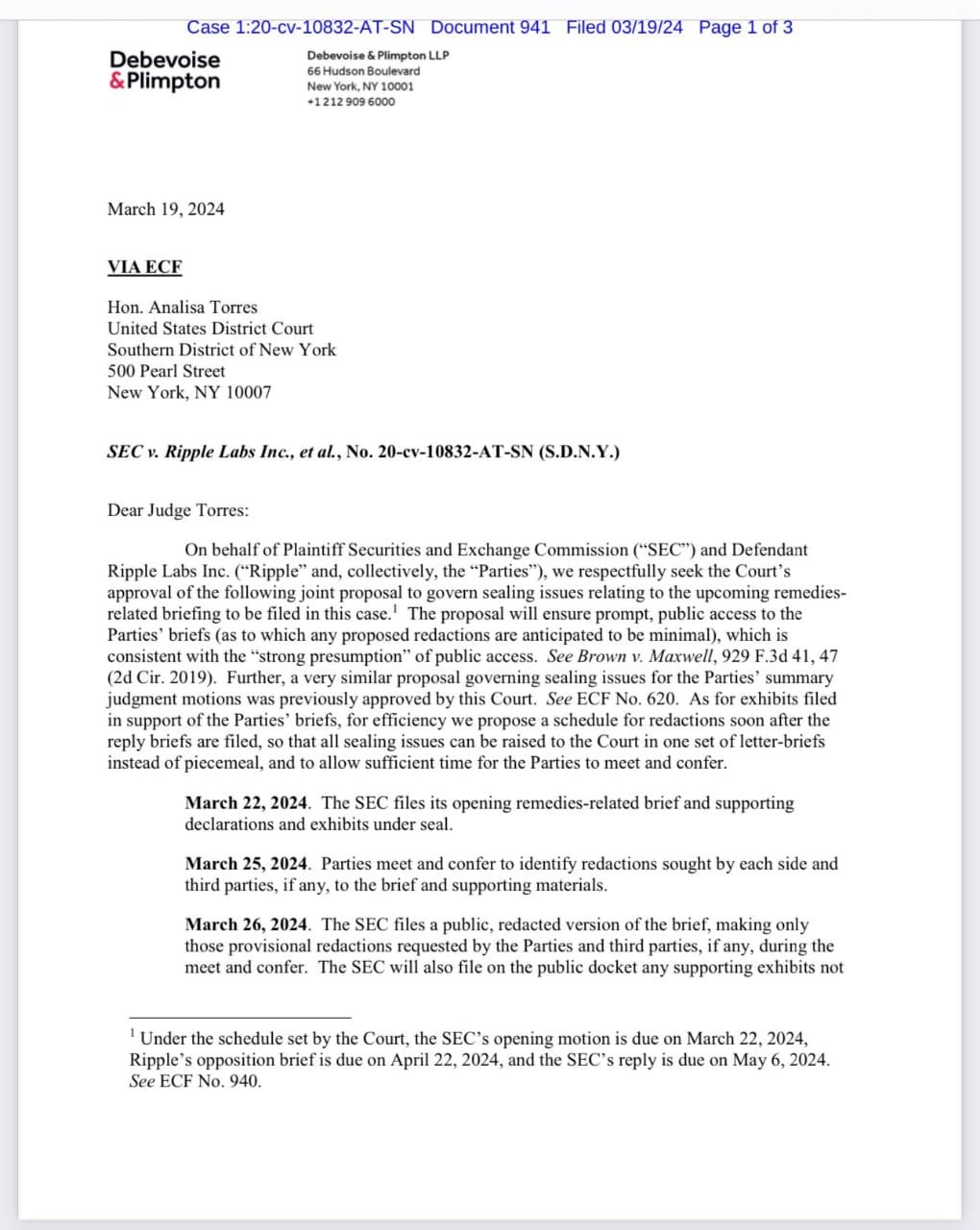
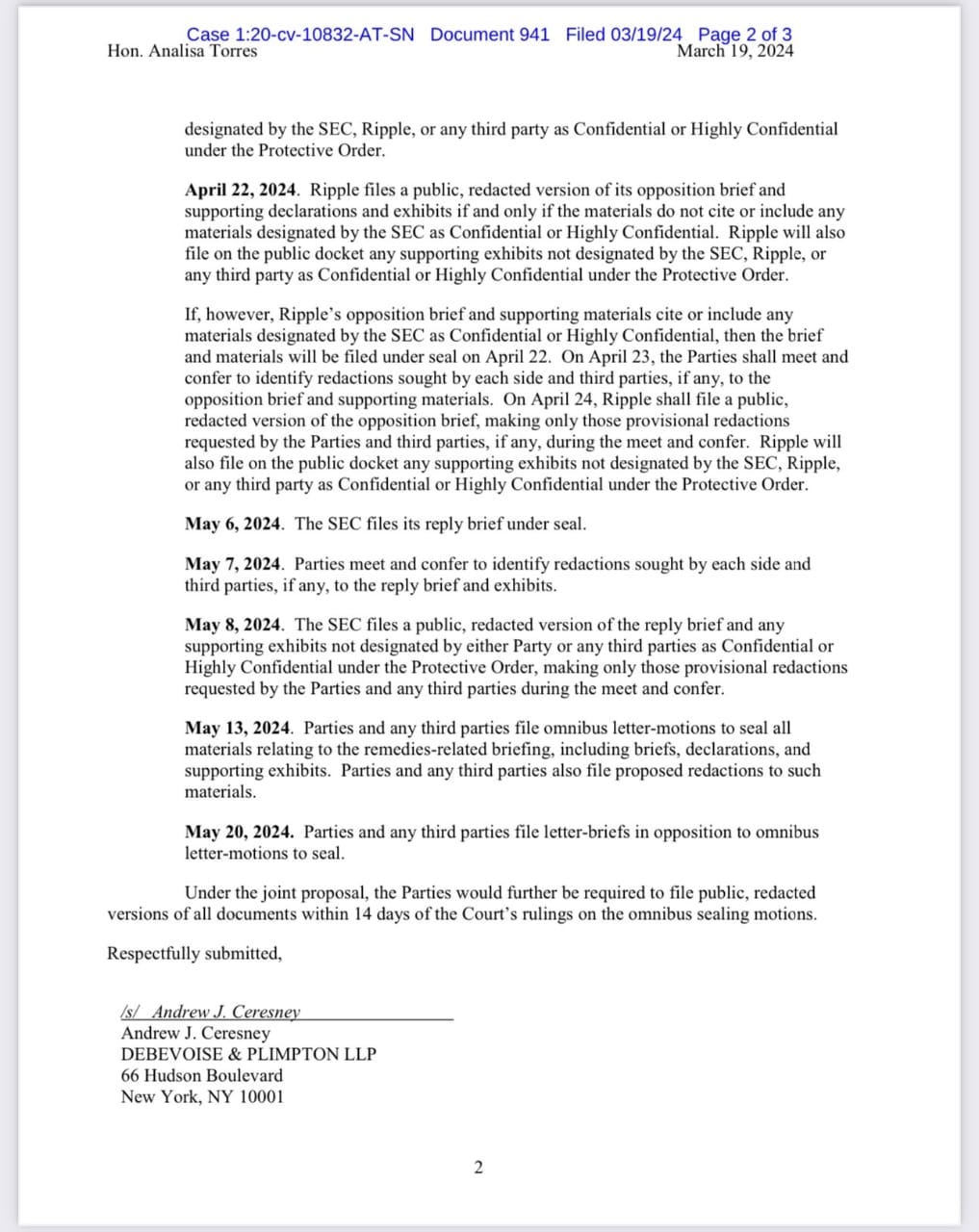
Ripple XRP Vs SECGov; Parties submits joint proposal addressing the Sealing of Document

0

The legal landscape surrounding Ripple and its associated token, XRP, has seen significant developments recently. The parties involved have submitted a joint proposal addressing the sealing of documents pertinent to the forthcoming briefings on remedies in this ongoing case.

This joint sealing proposal is a critical step in the litigation process, ensuring that sensitive information remains confidential while allowing public access to documents that are crucial for understanding the case’s implications for the XRP community and the broader cryptocurrency market.

This proposal aims to balance the need for public access to court documents with the protection of sensitive information. It’s a strategic move that underscores the complexity of legal issues surrounding digital assets and their regulatory treatment.

As for the current status, we await the court’s decision on this proposal, which will subsequently influence the timeline and disclosure of future briefings. The outcome of these proceedings continues to be of utmost importance to the XRP community and could have far-reaching consequences for the cryptocurrency industry at large.

The SEC’s stance on XRP has been a subject of much debate and analysis within the cryptocurrency community. The regulatory body has posited that XRP should be classified as a security, not a currency, which underpins the ongoing litigation against Ripple.

According to the SEC, Ripple’s sale of XRP tokens constitutes an offering of unregistered securities, which is in violation of U.S. securities laws. This perspective challenges Ripple’s view that XRP is a utility token used to facilitate cross-border transactions and does not represent an investment contract.

Ripple’s stance on XRP is firmly rooted in the belief that XRP is not a security but rather a utility token essential for their innovative cross-border payment solutions. Ripple argues that XRP is used as a bridge currency to facilitate transactions between different fiat currencies, thus operating outside the traditional definitions of a security.

Contrary to the SEC’s claims, Ripple maintains that XRP holders do not receive shares of Ripple and are not entitled to dividends or profits based on Ripple’s success. Instead, XRP functions in a decentralized ecosystem where its value is not directly tied to the actions or financial performance of Ripple.

The joint sealing proposal recently filed by both parties will play a crucial role in how evidence and arguments are presented moving forward. The SEC’s approach to this case could set a precedent for how other cryptocurrencies are regulated, making this case a landmark event in the history of digital assets.

The anticipation builds as stakeholders from various sectors watch closely, recognizing that the SEC’s case against Ripple is more than just a lawsuit; it’s a potential turning point in digital asset regulation.

The outcome of this legal battle is poised to affect the crypto market significantly. A favorable ruling for Ripple could validate the use of utility tokens in the financial sector, potentially leading to increased adoption and innovation within the industry. Conversely, if the SEC’s view prevails, it may result in stricter regulations and possibly hinder the growth of similar cryptocurrencies.

The joint sealing proposal’s handling and subsequent court decisions will be closely watched by investors, developers, and regulators alike. The crypto market is at a pivotal juncture, with this case serving as a bellwether for future regulatory approaches to digital assets.

Blackrock to launch Tokenised Investment Fund with Securitize

0

Blackrock, the global investment management corporation, is set to revolutionize the financial industry by partnering with Securitize, a recognized platform for tokenizing assets. This collaboration aims to launch a tokenised investment fund, marking a significant milestone in the integration of blockchain technology within traditional financial services.

The initiative promises to enhance liquidity and transparency for investors, leveraging the inherent benefits of distributed ledger technology. As Blackrock ventures into this innovative domain, the move signals a broader acceptance and adoption of cryptocurrency-related products in mainstream investment portfolios.

This collaboration is set to unveil a tokenised investment fund, which is anticipated to be a game-changer for the industry. The fund will utilize blockchain technology to tokenize shares, thereby providing investors with a novel way to access and trade fund shares on a digital platform.

The tokenization process involves converting the rights to an asset into a digital token on a blockchain. This innovative approach offers numerous advantages, including improved liquidity of traditionally illiquid assets, enhanced transparency through real-time tracking of asset ownership, and streamlined processes with reduced intermediaries.

Blackrock’s initiative with Securitize is expected to open up new avenues for investors by offering a more flexible and efficient investment structure. It also reflects Blackrock’s commitment to staying at the forefront of financial innovation, embracing the potential of blockchain technology to transform investment practices. As regulatory frameworks continue to evolve, this venture could pave the way for broader acceptance of tokenized assets in regulated financial markets.

BlackRock and Fidelity now own a combined 372,227 BTC worth $23.5 billion for their spot Bitcoin ETFs.

In an unprecedented move within the cryptocurrency investment landscape, BlackRock and Fidelity have made a significant commitment to Bitcoin ETFs. The two financial giants now collectively hold a staggering 372,227 BTC, valued at an astonishing $23.5 billion. This bold step not only underscores the growing institutional interest in digital assets but also marks a milestone for Bitcoin’s acceptance in the traditional financial sector.

BlackRock’s strategic decision to invest heavily in Bitcoin ETFs reflects its recognition of cryptocurrency as a legitimate asset class. With its vast resources and influence, BlackRock is positioning itself at the forefront of this emerging market, signaling confidence in Bitcoin’s long-term potential.

Fidelity’s involvement further cements the notion that cryptocurrencies are gaining traction among established financial institutions. By allocating substantial resources to Bitcoin ETFs, Fidelity is diversifying its portfolio offerings, providing its clients with exposure to the digital currency market while maintaining its reputation for innovative investment solutions.

The combined ownership of 372,227 BTC by BlackRock and Fidelity through their spot Bitcoin ETFs is not just a significant financial investment; it represents a strategic move into a market that continues to demonstrate resilience and growth potential.

As these two industry leaders deepen their involvement in cryptocurrency, it may encourage other institutions to follow suit, potentially leading to broader acceptance and integration of digital assets within global financial systems. This can lead to increased investor confidence in other digital assets, as they may be perceived as more legitimate and stable investment options in the wake of such significant endorsements.

Furthermore, the entry of major institutional investors into the cryptocurrency space could accelerate the development and adoption of other cryptocurrencies. It may prompt further innovation, as altcoins strive to differentiate themselves and capture the attention of these large-scale investors.

However, this could also lead to increased volatility in the short term for other cryptocurrencies. As Bitcoin garners more attention and investment, it may overshadow smaller or emerging coins, leading to fluctuations in their market performance.

Overall, BlackRock and Fidelity’s investment in Bitcoin ETFs is a testament to the growing integration of cryptocurrencies into mainstream finance. It not only benefits Bitcoin but also has far-reaching implications for the entire cryptocurrency market, potentially ushering in a new era of digital asset investment.

Nigeria’s Central Bank Says It Has Cleared FX Backlog As External Reserve Hits $34.11bn

0

The Central Bank of Nigeria (CBN) said it has successfully cleared the entire valid foreign exchange (FX) backlog, marking a significant milestone in the nation’s fight against FX volatility.

This accomplishment, long-awaited and ardently pursued, was formally announced by Mrs. Hakama Sidi Ali, the Bank’s Acting Director of Corporate Communications. Mrs. Ali’s announcement signifies the CBN’s steadfast commitment to addressing the substantial backlog of outstanding FX claims inherited by the CBN Governor Mr. Olayemi Cardoso, totaling an estimated $7 billion.

Mrs. Ali disclosed the finalization of payments amounting to $1.5 billion in the capital city of Abuja.

According to a statement issued by the CBN, transparency and accountability formed the bedrock of this achievement, with Deloitte Consulting’s independent auditors meticulously examining each transaction to ascertain its legitimacy. Any discrepancies or irregularities identified were promptly flagged for further scrutiny by relevant authorities, underscoring the CBN’s commitment to upholding the highest standards of financial integrity.

A statement from the CBN further said: “She [Mrs. Ali] noted that the CBN recently concluded the payment of $1.5 billion to settle obligations to bank customers, effectively settling the residual balance of the FX backlog. She also disclosed that independent auditors from Deloitte Consulting meticulously assessed these transactions, ensuring that only legitimate claims were honored. Any invalid transactions were promptly referred to the relevant authorities for further scrutiny.”

The apex bank further noted that this milestone was bolstered by a substantial surge in Nigeria’s external reserves, which skyrocketed by $993 million to reach $34.11 billion as of March 7, 2024, marking an eight-month high. In addition, the remarkable increase was fueled by heightened remittance payments from Nigerians abroad and increased interest from foreign investors in local assets, particularly government debt securities.

“Clearance of the foreign exchange transactions backlog is part of the overall strategy detailed in last month’s Monetary Policy Committee meeting to stabilize the exchange rate and thereby curb imported inflation, spurring confidence in the banking system and the economy, the CBN said in a statement.

“Cardoso used the MPC meeting and a subsequent conference call with foreign portfolio investors to set expectations for sustained increases in Nigeria’s foreign currency reserves and improved liquidity in the foreign exchange market.

“The CBN followed this month by reporting a significant increase in external reserves, rising by $993 million to $34.11 billion as of March 7, 2024, the highest level in eight months. The month-on-month increase was driven by a marked advance in remittance payments by Nigerians overseas, as well as higher purchases of local assets, including government debt securities, by foreign investors.”

The clearance of the FX backlog is seen as a significant feat by the CBN that is likely going to help in stabilizing the exchange rate and curbing imported inflation. Attributed also to the uptick in oil output, this development is believed to have set the stage for sustained growth in Nigeria’s foreign currency reserves and enhanced liquidity in the foreign exchange market.

In February, Governor Cardoso disclosed that approximately $2.4 billion of the FX backlog was deemed invalid for settlement following a forensic audit by Deloitte Management Consultant.

The recent efforts by the CBN to stabilize the naira have yielded positive results, with the parallel market trading at N1,590/$1 on Wednesday. Additionally, the exchange rate on the official market fell to N1,560/$1 on Tuesday, marking the strongest performance of the naira since March 4.

With the FX backlog cleared and external reserves fortified, the naira is expected to sustain its recent gain, with some analysts predicting it will rise above N1,000 per dollar by December.

Fintech Market Size Projected to Grow to $882 Billion by 2030

0

A recent report from Fortune Business Insights has projected that the fintech market size is projected to grow from $294.74 billion to $882.30 billion by 2030.

The report stated that the Covid-19 pandemic accelerated the digital transformation of financial services, as businesses and consumers increasingly turned to online and mobile banking, due to the growing demand for financial technology platforms.

In addition, financial technology companies offering payment and transaction processing services experienced a surge in demand as e-commerce, contactless payments, and digital wallets became more prevalent during the pandemic.

Also, the economic impact of the pandemic led to an increased demand for lending and credit services, which saw companies offering digital lending platforms and credit scoring solutions record massive growth in the period. These factors fueled the fintech market growth during the pandemic.

With the integration of the latest trends in fintech platforms such as Artificial Intelligence and Machine Learning, it has continued to play an important role in meeting customer demands which has propelled the market growth. These innovative technologies enhance fraud detection, customer service, credit scoring, and personalization of financial services.

The artificial intelligence (Al) segment is poised to grow at the highest CAGR during the forecast period. Al-powered chatbots and virtual assistants provide instant and efficient customer support, improving the overall customer experience. In addition, Al can quickly identify and flag potentially fraudulent activities, reducing the risk of financial fraud, which is expected to help the fintech industry grow in the upcoming years.

With increased digital financial transactions, there is a growing emphasis on Cybersecurity. Financial technology companies are developing advanced security measures to protect financial data and transactions. Moreover, demand for real-time payments is on the rise as financial technology service providers are delivering solutions that enable instant, cross-border, and secure transactions.

The fraud monitoring segment is reported to have captured the largest share of the market in 2022. Owing to the remarkable feature of the segment, it is anticipated to continue its dominance during the forecast period.

Based on region, North America is leading the fintech market share globally with a market value of $89.61 billion in 2022. The region, particularly Silicon Valley, is a global center for fintech innovation.

According to the survey, the Asia Pacific region is anticipated to overtake the U.S. and become the world’s largest market by 2030.  As key companies are emphasizing the expansion of their geographical boundaries globally by introducing industry-specific solutions, these companies are strategically acquiring and collaborating with local players to capture a regional hold. 

These key players in the industry are introducing new products to attract new customers and retain their customer base. A report by the World Economic Forum disclosed that in developing nations, digital innovation by fintech companies has allowed entire economies to bypass the high-street bank system, and offer a multitude of options to people who would likely be excluded from traditional banking systems.