DD
MM
YYYY

PAGES

DD
MM
YYYY

spot_img

PAGES

Home Blog Page 3223

How To Raise Capital for Young Scalable Companies

0

How do you raise funds before investors? What are the things they look for, in extremely young companies? It is very important to understand that a venture capitalist raises funds from limited partners (rich family offices, fund managers, pension funds, companies, etc).

So, just as a startup goes out to raise funds, even those you are trying to raise funds from also raise funds, to have money to invest in you. In other words, a venture investor is also a good fundraiser because he/she must raise funds first before the opportunity to invest funds will come. (Sure, there are those who have so much they can invest from their purses; not typical at the mainbowl.)

Join me at Africa’s finest business school for entrepreneurial capitalism as we examine How To Raise Capital for young scalable companies, tomorrow. Meanwhile, Tekedia Mini-MBA has opened registrations for the next edition, pick your seat here.

US Legal Framework on IP and its Applicability to the Burgeoning Digital Asset Class

0

US present Intellectual property laws are sufficient to address concerns surrounding NFTs – Research.

Current U.S. intellectual property laws are sufficient to address concerns surrounding NFTs, according to a recent government study. The study, which analyzed the legal framework and its applicability to the burgeoning digital asset class, concluded that existing statutes and regulations are equipped to handle the unique challenges posed by NFTs.

Digital assets, a term broadly encompassing digital representations of value like cryptocurrencies, non-fungible tokens (NFTs), and other tokenized assets, are rapidly gaining prominence. As these assets burgeon, questions arise about how existing IP laws apply to them.

The United States legal framework on intellectual property (IP) is a complex tapestry that has evolved over centuries, adapting to the changing landscapes of innovation and commerce. With the advent of digital assets, this framework faces new challenges and opportunities.

The report highlights that while NFTs present novel considerations, the principles underpinning intellectual property rights remain relevant and enforceable. It suggests that rather than overhauling the legal system, stakeholders should focus on education and awareness to ensure that creators and consumers understand their rights and responsibilities within the current legal context.

Furthermore, the study calls for ongoing monitoring of the NFT marketplace to identify any gaps in legislation that may emerge as the technology evolves. It emphasizes that intellectual property laws must adapt to technological advancements, but this process should be gradual and informed by real-world implications.

At the heart of the US IP legal framework are four main pillars: patents, copyrights, trademarks, and trade secrets. Each of these plays a distinct role in protecting different facets of intellectual creativity and commercial branding.

Patents, granted by the United States Patent and Trademark Office (USPTO), protect inventions that are novel, non-obvious, and useful. The applicability of patents to digital assets can be seen in the realm of blockchain technology, where unique algorithms and processes may be patentable.

Copyrights, on the other hand, protect original works of authorship such as literature, music, and art. With digital assets like NFTs that represent unique digital art pieces or collectibles, copyright law becomes pivotal in determining ownership rights and combating infringement.

Trademarks protect symbols, names, and slogans used in commerce to identify the source of goods or services. As digital assets become more commercialized, trademarks will play an essential role in brand differentiation within the digital asset space.

Lastly, trade secrets protect confidential business information that provides a competitive edge. In the context of digital assets, trade secrets could cover proprietary algorithms or methodologies underlying a digital asset’s value or operation.

As the digital asset class continues to expand, it will be imperative for lawmakers, regulators, and legal practitioners to clarify how traditional IP laws intersect with these novel forms of property. This will ensure that innovators can secure their creations while fostering an environment conducive to growth in this exciting new frontier.

The government study provides a vote of confidence in the robustness of U.S. intellectual property laws. It reassures stakeholders that while NFTs are a new frontier in digital ownership, they do not necessitate an immediate legislative response but rather a thoughtful approach to existing law application.

However, the application of these IP protections to digital assets is not straightforward. The decentralized and often pseudonymous nature of blockchain-based assets presents unique challenges for IP enforcement. Additionally, the global reach of digital assets complicates jurisdictional issues.

The Brilliant Interswitch’s MVNO Business Model in Nigeria

0

In June 2023, I wrote: “Tekedia Capital is looking for innovators who are building around MVNO (mobile virtual network operator) in the Nigerian market…We have great ideas on how MVNO could unlock massive opportunities through subscriber-based business models; one case study: Incentivize customers to go subscription in logistics, ecommerce, etc sectors, where paying subscriptions could unlock many benefits, including affordable data plans. Think of Jumia Prime subscription shoppers who also get cheap phone services from Jumia!

The playbook here is to execute a double play strategy (read how I explained it in Harvard here) where the MVNO may not deliver the direct financial rewards, but would accelerate value capture via other ways. Tekedia Capital believes that startups within our portfolio can create GREAT PRODUCTS by using the telecom-based services for subscription-based customers, delivering superior customer retention and value capture over time.” 

But you know what? Interswitch is going on that business model. Yes, the payment giant has acquired an MVNO operator license: “Interswitch intends to leverage this newly acquired license to pioneer a novel approach in the telecommunications market, merging payment and telecoms services tailored for both business-to-business (B2B) customers and consumers. By exploring a low-capital-expenditure virtual telecoms model, Interswitch aims to bridge the gap in underserved areas while simultaneously tapping into Nigeria’s vast phone market.” That is a brilliant business model.

While I am not a fan of generic MVNO business model where already overburdened core network operators are asked to add more users via MVNOs, this in-customer focused model is a brilliant playbook on how MVNO can help a company deepen services competitive advantages. Yet, the challenge remains since Interswitch customers will still be tethered to the same overburdened networks unless it can find ways to wall them off, to ensure network services are better for them.

But in Nigeria, I do posit that some of our core telcos are already operating at above customer-capacity. For example, they are built for say 20 million users, but they have 30 million users, causing service failures, call drops, inability to browse efficiently, and broad network congestion.

If you now allow them to add an NMVO, and that company brings 2 million users, you are not helping any person. This is why I do not have a positive view of the MVNO market in Nigeria considering the Naira FX paralysis.

Bitcoin, Ethereum and Dogecoin Performance Analysis

0

As we delve into the performance of Bitcoin for the week, it’s essential to approach the analysis with a comprehensive perspective. This week has been particularly pivotal for Bitcoin, showcasing a volatility that is both characteristic of the cryptocurrency market and indicative of underlying economic shifts.

Both bitcoin and memecoins have experienced periods of euphoria and panic, depending on the market conditions and events.

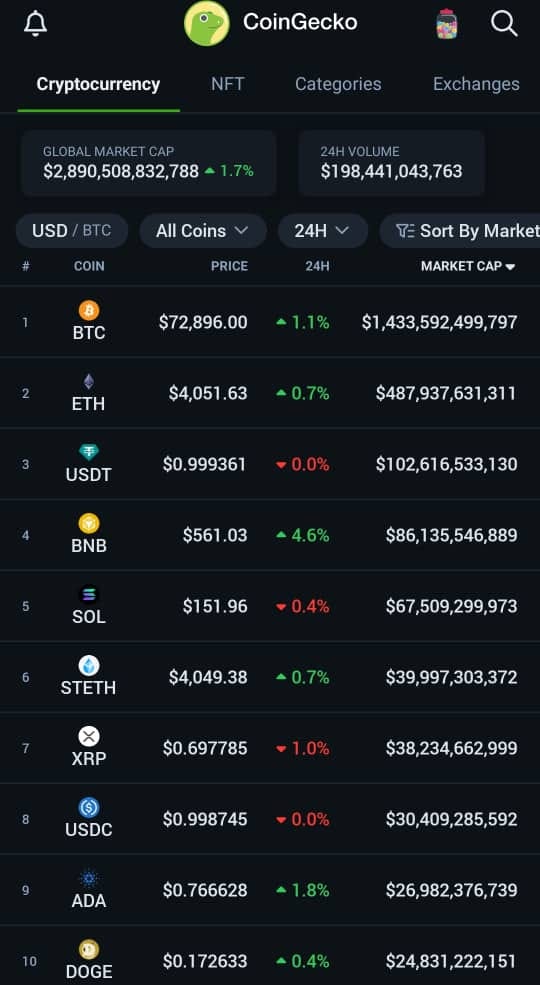
The week opened with Bitcoin at a strong position, continuing its upward trajectory from the previous week with Bitcoin hitting a new all time of $73,000 early Wednesday. The bullish sentiment was fueled by positive news regarding institutional adoption and technological advancements within the blockchain ecosystem. However, as the week progressed, Bitcoin faced significant resistance, leading to a consolidation phase.

The cryptocurrency market has witnessed significant fluctuations this week, with Ethereum at the forefront of discussions. As of the week of 13th March 2024, Ethereum has showcased a resilient performance amidst market volatility, Price of Ether is trading $4040 per coin, a price never seen since creation.

Ethereum maintained a steady growth trajectory, indicating strong investor confidence. Transaction speeds and processing costs remained stable, ensuring efficient network functionality. Upcoming upgrades in the Ethereum network are anticipated to further enhance performance metrics.

Ethereum’s performance this week paints a promising picture for its future prospects. Investors and users alike remain optimistic about its potential for continued growth and innovation.

Midweek brought about a turning point as market sentiment shifted. A series of geopolitical events stirred uncertainty among investors, resulting in a cautious approach towards cryptocurrency investments. This was reflected in Bitcoin’s price action, which saw a noticeable retracement from its weekly high.

Despite these challenges, Bitcoin’s resilience remains evident. The latter part of the week saw a recovery phase as it regained some of its lost ground. This rebound can be attributed to the steadfast confidence of long-term investors and the continuous growth in user adoption rates.

If crypto prices continue to progress at their current pace, we may soon need scholars devoted to the study of Dogecoins.

The burgeoning realm of cryptocurrency has witnessed an unprecedented surge in the variety of digital currencies, with ‘dog coins’ emerging as a notable segment. These meme-inspired tokens, initially perceived with skepticism, have garnered a substantial following, prompting discussions on their legitimacy and potential impact on the financial landscape.

If the current trajectory of crypto prices persists, it may become imperative to establish a dedicated scholarly discipline focused on these canine-themed assets. Such an academic pursuit would delve into the intricacies of dog coins, scrutinizing their market trends, community engagement, and influence on broader economic patterns. This specialized study could provide valuable insights into the dynamics of meme cryptocurrencies and their role in shaping future monetary ecosystems.

This week’s performance highlights the dynamic nature of Bitcoin, Ethereum and Meme’s market value. While short-term fluctuations are inevitable, the long-term outlook continues to be promising due to the robust fundamentals supporting Bitcoin’s value proposition.

Bitcoin and memecoins are going up at the same time because they share some common factors that affect their price movements, such as demand and supply, media attention and social influence, innovation and diversification, and speculation and sentiment.

However, they also have some unique characteristics that differentiate them from each other, such as their history, design, purpose, and community. Therefore, investors should be aware of the risks and opportunities of each type of coin before making their decisions.

Buying a crypto token feels exactly like buying a stock

0

Investing in financial markets has evolved significantly with the advent of blockchain technology, leading to the creation of crypto tokens. Despite their differences, crypto tokens and stocks share several similarities that are worth noting for investors.

Buying a crypto token feels exactly like buying a stock in many ways. Both are forms of investment and carry a certain level of risk and potential for return. However, there are also key differences to consider.

When you buy a stock, you’re purchasing a small piece of ownership in a company. As a shareholder, you may receive dividends and have voting rights. Stocks are traded on regulated exchanges, and their prices are influenced by factors such as company performance, industry trends, and economic conditions.

Similarities between Crypto Tokens and Stocks

Ownership: Both stocks and crypto tokens represent a form of ownership. Stocks are shares in the ownership of a company, while crypto tokens can represent ownership in a variety of assets or projects.

Value Determination: The value of both stocks and crypto tokens is determined by market dynamics. Supply and demand in the market influence their price, although the factors driving demand may differ.

Trading: Both can be traded on exchanges. Stocks are traded on stock exchanges, while crypto tokens are traded on cryptocurrency exchanges. This trading is facilitated by technology and allows for liquidity in both markets.

Dividends and Rewards: Some stocks provide dividends to shareholders as a share of profits. Similarly, certain crypto tokens offer rewards or staking benefits to holders, which can be seen as a form of dividend.

Regulatory Environment**
While the regulatory landscape for crypto tokens is still developing, both assets are subject to regulatory scrutiny. Stocks are regulated by securities laws, which ensure transparency and fairness in the market. Crypto tokens, especially those considered securities, may also fall under similar regulations.

Investment Strategies: Investors employ various strategies such as fundamental analysis, technical analysis, and portfolio diversification in both stock and crypto markets to make informed decisions and manage risk.

While stocks and crypto tokens operate within different frameworks and have distinct characteristics, they share common ground in terms of investment principles and market behavior. Understanding these similarities can help investors navigate both markets more effectively.

The value of both stocks and crypto tokens is influenced by market dynamics such as supply and demand, investor sentiment, and market liquidity. Both markets experience volatility, with prices fluctuating based on news, trends, and economic indicators.

Crypto tokens, on the other hand, represent a stake in a blockchain project or access to a specific service or product within its ecosystem. Unlike stocks, most crypto tokens do not confer ownership rights or dividends.

They are traded on cryptocurrency exchanges, which may be less regulated than stock markets. The value of a crypto token can be highly volatile, often driven by market sentiment, speculation, and the perceived value of the underlying technology or use case.

It’s important for investors to conduct thorough research and understand the unique characteristics of each asset before making an investment decision.