DD
MM
YYYY

PAGES

DD
MM
YYYY

spot_img

PAGES

Home Blog Page 3939

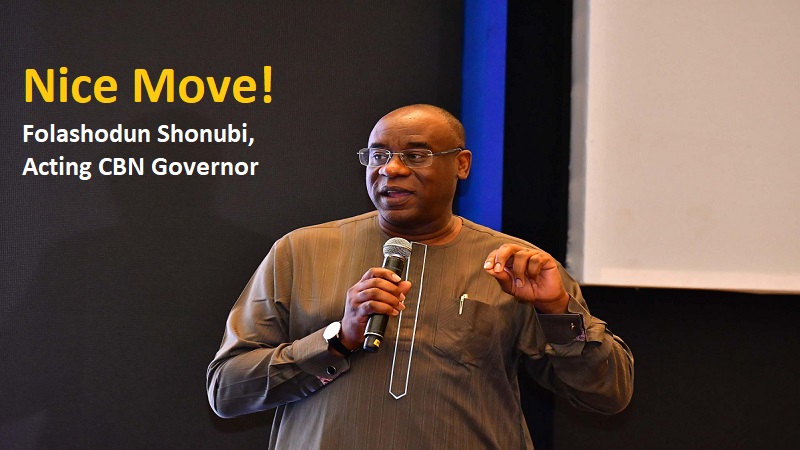
Well Done Folashodun Shonubi, Acting CBN Governor; Truly Brilliant Move

2

Good People, join me to commend this gentleman: Folashodun Shonubi, acting governor of Nigeria’s central bank. He impressed me today. Yes, since 2016 when they froze the publication of the Central Bank of Nigeria financial statements, I have written and challenged the government to obey the CBN Act: publish those documents for We The People. Today,  the documents have been published, and Shonubi is bringing Nigeria to the old order, at least in one area.

Read this: “The Group entered into a securities lending agreement with Goldman Sachs and J. P. Morgan and as part of the agreement, the Group pledged its holdings on foreign securities in return for cash. The cash received from Goldman Sachs is N0.23tn ($500m), 2021: N0.22tn ($500m), and JP Morgan N3.23tn ($7bn), 2021: N3.05tn ($7bn) is recognised in other foreign securities.”

So, when they told you that we had no money to pay doctors, nurses, lecturers, etc, even as they raked $billions in debts from American banks, it was all vapour lies. Without going political: Buhari took Nigeria backward by miles. He just held the “President” as a title!

That a general would allow that kind of rascality was simply unfortunate. In my village of Ovim, we have many military  generals, and we respect these men because even in their Isi-agu native dresses, you know they’re men of steel. What did they do with this money is the question we need to ask Buhari and his government because nothing was largely achieved?

And you know the unfortunate? More revelations are coming… Shonubi, go ahead and publish more. Of course, we also need the books to be audited.

Comment on Feed

Comment from user: I do appreciate your various posts and regular contributions. On the last one regarding the CBN’s books and loans, aren’t we missing part of the equation? You’re saying that the debt the CBN took was “rascality”. Wouldn’t it depend on whether the loans were taken for valid reasons? Were the funds used to grant loans for capex projects (in which case they’re not necessarily bad IF these projects are executed) OR were they squandered for subsidy and landed in the pocket of the few (which would be mayhem like you suggest). I think it’d be fair to add this point to your argument to drive the reasoning even further !

My Response: They were not disclosed until now. That is the rascality. It was hidden from Nigerians. This is not the sovereign debt.

Comment 1R: Ah OK. The fact they weren’t disclosed. Agreed. CBN were cowboys for sure. I really wonder how we’re going to get out of the mess we’re in. Subsidies destroy value as we’re totally incapable of managing properly. Lack therefore is the naira going into a tailspin.

My Response: I agree with you. But note that the subsidy is not really that bad. What is bad is the corruption in subsidy.

Why NFTs Market Has Plummeted in 2023

1
A woman looks at a NFT by Mad Dog Jones titled "SHIFT//" during a media preview on June 4, 2021, at Sotheby's for the Natively Digital: A Curated NFT Sale Online Auction to take place June 10, 2021. - They are technology enthusiasts on the hunt for opportunities in the Wild West market surrounding NFTs: the popular certified digital objects that have spawned a new generation of collectors convinced of their huge potential. (Photo by TIMOTHY A. CLARY / AFP) / RESTRICTED TO EDITORIAL USE - MANDATORY MENTION OF THE ARTIST UPON PUBLICATION - TO ILLUSTRATE THE EVENT AS SPECIFIED IN THE CAPTION

NFTs, or non-fungible tokens, are digital assets that represent unique and scarce items such as art, music, collectibles, and even virtual land. They have been one of the hottest trends in the crypto space since 2021, when they exploded in popularity and value. However, in 2023, the NFT market has seen a sharp decline in both volume and price, with some analysts predicting that it may never recover. What are the reasons behind this collapse, and what does it mean for the future of NFTs?

One of the main factors that contributed to the downfall of NFTs was the environmental impact of their creation and transaction. NFTs are mostly built on the Ethereum blockchain, which uses a proof-of-work (PoW) consensus mechanism that requires a lot of computing power and energy to validate transactions and mint new tokens. According to some estimates, a single NFT transaction can consume as much electricity as an average American household in a month. This has raised concerns among environmentalists, regulators, and even some artists and collectors, who have questioned the sustainability and ethics of NFTs.

Another reason why NFTs have lost their appeal is the oversaturation and dilution of the market. As more and more people jumped on the NFT bandwagon, the supply of NFTs increased exponentially, while the demand decreased. This resulted in a lower quality and originality of NFTs, as well as a loss of exclusivity and rarity. Many NFTs were simply copies or derivatives of existing works, or even outright scams or frauds. Moreover, some platforms and creators inflated the prices of their NFTs artificially, creating a bubble that eventually burst.

A third factor that affected the NFT market was the legal and regulatory uncertainty surrounding them. NFTs are still a relatively new phenomenon, and there is no clear or consistent framework for their governance, taxation, ownership, and protection. This poses a number of challenges and risks for both buyers and sellers of NFTs, such as disputes over intellectual property rights, copyright infringement, counterfeit detection, taxation compliance, and consumer protection. Furthermore, some governments and authorities have expressed their skepticism or hostility towards NFTs, citing their potential for money laundering, tax evasion, and illicit activities.

According to a recent study by the University of Cambridge, the annual electricity consumption of the Ethereum network, which hosts most of the NFTs, is equivalent to that of the entire country of Argentina. This is because every transaction on the network requires a complex mathematical computation, known as proof-of-work, that consumes a lot of computing power and electricity. Moreover, most of the electricity used by the network comes from fossil fuels, which emit greenhouse gases and worsen climate change.

So, how can we make NFT more sustainable and reduce their environmental impact? Here are some possible solutions:

Switch to a more energy-efficient consensus mechanism. Proof-of-work is not the only way to secure a blockchain network. There are alternative methods, such as proof-of-stake, proof-of-authority, or proof-of-burn, that require less computing power and energy. Some projects, such as Tezos, Flow, or Polygon, already use these methods to create more eco-friendly NFT platforms.

Use renewable energy sources. Another way to make NFT more sustainable is to use clean and renewable energy sources, such as solar, wind, or hydro power, to run the blockchain network. This would reduce the carbon footprint and emissions of the network and make it more environmentally friendly. Some initiatives, such as Crypto Climate Accord or Green NFTs, are working to promote the use of renewable energy in the crypto space and to offset the carbon impact of NFTs.

Create less but better NFTs. Finally, a simple but effective way to make NFT more sustainable is to create less but better NFTs. Instead of minting thousands of low-quality and generic NFTs that have no artistic or cultural value, we should focus on creating high-quality and meaningful NFTs that have a lasting impact and appeal. This would not only reduce the energy consumption and waste of the network, but also increase the value and reputation of the NFT market.

The NFT market has plummeted in 2023 due to a combination of environmental, economic, and legal factors that have eroded its value proposition and attractiveness. While some enthusiasts and optimists believe that NFTs still have a future and will bounce back once these issues are resolved or overcome, others are more pessimistic and think that NFTs were just a fad or a bubble that has burst. Either way, it is clear that NFTs need to undergo some major changes and innovations if they want to survive and thrive in the long term.

NFTs are an exciting and innovative technology that can revolutionize the digital economy and culture. However, they also pose a serious threat to the environment and sustainability. Therefore, we should take action to make NFT more sustainable and responsible, and to balance their benefits and costs.

Cool Cats Introduces New NFT Character Sidechick to Cooltopia Game Ecosystem

Meanwhile, Cool Cats, one of the most popular NFT collections on the Ethereum blockchain, has announced the launch of a new character named Sidechick, who will join the Cooltopia game ecosystem as a playable avatar. Sidechick is a female cat with a sassy attitude and a stylish outfit, who can interact with other Cool Cats and explore the virtual world of Cooltopia.

Cooltopia is a game platform that allows Cool Cats owners to use their NFTs as digital identities and participate in various activities such as socializing, gaming, and earning rewards. Cooltopia is powered by Immutable X, a layer-2 scaling solution that enables fast and gas-free transactions on the Ethereum network. Cooltopia aims to create a fun and immersive experience for NFT enthusiasts and gamers alike.

Cooltopia offers a variety of activities and features for its users. You can create your own avatar and customize it with different outfits, accessories, and hairstyles. You can chat with other users in public or private rooms, or join groups based on your interests. You can play games with other users or by yourself, such as puzzles, quizzes, racing, or trivia. You can also create your own games using the easy-to-use game editor. You can explore different worlds created by other users or by the Cooltopia team, such as forests, beaches, cities, or space stations. You can also create your own worlds using the world editor and share them with others.

Sidechick is the first new character to be introduced to the Cool Cats collection since its launch in July 2021. The collection consists of 9,999 unique and randomly generated Cool Cats, each with its own traits and personality. The collection sold out in less than an hour and has since become one of the most sought-after NFTs on the secondary market, with an average price of over 8 ETH.

To celebrate the arrival of Sidechick, Cool Cats is hosting a special giveaway event, where 100 lucky winners will receive a free Sidechick NFT. To enter the giveaway, participants need to follow the official Cool Cats Twitter account, retweet the announcement tweet, and tag three friends. The winners will be randomly selected and announced on September 1st.

Cool Cats is also planning to release more new characters and features for the Cooltopia game ecosystem in the near future. According to the team, they are working on developing more mini-games, quests, items, and customization options for the players. They are also collaborating with other NFT projects and artists to create cross-over events and partnerships.

Cool Cats is more than just an NFT collection; it is a vibrant community of passionate and creative people who share a love for cats and gaming. By introducing Sidechick and expanding the Cooltopia game ecosystem, Cool Cats hopes to attract more users and fans to join their Meowtastic adventure.

Cool Cats Meowtastic Adventure is not only a game, but also a learning experience. As you play, you will discover fascinating facts and trivia about cats, such as their origins, evolution, behavior, and symbolism. You will also learn about the different types of cats that exist in the world, from domesticated to wild, and how they adapt to their environments. You will also encounter some famous cats from history, literature, art, and pop culture, and see how they have influenced human society and culture.

Nigeria Opens the Central Bank of Nigeria (CBN) Books And Bad Things Are There!

2

For years, including just last week, I have been demanding that the Central Bank of Nigeria (CBN) opens its books for the public to see what we have there. Amazingly, they have done that, after seven years,  and there are many bad things there: “Also, the CBN owes JP Morgan and Goldman Sachs a combined sum of $7.5bn as of the financial year ended December 2022. Included as part of its liabilities is another $6.3bn owned in foreign currency forwards.”

The Central Bank of Nigeria has released the Consolidated Financial Statements for the last seven years, making it the first time since 2015 that the apex bank will be making its book available for public scrutiny.

The Consolidated Financial Statements, which were released by the CBN, are for 2016, 2017, 2018, 2019, 2020, 2021 and 2022 financial periods.

The CBN declared a profit after tax of N103.8bn in 2022, up from N75.13bn reported a year earlier.

Also, the CBN owes JP Morgan and Goldman Sachs a combined sum of $7.5bn as of the financial year ended December 2022.

Included as part of its liabilities is another $6.3bn owned in foreign currency forwards.

The apex bank, however, stated it owes Goldman Sachs $500 million and JP Morgan $7 billion in what it classified as securities lending.

The 2022 financial statement read, “The Group entered into a securities lending agreement with Goldman Sachs and J. P. Morgan and as part of the agreement, the Group pledged its holdings on foreign securities in return for cash. The cash received from Goldman Sachs is N0.23tn ($500m), 2021: N0.22tn ($500m), and JP Morgan N3.23tn ($7bn), 2021: N3.05tn ($7bn) is recognised in other foreign securities.”

Securities lending forms part of the CBN’s total external reserves of about N14.3tn or $29bn using the official exchange rate of N494/$1 as of 2022.

However, the apex bank also owes another N3.15tn ($6.3bn) in foreign currency forward which are forex obligations it needs to make to foreign investors.

The financial statements uploaded on the CBN website is an indication that the apex bank, under the leadership of acting Governor Folashodun Shonubi, is ready to open its book to public scrutiny.

Comment on Feed

Comment 1: As Buhari became president, the CBN stopped publishing its report. What we witnessed in the past 8 years was a unique combination of ineptitude and impunity, it’s both unbelievable and unbeatable.

We are yet to know the true debt we are owing and the people we are owing. Everything that could go wrong went wrong, and up till now many are still in denial as to whether Nigeria is progressing or regressing. NNPC did its own magic.

You cannot wake up people who are pretending to be asleep.

Comment 2: It’s truly eye-opening to see the Central Bank of Nigeria’s finances being made public after seven long years. The startling revelation that the Central Bank of Nigeria owes JP Morgan and Goldman Sachs a whopping $7.5 billion raises important questions about financial management.

Let’s hope this is a game-changer for Nigeria’s accountability and economic progress.

The financial kinetics and mathematics continue.

But my simple questions include: is this figure complete? Or we should still be expectant? Why is it taking 7 years to show what is in there? Are they mutilating the data like the election results?

The Plea for Likes and Shares in Nigeria’s Content Creation Market

0

Nigeria’s skitmakers and pranksters have emerged as dynamic figures within the country’s digital landscape, blending creativity with humor to capture the attention of audiences across social media platforms.

However, they have adopted a peculiar rallying cry: “Please, like, share, and comment.” This seemingly innocuous phrase carries a deeper significance when examined through the lens of Karl Marx’s insights on capital accumulation.

Imagine these content creators as modern-day artisans, crafting digital skits and pranks to captivate their audience. In Marx’s worldview, their labor is the wellspring of value, yet under the sway of capitalism, this value often flows elsewhere. The content they produce is designed to beckon likes, shares, and comments – the lifeblood of social media platforms. As users engage, the value of their labor accumulates, akin to the hidden surplus labor that underpins capitalist economies.

But a more intricate story emerges when we look at these creators’ aspirations. Beyond the lure of viral fame, they are vying for a place of influence within their digital realm. The refrain, “Please, like, share, and comment,” is their plea for recognition, an attempt to establish themselves as authorities in a realm where attention is the new currency. It’s as if they are striving to build a following, akin to Marx’s vision of workers seeking validation for their contributions within a system that often disregards their true worth.

However, a twist of irony permeates this narrative. While these creators endeavor to shape the digital landscape, they remain ensnared within the very system they hope to conquer. The likes and shares they amass contribute to the profit margins of the social media platforms they use, echoing Marx’s concerns about the concentration of wealth in the hands of those who own the means of production.

The phrase “Please, like, share, and comment” carries a weighty significance. It encapsulates the creators’ quest for recognition and validation, a yearning for influence within a realm dominated by unseen forces of capitalism. It’s a reminder that even in the age of digital innovation, the echoes of Marx’s observations on labour, value, and the struggle for a fair share continue to reverberate.

United States Unadjusted Annual Consumer Price Index (CPI) Rate in July Accelerates to 3.2%

0

The latest data from the Bureau of Labor Statistics shows that the US unadjusted annual CPI (consumer price index) rate in July rose to 3.2%, the highest level since June 2022. This indicates that inflationary pressures are still present in the economy, despite the easing of some pandemic-related restrictions and supply chain disruptions. This means that the average prices of goods and services in the US increased by 3.2% over the past year, exceeding the Federal Reserve’s target of 2%.

The main drivers of the increase in the CPI rate were energy, food, and shelter costs, which rose by 23.8%, 3.4%, and 2.8%, respectively, compared to a year ago. These categories account for more than half of the consumer basket and reflect the rising demand and limited supply of essential goods and services.

The core CPI rate, which excludes food and energy, also accelerated to 2.9% in July, up from 2.7% in June. This suggests that inflation is not only driven by transitory factors, but also by underlying structural changes in the economy, such as labor shortages, wage growth, and higher production costs.

The CPI is used to measure inflation, which is the general rise in the level of prices in an economy. Inflation reduces the purchasing power of money, meaning that consumers can buy less goods and services with the same amount of money over time. The CPI is also used to compare the cost of living between different countries or regions, by converting the prices into a common currency using exchange rates. The CPI is also used to index the real value of wages, salaries, pensions, and other payments that are affected by inflation.

The CPI is not a perfect measure of inflation or the cost of living, because it does not capture all the changes in consumer preferences, quality, availability, or substitution effects that may occur over time. The CPI also does not include some items that are important for consumers, such as income taxes, investments, or savings. The CPI may also differ from the personal experience of individual consumers, depending on their specific spending habits and consumption patterns.

Food prices rose by 3.4%, reflecting the impact of supply chain disruptions, labor shortages, and droughts on agricultural production. Transportation prices surged by 10.7%, as the demand for air travel, car rentals, and public transit rebounded from the pandemic lows.

The high inflation rate poses a challenge for the Fed, which has maintained an accommodative monetary policy stance to support the economic recovery from the Covid-19 crisis. The Fed has argued that the current inflation spike is transitory and will subside as the economy returns to normal. However, some economists and market participants are worried that inflation may persist or even accelerate, forcing the Fed to raise interest rates sooner than expected.

The Fed’s next policy meeting is scheduled for September 21-22, where it will review the latest economic data and discuss its plans for tapering its bond-buying program. The market will be closely watching for any signals from the Fed on how it intends to balance its dual mandate of price stability and maximum employment in the face of rising inflationary pressures. However, some analysts and policymakers have expressed concerns that inflation could become more persistent and entrenched, requiring a faster and more aggressive monetary policy response.

The Fed is expected to announce its plans for tapering its asset purchases later this year, which would be the first step toward normalizing its monetary policy stance. However, the timing and pace of tapering will depend on the evolution of inflation and other economic indicators, as well as the risks posed by the Delta variant of the coronavirus and other potential shocks.

The July CPI report adds to the uncertainty and complexity of the Fed’s decision-making process, as it shows that inflation is not only high, but also accelerating. The Fed will have to balance the need to support the economic recovery with the need to prevent inflation from becoming a long-term problem.