DD
MM
YYYY

PAGES

DD
MM
YYYY

spot_img

PAGES

Home Blog Page 3981

Political and Economic Uncertainty: A Catalyst for Coups in West Africa’s GUBUMAN Countries

0

The recent history of West African nations, specifically Guinea, Mali, Burkina Faso, and Niger, bears witness to a series of coups that have shaken the political landscape. These coups have left citizens questioning the stability of their democratically elected governments. Delving into the data and the societal response, it becomes evident that political and economic uncertainty played a pivotal role in facilitating these coups. This article explores how these uncertainties paved the way for military takeovers in these nations and examines the public’s attitude towards democracy during this tumultuous period.

The Unraveling of Stability

As we assess the trajectory of political and economic uncertainty in the four countries over the span of nine years, a distinct pattern emerges. Burkina Faso, Guinea, Mali, and Niger all witnessed varying degrees of instability during this period. Among them, Burkina Faso experienced the highest levels of uncertainty, notably in 2015, 2020, and 2022. Guinea followed closely with its peaks in 2019, 2020, and 2021. Mali and Niger displayed a more unsteady growth in uncertainty but shared their highest points in 2020 and 2021. These elevated levels of uncertainty have been instrumental in providing fertile ground for the growth of dissatisfaction and discontent among citizens.

The Nexus of Uncertainty and Coup d’état

The connection between political and economic uncertainty and the occurrence of coups is apparent when observing the timeline of these events. In each of these countries, the years of highest uncertainty often coincide with coup attempts. It is here that we find the intersection of public disillusionment, wavering confidence in the government’s ability to address socio-political challenges, and an environment conducive to a military intervention.

Guinea, Mali, Burkina Faso, and Niger all experienced their own unique challenges – from economic instability to corruption and lack of effective governance. In these environments, citizens often seek a semblance of stability and progress, two elements that are sorely lacking in times of high uncertainty. This vacuum leaves room for charismatic military leaders, promising swift solutions, to emerge as saviors of the nation. The dissatisfied masses, feeling abandoned by traditional democratic institutions, can be easily swayed to support military interventions.

Exhibit 1: Level of political and economic uncertainty between 2015 and 2023(Q2)
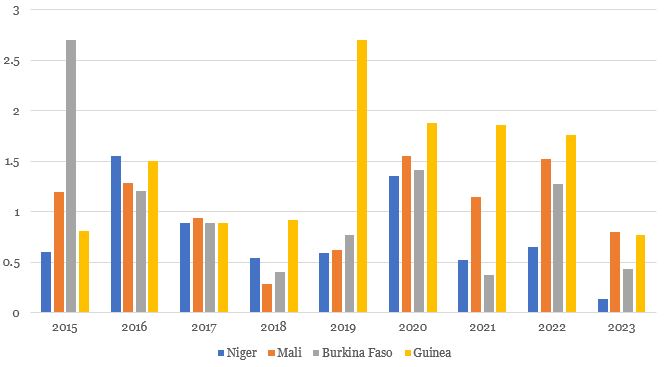
Source: World Uncertainty Index, 2023; Infoprations Analysis, 2023

Exhibit 2: Cumulative level of political and economic uncertainty between 2015 and 2o23(Q2)
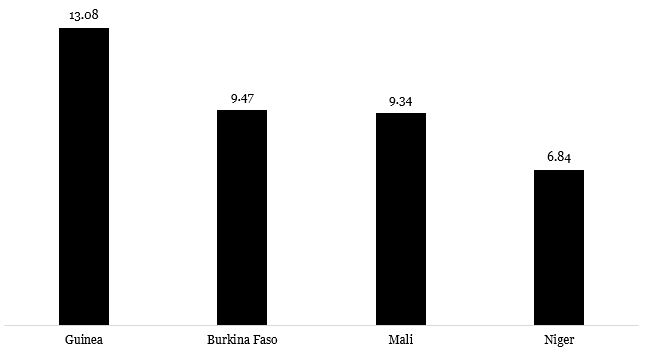
Source: World Uncertainty Index, 2023, Infoprations Analysis, 2023

Citizen Attitudes: Democracy vs. Military

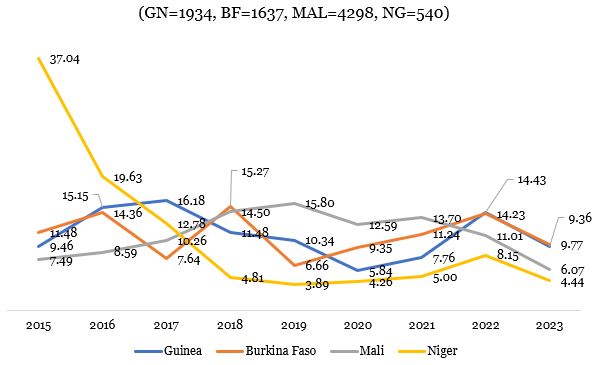
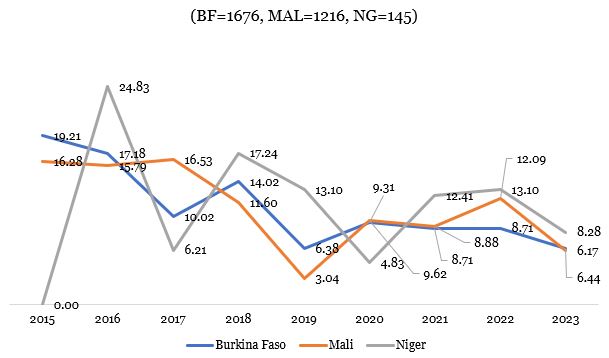
The citizens’ search behaviour on the Internet, as evidenced by Google search trends, provides valuable insights into their priorities and inclinations. Surprisingly, the data shows that throughout the period analyzed, citizens displayed greater interest in the military and armed forces rather than in democracy. This trend is consistent across all four countries, further underscoring the population’s growing disillusionment with the efficacy of democratic governance.

The public’s information-seeking behaviour reflects their yearning for stability and effective governance, even if it means resorting to military intervention. The military often portrays itself as a force capable of restoring order, promising swift and decisive actions that democratic governments may struggle to deliver.

Exhibit 3: Public interest in military between 2015 and 2023
Source: Google Trends, 2023, Infoprations Analysis, 2023

Exhibit 4: Public interest in democracy between 2015 and 2023
Source: Google Trends, 2023, Infoprations Analysis, 2023

The Imperative of Addressing Uncertainty

In the aftermath of these coups, it becomes clear that political and economic uncertainty has acted as a catalyst for the erosion of democratic norms and the rise of military interventions. The stability of nations rests on their ability to address socioeconomic and political challenges with sustainable strategies. Failure to do so not only perpetuate uncertainty but also exacerbates the potential for coups, further perpetuating a cycle of instability.

As West African nations grapple with the aftermath of coups, it is imperative for leaders and policymakers to recognize the critical role of uncertainty in shaping the political landscape. Strengthening democratic institutions, promoting transparent governance, and addressing economic disparities are essential steps toward fostering stability and avoiding the lure of military interventions. Only through these efforts can the region move forward toward a future of sustainable progress and democratic resilience.

Marketers Announce Plan to Increase Cooking Gas Prices Next Week

0

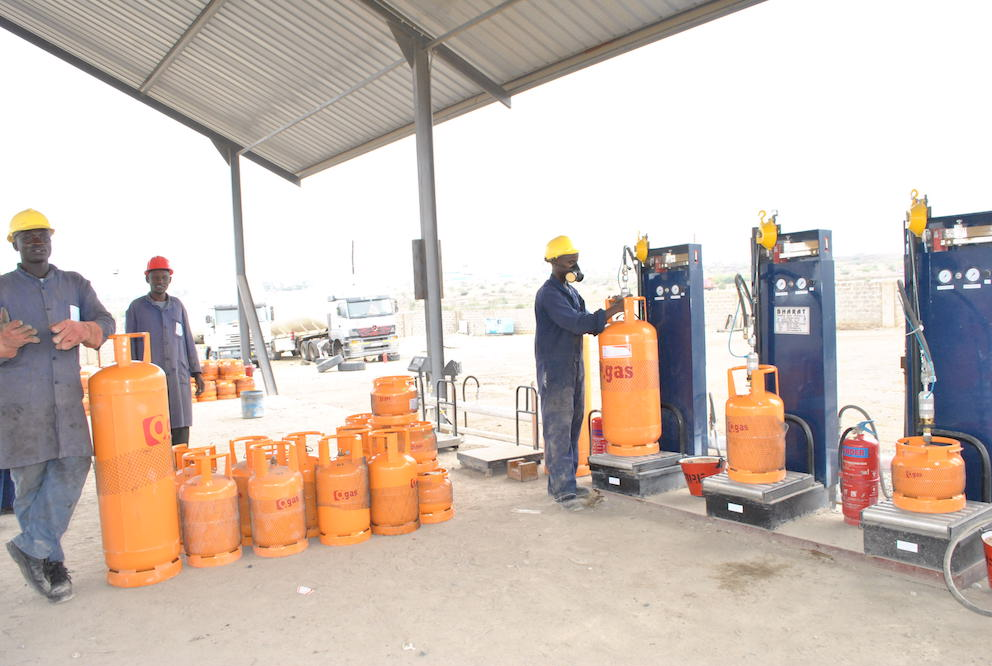
The Nigerian Association of Liquefied Petroleum Gas Marketers has announced a plan to increase prices for cooking gas, adding to the plethora of spikes in commodity costs choking consumers.

The President of the association Olatunbosun Oladapo attributed the price hike to the recent subsidy, electricity, and forex reforms carried out by the federal government.

Oladapo said the reforms, which have significantly stoked the cost of goods and services, have added to rising international prices, high tax rates, and prices of vessels – leaving marketers with no other option than to conduct an upward review of cooking gas prices.

“It is starting next week because international prices have gone up. The prices of vessels have gone up and taxes are high, but consumers are not earning more.

“Their purchasing power has gone down. Everybody is crying. Consumers, middlemen, and retailers are feeling the impact because business is now on the low side,” he said.

The move which comes amid the declining spending power of consumers has been decried as an additional nail on the coffin of suffering Nigerians, a situation Oladapo acknowledged.

“The situation is very unfortunate because prices are going higher. Nigerian consumers are passing through very difficult times because they can no longer afford gas,” he said.

The move also follows the push by organized labor to force the government to provide palliatives that will mitigate the impacts of the reforms. Though the push has suffered setbacks, with the Nigeria Labour Congress and the Trade Union Congress embarking on only a day nationwide strike, Oladapo believes one way the government should provide the palliative is through tax breaks.

He indicated that besides the impacts of President Bola Tinubu’s economic reforms, taxes have played a major role in the decision of marketers to review gas prices.

“The government should come in and alleviate the suffering of the masses by providing palliatives, reducing taxes and levies.

“You can imagine that for every 1kg of gas priced at N700, tax would take way N3.50. How much is left in such a business?” he lamented, adding that “local taxes are worsening the problem.”

As part of his economic reforms, Tinubu has set up a committee on fiscal policy and tax reforms, aimed at eliminating the issue of multiple taxation among other bottlenecks hindering economic growth; the implementation is expected to take a while.
The period is expected to see a further increase in the price of commodities, including gas, as the naira dips further in the FX market.

The naira traded at N920/$1 in the parallel market on Wednesday, compounding inflationary shocks.

LPG prices in Nigeria are determined through international benchmarks using Nigerian Liquefied Natural Gas Contract prices and are consistently influenced by global price trends.

According to a National Bureau of Statistics report on retail gas prices, the mean retail cost for refilling a 5kg cooking gas cylinder showed a month-on-month decline of 6.71%, dropping from N4,360.69 in May to N4,068.26 in June.

On a year-on-year basis, this marked a decrease of 3.56% from June 2022’s figure of N4,218.38.

Oladapo did not say how much the increment will come with.

Modern banking is here and Moove is the largest in financing vehicular fleet in Africa

0

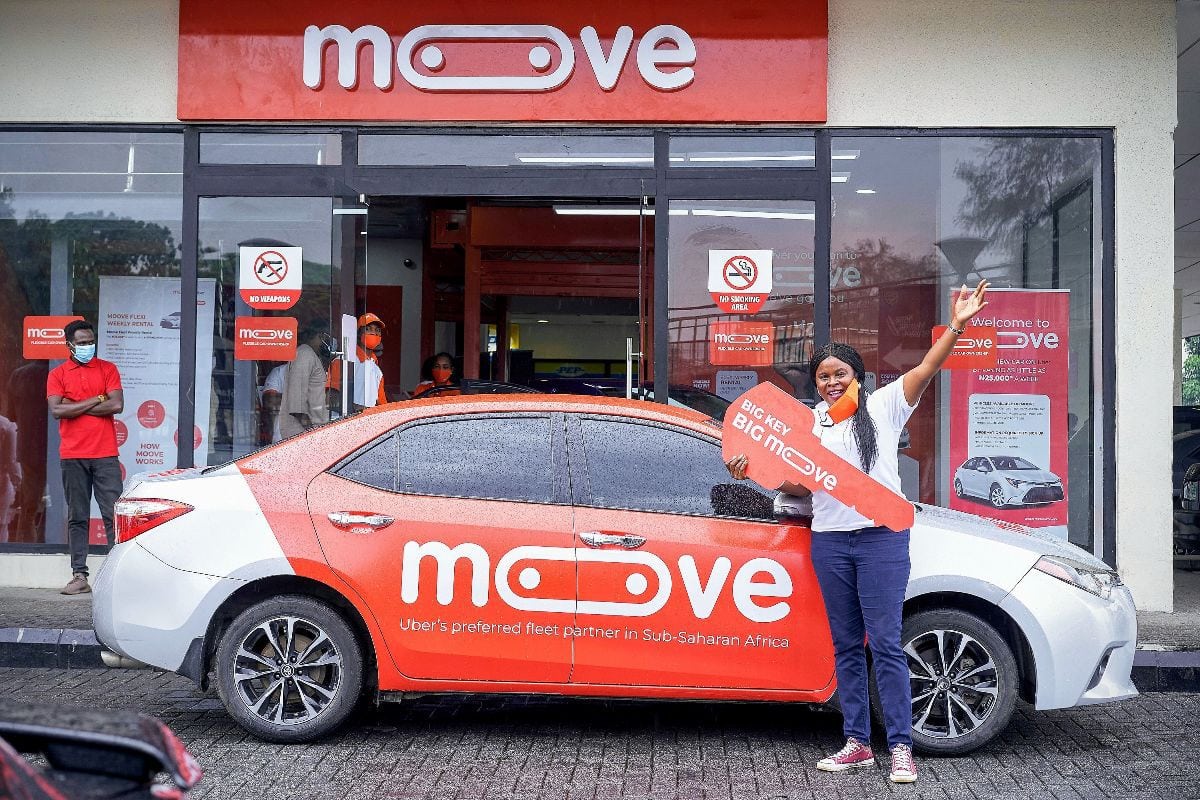
Modern banking is here and Moove is the largest in financing vehicular fleet in Africa: “Moove, a Nigerian mobility startup that provides vehicle financing to drivers of ride-hailing platforms like Uber, has secured $76 million in new funding to expand globally.” Yes, Moove is moving things and great brands like Blackrock are believers.

Do not be confused: Moove is a tech company which offers banking services for those who want to buy cars for use in the ride-sharing ecosystem. It has essentially disintermediated the regular banks in the sector. As they grow, new ordinances will emerge. I expect them to be closing in total at least $500 million by Dec 2023 (they’re at $334 million before this new announcement).

Tekedia Capital salutes #builders.

Speaking on the funds raised, Moove Co-Founder Ladi Delano said: We are excited to be partnering with Mubadala and BlackRock to double down on our already profitable markets including the UAE, India, Uk, and South Africa, as well as continuing to invest in our customer experience and accelerate our product development to deliver group-wide profitability within the next 12 months.

“With this investment, we will now accelerate our mission and continue creating life-changing opportunities for our customers while working towards profitability, It gives us great pride in seeing our customers build a better life for themselves and their families, and this funding will allow us to offer this chance to more entrepreneurs.”

While Moove is raising money, not many startups are that lucky as global challenges on fundraising continue.

Startup companies are struggling to survive as venture funding dries up, according to The Wall Street Journal. Some potential investors pulled back after Russia invaded Ukraine, while others are hesitant to invest in companies that aren’t growing revenue or turning a profit. Despite investors’ enthusiasm in artificial intelligence companies, funding for U.S. tech startups plunged 49% in the year ended June 30, per recent PitchBook data. Investment in U.S. early-stage startups in the second quarter also fell sharply to $10 billion, leading more startups to fail. One investor calls it a “perfect storm.”

Nigerian Mobility Startup Moove, Secures $76 Million for Global Expansion

0

Moove, a Nigerian mobility startup that provides vehicle financing to drivers of ride-hailing platforms like Uber and Bolt, has secured $76 million in new funding to expand globally.

The funding round was led by Mubadala Investment Company, $10m venture debt from funds and accounts managed by BlackRock, and $38 million in a previously undisclosed fund raised during the prior twelve months.

Moove disclosed that it will use the funds raised to continue its mission to build the largest tech-driven financial services platform for mobility entrepreneurs and strengthen its position on the global stage.

Speaking on the funds raised, Moove Co-Founder Ladi Delano said,

We are excited to be partnering with Mubadala and BlackRock to double down on our already profitable markets including the UAE, India, Uk, and South Africa, as well as continuing to invest in our customer experience and accelerate our product development to deliver group-wide profitability within the next 12 months.

“With this investment, we will now accelerate our mission and continue creating life-changing opportunities for our customers while working towards profitability, It gives us great pride in seeing our customers build a better life for themselves and their families, and this funding will allow us to offer this chance to more entrepreneurs.”

Launched in 2020 to assist African mobility entrepreneurs in obtaining vehicle financing, Moove since its inception has experienced significant revenue growth.

The mobility company was founded in response to the challenge faced by over 2 million African mobility entrepreneurs, which is the lack of access to vehicle financing. Moove was initially built to solve this problem in Lagos, but has since expanded to 6 cities across Africa.

The company is now taking its revenue-based financing model globally to serve the millions of mobility entrepreneurs in emerging markets around the world who have limited or no access to a vehicle or vehicle financing,

Key features of Moove include:

  1. Vehicle Subscription: Moove offers vehicle subscription services that allow individuals to access vehicles without the upfront costs associated with traditional vehicle ownership. This is particularly beneficial for rideshare drivers and those who need a vehicle for their livelihoods.
  2. Flexible Payments: The startup provides flexible payment options, making it easier for drivers to afford the vehicles they use for ridesharing or personal transportation. This can include installment plans and tailored payment schedules.
  3. Maintenance and Support: Moove often includes maintenance and support services as part of their offerings, ensuring that drivers have access to well-maintained vehicles and assistance when needed.
  4. Rideshare Integration: Moove’s services are often targeted at rideshare platforms, allowing drivers to access vehicles specifically suited for their work as rideshare partners.
  5. Technological Integration: The company typically integrates technology into its services, such as apps or online platforms, to streamline the vehicle subscription process and provide support to drivers.

Notably, Moove is Uber’s largest vehicle financing partner in EMEA, and already operates the largest EV fleet by supply hours on the Uber platform in the UAE, despite launching only four months ago.

The company is backed by investors from around the world which include, KORA, Phoenix Court Group, Speedinvest, Africinvest, FJ Labs, Palm Drive Capital, Tekton Ventures, and MUFG Innovation Partners.

Moove has a vision to build the largest integrated vehicle financing platform for mobility entrepreneurs using technology and future productivity, with a mission to drive productivity and success for the world’s mobility entrepreneurs by democratizing access to vehicle ownership.

Apecoin (APE) And Fantom (FTM) Falls While Pomerdoge (POMD) Presale Gets Off to a Perfect Start

0

While established coins such as Apecoin and Fantom are experiencing falls, the Pomerdoge presale has seen millions of tokens sold in the last few days. Analysts predict a 50X return for those who have been able to invest in the presale. But what is Pomerdoge and how is it outperforming industry mainstays? Let’s find out.

Pomerdoge (POMD): The Memecoin Outshining Apecoin (APE) And Fantom (FTM)

Pomerdoge is a cryptocurrency project that is capturing attention by combining the charm of meme culture with tangible utility. The blend of a play-to-earn (P2E) game, a marketplace for in-game assets (Pomerplace), and an engaging meme token set the stage for a multifaceted ecosystem.

Unlike many meme tokens that rely solely on meme appeal, Pomerdoge is developing a P2E game that offers players a chance to compete and earn rewards. This adds a tangible value proposition to the token and encourages community engagement.

The Pomerplace is a unique addition that facilitates the buying, selling, or trading of in-game assets. This marketplace not only enriches the gameplay but creates an additional revenue stream for players.

The POMD token is not just a meme; it’s an essential component of the Pomerdoge ecosystem. Whether it’s making purchases within the Pomerplace or unlocking special rewards, POMD offers real utility.

Those looking to join the Pomerdoge universe can buy POMD at a discounted rate of $0.007 during Phase 1 of the presale. With the price set to rise in future phases, early participation should offer a significant advantage.

Market analysts see potential in Pomerdoge, drawing comparisons to Dogecoin’s success. A price target of $1.00 by 2024 reflects confidence in Pomerdoge’s growth trajectory.

Apecoin (APE): Struggling to Find Support

Serving as a versatile utility token, Apecoin grants users access to a plethora of offerings from Yuga Labs. This versatility garnered significant attention and propelled the Apecoin price from $0 to $34 in a matter of weeks in 2021.

Yet, the tides have shifted for Apecoin. Currently, Apecoin is valued at a modest $1.87 after dropping 95% from its peak. The past week alone has witnessed a 4% decline in its price.

Market experts note that the poor performance of the BAYC NFTs from Yuba Labs is also dragging down the Apecoin price. These NFTs once had a floor price of 128 ETH, yet now they are being sold for only 29 ETH a piece.

With Apecoin now under the $2.00 support, holders are switching over to Pomerdoge in order to take advantage of its presale. The phase-1 prices of $0.007 are particularly attractive with analysts predicting $1.00 for the POMD token within 3 years.

Fantom (FTM): A Deep Dive into Declining User Engagement

Distinctive in the world of distributed ledgers, Fantom distinguishes itself by leveraging Directed Acyclic Graph (DAG) technology. This innovative approach fast-tracked Fantom to a notable market cap surpassing $1 billion in its debut year.

In 2022, Fantom’s Total Value Locked (TVL) soared, touching a peak of $7.58 billion. This uptick was largely supported by various decentralized exchange protocols bolstering the asset’s trade volume. Yet, Fantom’s TVL has shrunk by 99% to a mere $64 million, underscoring a decreasing active user engagement.

The plunge can be primarily traced back to a devastating security breach on the Multichain’s Fantom bridge, where malefactors made away with over $125 million. Given that Multichain was pivotal to the Fantom ecosystem, this debacle has naturally had a domino effect and eroded user trust.

Analysts are treading carefully when it comes to predicting Fantom’s trajectory, especially considering its recent dip below the pivotal $0.30 threshold. While the prevailing sentiment hints at a potential floor of $0.20 for Fantom, it’s incumbent upon the project’s leadership to restore faith and re-energize its community to reclaim its earlier vibrancy.

Find out more about the Pomerdoge (POMD) Presale Today

Website: https://pomerdoge.com/

Telegram Community: https://t.me/pomerdoge