DD
MM
YYYY

PAGES

DD
MM
YYYY

spot_img

PAGES

Home Blog Page 4069

As followers find 9ja Cosmos brand page, LinkedIn finds Nigeria!

0

By now, some of my followers will be aware, that the 9ja Cosmos Website is done ( a few tie ups remain on the channels page), and we have also put up a business page on LinkedIn.

This got me to think about some posts I produced in the past for Tekedia – first one I produced in August 2021, where I shared that at that time, 85% of my LinkedIn contacts were in Nigeria, but LinkedIn didn’t seem to be able to capture them as part of my engagement statistics.

I went into some of the data transport arguments that might explain why that was, but nothing seemed conclusive to me.

Why doesn’t Nigeria show in the stats??

Roll on to November of the same year, and another post remarking that a relatively small business like Tiny URL has succeeded where LinkedIn had not.  (LinkedIn has been owned by Microsoft since 2016)

TinyURL ‘knows’ Nigeria !

Having got past the first 100 followers for the 9ja Cosmos brand page, I decided to have a good look at who had decided to join and where they had been joining from. I was surprised at the level of geo detail.
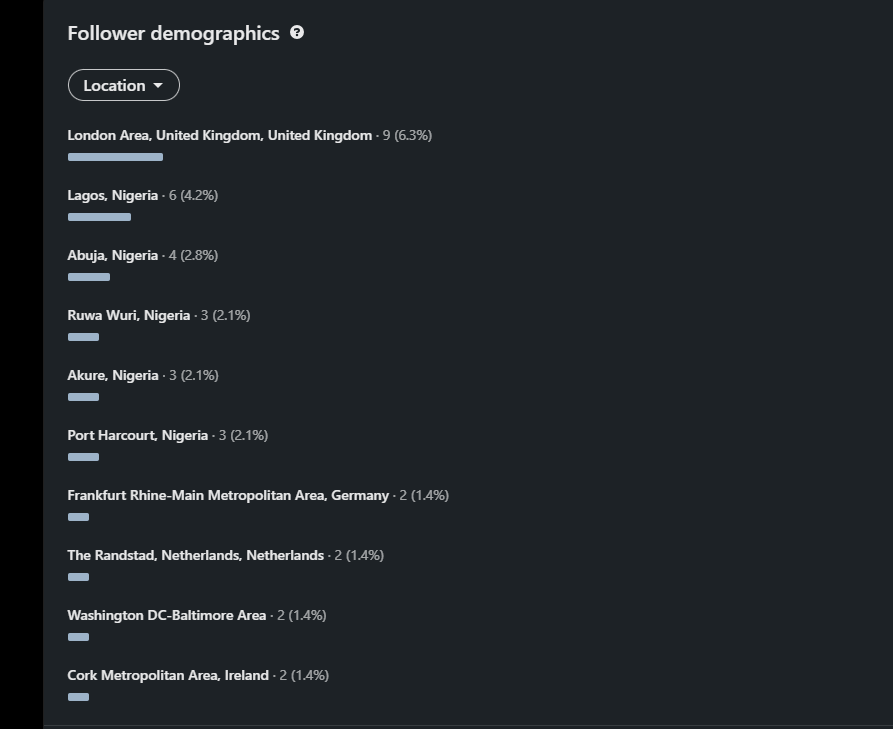
Since I was moaning in 2021, the improvement of detail in the 9ja Cosmos page stats as of July 2023 are far superior. It even lists Ruwa Wuri, a very small place in Sokoto State, Nigeria.

From a specimen of 140 members, London UK scored the highest for a single location – 9/140, though Nigeria took positions 2-6 of the top 10 locations. and as a nation, the largest presence overall. The city of my birth, Cork in Ireland sneaked into the top 10, with similar showings from Frankfurt,  Germany; Randstad, Netherlands; and Washington DC.

In the extended list there were many locations with a single follower, one of which simply said ‘Poplar Bluff’, which is this small town in Missouri, US at the foot of the Ozark Mountains – probably a bit like US version of Ruwa Wuri!

There were also 78 followers LinkedIn couldn’t say where they were. That’s about 55%, so still a lot of potential business intelligence not captured. Still a massive improvement in being able to name Nigerian cities and towns though, as compared to 2021.

I then decided to look at the stats of my most recent post, to see if this new geo inclusion capability was replicated elsewhere, and not just a feature of the 9ja Cosmos brand page.
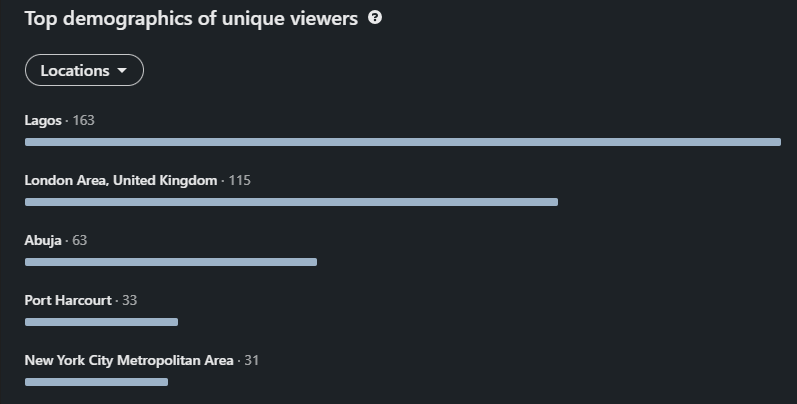
This just gave me a top 5, and was unable to give me any details of what it failed to capture – though again, much better than what had been available two years ago. This was the post entitled ‘A SUNDAY MUSING’, a ‘direct to LinkedIn’ post with no Tekedia piece. It didn’t especially have a ‘Nigeria’ focus, so interesting that Lagos blitzed London on it.

Thank you to those who have come out to support the new 9ja Cosmos page

We do however need the strong support of ‘Tekedians’ to move the needle forward, so more followers for the page are urgently needed.

9ja Cosmos is here… 

Get your .9jacom and .9javerse Web 3 domains  for $2 at:

.9jacom Domains

.9javerse Domains

Visit 9ja Cosmos

Follow us on LinkedIn HERE


All reference sites accessed 20/07/2023

poplarbluff-mo.gov/

linkedin.com/company/98217334/admin/analytics/followers/

linkedin.com/analytics/post-summary/urn:li:activity:7086401079734587392/

Registration for Next Tekedia Mini-MBA Opens; Programs on AI in Business, Project MGT Unveiled

0

Greetings! Tekedia Mini-MBA opens registrations for the next edition (Sep 11 – Dec 2, 2023). Please go and register; beat the early bird deadline and save with awesome benefits. Here is our curriculum: 14 modules for close to 100 courses, taught by executives of some of the finest companies you admire.

Week 1: Innovation, Design Thinking & Growth
Week 2: Business Systems & Processes
Week 3: Business Model & Transformation
Week 4: Exponential Technologies and Singularity
Week 5: New Technologies, Growth, Disruptive Innovation

Week 6: Finance, Investing, Fundraising
Week 7: Logistics & Supply Chain Management
Week 8: Marketing, Sales Management & Business Objectives
Week 9: Law, Contracting & Globalization
Week 10: Leadership, Human Capital & Project Management

Week 11: Business Communication, Design, Media & Branding
Week 12: Accounting, Sustainability & Risk Management
Week 13: Growth, Pricing & Taxation
Week 14: Startups, New Businesses, Products, Markets, Customers
Final Week: Business Execution and Closure

Also, we’re launching two new programs:

  1. Tekedia AI in Business Masterclass: Tekedia Artificial Intelligence in Business Masterclass will focus on how AI (artificial intelligence) will redesign the world of business, and re-architect economies even as it transforms markets, communities and organizations.  The program runs for 8 weeks and costs $400 (or N200,000).
  2. Tekedia Program Management Program: Tekedia Project Management educates on how to manage projects efficiently and effectively, using modern project management methodologies, to deepen capabilities and accelerate productivities, for the best project outcomes.  The program runs for 8 weeks and costs $400 (or N200,000).

For these new courses and more, please go here and register; all programs are online-based with pre-recorded and live Zoom components. Tekedia Mini-MBA is among the best business schools in Nigeria and Africa with a deep focus on entrepreneurial capitalism and personal career development.

StarkNet’s TVL surpasses $100 Million with Record TPS and Reduced Latency

0

StarkNet, the decentralized and scalable layer-2 solution for Ethereum, has reached a new milestone in its growth and adoption. According to the latest data from DeFi Llama, StarkNet’s total value locked (TVL) has surpassed $100 million, making it one of the largest layer-2 platforms in terms of assets secured.

StarkNet’s TVL has increased by more than 10x since its launch on mainnet in November 2021, when it had around $9 million locked. The rapid growth of StarkNet’s TVL can be attributed to several factors, including the launch of new applications and integrations, the improvement of user experience and developer tools, and the enhancement of network performance and security.

Some of the notable applications and integrations that have contributed to StarkNet’s TVL growth are:

The launch of StarkEx 3.0, which introduced Cairo-based smart contracts and enabled developers to deploy any DeFi application on StarkNet. The integration of several popular DeFi protocols, such as dYdX, Immutable X, Paraswap, and SushiSwap, which leveraged StarkNet’s scalability and security to offer better user experience and lower fees.

The improvement of StarkNet’s performance and reliability, which achieved record throughput of over 9,000 transactions per second (TPS) and reduced latency to less than 10 minutes. StarkNet’s impressive metrics demonstrate the potential of its technology, which is based on zero-knowledge proofs (ZKPs). ZKPs are cryptographic techniques that allow users to prove the validity of their transactions without revealing any sensitive information. This enables StarkNet to process thousands of transactions off-chain and batch them into a single proof that is verified on Ethereum, thus reducing congestion and costs.

StarkNet’s vision is to become a fully decentralized and permissionless layer-2 network that supports any DeFi application. To achieve this goal, StarkNet is working on several initiatives, such as:

The launch of Planets, which are independent shards that can run different applications and communicate with each other via cross-shard messages. The transition to a decentralized governance model, which will allow the community to propose and vote on upgrades and parameters of the network.

The development of a rich ecosystem of tools and libraries, which will make it easier for developers and users to interact with StarkNet. StarkNet is one of the most promising projects in the layer-2 space, as it offers a scalable and secure solution for Ethereum’s scalability challenges. With its TVL surpassing $100 million and its performance reaching new heights, StarkNet is proving that ZKPs are the future of DeFi.

Paraswap, the popular decentralized aggregator for token swaps, which integrated with StarkNet in January 2022, offering users lower fees and faster transactions. DeversiFi, the decentralized exchange for professional traders, which announced its upcoming migration to StarkNet in February 2022, promising to deliver high-speed and low-cost trading with full self-custody.

In addition to attracting more applications and users, StarkNet has also improved its user experience and developer tools, making it easier and more convenient to interact with the platform. Some of the recent improvements are:

The launch of Cairo Playground, a web-based IDE for developing smart contracts in Cairo, the native programming language of StarkNet. The release of Cairo Lang Server, a VS Code extension that provides syntax highlighting, auto-completion, and error checking for Cairo code.

The introduction of StarkNet Bridge, a cross-chain bridge that allows users to transfer assets between Ethereum and StarkNet with minimal friction. The support of EIP-712 signatures, a standard that enables users to sign messages with their Ethereum wallets without exposing their private keys.

Finally, StarkNet has also enhanced its network performance and security, delivering faster and more reliable transactions with lower latency. Some of the recent enhancements are: The upgrade to Alpha 3, the latest version of StarkNet’s protocol, which increased the throughput from 3K to 9K transactions per second (TPS) and reduced the latency from 30 minutes to 10 minutes.

The deployment of Cairo Prover Service (CPS), a decentralized network of providers that generate zero-knowledge proofs for StarkNet’s transactions, ensures their validity and finality. The implementation of Validium mode, a configuration that allows applications to store their state data off-chain, reducing the gas costs and increasing the scalability.

Hong Kong Banks Resist Despite Cryptocurrency Boom, Polychain Capital raises $200 million

0

Cryptocurrencies have been gaining popularity and value in recent years, attracting investors and enthusiasts from all over the world. However, not everyone is on board with this new form of digital money. In Hong Kong, banks have been reluctant to embrace cryptocurrencies, citing regulatory uncertainty, security risks and operational challenges.

According to a report by the Hong Kong Monetary Authority (HKMA), the de facto central bank of the city, only a handful of banks have expressed interest in offering cryptocurrency-related services to their customers. The report also stated that the HKMA has not received any applications from banks to operate virtual asset service providers (VASPs), which are entities that facilitate the exchange, transfer or storage of cryptocurrencies.

The HKMA has adopted a cautious approach to regulating cryptocurrencies, following the principles and standards set by the Financial Action Task Force (FATF), an intergovernmental body that combats money laundering and terrorist financing. The HKMA requires VASPs to obtain a license and comply with anti-money laundering and counter-terrorist financing rules, as well as other prudential and conduct requirements.

However, some industry experts argue that the HKMA’s regulatory framework is too vague and restrictive, discouraging banks from entering the cryptocurrency space. They point out that the HKMA has not provided clear guidance on how to classify and treat different types of cryptocurrencies, such as stablecoins, which are pegged to fiat currencies or other assets. They also claim that the HKMA’s licensing process is too lengthy and costly, creating barriers to entry for potential VASPs.

Moreover, banks face significant technical and operational challenges when dealing with cryptocurrencies, such as ensuring the security and reliability of their systems, managing the volatility and liquidity of crypto assets, and integrating with existing payment infrastructure. Banks also have to deal with reputational and legal risks, as cryptocurrencies are often associated with illicit activities, such as fraud, hacking and tax evasion.

Despite these challenges, some banks in Hong Kong have shown interest in exploring the potential of cryptocurrencies and blockchain technology, which underpins most crypto assets. For instance, Standard Chartered Bank has partnered with BC Technology Group, a Hong Kong-based digital asset platform, to launch a joint venture that will offer institutional-grade custody services for cryptocurrencies.

HSBC, on the other hand, has stated that it has no plans to offer cryptocurrency-related products or services to its customers, but it is monitoring the developments and innovations in the crypto space. As cryptocurrencies continue to grow and evolve, banks in Hong Kong will have to weigh the risks and opportunities of engaging with this emerging asset class. While some may choose to stay on the sidelines, others may decide to take a more proactive role in shaping the future of digital finance.

Polychain Capital raises $200 million for fourth fund

Polychain Capital, one of the leading cryptocurrency investment firms, has announced that it has raised $200 million for its fourth fund, which will focus on early-stage projects in the blockchain space.

The fund, which was oversubscribed, attracted investors from both traditional and crypto sectors, including venture capital firms, family offices, hedge funds, and endowments. Some of the notable backers include Andreessen Horowitz, Bain Capital Ventures, Paradigm, Sequoia Capital, and Union Square Ventures.

Polychain Capital was founded in 2016 by Olaf Carlson-Wee, the first employee of Coinbase, the largest US-based crypto exchange. The firm has been at the forefront of investing in innovative and disruptive projects that leverage blockchain technology, such as Compound, MakerDAO, Polkadot, and Filecoin, Polychain Capital also manages a hedge fund that invests in liquid crypto assets.

The firm’s fourth fund will continue to support entrepreneurs who are building the next generation of decentralized protocols, platforms, and applications. According to Carlson-Wee, the fund will also explore new opportunities in areas such as decentralized finance (DeFi), non-fungible tokens (NFTs), Web3, and metaverse and that it is looking for innovative teams that can solve real-world problems with decentralized solutions.

“We are incredibly excited to partner with some of the most visionary founders in the crypto space and help them realize their ambitious visions,” Carlson-Wee said in a press release. “We believe that crypto is not only a new asset class, but also a paradigm shift in how humans organize and coordinate around shared goals. We are witnessing the emergence of a more open, fair, and inclusive internet that empowers individuals and communities around the world.”

Polychain Capital’s fourth fund is one of the largest crypto-focused funds to date, reflecting the growing interest and adoption of cryptocurrencies and blockchain technology among institutional and retail investors. The firm currently manages over $1.5 billion in assets across its funds and has a team of 25 professionals based in San Francisco and Singapore.

Polychain Capital is not the only crypto investment firm that has raised a new fund recently. Last month, Andreessen Horowitz announced that it had raised $2.2 billion for its third crypto fund, which will also invest in early-stage projects as well as later-stage ones. Other notable crypto funds include Paradigm, Pantera Capital, Blockchain Capital, and Multicoin Capital.

Safaricom Partners Terrapay to Expand M-PESA to Bangladesh And Pakistan

0
USSD Nigeria

Kenya’s leading telecommunications company M-Pesa has partnered with Terrapay, a leading Omnichannel payment solution for cross-border money transfers, to expand M-Pesa to Southeast Asian countries, Bangladesh and Pakistan.

This partnership will see Safaricom more than 30 million M-PESA mobile wallet holders in Kenya, gain access to TerraPay’s extensive network of 4.5 billion bank accounts and 1.5 billion mobile wallets, providing them with fast and affordable payment options worldwide.

M-PESA customers can now conveniently send and receive money to Bangladesh and Pakistan through the M-PESA Global service, available on the M-PESA Super App.

Speaking on the collaboration with Terrapay, Safaricom CEO Peter Ndegwa said,

“We are thrilled to partner with TerraPay as it comes at a time when a growing number of customers are embracing digital payments to send money to their loved ones, TerraPay’s interoperable technology platform will enable our customers to execute secured & low-cost payments across key regions further encouraging the adoption of digital payments in the region. We look forward to a successful collaboration”.

Also commenting on the collaboration Founder and CEO Terrapay Amber Sur said,

“We believe this breakthrough collaboration with Safaricom will spur a world of new possibilities for mobile financial service operators to directly scale globally and provide customers with a choice to send payments in a secure, transparent, and swift manner. Our partnership with Safaricom will further boost our capabilities in providing an inclusive global financial ecosystem powered by our agile payments infrastructure and empower Safaricom customers with fast & affordable borderless payment options and access to TerraPay’s widespread partner network of 7.5Bn+ bank accounts and 2.1Bn+ mobile wallets”.

M-PESA has continued to maintain its dominance in the money transfer space by being a leader in cross-border and cross/currency money movement through its numerous strategic partnerships with remittance top companies.

The mobile wallet has continued to revolutionize financial inclusion over a decade, by enabling millions of Kenyans to receive money from abroad, store and send money or make payments locally, and leapfrog traditional infrastructure.

Notably, M-PESA wallet holders already have the option to receive money from around the world via Western Union.

The parent company Safaricom, has continued to help millions of Kenyans establish financial services on mobile wallets within Kenya. It is worth noting that more than 1.7 billion transactions are processed over M-PESA annually, equivalent to more than 50 percent of Kenya’s GDP value. In 2022, Safaricom earned Sh 107.7 billion from its M-PESA operations in Kenya 2022.

By opening up M-PESA to the world, the Fintech giant aims to enable a world of opportunity for Kenyans by making it easy and seamless for them to connect with the world.

With this collaboration, Terrapay joins the list of over 35 partners under the M-PESA Global Service, facilitating money transfers and payments across more than 170 countries.

TerraPay believes that the smallest payment deserves a borderless journey as safe as the largest. The group has been building an ever-expanding payments highway that empowers businesses to create transparent customer experiences with an uninterrupted, secure, and real-time global passage for every payment, however small or large.

Registered and regulated across 27 global markets, TerraPay is one of the leading global partners to banks, mobile wallets, money transfer operators, merchants, and financial institutions, creating a more expansive and inclusive international financial ecosystem. The Fintech company’s mission is to create a safe and accessible global payments highway.