DD
MM
YYYY

PAGES

DD
MM
YYYY

spot_img

PAGES

Home Blog Page 4106

Leave Binance (BNB) and KuCoin (KCS) Behind: TMS Network (TMSN) Emerges as the Premier Choice for Crypto Investors

0

While established platforms like Binance (BNB) and KuCoin (KCS) have long been regarded as go-to options, a new contender has emerged, promising a fresh perspective and a host of innovative features. Introducing TMS Network (TMSN), the rising star that is captivating the attention of crypto enthusiasts. In this blog, we’ll explore why it might be time to consider leaving the familiar shores of Binance (BNB) and KuCoin (KCS) behind, and acquire TMS Network (TMSN).

Binance (BNB) Faces Regulatory Hurdles: SEC Allegations and Price Decline

Binance (BNB) has recently faced significant challenges. The Securities and Exchange Commission (SEC) accused Binance (BNB) of mishandling customer funds and engaging in manipulative trading practices. Court filings revealed a complex web of transactions involving two American banks, Silvergate Bank and Signature Bank, which raised concerns about the movement of billions of dollars across international borders. The SEC further claimed that Binance (BNB) failed to pay over $13 million in taxes over the past four years. While Binance (BNB) denied any wrongdoing, the magnitude of the allegations and the documentation presented by the SEC paints a troubling picture. Such controversies have led to a loss of confidence among investors, resulting in a substantial decline in Binance’s (BNB) token price. As of today, the live price of Binance (BNB) is $ 264.72. Binance (BNB) is 55.66% below the all-time high of $690.93.

KuCoin (KCS) Faces Setbacks: Accidental Transfer and Investor Skepticism

KuCoin (KCS) has faced its fair share of challenges recently. KuCoin (KCS) made headlines when it accidentally transferred a substantial sum of Ethereum (ETH) worth over $10 million to a burn address. This incident of KuCoin (KCS) raised questions about the underlying causes, and highlighted the lack of available information surrounding the mishap. As a consequence, the value of KuCoin (KCS) has experienced a noticeable decline. This incident, combined with the prevailing uncertainties, has left investors skeptical about the reliability and security of KuCoin (KCS) as a trading platform. The current price of KuCoin (KCS) is $7.35. KuCoin (KCS) is 74.46% below the all-time high of $28.80.

TMS Network (TMSN) Surges in Price, Sets New Crypto Milestones

Amidst the disappointment surrounding Binance (BNB) and KuCoin (KCS), TMS Network (TMSN) has emerged as a shining star in the cryptocurrency space. TMS Network (TMSN) introduces a fresh concept by offering a decentralized exchange (DEX) that enables both fiat and crypto asset trading services. Unlike other platforms like Binance (BNB) and KuCoin (KCS), TMS Network (TMSN) sets itself apart by facilitating asset trading from multiple exchanges worldwide, providing users with a seamless and comprehensive trading experience. TMS Network (TMSN) aims to bridge the gap between traditional fiat exchange traders and decentralized finance (DeFi) audiences, offering a wide range of resources such as educational videos, webinars, and powerful tools. TMS Network (TMSN) revolutionizes the trading experience with features like social trading, AI trading bots, and arbitrage trading signals, empowering users to trade with sophistication and confidence. Investor response to TMS Network (TMSN) has been remarkable, with over $6 million poured into the project. TMS Network (TMSN) ICO set a hard cap of $12 million, and industry analysts predict that the target will be achieved well before the deadline.


Join the Presale:

Presale: https://presale.tmsnetwork.io

Website: https://tmsnetwork.io

Telegram: https://t.me/TMSNetworkIO

Twitter: https://twitter.com/@tmsnetwork_io

EU Summons Google Over Antitrust Violations in Advertising Technology

0

The European Union (EU) has summoned tech giant Google over antitrust violations in advertising technology, which may likely see the union breakup part of the tech giant’s business.

The Union alleged that Google’s involvement in multiple parts of the digital advertising supply chain has continued to create a conflict of interest that has stifled competition in the advertising space.

In a statement released on Wednesday, the EU disclosed that Google violated antitrust regulations in the advertising technology industry (Adtech).

Part of the statement reads,

“The European Commission has informed Google of its preliminary view that the company breached EU antitrust rules by distorting competition in the advertising technology industry (ad tech). The Commission takes issue with Google favoring its own online display advertising technology services to the detriment of competing providers of advertising technology services, advertisers, and online publishers.

“Advertisers and publishers rely on the adtech industry’s digital tools for the placement of real-time ads not linked to a search query, such as banner ads in websites of newspapers (‘display ads’). In particular, the adtech industry provides three digital tools: (i) publisher ad servers used by publishers to manage the advertising space on their websites and apps; (il) ad buying tools used by advertisers to manage their automated advertising campaigns; and (ili) ad exchanges where publishers and advertisers meet in real time, typically via auctions, to buy and sell display adds. Google provides several adtech services that intermediate between advertisers and publishers in order to display ads on websites or mobile apps. It operates (i) two ad-buying tools – “Google Ads” and “DV 360”, (il) a publisher ad server, Double Click For Publishers or DFP”; and (li) an ad exchange, “AdX”.

The EU further disclosed that advertisers who used Google’s ad-buying tools frequently had their purchases routed to the tech giant’s Adx instead of to rival ad exchanges.

In a tweet made by the Executive Vice President of the EU Margrethe Vestager, she stated that Google controls both sides of the ad tech market (buy and sell), expressing concerns that the tech giant may have abused its dominance to favor its Adx platform which is illegal.

In response to the EU’s allegations, Google’s Vice President of global ads Dan Taylor said that the EU’s probe focuses on a narrow aspect of its advertising business. He noted that the company opposes the commission’s preliminary conclusions and that Google will respond accordingly while opposing the call for a break up of part of its business.

“Our advertising technology tools help websites and apps fund their content, and enable businesses of all sizes to effectively reach new customers. Google remains committed to creating value for our publisher and advertiser partners in this highly competitive sector”, he added.

It is worth noting that the European Union preliminary findings reveal that since at least 2014, Google abused its dominant position in the ad tech space. The tech giant controls a large part of digital advertising globally with a market share of 28% of ad revenue worldwide.

Google Adtech revenue made up 79% of the company’s total revenue in 2022. Sources of revenue including search services, Gmail, Google Play, Google Maps, YouTube adverts, Google Ad Manager, AdMob, and AdSense totaled $224.5 billion in 2022.

Reports reveal that Google attempted to settle the case three months after the investigation began. If forced to sell parts of its adtech business following the EU claim, Google’s revenue could be hampered in the future.

European Union regulators went after Google Wednesday, charging the tech giant with violating antitrust laws. Accused of abusing its power in online advertising to “undercut rivals,” it’s the fourth time in recent years that Google has been charged with violating antitrust laws in Europe. The EU said it may seek to break up Google’s ad business. The outcome could have major ramifications for its parent company, Alphabet, which saw most of its $60 billion in profit last year come from advertising, said The New York Times.

In January, the U.S. Justice Department also accused the search engine of abusing its power in online advertising. (LinkedIn News)

Tinubu Suspends EFCC Chairman, Abdulrasheed Bawa, Indefinitely

0

The Chairman of the Economic and Financial Crimes Commission (EFCC), AbdulRasheed Bawa, has been suspended indefinitely, according to a statement issued by the Director of Information at the Office of the Secretary to the Government of the Federation, Willie Bassey.

The statement disclosed that the suspension was approved by President Bola Tinubu to allow for a proper investigation into many of the “weighty” allegations surrounding his time in office.

“Mr. Bawa has been directed to immediately handover the affairs of his office to the Director, Operations in the Commission, who will oversee the affairs of the Office of the Chairman of the Commission pending the conclusion of the investigation,” the statement said.

With this, Bawa becomes the second head of an institution to be suspended under the approval of Tinubu, following the suspension of the Central Bank of Nigeria (CBN) governor Godwin Emefiele last Friday.

Like Emfiele, Bawa is currently in the custody of the Department of State Services (DSS). A statement signed by Peter Afunanya, DSS spokesperson, on Thursday, said that Bawa arrived a few hours ago at the secret service headquarters, Abuja on invitation.

Last month, the Coalition of Arewa Civil Society Organizations, a northern group, had asked for Bawa’s resignation following allegations of corruption and abuse of office leveled against him.

“The fourth executive chairman, Mr. Bawa, has been at the center of so many corruption allegations even before his appointment as the chairman, which was believed to be surrounded by so many controversies and mysteries,” the group’s chairman Adamu Aminu Musa said in a statement.

Former governor of Zamfara State, Bello Mattalle, also accused the former anti-graft head of corruption. The governor said Nigerians will only learn how corrupt Bawa is when he leaves office.

“He requested a bribe of $2 million from me and I have evidence of this. He knows the house we met, he invited me and told me the conditions. He told me governors were going to his office but I did not. If I don’t have evidence, I won’t say this,” he said.

However, Tinubu’s decision to suspend Emefiele and Bawa has stirred mixed reactions from Nigerians. While many believe that the president is making the right calls to sanitize the affected institutions, others believe that he is being vindictive – removing those he believed had opposed his presidential ambition to replace them with his loyalists.

Read the full statement below:

OFFICE OF THE SECRETARY TO THE GOVERNMENT OF THE FEDERATION

14th June, 2023

PRESS RELEASE
PRESIDENT BOLA AHMED TINUBU SUSPENDS BAWA INDEFINITELY FROM OFFICE AS CHAIRMAN ECONOMIC & FINANCIAL CRIMES COMMISSION

President Bola Ahmed Tinubu, GCFR, has approved the indefinite suspension from office of Mr. AbdulRasheed Bawa, CON, as the Chairman, Economic and Financial Crimes Commission (EFCC) to allow for proper investigation into his conduct while in office.

2. This follows weighty allegations of abuse of office leveled against him.

3. Mr Bawa has been directed to immediately handover the affairs of his office to the Director, Operations in the Commission, who will oversee the affairs of the Office of the Chairman of the Commission pending the conclusion of the investigation.

Willie Bassey
Director, Information

Could Gary Gensler be an unlikely saviour of Web 3?

0

Those who have been reading from me for some time will remember the phrase I coined

‘Web 3 is an end-to-end decentralized UX’

It’s one of the signature comments I regularly make on other people’s posts.

I usually have a narrative that goes something like:

‘It is a user condition. It is an occurrence. Something that ‘happens’..
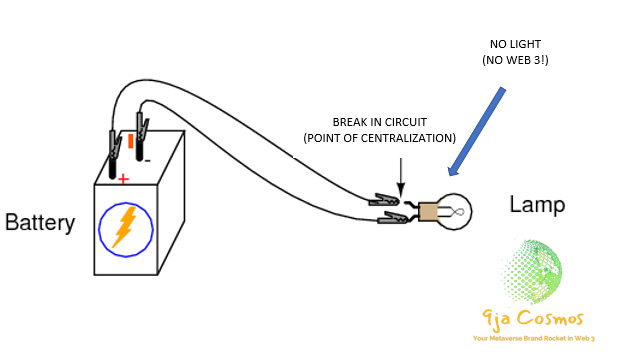
I like the analogy of a simple circuit with a battery, two wires and a bulb. Web 3 analogy is the state of the bulb being lit.
The battery is not a Web 3 battery; The wires are not Web 3 wires. Wires and batteries can be used for many things.
In this way then, it is incorrect to use ‘Web 3’ as a prefix or adjective through which other things are defined. Web 3 can’t define anything. It is ephemeral in nature.
Web 3 fails to happen as a result of a point of centralization in the user journey. This is the equivalent of a break in the circuit.’


Examples of Web 3 obstruction/failure – use of (centralized) ICANN domain names, CEX’s for trading currencies, or storing keys/hashes off-chain in eth scaling solutions and protocol architectures.

When a UX exhibits Web 3 characteristics, the exclusion of certain undesirable phenomena are enforced:

Hacking

Regulatory Encroachment

Litigation and other hostile corporate actions

Fraud and Embezzlement.

Corporate Espionage.

The corollary of these is, should any of these phenomena successfully present themselves, then what has happened for the user, was NOT Web 3.

One of my close connections on LinkedIn recently said in response to a post that the SEC (under Gensler) was ‘chopping Web3 off at the knees’…

You see, the human body has a lot of parts that are actually made up of dead cells the moment they are born. This includes hair, finger nails, toe nails, and the outer layer of skin called the ‘epidermis’.

Nails and hair do not hurt when cut. The sensation felt by the touch of skin only happens because the epidermis itself is generally very thin, and the touch can impact on nerves in the physiology underneath.

While these ‘dead things’ provide the body with some functions with a minimal presence, they can cause huge problems in a human ecosystem when allowed to grow unchecked.

Out of control hair creates an environment to trap infection carrying detritus and provide a habitat for bugs and lice. Decaying epidermal detritus is kept in check with some moderate level of scrubbing while showering or bathing. Failure to do so can lead to skin cancers and other ailments. Unkept finger nails can harbour harmful bacteria, while toe nails in addition can grow inwards, causing painful conditions, which can ultimately result in a toe being lost to amputation.

Web 3 is no longer a young child, and at this stage is more like an elderly vagrant experiencing the ills of social exclusion.

Web 3 has a lot of problems with these ‘dead things’ growing unchecked.

It’s unfair to be saying ‘good old Gary’ has cut Web 3 off at the knees… at most he’s just providing a nails boutique, and also giving it a haircut.

This has been cutting out a lot of the out-of-control dead stuff, the things that are actually not Web 3.

The problem at the moment is that people are attaching ‘brands’ to things that do not enable Web 3. In fact, they are 100% brand and 0% Web 3.

In a recent post, Brian Naughton said: ‘We all enjoy hating on Gary Gensler… I suspect our vitriol is unproductive: My impression is that SEC staff are not just taking orders from the top. Instead, they are likely making a good-faith effort to protect investors by applying current law the best they can’

The way the SEC is going… all the CEXs that are dumping loads of tokens from their trade portfolios…. mostly ‘0x’ stuff.

Zhao though he was being clever trying to be a Robin Hood (pun not intended!) taking interest in the demise of FTX… it backfired on him and now he is enemy no. 1.

Now Wyatt is trying to be the darling of US political enquiries and regulation regimes making himself available for ‘free advice, and testimony’….

These are not communities you cosy up to, and it could easily end badly for him as well.

He will get away with it for a while due to the perception of being a ‘blue blood American’ but it will come a time when they all get bored with the Zhao thing, and they will be looking for someone new to get in the cross hairs.

Political animals need a constant stream of scape goats to create the noise that keeps them relevant and wins elections.

And any layer built on top of Eth is just ‘roadkill’ lying there, waiting for the political or regulatory scavenger to move in

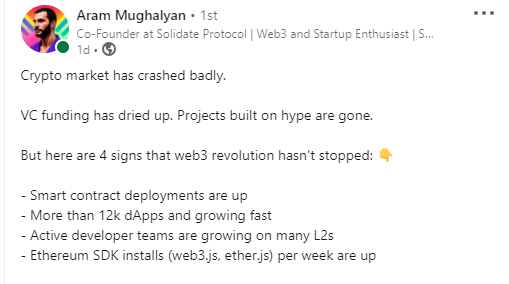
Aram’s post suggests optimism? But should it be thought of as that, really?

Folk are looking at what Gensler is doing, and they are saying OK… and they they just go back to what they were doing before, like as if nothing is happening…. more ‘fake’ Web3.

Its like living in California and thinking earthquakes only happen to ‘someone else’ or flash fires just happen to ‘someone else’ and the SEC is way more of a certainty than flash fires or earthquakes can ever be.

Now some folk from the ‘fake Web 3′ crew have gone and lobbied to have Republican politicians going after Genslers’ head. Rep. Warren Davidson, R-Ohio, and House Majority Whip Tom Emmer, R-Minnesota, introduced a bill

“U.S. capital markets must be protected from a tyrannical Chairman, including the current one,” Davidson said.

“That’s why I’m introducing legislation to fix the ongoing abuse of power and ensure protection that is in the best interest of the market for years to come,” he continued. “It’s time for real reform and to fire Gary Gensler as Chair of the SEC.”

Is this really required?

Gensler is showing us what the difference is between building on a strong foundation, and building on sands that can be washed away.

Instead of lamenting his actions, we should be doing two things…

  1. Thanking him for showing us the difference between sand and good bedrock
  2. Stop building on sand

We may need folk like Gensler around to stop fake Web 3, and to prevent ‘real’ Web 3 from needing serious chiropody to prevent it from losing toes, and that haircut literally costing an arm and a leg!

9ja Cosmos is here…

Get your .9jacom and .9javerse Web 3 domains  for $2 at:

.9jacom Domains

.9javerse Domains

All reference sites accessed 13-14/06/2023


foxnews.com/politics/house-republicans-introduce-bill-remove-sec-chair-gary-gensler

u.today/plot-to-remove-sec-chair-set-heres-how

linkedin.com/posts/arammughalyan_crypto-market-has-crashed-badly-vc-funding-activity-7073912219725430784-5jI2?

linkedin.com/newsletters/blockworks-daily-newsletter-6970764659159158784/

linkedin.com/feed/update/urn:li:activity:7072288123614871552?utm_source=share

Examining the Legal Framework Surrounding Online Poker in South Africa

0

The history of poker in South Africa is long and fascinating. The game was introduced in the country by early European settlers and has since built up a strong following amongst its citizens. Nevertheless, despite the game’s rich history in the nation, its legal status has been far from clear.

When the country first announced its initial gambling laws, most casino games, including poker, were considered illegal. However, a licensing system introduced in the 70s provided room for the legalization of certain games, and luckily, poker fell into the category. But then came online poker in the late 90s, the new technology that took the world by surprise, and while it took several years for online poker to gain traction in South Africa, it finally did in the early 2010s. Since then, the country has become one of the fastest-growing online poker hubs in Africa.

However, this growth has been heavily stunted by the very complicated regulations surrounding online poker in the country. Here, we’ll examine the legal framework surrounding online poker in South Africa and how the various regulations have shaped the industry. Read through to uncover the thrilling world of South African online poker.

History and Current Legal Status of Online Poker in South Africa

In 2004, the National Gambling Act was introduced in South Africa to replace the country’s outdated and inadequate gambling regulations. This was after the boom of online gambling and online poker in the country. According to The National Gambling Act 2004, all forms of online gambling were illegal, including online poker.

However, this Act did little or nothing to stop the fast-growing technology, and in a bid to cash in on the substantial annual revenue generated from online poker, the National Gambling Amendment Act of 2008 was published. With this Act, online casino games like poker would be legalized, and platforms would have to obtain a license from the government to operate.

Despite the multiple benefits of this Act, it was heavily confronted by anti-money laundering agencies and land-based casino operators who feared that the legalization of online poker would affect their revenue stream. After a prolonged legal battle, the Act was abandoned, but the industry continued to grow, albeit slowly.

In late August 2010, the North Gauteng High Court ruled a final judgment on the legality of online gambling in the country. According to the ruling, any form of online gambling was illegal, even if they were hosted on servers outside the country’s borders. Unlike other gambling regulations that targeted only site operators, the ruling confirmed that even players who played poker on these sites were in danger of the law. Guilty parties could face up to 10 years in prison or pay a hefty R10 million fine.

Online in Poker in South Africa, What You Must Know

Recently, there have been talks about reviewing the National Gambling Amendment Act of 2008 to give room for interactive gambling like online poker; however, no concrete conclusion has been reached.

Also, the 2010 court ruling did not explicitly specify the types of online gambling that were considered illegal.

In most countries, online poker rules are usually separated from other online gambling rules due to their nature. Operators and poker fans have managed to exploit this gray area. Currently, dozens of online poker sites offer services to players in South Africa, and so far, nobody has gotten into trouble with the government.

What the Future Holds for Online Poker in South Africa 

Online poker is fast growing around the world, especially in Africa. It’s now becoming increasingly difficult for countries to ignore the immense economic benefits of legalization, and soon, the South African government will have to sit and have that conversation.

Early this year, Geordin Hill-Lewis, a member of the South African Parliament, urged the government to take another look at the abandoned National Gambling Amendment of 2008. He later went on to introduce his Remote Gambling Act which is still being debated in Parliament today. This Act would revolutionize the online poker scene in South Africa and provide easier access to online poker and more revenue for the government.

The Bottom Line

Online Poker regulations in South Africa are a topic that has generated several debates in recent years. While many claim that the law prohibits all forms of online gambling, others argue that online poker wasn’t explicitly mentioned.

Nevertheless, the country doesn’t offer licenses to online poker sites, and players have to rely on offshore sites to play. So far, there have been no legal issues for players who play at offshore sites.