
DD
MM
YYYY

PAGES

DD
MM
YYYY

spot_img

PAGES

Home Blog Page 5

How Political Elections Work in the Modern World

0

Understanding modern political elections requires a look at how voting systems, technology, and public participation intersect. Across the globe, democratic frameworks rely on complex processes to translate citizen choices into governing authority. From local council seats to national leadership, every election relies on structured rules, digital tools, and active voter engagement.

Modern Campaign Strategies and Digital Outreach

Political campaigns no longer rely solely on door-to-door canvassing or television advertisements to reach voters. Digital infrastructure now forms the backbone of modern political messaging and voter contact initiatives. Campaigns leverage granular data analytics to identify key demographics and deliver tailored messaging across online networks.

Direct communication has shifted toward mobile technology to keep supporters informed and engaged. Utilizing a texting platform for political campaigns allows candidate teams to send rapid updates, coordinate local volunteer efforts, and drive grassroots fundraising efforts. This direct channel creates instant touchpoints between campaign headquarters and individual voters.

Digital communication strategies help campaigns maintain momentum during fast-paced election cycles. Fast outreach ensures that campaign teams can respond quickly to breaking news and key political developments.

The Role of Data Analytics in Voter Targeting

Data collection has transformed how political strategists map out their paths to victory. Modern campaigns gather public records, consumer habits, and online engagement metrics to build detailed voter profiles.

Strategists use this information to direct limited resources where they will have the highest impact:

  • Identifying undecided voters who require targeted persuasive messaging
  • Pinpointing reliable supporters to maximize election day turnout
  • Mapping out key geographic districts that could flip the overall election outcome
  • Tailoring policy discussions to match the primary concerns of specific neighborhoods

Precise targeting ensures that campaign budgets are spent efficiently rather than on broad, untargeted outreach. This analytical approach drives decisions on everything from event locations to digital ad placements.

Voter Identification and Polling Place Security

Securing the integrity of the voting process remains a central focus for election administrators. Standardized voter verification protocols help ensure that every cast ballot complies with state and national regulations.

Requirements at the ballot box have steadily expanded across many regions. A study analyzing voter experiences indicated that 85% of in-person voters presented valid identification before casting a ballot. This reflects a clear increase compared to election cycles from a decade ago.

Implementing clear identification rules aims to build public trust in election outcomes. Local officials balance these security steps with efforts to ensure legal voters face no unnecessary barriers.

Shifting Demographics and Electorate Behavior

Changing population dynamics continuously reshape the political terrain and alter winning campaign formulas. Younger generations are expanding their footprint within the active voting bloc every year.

An analysis of campaign strategy trends pointed out that Gen Z and Millennials will make up a significantly larger share of the active electorate. This generational shift forces political organizations to update their policy focus and communication channels.

Younger voters often prioritize different societal issues than older cohorts, influencing party platforms. Adapting to these demographic changes is vital for any long-term political movement.

Campaign Finance and Advertising Budgets

Running a competitive political campaign requires substantial financial backing to fund staff, travel, and media buys. Advertising consumes the largest portion of most campaign budgets, with digital placements taking an ever-growing share.

Timing these financial investments is critical to maximizing voter influence. Industry research tracking digital advertising spending revealed that 48% of digital ad budgets were used during the final 30 days before Election Day. Nearly half of those late-stage funds were concentrated within the final 10 days.

This heavy end-of-cycle spending targets voters when they are most focused on making their final decisions. Capitalizing on late momentum can often make the difference in close contests.

Youth Voting Preferences and Methods

Younger citizens participate in elections using a wide variety of voting channels depending on local access laws. Understanding these preferences helps civic groups design better voting awareness programs.

An investigation into youth voting patterns showed that 37% of young voters cast their ballots in person on Election Day. Meanwhile, 25% voted early in person, 28% submitted mail-in ballots, and 10% utilized designated drop boxes.

These figures demonstrate that young voters take advantage of flexible voting infrastructure when it is available. Tailoring outreach to these distinct methods helps boost turnout among younger demographics.

Voter Turnout Versus Persuasion Dynamics

Campaign strategists frequently debate whether to focus resources on persuading undecided voters or mobilizing existing supporters. While changing minds is valuable, securing high voter attendance often determines the final result.

A report on campaign strategy noted that while persuasion remains a factor, the majority of modern elections are ultimately decided by voter turnout. Getting known supporters to actually submit their ballots often yields better results than attempting to convert opposing partisans.

The mechanics of modern elections rely on a balance of established democratic rules, evolving technology, and changing voter habits. As campaigns adopt new digital outreach tools and analytical methods, the core objective remains unchanged: reaching citizens and encouraging them to exercise their right to vote.

Exploding Squishy Toys Put Kids at Risk as Parents Warned of Burns and Toxic Exposure

0

Squishy toys are soft, colorful and endlessly squeezable, designed to give children a tactile distraction that can be calming, entertaining and strangely addictive. But as their popularity has exploded, so too has a darker problem: some squishy toys can become dangerous when they rupture, overheat or break apart.

Reports this year of children suffering burns and potential toxic exposure have transformed what looked like an innocent playground trend into a consumer-safety concern.

Parents who bought the toys for entertainment or sensory stimulation have instead found themselves dealing with injuries and questions about what exactly is inside the products their children are handling.

The central problem is that not every squishy toy is made the same way. Products sold under the same broad category can contain different materials, fillings and chemical components.

Some are designed to expand, glow, stretch or change shape, creating additional opportunities for the outer casing to fail. When a toy splits open, its contents can come into contact with a child’s skin, eyes or mouth.

Heat can make the situation more serious. A toy exposed to high temperatures or subjected to repeated pressure may rupture unexpectedly. For a child, that can turn an ordinary moment of play into an emergency.

Parents interviewed about the phenomenon have described the unsettling speed with which these toys can spread. One child brings a popular squishy to school, another wants one, and soon an entire classroom may be carrying them.

Social media accelerates that cycle. A toy can move from an obscure product to a must-have item almost overnight, long before parents or regulators have enough information to evaluate its risks. That creates a difficult challenge for doctors and regulators.

Medical professionals are primarily concerned with treating injuries and identifying possible exposures, while consumer-safety authorities must determine whether particular products violate safety standards or require recalls.

The distinction matters because a dangerous incident involving one product does not necessarily mean every squishy toy presents the same risk.

For parents, that nuance can be difficult to navigate. The safest approach is to examine the product before giving it to a child. Parents should check packaging for age recommendations, manufacturer information and safety warnings.

Damaged toys should be discarded rather than repaired and returned to play. Children should also be discouraged from biting, cutting or deliberately puncturing squishy toys. Particular caution is warranted when a toy contains an unidentified liquid, gel or powder.

If a product ruptures, children should not touch or taste the spilled material. Parents should wash exposed skin and seek medical advice if a child experiences burning, irritation, breathing difficulties or other concerning symptoms.

The broader lesson extends beyond squishies. Children’s products can become viral commodities faster than families can investigate their safety. A toy’s popularity, attractive packaging or presence on a major marketplace does not automatically establish that it is safe for every child or circumstance.

Squishy mania is therefore more than a story about one fashionable toy. It is a reminder that consumer safety has to keep pace with internet-driven trends. When a product becomes ubiquitous among children almost overnight, regulators, manufacturers, retailers and parents all face the same responsibility.

China’s CXMT Says New DRAM Platform Enters Mass Production, Challenging Samsung and SK Hynix

0

Chinese memory-chip maker CXMT said Sunday that its fifth-generation technology platform has entered mass production, marking a significant advance in Beijing’s effort to build a domestic competitor to Samsung Electronics, SK Hynix and Micron Technology in the global DRAM market.

The Hefei-based company said the new platform can produce more powerful memory chips at lower cost and with lower power consumption, giving Chinese electronics manufacturers another domestic source of DRAM for smartphones and other devices.

The announcement is particularly significant because DRAM is a foundational component of modern electronics. It provides the short-term working memory used by smartphones, computers, servers, and other devices to run applications and process data.

CXMT is China’s leading DRAM producer and has been expanding its technological capabilities as Beijing pushes to reduce the country’s dependence on foreign semiconductor suppliers. The company listed on Shanghai’s STAR Market this year, giving it access to domestic capital as it expands production.

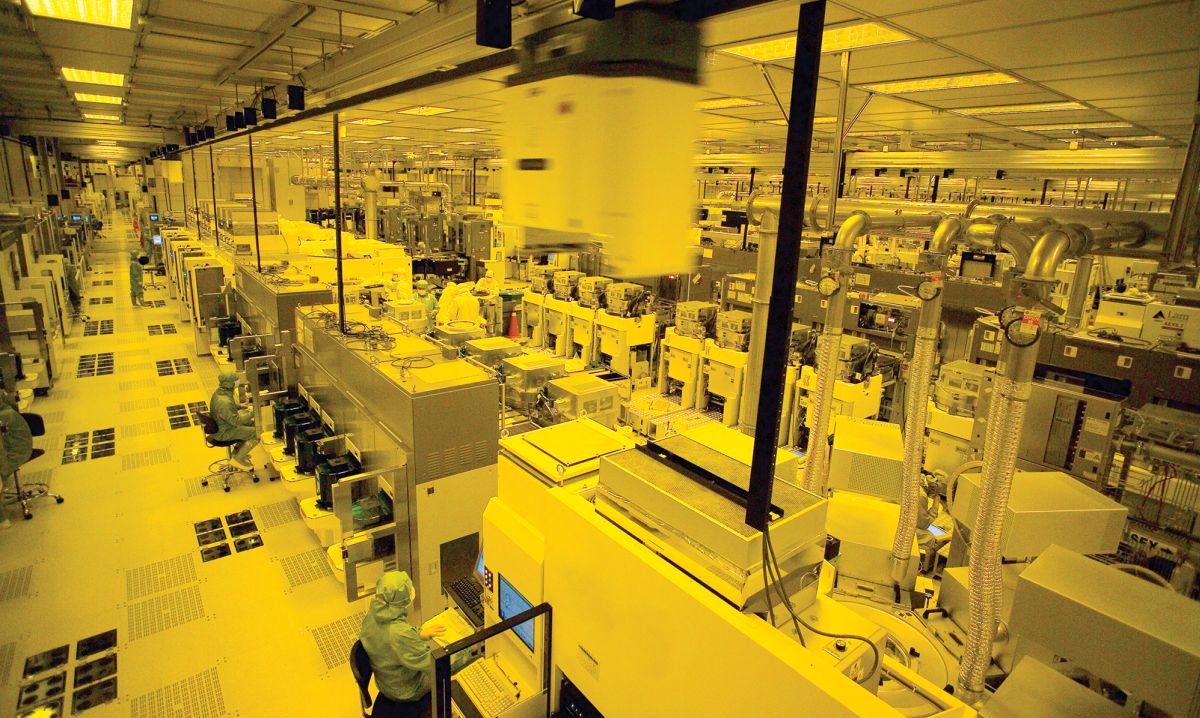
The fifth-generation platform is designed to improve both chip density and manufacturing efficiency. CXMT said it has reduced the spacing of key features in the data-storage portion of its chips to 11.95 nanometers, allowing more memory to be packed into each chip and more individual dies to be produced from every silicon wafer.

The company said it achieved the advance using quadruple patterning, a manufacturing technique that repeats lithography steps to create fine circuit patterns.

“Our process capability is now on par with the most advanced mass-produced nodes out there in the industry,” Luo Xiaodong, CXMT’s vice president and head of its marketing center, said at the 2026 World Manufacturing Convention in Hefei.

That claim, if sustained in commercial production, would narrow an important technological gap between CXMT and the established global memory-chip leaders.

CXMT Targets Smartphone Memory Market

CXMT also unveiled two 24-gigabit LPDDR5X products manufactured using the new platform. LPDDR5X is a low-power form of DRAM widely used in smartphones and other portable electronics. The company said the new products can hold 50% more data than its previous equivalent products and have already entered mass production. They are available in two package formats intended for different smartphone and portable-device designs.

CXMT said the new manufacturing platform can generate at least 50% more gross chip dies per wafer than its fourth-generation technology, based on an 8-gigabit chip baseline. The figure is important because wafer productivity directly affects the economics of semiconductor manufacturing. Producing more dies from each wafer can lower the amount of silicon required for every chip and potentially improve manufacturing costs.

CXMT clarified that the 50% increase refers to the gross number of potential dies produced from a wafer before defective chips are removed. It therefore does not represent a 50% increase in the proportion of chips that successfully pass final testing.

The company said it developed the new platform through computer simulations and cooperation with Chinese semiconductor equipment manufacturers on critical production processes.

That approach is also considered bold and defiant in the context of U.S. restrictions on China’s semiconductor industry.

Since 2022, Washington has tightened export controls covering advanced semiconductor manufacturing equipment, software and other technologies that China can access. The restrictions have complicated Beijing’s efforts to develop cutting-edge chips using the same equipment and production ecosystems available to companies in South Korea, Taiwan and the United States.

CXMT’s progress therefore represents more than a commercial push into the memory market. Many see it also as a test of whether Chinese semiconductor manufacturers can continue advancing through domestic engineering, equipment development and manufacturing improvements while operating with more limited access to foreign technology.

A Bigger Challenge for Global Memory Makers

Samsung, SK Hynix and Micron currently dominate the global DRAM industry, making CXMT’s expansion a potential source of additional competition in a market where manufacturing scale and technological sophistication are critical.

But the emergence of a larger Chinese supplier could have implications for both prices and supply chains, particularly in lower-power memory used in consumer electronics.

CXMT’s latest products are initially focused on smartphones and other portable devices rather than demonstrating that the company has matched the leaders across every segment of the DRAM market. The company’s claim that its process capability is comparable with advanced mass-produced nodes is also a company statement rather than an independently verified assessment.

Still, moving a new technology platform into mass production is materially different from demonstrating a chip in a laboratory or announcing a prototype. It suggests CXMT has reached a stage where the technology can be incorporated into commercial manufacturing at scale.

The economics of that production will ultimately determine how significant the advance becomes.

China remains one of the world’s largest electronics manufacturing hubs, creating a large potential domestic market for locally produced memory. Chinese smartphone and electronics manufacturers could benefit from having an additional supplier, while CXMT can use domestic demand to increase production volumes and gather manufacturing experience.

The company is also entering the market at a time when memory has become increasingly important to the artificial intelligence industry. DRAM and higher-performance memory technologies are essential components of the computing systems used in data centers, although the requirements of AI accelerators are increasingly centered on high-bandwidth memory, or HBM, a more specialized segment where Samsung and SK Hynix remain major players.

CXMT’s progress does not immediately translate into a challenge across the entire memory industry. But a stronger domestic DRAM producer gives China a broader foundation from which to develop more advanced memory technologies.

That is precisely what makes the company’s fifth-generation platform important to Beijing’s wider semiconductor ambitions. China is not simply trying to replace individual imported chips. It is attempting to develop a complete domestic semiconductor ecosystem spanning chip design, manufacturing, equipment and materials.

CXMT’s ability to increase the number of dies produced from each wafer while reducing feature spacing points to progress on the manufacturing side of that effort.

However, industry analysts say the next test will be whether those gains can translate into reliable yields, competitive costs and sustained commercial volumes. If CXMT can achieve those targets, the company could become a more significant force in global DRAM supply and further reduce Chinese electronics manufacturers’ dependence on Samsung, SK Hynix and Micron.

This means for the established memory leaders, another competitive variable in an industry already undergoing a major investment cycle driven by smartphones, data centers and AI infrastructure.

The Quantum Threat to Bitcoin, Digital Assets and Modern Cryptography

0

The most unsettling part of the quantum-security problem is not that a sufficiently powerful quantum computer might eventually break today’s cryptography. It is that defenders have to prepare for an attack whose technological timetable remains uncertain while the information being protected is already moving through hostile networks.

The U.S. National Institute of Standards and Technology (NIST) has been pushing organizations toward post-quantum cryptography, with the broader U.S. government transition goal aimed at mitigating quantum risk by 2035.

NIST’s transition work calls for quantum-vulnerable algorithms to be deprecated and ultimately removed from its standards by 2035, with higher-risk systems moving earlier.

That deadline, however, should not be interpreted as a countdown clock for attackers. NIST itself warns about “harvest now, decrypt later”: adversaries can collect encrypted information today and retain it until technology capable of breaking the underlying cryptography becomes available.

For information whose value lasts for years—government records, intellectual property, financial data, military communications or sensitive corporate research—the attack can begin long before the encryption is actually defeated. This creates an uncomfortable asymmetry.

Defenders think in terms of migration schedules, software upgrades, procurement cycles and compliance deadlines. Attackers think in terms of opportunity.

That distinction matters when considering claims that adversaries are already combining artificial intelligence, quantum annealing and specialized computing hardware to break modern cryptographic keys today.

Such claims should be treated carefully. There is no public evidence establishing that existing AI systems, quantum annealers and post-halving ASIC mining machines can collectively defeat the cryptographic algorithms targeted by NIST’s post-quantum transition.

NIST continues to describe cryptographically relevant quantum computers as a future capability, with experts disagreeing substantially about when such machines could arrive. But dismissing the problem because a universal quantum computer has not arrived would also miss the larger security lesson.

Attackers do not need to reproduce a textbook attack exactly as cryptographers imagined it. They can combine weaknesses across systems. Poor key management, vulnerable implementations, stolen credentials, side-channel information, exposed infrastructure and conventional computing can all reduce the amount of cryptographic work an adversary actually needs to perform.

That is why the post-quantum transition is about more than quantum computers. NIST has already finalized three post-quantum standards—ML-KEM, ML-DSA and SLH-DSA—and explicitly encourages organizations to begin migration now.

The agency’s guidance recognizes that replacing cryptographic infrastructure is a long process involving hardware, software, protocols, vendors and inventories of where vulnerable algorithms are being used. For financial markets and digital assets, the stakes are particularly high. Public-key cryptography sits beneath authentication, secure communications and digital signatures.

A future ability to derive private keys from public information could transform an abstract cryptographic vulnerability into an ownership problem: accounts, certificates, wallets and other cryptographically secured assets could become targets. The critical question, therefore, is not whether someone has secretly built a machine capable of breaking everything today.

There is no verified public evidence for that claim. The more immediate question is whether organizations are migrating quickly enough that tomorrow’s breakthrough—whenever it arrives—does not turn today’s encrypted infrastructure into tomorrow’s exposed attack surface.

In cybersecurity, the deadline is rarely the moment the threat begins. It is usually the moment preparation can no longer be postponed.

OpenAI Projects $278 Billion Cash Burn Through 2030 as AI Infrastructure Costs Soar

0

OpenAI expects to burn through $278 billion in cash between 2026 and 2030 as it pours money into computing power and infrastructure, underscoring the extraordinary capital requirements behind the race to build and operate powerful artificial intelligence systems.

The projection, reported by the Financial Times on Friday based on a company presentation, highlights the scale of funding OpenAI will need to sustain its expansion even as it forecasts a tenfold increase in revenue over the same period.

The ChatGPT maker expects revenue to rise from $36 billion in 2026 to $350 billion in 2030, while generating cumulative revenue of about $840 billion through the end of the decade. But those gains would come alongside an enormous infrastructure bill.

OpenAI forecasts spending roughly $856 billion on computing power and infrastructure through 2030, making the category by far its largest expense, according to the FT. The company expects cumulative negative free cash flow of $278 billion over the five-year period as it invests heavily in the capacity required to train and run its AI models.

The figures illustrate the unusual economics of the current AI boom. OpenAI is projecting explosive revenue growth, but the computing infrastructure required to support that growth is expanding almost as aggressively. The company is effectively betting that demand for AI services will eventually scale fast enough to absorb the enormous cost of the servers, chips, data centers and energy needed to operate them.

That creates a substantial financing requirement.

OpenAI raised $122 billion in March at an $852 billion valuation. The company is nevertheless projected to exhaust that cash by 2028 if spending follows the trajectory outlined in its presentation.

The funding challenge comes as OpenAI explores additional capital at an even higher valuation. The FT reported earlier this week that the company has held discussions with investors that could value it at around $1.2 trillion ahead of a potential public listing.

OpenAI confidentially filed for an initial public offering in June, although CEO Sam Altman said on Saturday that the company would not go public in 2026, citing concerns about AI safety.

The projected cash burn also provides a clearer picture of why the AI industry’s infrastructure race has increasingly become a capital markets story. The largest AI developers are not simply competing on model performance. They are competing to secure long-term access to the computing capacity needed to serve rapidly growing numbers of users and enterprise customers.

The financial challenge is huge for OpenAI because much of the expected spending must occur before the corresponding revenue is realized. Building or securing data-center capacity, purchasing computing resources, and developing sophisticated AI models require substantial upfront commitments, while the commercial return depends on continued growth in usage and pricing.

The company’s forecast assumes that revenue will increase from $36 billion to $350 billion in just four years after 2026. That would represent an increase of more than ninefold, meaning OpenAI’s financial model depends on the AI market expanding rapidly enough to support both its own growth and the infrastructure investments required to deliver it.

The numbers also show why the economics of AI cannot be judged solely by headline revenue growth. A company can grow sales rapidly while still consuming enormous amounts of capital if computing and infrastructure costs rise faster than operating cash generation.

OpenAI’s projected $278 billion cumulative negative free cash flow therefore puts greater emphasis on its ability to convert AI adoption into durable cash generation. If demand grows as projected, the company’s infrastructure commitments could provide the capacity needed to support a much larger business. If growth falls short, the scale of those commitments could become a significant financial burden.

For now, OpenAI’s projections point to a business that is still in an investment-intensive phase. The company is forecasting hundreds of billions of dollars in future revenue, but it is also preparing to spend hundreds of billions more to build the computing foundation required to generate it.