DD
MM
YYYY

PAGES

DD
MM
YYYY

spot_img

PAGES

Home Blog Page 5050

Christain Religion fanaticism in Nigeria

0

Religion is the greatest menace plaguing Nigerian society. Surprisingly, our problem is not even politics but religion. Some religions are raising cult groups, fanatics, and extremists, those that can kill and cause mayhem and would not mind clearing off entire mankind or go any length in the fight and defense of their religion. 

When we talk about religious extremism and fanaticism, people cast their minds first to the Islam religion but surprisingly, Islam is not the only religion with some sects being fanatics and extremists; some Christian religious groups are arguable raising extremists who if care is not taken will soon start taking up arms to cause havoc all in the name of fighting for their god, fighting for their leader or in defense of their church. 

Some Christian religious leaders are raising cult members, feeding their minds, and feasting their souls with adulterated doctrines of the Christian faith, some have turned some of the followers into violent extremists waiting to explode at any slightest opportunity. 

What happened in Adoration ground on Sunday is a recent case study on how some of the Christain religious groups if not bridled may blow up into terrible violent groups who can do anything, “anything” in defense of their leader or church. 

The protest that was staged on Sunday by the members of the adoration ministry or “adorers” (as they are fondly called) for the fact that the higher authority of the catholic religion in Enugu state decided to call the adoration ministry spiritual director to order should be a cause to worry about. 

Background to the story: Adoration Ministry is a religious group that was founded by Father Ejike Mbaka and is located in Enugu State, Nigeria. Father Mbaka as he is famously called is fond of getting involved in politics and telling his followers who to vote and who not to vote during the elections period, sometimes, he publicly insults politicians and lays curses on them in his church before the worshippers. 

The story goes that he (Mbaka) had an unsettled score with Mr. Peter Obi, the former governor of Anambra state and a presidential hopeful under the platform of the labour party and he (Mbaka) got a wind that Peter Obi is contesting for the presidency, he launched a verbal attack on Peter Obi, he stated before his worshippers that Peter Obi is a stingy person and cannot be Nigerian President that a stingy man cannot be a Nigerian president.

Mr. Mbaka, during his weekly ministration service, last Wednesday is quoted to have said emphatically that Mr. Obi will never be the president of Nigeria come 2023 because Obi is a “stingy man who does not give out money to people.”

He said unless Mr. Obi returned to his ministry to apologize for refusing to make a donation to the ministry when he was asked to do so, his ambition to become president of Nigeria would be fruitless.

Many Nigerians, especially the youths who have been the major advocates of Mr. Obi’s emergence as Nigerian President come 2023 severally called out and criticized Mr. Mbaka over his comment on Obi. 

The Enugu Diocese of the Catholic church first disassociated themselves from the comment of Mr. Mbaka and the Bishop of Enugu Diocese, Callistus Onaga subsequently banned Catholic members from attending activities of the Father Mbaka ministry until further notice. 

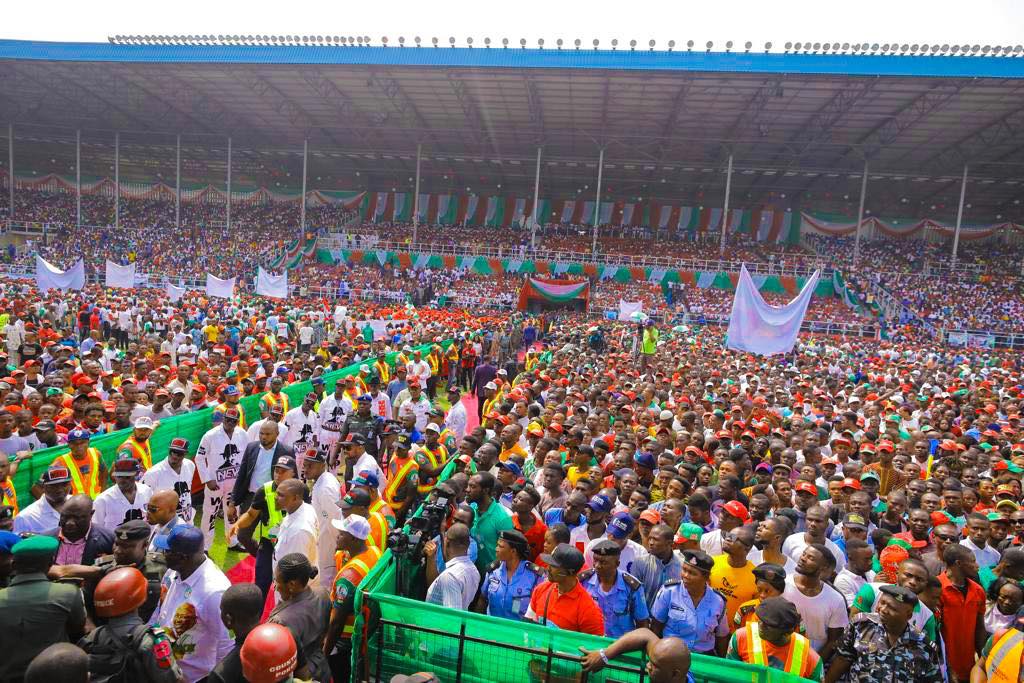
The worshippers of the chapel launched a heated protest on Sunday, protesting against the Bishop, some are even threatening to Kill the Bishop and Kill Peter Obi and some can be heard boldly praying that the Holy spirit should kill the Bishop. 

The fact that a Christain religious group can stage a heated protest against the superior head of their organization for the reason that the superior called their leader to order is troublesome. One will be forced to ask what doctrine are they being taught in their place of worship because the Bible I also read which is the handbook of the Christain religion states: 

“Everyone must submit himself to the governing authorities, for there is no authority except that which God has established. The authorities that exist have been established by God”- Romans 13:1.

Business Growth and Lean Supply Chain At Tekedia Institute

0

The world of commerce is nothing but supply chain. If you improve your supply chain, you can have competitive advantages in the market. That improvement comes with deepening optimization, agility and lean management. Tekedia Institute faculty, Chibueze Noshiri, on Tuesday (Tomorrow) will explain how to design, develop and execute a winning supply chain framework.

Mr Noshiri worked in DHL and UPS where he rose to Global Engineering EUD Manager – Global Logistics. Today, he works in Barry Callebaut Group, Belgium which turns cocoa to chocolate.

He will help us understand how we can accelerate business growth through an efficient supply chain regime.

Tekedia Mini-MBA >> master the mechanics of entrepreneurial capitalism here

OSUN 2022: Opposition Increases Attacks Campaign Strategy Use, Slightly Abandons Issue-Based Campaign

0

The People’s Democratic Party, the Osun state’s main opposition party, has increased its level of deploying attacks campaign strategy while abandoning engaging the electorate on issues and needs that are important. This was revealed in the non-governmental organisation’s most recent report on campaign monitoring in the state.

The sixth report of the monitoring states that political parties and their supporters deployed more attacks than acclaims and defenses, though defensive messages outweighed the acclaimed ones. Specifically, the ruling party aligned with defenses and acclaims than attacks as its strategic communication approaches while the main opposition party largely deployed attacks as a strategy.

“As observed in the previous weeks monitored, attacking the personality of opponents and their political parties remains a strategy deployed by the political parties, though the ruling party has drastically reduced its attack strategy if we consider what was observed in week one of the monitoring. The ruling party remains the only political party that has significantly engaged the public across the campaign issues in the last six weeks. The party has discussed what he has done in the areas of health, social programmes and workers’ salary, welfare and employment more than telling the public what it intended to do differently if elected for another four years. The main opposition party, on the other hand, has relatively engaged the public by discussing issues and needs within agriculture, security and economy more than other expectations of the public.

Also, during the week, opposition parties condemned some policies of the ruling party (e.g., salaries and pensions, roads, education) while the ruling party issued rejoinders to defend itself. This, we believe, is a feature of democratic political contests in as much as the condemnations and the defenses are evidence-based and backed. Having a discussion on local government autonomy by the main opposition party shows that its campaign is being directed to the grassroots. Despite this, issues that cannot influence the potential voters’ decision on July 16, 2022 also appeared in the communication infrastructure of the political parties this week.”

The report further notes that as campaigns get hotter and the election day draws nearer, political thuggery or violence and vote buying keep appearing in discussions of political parties and their supporters. We therefore urge the Independent National Electoral Commission (INEC) to partner with security agents in the state with a view to ensuring lives and property of voters are protected on the election day.

“We also urge the INEC to convene meetings of political stakeholders in the state where issues relating to vote buying and violence alongside the legal penalties for offenders will be discussed. In addition, as election draws nearer, we specifically suggest that the two main political parties convene meetings among their media teams and handlers, and enlighten them on the need for decorum and strategic issue-based campaigns across their online platforms. This, we believe, will reduce the toxic political atmosphere being observed in Osun online-sphere,” the report notes.

Download the full report here

Celebrating the Commonwealth Women’s Forum 2022

0

When I first penned down my women entrepreneurship research in March 2019, Celebrating Women’s Day: A Poem on my Research, little did I realise that I would be reflecting upon that piece more than 3 years on. There are two issues here with a common denominator.

First, my most recent research on a woman businessowner (i.e., Heaven Kigali, Rwanda) highlighted a major pivot which is acknowledged here. Second, the 2022 Commonwealth Womens’ Forum is today and tomorrow, and yes here in Rwanda!

As I pointed out many years ago, or so it seems, “I am pleased to share a timeline of my research on women between 2009 and 2015 – albeit from an entrepreneurship lens.” Let me recount the journey of my research staring with that which published in 2009. This inaugural article on the subject, which is entitled Breaking the glass ceiling in Nigeria: A review of women’s entrepreneurship, explores the relevance of the age-long conundrum known as the glass ceiling as ever more questionable for a number of compelling reasons. First, its root in the invisible barriers (push factors) facing women’s career progression prospects in the corporate world is ever-changing at a rapid pace across every region of the globe. Second, research shows some evidence of a major dramatic increase in women-owned businesses as being attributable to women’s desire to gain more flexibility in their work arrangements (pull factors). By providing a catalogue of pull factors in the context of African (especially Nigerian) women entrepreneurs, this paper surmised that:

the glass ceiling problem may have well been shattered in numerous spheres, and thus become less tenable as a gender-specific reality in the twenty-first century.

The second article entitled Micro-credit for microenterprises? which published in 2010, is a co-authored paper that examines the factors that constrain women petty traders’ access to microcredit, and the innovative measures they have initiated in order to counter these constraints. Based on in?depth interviews with women micro?entrepreneurs drawn from a convenience sample of 20 petty traders in the market town of Awka – the capital of a state in Eastern Nigeria, the paper identifies three main constraints – internal, socio?cultural and policy induced – as the key moderating influences on women petty traders’ ability access to micro?credit. This paper posits that the lack of access to credit promotes market exclusion and deepens the socioeconomic and political vulnerability of women as a consequence.

In the third article entitled Setting an agenda for women entrepreneurship in Nigeria, and published in 2011, the discourse on women in a developing world context is moved from the margins of international obscurity by acknowledging the contributions of reputable academics from an emerging market context on a subject that has pervaded the global podium in recent years – i.e. women in management. Adopting a strictly qualitative stance – a narrative analysis of a single book on women written by “a woman of status” – Dr (Mrs) Faseke, a graduate of the University of Ibadan and one time Head of the Department of History at the Lagos State University (Nigeria). This paper acknowledges:

…the “silent voices” of African women, drawing upon a publication that was encountered purely by chance – Modupe Faseke’s “The Nigerian Woman,” published by Agape Publications (Ibadan, Nigeria) in 2001.

Fourth in the line-up is a co-authored article Broken silence: a commentary on women’s entrepreneurship in the United Arab Emirates, published in 2012, which draws upon the scant literature on women’s entrepreneurship in the United Arab Emirates (UAE). It explores the motivations of women business owners in the country based on 10 in-depth interviews. Considering the patriarchal socio-cultural environmental context associated with the Middle East, a number of surprising dynamics are highlighted in the specific case of the UAE.

Growing numbers of women graduates and businesses are observed, which suggests that the historical silence among this group is gradually being broken and that changes in government policies and the socio-cultural environment are the key drivers behind this evolution.

In the fifth article, this book chapter entitled Women entrepreneurship in sub-Saharan Africa, published in 2014/ 2015, highlights the challenges of women business owners in SSA using in- depth interviews from four different countries. The primary aim of the chapter is to pinpoint shared challenges of women entrepreneurs and/ or business owners drawing upon their narratives and attributions. The chapter unpacks four critical dimensions impacting upon the similarities and/ or differences in experiences – notably:

The owner’s background (nationality, ethnicity, education, family etc.); prior motivations (why they chose to start- up); challenges (including start- up capital, government regulations, personal achievements), and plans for the future.

Sixth, and finally this full case study entitled Heaven Kigali-Knocking on Heaven’s Door, which published in a leading textbook, Strategic Marketing: Creating Competitive Advantage published by Oxford University Press in 2015 highlights the story of Heaven Restaurant & Bar, Kigali (capital city of Rwanda), owned and managed by an American woman who has been doing business in a foreign country since 2006 and navigating the “liability of foreignness”. The case was developed over a 6-month period (June-December 2012), on the back of personal observation and a prolonged in-depth interview with the Entrepreneur. Heaven first came to light as part of a CNN documentary with a focus on developments in Rwanda – dubbed Africa’s Singapore.

Given Rwanda’s tourism plan in its Vision 2020 commitment to improving hospitality and supporting tourism, the story of Heaven, provides an ideal contribution to the realities of doing business abroad and the attendant liability-of-foreignness usually attached to such enterprise. 

The same case was only recently updated in an article Hospitality in Crisis Times: Heaven Kigali Case Study | ICSB | International Council for Small Business

Indeed, further scholarly enquiry on how to cope with the realities of women in business both large, small and everything in-between.

I have since added two more case profiles from Ghana and again Rwanda – notably Alhaji’s Wife Kitchen redefines the Waakye Experience – Tekedia and Pangolin’s Burrows, Kigali, Rwanda: My Encounter with Aileen Lyatuu, CEO – Tekedia

The Coming of Amazon America to Nigeria

2
Amazon has been investing in India

In June 2017, I wrote and asked Amazon to come to Nigeria. I also made a video (below).  The main postulation is this: Amazon has the capacity to become the postal service system in Nigeria that will connect rural and urban Nigeria at scale. Yes, Nigeria needs Amazon to help support its infrastructural development especially in the areas of logistics and transportation.

The rumour is that Amazon is coming to Nigeria. If that is true, that is a big deal. Amazon is more important to Nigeria than Google or Facebook. Why? Amazon has the capacity to unify rural and urban Nigeria through catalytic infrastructure. Nigeria began fading at scale when the postal system collapsed.

Today, there are two generations of Nigeria: those who witnessed a working postal system (and train system) and those who came when everything was gone. If Amazon comes and invests $billions – more than Nigeria’s national budget on logistics and transportation, and opens it to all farmers, shippers, etc via its fulfillment business model, it would be magical. (Sure, the neocolonialism vibes will rise; I get it.)

Read what I wrote in June 2017 when I was dreaming of the impact of Amazon coming to Nigeria, not just to sell cloud services, but run ecommerce operations.

Amazon today is a bank, lending to small companies that sell on its platform. It is also a transformation company with expertise in logistics in the air, sea, and road. With its networks of empires, anyone can live in the Amazon America, eating food from Whole Foods, watching moves from Amazon, reading on the Kindle, buying most things from Amazon. The list goes on. Its impact permeates industrial sectors and anyone it touches, it secures it as Napoleon Bonaparte did when it conquered nations in the 18th century.

From Business Insider leak, Amazon will launch in April 2023. With that, Jumia and Konga will see more competition. This remour differs from another one here which focuses on Amazon Web Services.

  • “Belgium’s marketplace, called Project Red Devil, is slated for late September 2022. The one in Colombia, dubbed Project Salsa, is scheduled for February 2023.
  • “South Africa, codenamed Project Fela, is also expected in February 2023. The marketplace in Nigeria is due to launch in April 2023. That project shares the codename Project Fela with South Africa,” it said.
  • “Chile is planned for April 2023, too. It shares the Project Salsa name with Colombia,” the report added.

All countries are planning to launch with their own marketplace and access to Amazon’s fulfillment service called Fulfillment by Amazon, one of the documents said.

For Amazon, expanding into more countries now makes sense. The company needs to generate more demand, as growth is slowing across the board following a two-year, pandemic-driven sales explosion. Amazon has been scaling back hiring, subleasing warehouse space, and limiting delivery network expansion this year in anticipation of a prolonged slowdown. Onboarding more sellers in new countries may help Amazon fill more of its warehouses, which are dealing with excess capacity after overbuilding facilities during COVID-19 lockdowns.

If this materializes, Amazon’s infrastructure can fix the marginal cost problems for many sellers. I expect Amazon to have an immediate impact as many people can begin selling online, connecting into the logistics apparatus Amazon would be expected to build. It is dropping $5 billion in the Indian market, a fraction of that will help on foundational logistics infrastructure that will help Nigeria.  You can call that Nigeria ecommerce 2.0.

Opportunity for B2C Sector

The reason why ecommerce companies, especially those in B2C, struggle in Nigeria, is  the huge marginal cost on distribution. If Amazon arrives and builds the foundational operating system for logistics, and allows everyone into it, Nigeria will begin the ecommerce 2.0 era. Sure, Amazon will “tax” Nigerian companies and people, but when you aggregate the impact, good things will happen.

Of course, how does it feel for a nation to put its hope on another conglomerate? Nigeria is waiting for Dangote Refinery to fix its currency by substituting the import of fuel. Now, Ndubuisi is hoping for Amazon to fix its ecommerce B2C market by providing logistics.

Do not blame me: this is being pragmatic. Nigeria’s ecommerce B2C market will not scale profitably until we have a postal system; Amazon has a chance to build a quasi-version.  Yet, it is all rumour since Amazon did not confirm the leak! Nonetheless, I hope it comes; Nigeria needs those $billions.

Comment from Feed

Comment: making a case that Google is better for Africa. Google inc has been a great resource to us Africans in both resources and support. For internet savvies it is almost impossible to do anything online without Google and /or it’s product, Amazon inc confirms this superiority. Google has breached the gap of unemployment and providing substantial resource and support to Africans , of which many Nigerians have benefited and can attest to. Virtually everything we do currently on the internet space is directly or indirectly linked to Google. Business may not be recognized if not listed on Google, this include Sme’s and large scale Businesses. As the world has gone hybrid in execution of task and providing meaning service , Google remains the most vital resource to lean on. In comparison, Google is more like Microsoft which will always be a base for all computers in data synchronization, manipulation and analysis. As a beneficiary of Google bootcamp program, I was wowed with numerous Opportunities with Google inc. I am aswell familiar with Amazon inc and its service, but I cannot compare theirs as a better fit to GOOGLE.

My Response:  Fair. Amazon will affect our agriculture in many ways if it can build logistical infrastructure. Agro commands 30% of our GDP. Agro employs 67% of workers in Nigeria. ICT is fine, we are here chatting, but its impact is marginal when compared to agro. If we improve our logistics, we can double food production. 

That will help millions of people, not just a few with smartphones. Google is great but Amazon funds millions of vendors by giving them working capital loans provided they sell. What that means is that if you run a business on Amazon, it can use your sales projections to give you loans; no need to visit any bank. Check AWS which is #1 in Africa – more than 70% of leading startups in Nigeria are in AWS. Most of the things you noted are offered by AWS.

Comment: Prof, is this not an eye opener for Nigerian e-commerce & tech entrepreneurs like you to dare to take the plunge? With your clear-cut explanation of the market dynamics at play, one can see that a “business model” is already looming large in your head. Can’t we, Nigerian e-commerce/tech entrepreneurs, financiers and stakeholders like yourself aggregate your skills and network to deploy this business model/infrastructure and revolutionize our e-commerce logistics value chain? I know this sounds really fantastic compared to actual implementation, and I have nothing against FDIs, but do we keep waiting for foreigners to come discover and reap the hidden riches in our country?

My Response: ecommerce is not making fanciful websites. Ecommerce is buying aircrafts, vehicles, ports, etc to move goods and services. You need to build logistics, warehouses for fulfilment, etc and for that, you may need to spend the budget of Lagos state. I am not sure there is anyone with the heart of that in Nigeria. Amazon Logistics is bigger than FEDEX. You may see a website but behind are planes, vehicles, etc https://www.axios.com/2021/10/21/amazon-shipping-bigger-than-fedex. You need $billions  for such; Amazon spends half of Nigeria’s annual budget (~ $16 billion) on those planes, vehicles… yearly.

Comment: I agree with Joachim Duru Google is more important than Amazon. We resource for ideas….. selling item without the concept of the operation is trash

My Response: More than 70% of startups and digital companies in Nigeria that are worthwhile are powered by Amazon AWS. From Paystack to Flutterwave to Tekedia.com, etc all live on Amazon. If you shut down Amazon, those shiny things will go. Amazon is not just selling things.