
DD
MM
YYYY

PAGES

DD
MM
YYYY

spot_img

PAGES

Home Blog Page 5324

Charles Soludo To Promote Made In Anambra and Igbo Products Nationally And Globally

0

Anambra state governor-elect Prof. Charles Chukwuma Soludo recently spoke on the vision he intends to carry out immediately he resumes office as the governor of Anambra state. The governor-elect promised to revive firms (Akwaete clothing) in Anambra and make innoson his official vehicle.

In his words, “Igbo land is one and we must protect it. We want to bring back the zeal of patronizing our own. I have said it even during campaigns, and I meant it, that if I win, the official car of the governor of Anambra state will be innoson motors”.

While giving this speech, the governor was seen putting on a locally made fabric, known as Akwete, which is produced by Akwete women in Abia State. He emphasized that his outfit was not a coincidence as he did it on purpose to support local firms and also make a statement. In his words, ” My Akwete dress is not just a dress, it is a statement. You know in the entire South-east, this is the only textile alive, and it is handmade. The dresses I will be wearing are those made locally in our place here. We must protect the things that are made in our place. Something is about to happen in Igboland, and together we will get there”.

This statement by Prof. Charles Soludo demonstrates his support and commitment towards supporting Nigerian-made products and the manufacturing sector. This initiative is very commendable, and it will be great if all government officials can take a cue from him. Just recently, the governor of Abia state, Gov. Okezie Ikpeazu was seen rocking a locally made in Aba shoe. I said to myself, “this is how it should be”. Sometimes I feel that most government officials haven’t yet emancipated themselves from mental slavery to think that foreign-made products are more superior and durable to locally made products. This is why Nigeria has been hampered by a high level of importation, with billions of dollars wasted on things that could be produced locally. Over-dependence on the importation of these foreign goods has devalued the Naira and weakened the economy.

This move by Prof. Soludo, if implemented will be beneficial because it will reverse the trend of patronizing foreign-made goods to locally made ones. It will restore confidence in locally made goods. One thing he should ensure to do, is to provide financial and other forms of support needed to manufacturers of these locally made goods so that they will have the needed facilities and equipment to be able to manufacture such goods, especially in very large quantities.

It would be a thing of pride for not just the Igbo Nation but Nigeria as a whole if locally made brands compete with well-known foreign brands. For instance, Innoson motors competing with top brands like Toyota, Nissan, etc, and locally made brands competing with top brands like Zara, Gucci, Louis Vuitton, etc. Once these brands gain not just local dominance but penetrate the foreign market, it will positively impact the economy. Money spent on the importation of these goods will be invested home, which can also lead to the exportation of locally made products.

If only the Nigerian government is visionary enough to see that promoting locally made goods will greatly improve the economy, they will take a cue from Prof. Charles soludo. There are so many creative talents untapped here. Proper investment and patronage will turn things around. Not only will poverty be kept at bay, the teeming youths would not resort to vice in the society, because they would be productively engaged. The economy of any nation grows rapidly when locally made goods are promoted.

The Airtel’s N5.4 Trillion Ascension And the Power of Business Model

1

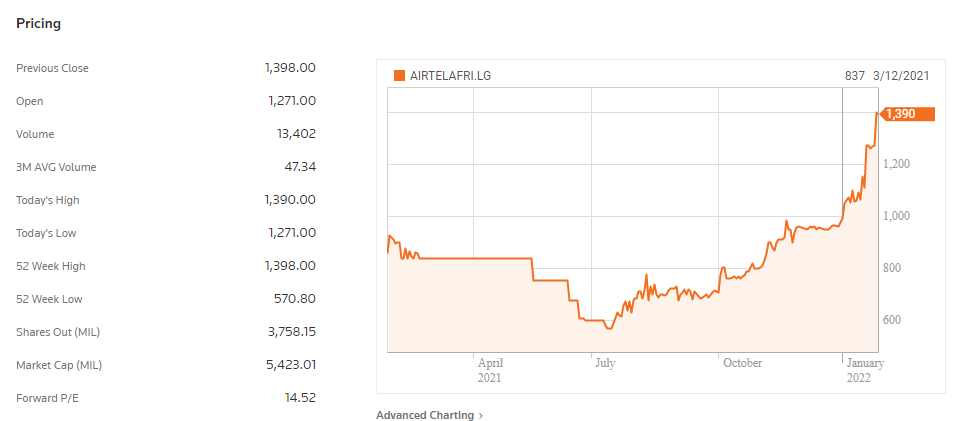
Airtel Africa has hit a market cap of N5.4 trillion and became the most valued public company in Nigeria, eclipsing Dangote Cement, in the elite club of SWOOTs ( stock worth over one trillion naira). But it was not a smooth ride; this company nearly packed up and left for India. Fortunately, some smarts came up with new ideas.

I had written: “Having no alternative, Airtel retooled its business model, and became a quasi-financial institution which offers telecommunication services. Yes, Airtel outsourced some infrastructure components of its business, improving its CAPEX and by doing that, had money to invest on its customers. The result has been superb”.

The Airtel Africa transformation is a great case study of the power of business model. Yes, most times, the problem is not the market but your business model. Blaming customers will not grow the business!

In Tekedia Mini-MBA, I have a brief case study on Airtel Africa, using it to make a case why companies must do all to figure out a working business model. I see Airtel Africa as a quasi-financial institution in the business of telecoms. As a result of that model, it has great ratios.

Congratulations Airtel – the trophy goes to you.

Reuters

Meanwhile, MTN Nigeria continues to lead on the revenue table: “MTN Nigeria Communications Plc (MTNN) has reported turnover in the sum of N1.7 trillion for full-year 2021, a milestone that will help firm up its status as Nigeria’s biggest listed company by revenue.” Yes, MTNN has normalized the more than a trillion naira annual revenue which it began a few years ago.

The Nigerian operation of South African-owned MTN Group attained the new height after the number of its active data users surged by 1.7 million to 34.3 million, helping income from data sales increase by 55.3 per cent to N516 billion.

MTNN cited an extension of its coverage areas for 4G services October through December as the catalyst for the higher earnings from data.

Relative to its figure for 2020, revenue for last year grew by 22.9 per cent.

Airtel Overtakes Dangote Cement, Becomes Nigeria’s Most Capitalized Public Company

Airtel Overtakes Dangote Cement, Becomes Nigeria’s Most Capitalized Public Company

0

A big change came to Nigeria’s stock market this weekend. Airtel Africa has dethroned Dangote Cement as the most capitalized company listed on the Nigerian Stock Exchange, a big move that highlights the growth of the Nigerian telecom sector.

Airtel Africa, like Dangote Cement, is a member of the SWOOT (Stocks Worth Over One Trillion). Since 2021, the second-largest telco in Nigeria has made big moves geared at boosting its growth. These include divestment to payment service with SMARTCASH Payment Service Bank Limited and approval in principle by the Central Bank of Nigeria for Airtel Commerce Nigeria Limited’s super-agent license.

Supported by covid-induced shift to digital life, which ensured stable growth for the telecom industry at the peak of the pandemic, these moves by Airtel are believed to have spurred its leap at NSE, beating other telcos to it.

Airtel Africa crossed the N5 trillion mark on Friday as the stock gained 9.9% to close at N5.4 trillion, marking the first time any Nigerian company has surpassed N5 trillion in Market Capitalization.

Per Nairametrics, the new development came as a result of up and down stock movements for both Airtel Africa and Dangote Cement. Airtel Africa first surpassed Dangote Cement as the most capitalized stock on Thursday after it gained 10% closing at N1,271. Dangote Cement in contrast fell on Thursday by 8.53% from its 52-week high of N284.90 to close the trading session at N260.60, on profit-taking by investors. This saw Dangote’s market capitalization fall by N414.1 billion, from N4.86 trillion to N4.44 trillion. It remained flat on Friday, January 28.

Whereas Airtel on Friday gained another 9.9% taking its share price to N1,390 as it continued its bullish run. Airtel’s share price has now gained over 46% this year on the back of improved operational performance, share buybacks, and investor sentiments, according to Nairametrics.

Nigeria’s telecom industry has remained the best performing sector of the economy despite the SIM registration policy that has hampered its growth, cutting off millions of telecom subscribers. As of October 2021, the telecom industry has lost 9.6% internet subscribers, representing 14.5 million in one year, according to data from Nigerian Communication Commission.

The drop is as a result of the federal government’s directive to telcos to halt sales and activation of SIMs, which took effect from December 2020. Although the government lifted the ban on sales and activation of SIMs in April last year, it mandated the use of National Identification Numbers (NINs) for new SIMs’ registration. That has also impacted the number of telecom subscribers in Nigeria as many potential subscribers are yet to get their NIN.

For internet subscription, MTN recorded the biggest loss of 7.5 million subscribers, representing a drop from N65.76 million in November 2020 to N58.32 million in October 2021. Airtel was also hardly hit, recording a N4.6 million drop in internet users. Subscribers dropped from 41.52 million in November last year to 36.89 million in October 2021.

The Twitter ban which took effect in June last year and lasted until January 2022, was also blamed for the drop in internet usage in Nigeria.

Policies and procedures without enforcement

0

We have talked all about setting a structure for your business and putting policies and standard operating procedures as necessary for building a system that works with or without you. One thing that is as important as all of these is enforcing the policies and procedures that you have put in place.

So, what if you have a hundred and one policies that are only active in writing, and you have failed to enforce them. What do you think you are communicating to your staff? That anything goes, right? Without enforcement, your policies and procedures might as well be non-existent because they will not make any significant difference in your operations.

When policies are not enforced, you weaken the same business structure you are trying to create. if you have delegated a task, let the person get it done. Some business owners may delegate a task and still turn around to do it or delegate it to a second person because they do not trust that the first person will deliver it on time. When you give tasks, allow the person to do it and make it clear that there will be consequences for failing to deliver.

If you have a defined hierarchy of reporting, let it work. Stop butting in every step of the way. If not, you will end up having a structure on paper and not in reality. You will end up having so many staff and team leaders, and still doing everything on your own. This is a quick recipe for burnout. If people are paid to do a job, let them do it. It is the reason they were recruited anyway.

One reason why some business owners are reluctant to enforce policies and processes is that they always want to directly control everything. This could be a serious problem if not addressed. It not only affects the speed of delivery but also creates bottlenecks in your processes.

If you are the only one who controls orders and supplies, what do you think would happen when you are not around? Can the business still run in your absence?

I read a post some time ago that the boss kept keeping the staff away from core business processes, in the fear that they would steal his business idea and become his competitors. I thought it was quite laughable especially since there is hardly any business idea that does not already have a competitor. That is a wrong mindset because it keeps you at one spot, with a business that cannot run without you.

Your business is your baby but at some point, you should let that baby crawl away from you, walk without your assistance, run, grow and become all independent. You have to be able to see the bigger picture. Enforce every policy and procedure. The bigger picture should be a business that outlives you and still thrives.

WhatsApp Desktop Video Does Not Need To Beat Zoom To Be Successful!

1

Great comments by the community on the piece I wrote on WhatsApp Web and WhatsApp Desktop. Largely, the consensus from our community is this: “WhatsApp can’t beat Zoom at the game of video conferencing.” I had noted that the new WhatsApp Desktop app enables users to make calls from their laptops, creating a mini-alternative for Zoom. In other words, if most Zoom calls originate at WhatsApp (and LinkedIn), with this new feature and possible screen-show feature in future, WhatsApp Desktop could go after Zoom.

Our community does not think that WhatsApp has a chance. I agree, but note this : WhatsApp does not need to be as good as Zoom to be successful. The strategy is this: have the one oasis (the core WhatsApp which here is Chat) and try to offer many other features primarily  to reduce the churn, and keep your customers with you. So, provided WhatsApp video is good enough, even if not great, the company has won. Why? That “good enough” can keep say 30% of the users especially for a free product.

In other words, WhatsApp Desktop video does not need to be as great as Zoom to be a success. It simply needs to be good enough to keep many within its ecosystem. So, examining the whole construct that it has to “beat” Zoom may not be the right call. 

Video is Zoom’s one oasis, Chat is WhatsApp’s one oasis; but they will offer marginal features to make it easier for users to enjoy one thing: have many of the things in one place and save themselves the headache of installing and flipping apps. Interestingly, most users appreciate that. That is what WhatsApp is doing – stay here and never leave for another Zoom call. In short, feel free to uninstall Zoom as we have all in one place.

Comment on LinkedIn Feed

Comment: It’s easy to underestimate what WhatsApp could do following this new development.

How can we overlook the fact that WhatsApp has Everyday Utility Value and consequently, it has the users? The other platforms are only borrowing those users. As WhatsApp recaptures its daily users on PCs, businesses will chase after those users, whether they like it or not as businesses tend to gravitate around platforms with large user base.

In my comment on the previous post, I also pointed out that WhatsApp doesn’t need to beat the tier one enterprise communications space. You, however worded it much better “WhatsApp doesn’t need to be as good as Zoom to be successful”, it only needs to be WhatsApp at the PC level.

WhatsApp is not the one competing here, it’s only taking back its rightful place.

My Response: “WhatsApp has Everyday Utility Value and consequently, it has the users” – the morning begins at WhatsApp, not Zoom!

WhatsApp Goes After Emails, Zoom, via Updated WhatsApp Web and Desktop