
DD
MM
YYYY

PAGES

DD
MM
YYYY

spot_img

PAGES

Home Blog Page 5432

The African Edtech Opportunity

0

COVID19 exposed the insubstantialities of the African educational system. For students living in rural communities and low-income households, it was like the end of schooling.  The pandemic has revealed that the most educationally disadvantaged are in the primary school level and they are worse off. While the pandemic has worsened Africa’s educational pains, it has made us coalesce on a single point: we need to move education into the digital age backed by the right policies.

Stakeholders like parents, teachers, education regulatory authorities are beginning to see the value of using contemporary tools to connect African students with learning opportunities. The school closings we have experienced during the lockdowns has taught us all to beat foot-dragging-and urgently apply educational technologies! This would enable us to connect millions of African students to the new world of learning tools and technologies.

That would mean taking out all the impediments involved in bringing less privileged kids to access quality education, anywhere, everywhere. This will boost economic opportunities and will help Africa to benefit from globalization and the accelerated digitalization we have witnessed recently. If we don’t take this wake up call for a new way to learn and bridge this massive digital inequality, we could be setting the stage for social unrest.

Welcome edtech.

Digitalization has brought the future to the present. We can finally bring millions of African children into a new era of tech-enabled learning experiences. Technology use in education will become more widespread as a result of Covid-19, setting the stage for us to build working educational systems for thousands of communities across Africa.

Education technology (EdTech) utilizes technological capabilities to deliver new teaching experiences for an effective day-to-day management of education institutions. It involves the use of hardware and software all designed as an inseparable thread woven throughout the processes of teaching and learning. Regarding hardware such as tablets, laptops or other digital devices), and software that supports teaching, delivers specific needs, and helps the daily running of education institutions (such as management information systems, information sharing platforms and communication tools).

An edtech strategy

EdTech cannot address all our educational problems. Edtech cannot replace schools. We believe that it should complement school attendance. Africa certainly needs an edtech strategy with tech-enabled processes at its core or more so an integrated educational technology strategy that should support working processes that improve our educational outcomes.

The best outcome for the overall growth of Africa’s education will be when critical support is given to both the education sector and the EdTech industry to build on existing good practice and drive further innovation. Any countries’ strategy should be anchored on the following: power the administration processes – cutting on the burden of ‘non-teaching’ tasks; bring efficiencies and effectiveness to the assessment processes, giving fillip to our teaching practices – boosting access, inclusion, and improved educational results for all.

Then there is the need to drive continuous professional development which is by supporting teachers, lecturers and education leaders so they can develop more adaptably. With rapid disruptive technologies occurring, every edtech strategy must incorporate life-long learning, supporting decisions about work or further study and helping those who are not in the formal education system acquire new skills.

Let’s bring learning to the world of social media

Learning is happening on social media platforms. It offers us the opportunity to equip African students with emotional intelligence, critical thinking and problem solving are key skills for the future of work. Learning shouldn’t be rote based alone, we must empower African youth with entrepreneurial mindsets, leveraging engaging interactive storytelling using social media as a delivery infrastructure.

In this disruptive technology age, our learning infrastructure must be transformed to unlock new innovative solutions for Africa’s problems. African education should be driven by a student-led, evidence-based learning combined with well-beingness and lots of career development platform opportunities. In a rapidly changing world, we must arm our youths with a sense of purpose and equip them with forthcoming skills, so they can steer through this rapidly budding world with buoyancy, and drive; as a result fulfill their potential.

New tools for interesting learning

We need African innovators to develop tools for our educators and organizations so we deliver learning at scale. Learning must be personalized and enabled by artificial intelligence with micro courses that aligns with the individual’s needs to improve learning outcomes, industrial-readiness, helping us achieve the urgent need for delivering important knowledge to people in spite of their circumstances.

Because of the massive unemployment in Africa, policy makers must bring our youths into the horizon of employment by harnessing their interest into a strong desire for technical-vocational jobs. Digital platforms that deliver on this through wholesome skills acquisition, industry training programs matched with industry offtaker opportunities could transform Africa’s unemployment market. If we include life-long learning programs with lifestyle products (pension, fintech products etc) we could be on the edge of making every African youth employed or employable.

A STEM of opportunities.

STEM gives us the capacity to understand our world and innovate in ways that improve our living conditions. Africa needs quality STEM to urgently impact productivity and deliver job-led economic growth and development.

Technology is breaking boundaries and we can scale STEM learning through cloud infrastructure. Leveraging the cloud technology giants’ infrastructure could bring in a 3D virtual platform that’s in strong similarity with physical laboratory experience for African students who don’t have access to laboratories.

In conclusion, edtech offers us a big opportunity to catalyze systemic educational change. But we have to move away from technology for technology’s sake, by identifying what works, how it addresses Africa’s unique needs and challenges, adopt and customize new ways and innovations that can deliver results for students, then scale them for the benefit of Africa’s economy. Whatever edtech strategy we seek, we must ensure it addresses the following: equitable access for all African students; enable investments in African teachers’ development; tech-driven processes and equip African students with the skillset to make sense of our rapidly changing world.

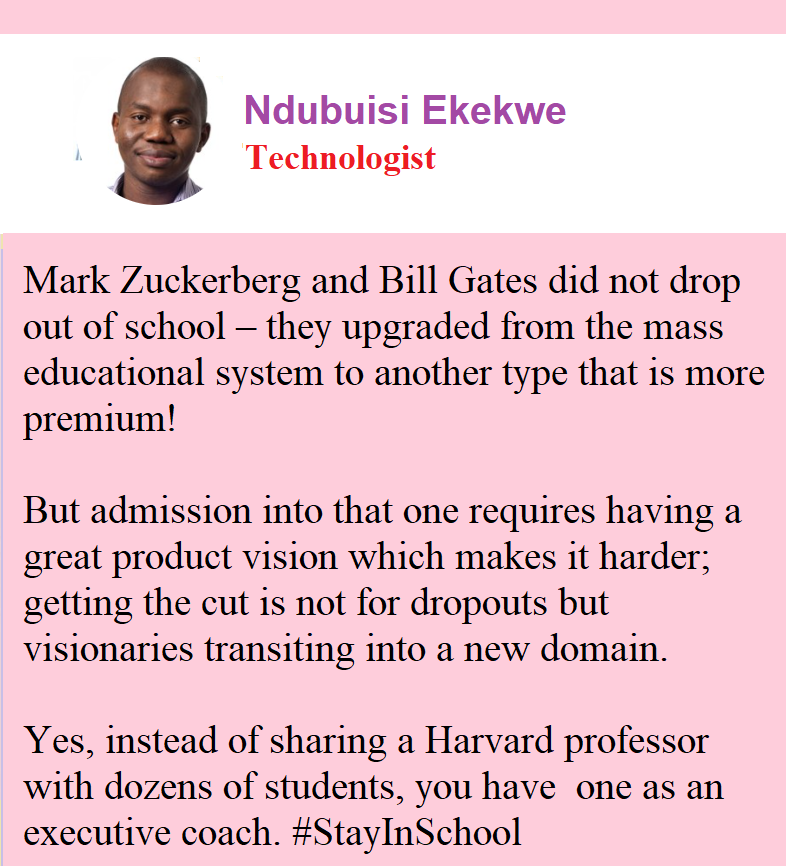
The Illusion in the Billionaire Dropouts

1
Great founders - Mark Zuckerberg (Facebook) and Bill Gates (Microsoft)

Mark Zuckerberg and Bill Gates did not drop out of school – they upgraded from the mass educational system to another type that is more premium!

But admission into that one requires having a great product vision which makes it harder; getting the cut is not for dropouts but visionaries transiting into a new domain.

Yes, instead of sharing a Harvard professor with dozens of students, you have one as an executive coach. #StayInSchool


#StayInSchool – Bill Gates and Mark Zuckerberg Are Not Dropouts


Posted To Go And Die

0

The Council of Legal Education and the Nigerian law school released their law school candidates posting on the late hours of Tuesday, 23rd of November, 2021 for the 2021/2022 batch and thousands of candidates were posted to the northern campuses of Bagauda, Kano and Adamawa, Yola.

The National Youth Service corps too resumed their orientation camp for the Batch C stream II on Wednesday, 24th of November, 2021 and as you already know, thousands prospective Corp members (PCMS) were deployed to core Northern orientation camps that are infamous for their insecurity issues and other high security threat zones.

Why will Council of Legal Education and National youth service corps keep posting young and innocent candidates to the core north despite the high insecurity bedeviling  that zone at the moment. Not everyone can afford a flight ticket therefore some candidates will have no choice than to take the risk of traveling by road and definitely ply through the all dreaded and ever dangerous Abuja -Kaduna way which is just that individual signing his/her death warrant and placing his/her life in the cold hands of kidnappers, bandits, unknown gun men, Boko haram or Iswap.

Kidnapping and killing is now of every day occurrence on that road. On Sunday, 21st November, 2021,  a highly placed politician, a former Zamfara state governorship aspirant was slaughtered and his blood splashed across the highway on that road with numerous others, while those that were not killed immediately were abducted and led into the bush before the security personnel could intervene, only God knows their fate now. Just yesterday, Tuesday, the 23rd of November, 2021, there was gun duel between the security forces and the criminals on that same Abuja-Kaduna high way, many people were killed while others were abducted. The video of this incident have been circulating around the social media.

Will the council of legal education and officials of the Nigerian law school pretend that they are not aware of all these or feign ignorance of the security risks associated with the northern part of the country  at this moment and continue posting students to northern campuses of Kano and Yola; for them to go and sacrifice their lives on their quest of achieving their dreams of becoming a lawyer or what’s the intention?

Why will the NYSC too keep posting innocent youths to security threat areas of the country at the moment just because they are eager to go and serve their motherland and contribute their quota for the peace, unity and development of the country after there have been every day report of how corps members are kidnapped, butchered and maimed by perpetrators of evil. I’m sure that signing up to serve your motherland is not signing up to go and die neither did a law school candidate offend the gods of death for nurturing the dream of becoming a lawyer and shouldn’t be made to pay with his/her dear life to achieve that dream.

I can bet my soul that no official of the NYSC will dare post or allow his or her ward to be posted to those Security threat areas same also that no member of the council of legal education or staff of the Nigerian law school will allow his or her ward to get posted to any northern campus at the moment despite how patriotic that fellow claims to be. So those thrown to those unsafe places are those folks who have no ‘Oga or Madam at the top’ to help them alter the course. Not knowing any ‘Oga or Madam at the top’ in Nigerian means your days are numbered as you can always be used as a sacrificial lamb in lieu of your honorable service to your country or in lieu of your quest of fulfilling your dream of becoming a lawyer.

A dead man cannot serve his country neither can a dead man become a lawyer or fulfill that dream and yes it’s better you stay safe and stay alive than getting yourself slaughtered like a Christmas chicken by perpetrators of evil who drink human blood and use human borne to light fire and keep themselves warm.

Solution?

The solution to this is simple, stop posting PCMs and candidates to security threat areas for service or for continuation of education till their security is guaranteed, till the security of those areas are fixed since you can’t in every sense of reason post your ward to those areas, remember that those candidates you posted there are people’s wards too, people’s children, people’s mother and father.

I call Nigeria to change its own-goal cryptocurrency policy

1

Nigeria is hurting its young people by banning and weaning its financial system of cryptocurrency. This is an opportunity injustice to a generation.

While I am not a crypto person, I hold this belief that nuanced, deliberate and future-forward policies would have helped the central bank and regulators mitigate any risk to the nation’s economy.

As America and Western Europe ascend in this domain, within a decade, Nigerian youth will become mere consumers and spectators in a sector they would have creatively and productively participated in.

I call Nigeria to change this own-goal policy.

Stripe May Onboard Bitcoin Support Again – CEO

0

As bitcoin goes mainstream, winning more and more institutional interests, many who had shunned the cryptocurrency in the past are beginning to rethink their decision.

Fintech company, Stripe, which divorced bitcoin three years ago, is considering accepting cryptocurrency as a method of payment in the future, co-founder John Collison said Tuesday.

The company ended support for bitcoin payments in 2018, citing volatility and a lack of efficiency in making everyday transactions. But there has been a lot of positive changes since then even though the volatility concerns remain.

The number of institutions that have adopted cryptocurrency has increased significantly, and so are countries and new ideas such as the non-fungible token (NFT), Electronic Fund Transfer (EFT) that have been incorporated into blockchain ledger.

Given the remarkable progress, Collins said: “We don’t yet but I think it’s not implausible that we would,” when asked whether Stripe would offer crypto support again.

“Crypto obviously means a lot of different things to a lot of different people,” Collison said at a CNBC-moderated panel at the Fintech Abu Dhabi festival on Tuesday.

Collison said there were some aspects to crypto — such as its use as a speculative investment — that are “not that relevant to what we do at Stripe.”

But, he added: “There have been a lot of developments of late with an eye to making cryptocurrencies better and, in particular, scalable and acceptable cost as a payment method.”

Cryptocurrency’s DeFi’s system has largely buoyed its mainstream acceptance, especially as it offers cheaper transaction fees compared with traditional financial institutions.

Evolving Web3, a web version of DeFi, is also fanning the frenzy, as many companies are positioning for the future decentralized internet. Stripe recently formed a team dedicated to exploring crypto and Web3, a sign that the company is rekindling its interest in bitcoin.

Per CNBC, Guillaume Poncin, Stripe’s head of engineering, is leading the effort. In addition, the company appointed Matt Huang, co-founder of crypto-focused venture capital firm Paradigm, to its board of directors earlier this month.

Collison said there are a number of innovations emerging in digital assets that have potential, including solana — a competitor to ethereum, the world’s second-biggest digital currency — to “Layer 2” systems like bitcoin’s Lightning Network, which aim to speed up transactions and process them at a lower cost.

Stripe is a big name in the financial industry, processing transactions for partners like Uber, Google and Amazon.  With $95 billion value and high profile investors such as Baillie Gifford, Sequoia Capital and Andreessen Horowitz, Stripe has become the largest privately-held fintech company in the U.S., a record for a company founded in 2009.

The company has gone on acquisition spree in recent years, acquiring fintech startups around the world. Late last year, Stripe acquired Nigerian fintech startup, Paystack, for a record $200 million. Now it is diversifying to areas such as insurance and loans.

With the huge influence it holds in the financial industry, Stripe onboarding bitcoin once again will become a big boost to the cryptocurrency that has erased a lot of gains recently, following a market pullback.