Welcome to Tekedia Institute. We run an amazing business school which has attracted professionals and students from 38 countries. Our Faculty members come from Microsoft, Shell, Flutterwave, Nigerian Breweries, Jobberman, Coca Cola, and other great organizations. Thrice weekly, I personally coordinate live Zoom sessions on the mechanics of business systems. We bring our Faculty and Guests on those sessions, covering industries and business domains. Program lasts for 12 weeks.
It is fully online, self-paced and you get a certificate at the end.
Registration for the next edition of Tekedia Mini-MBA (Feb 7 – May 7 2022) begins. The cost is $170 or N90,000. REGISTER today and get early bird benefits herehttps://school.tekedia.com/course/mmba7/
Playing casino games can be a lot of fun. However, if you’re also looking to earn some money, you need to find a real money casino. Seeing as how you will be putting real money on the line, you want to ensure the casino you decide to join can be trusted. Here is how you can find a reliable online venue in South Africa.
What are real money casinos?
Simply put, a real money casino is any casino that offers you a monetary reward if you win a game. So, you will have to make an account with them and, in most cases, deposit some cash on the account. Therefore, with these venues, you place a wager with your money and if you win a game, you could also win more money. To maximize your chances of winning, it’s vital to pick the right online casino. Keep the following tips in mind when choosing the casino you will join.
Look into their licenses
First and foremost, you need to ensure the casino you’re thinking about joining is licensed. While South African authorities only allow online betting through licensed bookmakers, players can still look for foreign platforms that offer casino games to South African residents as well as some that are licensed within the country. When picking a casino, you want to see if they are licensed by any of the leading online gaming regulators such as Malta Gaming Authority, UK Gambling Commission, or Curacao Internet Gambling Association. To ensure your security, you want to check the bottom of a casino’s homepage, as it usually displays logos from third-party authorities that regulate and check it on a regular basis.
Check out their game offer
Once you’re sure, you’ll be safe, you can check out the range of games that a website offers. For starters, if you prefer table games like craps, roulette, blackjack, and baccarat, you want to see what kind of options and variants they offer. If you want a live dealer game, look for that option as well. Then, if poker is more your style, there are surely different alternatives you can choose from. Lastly, as slots come in thousands of themes, you want to ensure there are at least a few that match your interests.
See what kind of bonuses they have
In addition to games, you also want to know what sorts of deals they include for their users. For example, many online operators offer generous welcome bonuses that double or triple the first deposit that players make. Then, there are also free spins on registration no deposit in South Africa that allow players to take a number of free spins in a game before putting real money on the line. Other casinos reward their regular users with free spins or some other promotions on a regular basis, so it’s essential to look into the various deals that are being offered for newbies and frequent players before deciding which casino you will join.
Make sure they support your favorite banking method
The next thing you should look into is the supported banking methods for deposit and withdrawal. This is crucial if you prefer or only have one payment method. With that in mind, some offer debit and credit cards only, while others also include various e-wallets such as PayPal, Neteller, Skrill, and ecoPayz. Moreover, bank transfers are also available in some cases, and you can even get a prepaid card. Besides the payment options, you also want to see how fast the transactions are processed. There is a big difference between waiting for a few minutes and a few days.
Read a few reviews about their customer services
Something else that you want to look into is an online casino’s customer service. You want an operator that you can contact 24/7, especially if you like to play games all day long. See if they are available via email, phone, live chat, and social media, and do some research that will help you determine which way of getting in touch is the most efficient. While no one expects problems, you never know when there might be an issue with the processing of your payment or a game bug. Remember to cover your bases, just in case.
Go over the terms and conditions carefully
Lastly, as we all tend to not read the terms and conditions that we easily agree to, it’s recommended that you actually pay attention and go through the agreement carefully. As you are playing with money, you want to understand when you are entitled to a bonus, when your winnings might be nullified, and similar scenarios that could happen. That way, you will not be surprised if some extra charge goes through or it turns out you don’t qualify for a promotion.
Playing for real money in South Africa is easy. Just remember to follow these tips in order to find a reliable online casino.
By mid-2021, the cryptocurrency industry was eagerly counting on bitcoin’s Taproot correction, to bounce back from the market’s decline that wiped off billions of dollars, depleting the market’s value by half.
The correction was billed to take place in November, and has now come to pass, introducing new features in bitcoin technology that are believed to be key in the leading cryptocurrency’s future growth.
Part of the features of the Taproot update are greater transaction privacy and efficiency, the ability to unlock the potential for smart contracts, which can be used to eliminate middlemen from transactions.
“Taproot matters, because it opens a breadth of opportunity for entrepreneurs interested in expanding bitcoin’s utility,” said Alyse Killeen, founder and managing partner of bitcoin-focused venture firm Stillmark.
The last time bitcoin underwent such a significant upgrade was in 2017. But the upgrade was called “last civil war” because it divided bitcoin adherents with its controversial ideas. But unlike the last civil war, Taproot was generally accepted, partly because ‘the changes involve fairly incremental improvements to the code.’
Besides volatility, bitcoin’s other challenge has been the growing concern about its carbon footprint, a large part of reasons for its plunge earlier in the year. There was expectation that the Taproot upgrade would in some way, address the carbon concern. What really changed?
What is changing according to CNBC.
A big part of bitcoin’s makeover has to do with digital signatures, which are like the fingerprint an individual leaves on every transaction.
Right now, the cryptocurrency uses something called the “Elliptic Curve Digital Signature Algorithm,” which creates a signature from the private key that controls a bitcoin wallet, and ensures that bitcoin can only be spent by the rightful owner.
Taproot will add something known as Schnorr signatures, which essentially makes multi-signature transactions unreadable, according to bitcoin miner Alejandro De La Torre.
It won’t translate to greater anonymity for your individual bitcoin address on the public blockchain, but it will make simple transactions indistinguishable from those that are more complex and comprised of multiple signatures.
In practice, that means greater privacy, because your keys won’t have as much exposure on the chain. “You can kind of hide who you are a little bit better, which is good,” said bitcoin mining engineer Brandon Arvanaghi, who now runs Meow, a company that enables corporate treasury participation in crypto markets.
Smart contracts
These souped-up signatures are also a game changer for smart contracts, which are self-executing agreements that live on the blockchain. Smart contracts could theoretically be used for practically any kind of transaction, from paying your rent each month, to registering your vehicle.
Taproot makes smart contracts cheaper and smaller, in terms of the space they take up on the blockchain. Killeen says that this enhanced functionality and efficiency presents “mind blowing potential.”
Currently, smart contracts can be created both on bitcoin’s core protocol layer and on the Lightning Network, a payments platform built on bitcoin, which enables instant transactions. Smart contracts executed on the Lightning Network typically lead to faster and less costly transactions.
“Lightning transactions can be fractions of a penny…while a bitcoin transaction at the core protocol layer can be much more expensive than that,” explained Killeen.
Developers had already begun to build on Lightning in anticipation of the upgrade, which will allow for highly specific contracts.
“The most important thing for Taproot is…smart contracts,” said Fred Thiel, CEO of cryptocurrency mining specialist Marathon Digital Holdings. “It’s already the primary driver of innovation on the ethereum network. Smart contracts essentially give you the opportunity to really build applications and businesses on the blockchain.”
As more programmers build smart contracts on top of bitcoin’s blockchain, bitcoin could become more of a player in the world of DeFi, or decentralized finance, a term used to describe financial applications designed to cut out the middleman.
Today, ethereum dominates as the blockchain of choice for these apps, also referred to as “dApps.”
So the Taproot upgrade focuses more on identification and security, which in an era when DeFi, NFT and EFT are becoming the blockchain’s cashcow, have become subjects of concerns. But this means that the concern about bitcoin’s carbon footprint, which has soured the coin’s relationship with cheerleaders like Tesla’s CEO Elon Musk, who is promoting environmental friendly ideology through his electric vehicle company, will linger into the future.
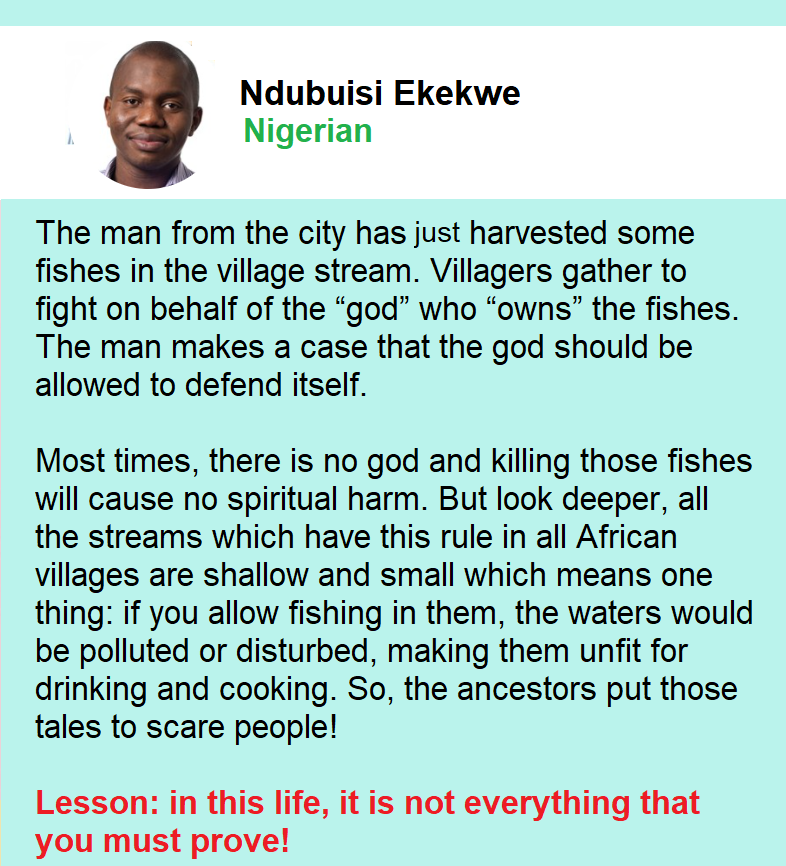
The man from the city has not harvested some fishes in the village stream. Villagers gather to fight on behalf of the “god” who “owns” the fishes. The man makes a case that the god should be allowed to defend itself.
Most times, there is no god and killing those fishes will cause no spiritual harm. But look deeper, all the streams which have this rule in all African villages are shallow and small which means one thing: if you allow fishing in them, the waters would be polluted or disturbed, making them unfit for drinking and cooking. So, the ancestors put those tales to scare people!
Lesson: in this life, it is not everything that you must prove!
The ‘Guns don’t kill people…. ‘ phrase began with the ‘pro gun lobby’ in the US. This is an argument that has been raging for years, and I’m not here to debate the merits of either for or against.
The phrase has been modified over time ad nausea, mostly by novelty and souvenir companies making t-shirts, mugs and so on, looking for a catchy phrase that can sell wares.
A check online reveals a wide variety of endings, anything from ‘Dads with Pretty Daughters’ to ‘The Clintons’.
Above is one taken from the ‘Karate Kid’ Blog which ends with ‘Ninjas’.
The ideology however, underlies a very basic fact, which is that inanimate, i.e. non living entities, do not spontaneously create problems on their own. Bad things can only come from the actions of bad people.
Crypto-currency in Nigeria is not inherently evil. It is a fluid way of transferring value. It is a money ‘species’.
The faster money, or to be more precise, ‘value’ can move to complete a transaction, and the lower the cost overhead on that transaction, then the quicker new and interesting things can happen.
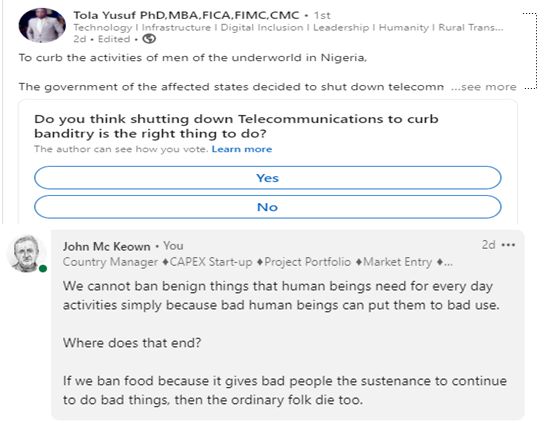
It is important to realize that transactional tools are neither good nor bad, they just ‘are’. Removing things or restricting things doesn’t discriminate on the basis of intent. However as nations, when we act to curb things of universal benefit in the hope of averting the perpetration of bad acts, those who often suffer the most are the innocent, the poor, the vulnerable, and/or those who contribute the most to the benefit of society.
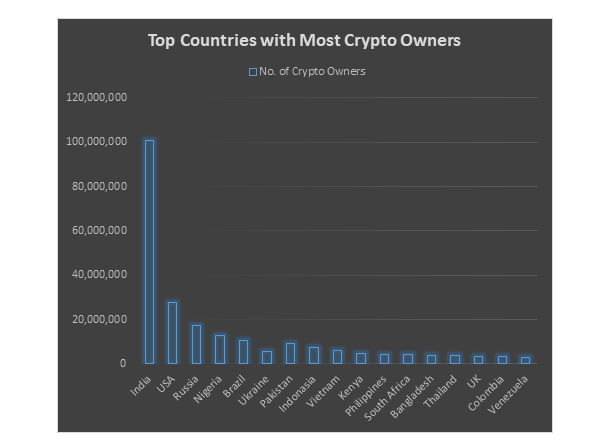
Nigeria could have been the apex global performer in a dynamic business sector only yet a few years old. It was once the second largest trader in the world, and despite a CBN ban, it still ranks 4th, as of Oct 21, 2021 (source c-sharpcorner.com)
Graph at c-sharpcorner.com showing Nigeria as 4th in Crypto Ownership activity as of Oct 21, 2021, despite the ban
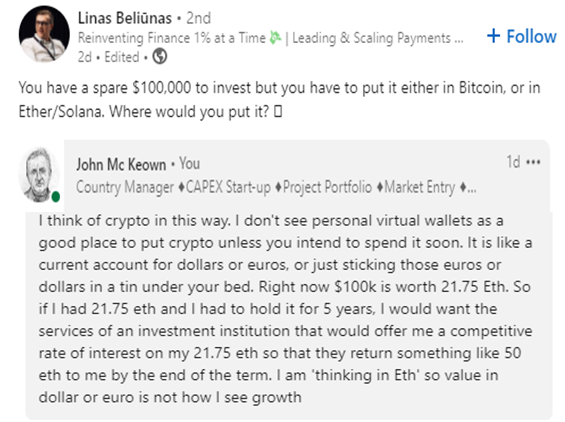
Crypto is just a transaction vehicle, and the problems arise when we think of them as an investment. In a lot of ways they are limited in their application, but so too are many currencies, including the Naira, which cannot be traded on open international money markets.
While the value of different cryptos and different FIATs can relatively go down as well as up, I just see them all as different forms of liquidity. I don’t see them as equity or commodities.
If a Nigerian decides to move to US, for a while, the way of thinking, they are converting dollars to Naira in their heads when they see prices. If they get to settle in US, they stop doing this, and think in dollars only. Dollar going up or down against Naira only matters if they are doing foreign remittances.
The problem with viewing crypto as an investment winner against FIAT, ie sovereign currencies is that it’s easy to win races against thoroughly useless competition.
The real goliath in the value race is not something that has value at all, but a completely different type of economic warrior, and that is the RPI , the Retail Price Index. The grim reaper that represents inflation.
RPI never really loses against transactional value instruments. Individual components of it may, in particular years but overall no.
So for prosperity, what we need is a very strong transactional value instrument to start with, but we also need the growth of specialist investment services around it, which are going to leverage it to stimulate business and commerce and give investors a return on their principal while preserving it, in a conspiracy to collectively thrash the RPI in the race.
Just as many investors in Nigeria who bring dollars want a deal where they get a return in dollars and preserve their dollar principal, the next stage, in the crypto ecosystem trajectory should be to build out on the financial services side, treating it just like any CURRENCY.
So if the RPI in Nigeria in a bad year is 33%, if you invest 100 Eth, let’s say you expect a modest 5% profit, then at the end of the year, you expect 138 Eth back. This is good business.
The sad thing is, Nigeria could have had that trajectory. Based on its transaction profile a few years back, and the extent to which it is leading in new Fintechs, the evolution in the crypto space would have been inevitable.
A CBDC is a distraction and cannot bring this dynamic. If anything, it will probably accelerate RPI though simplifying quantitative easing processes.
Let’s hope some new evaluation by FGN will bring a change of direction soon.