DD
MM
YYYY

PAGES

DD
MM
YYYY

spot_img

PAGES

Home Blog Page 6011

1,919,430,500% Returns in 11 Years!

1

On Oct 12 2009, a Finnish developer Martti Malmi sold 5,050 BTC for $5.02. Since that time, that digital value has returned  close to 1,919,430,500%. While I do not do crypto, it is something to think about, on how someone created such a staggering wealth from thin air.

Meanwhile, China continues its digital Yuan vision. Nikkei writes “China will expand trials of its digital yuan Friday evening with a feature letting individuals send money to each other by just touching their smartphones together, broadening use of the new currency beyond physical stores.”

The trial is timed to see whether the platform can handle digital yuan payments without a hitch under heavy stress. Online retailers offer steep discounts on Dec. 12 — a shopping event known as “Double 12” — and usually see a flood of orders right when the day begins at midnight.

Tests are also moving along in other cities. In Chengdu, people invited by employees at major banks are allowed to download a wallet app that can freely convert cash into digital yuan. The electronic currency can be spent at local supermarkets and other stores, and used to pay bills for smartphone service.

Why can’t we have a digital Naira to reduce corruption through electronic trails? Maybe a good idea or maybe the server will crash and all the money will be lost! You decide. But one thing is evident: nations have BIG roles to drive national growth, anchored on private sectors. Japanese government via Bank of Japan  is the largest investor in Japan’s stock exchange! China has funded state-owned-enterprises. America sends stimulus checks despite preaching capitalism, since capitalism works when things are fine, but needs socialism to bail it out at hard times.

The Bank of Japan has taken over as the biggest owner of the nation’s stocks, with the total value of its holdings climbing well above $400 billion.

Massive exchange-traded fund purchases by the BOJ to support the market amid the pandemic this year combined with subsequent valuation gains pushed its Japanese equity portfolio to 45.1 trillion yen ($434 billion) in November, according to estimates by Shingo Ide, chief equity strategist at NLI Research Institute.

Nigeria needs to pick a position and run its own playbook: there is no universal principle on how nations must run their economic policies.

What Nigeria’s Over 1,800 Trademark Applications Mean to Its Innovation Output

0

As businesses and individuals prepare for the year 2021, our analyst has discovered that profit and non-profit oriented establishments have filed a total of 1,889 trademark applications in Nigeria. This is gleaned from the database of the Nigerian Law Intellectual Property Watch, an organisation that curates and publishes trademark applications in the country.

NLIP notes that its database is “for information purposes only and is not the official register for trademarks in Nigeria. The official register is kept at the Registrar’s office in Abuja, Nigeria.” Looking at the applications, our analyst discovered that both Nigerian owned and non-Nigerian owned businesses and non-governmental organisations submitted applications as at October, 2020 [for the year].

Information has it that “trademark is the most active Intellectual Property Rights in sub-Sahara Africa most especially in Kenya, Ghana, Gambia, Nigeria, and South Africa. This is the area of IPRs which had witnessed numerous applications from nationals of the region.”

This position is highly supported with the preliminary outcomes of our ongoing analysis of patent and intellectual property rights in Africa.

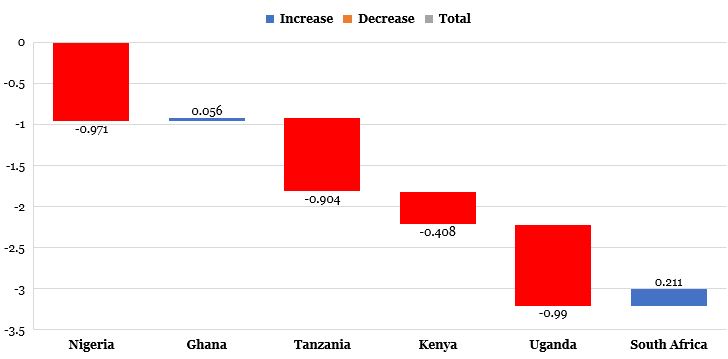
We have discovered how businesses of the Africa origin submitted little trademark and patent applications between 2017 and 2019. The preliminary results also indicate that South Africa is better in the area of patent and intellectual property protection than most African countries we analysed. The country demonstrated the leadership through its strong policies and institutional framework for the enforcement of intellectual property and patent rights.

To increase innovation ecosystem, our analyst notes that African leaders need to ensure sustainable patent and intellectual property protection. This is highly imperative in Nigeria, Kenya, Tanzania, Uganda and other countries where failure to file patent and trademark is reducing innovation output.

Exhibit 1: Link Between Intellectual Property Protection and Innovation Output (2017-2019)

Source: Global Competitiveness Index, 2020; Global Innovation Index, 2020; Infoprations Analysis, 2020

2021 is the Year of Growth in Nigeria

1

2021 is the Year of Growth in Nigeria. I am feeling the indicators everywhere. There are massive shifts after passing the inflection point. Yes, there is abundance in the future. With the new CBN policy, diasporas will push funds home; they could match our “executed” national budget. Innovators will have those first $30k, or $20k to begin new missions on fixing frictions which exist in our markets. Open your mind, do not allow dogmas of disbelief to cloud your awareness and observation on emerging patterns and opportunities; tomorrow has a promise.

No matter what you are doing, leading, servicing, working or founding, let’s put our best efforts for the nation. A working Nigeria is good business for everyone. #BeReady4Year2021


Nigerian Aviation Industry Considers Merger as Government’s Bailout Fails

0

As the COVID-19 induced economic strains bite harder, the plights of businesses in Nigeria, especially aviation and hospitality deepen.

Travel restrictions introduced earlier in the year to curtail the spread of the virus, drove more nails to the coffin of Nigeria’s aviation industry. Now companies within that sector are weighing merger as an option to stay in business.

The Director-General of the Nigerian Civil Aviation Authority (NCAA), Capt. Musa Nuhu said a merger could be the lifeline operators in the industry have left.

Nuhu made the statement on Nigeria’s Television Authority (NTA), while discussing the impact of COVID-19 on the economy. He said the aviation industry is hardly hit by the pandemic and many companies will not survive without bailout.

“The COVID-19 pandemic exaggerated a bad situation; some airlines may not survive but the industry will come back better. It has always gone through crisis but has come back better. It has always gone through crisis but has come out stronger. The Airlines Operators of Nigeria are coming together to see what they can do to help the situation and they met with me. The industry will be different altogether.

“I am sure a lot of them will see changes in their model. I won’t be surprised there would be merger activities around airlines to reduce cost and survive,” he said.

Following the lift of flight restrictions in July, the Ministry of Aviation imposed safety measures that involve social distancing on airline operators. To curtail the loss that would come from that, the companies increased airfare by almost 100%.

Nuhu said there are other reasons for the hike in air ticket charges.

“The airlines carry their maintenance out of the country and it is done in foreign exchange. They need to raise enough money to service the aircraft,” he explained, adding that the increment isn’t enough to keep the industry, which is desperately in need of bailout, afloat.

“The airlines have to find a source of raising more naira. Passenger load has decreased during the pandemic. That is why they have been significant increase in airfares, they are trying their best and by the time the bailout kicks in, things will be better.”

Earlier in the year, the federal government of Nigeria had promised a N25 billion bailout fund for the aviation industry. Unfortunately, the promise has failed to materialize as the industry groans in pain following 60% decrease in flight patronage.

In November, the federal government made a N5 billion bailout offer to the aviation industry, reneging on the earlier promise of N25 billion. Aviation stakeholders and the Senate Committee on Aviation rejected the “insensitive” offer, saying the industry is better left to die than accept the meager offer, as N4 billion will amount to nothing in addressing the financial crisis that has engulfed the industry.

“This is all a result of the COVID-19 pandemic. Reasonable countries intervened in their aviation in the second or third month. This is the eight month and Nigeria is just responding,” said Dr. Gbenga Olowo, the President, Aviation Safety Round Table Initiative (ASRTI).

“I think the government should just leave us to die, and then we will know that Nigeria has no aviation industry. The N4 billion palliative for the aviation sector is very insensitive. I condemn it totally,” he said, adding that the aviation industry has lost N360 billion so far.

Local airlines are currently indebted to NCAA at the tune of N22 billion, a situation degenerating daily due to decline in flight activities around the country.

Last week, Arik Air sacked 300 workers as a result of the impact of the pandemic on the aviation sector. Other companies in the industry are also taking drastic measures that include reduction of salaries and furloughing, to stay in business.

With the current situation, the Nigerian aviation industry is reeling at the mercy of bail-out that the government appears unwilling to offer, and merger may be the only choice left.

Tekedia Institute Partner in Kenya Is CareerSpot

0

Happy to report that CareerSpot_, a provider of coaching & guidance on career exploration, enrichment, transition and return-ships in Africa and Middle East, is now a partner of Tekedia Institute in Kenya. The company represents Tekedia, and also handles enrollments in the land of Harambee Stars.

Tekedia offers an innovation management 12-week program, optimized for business execution and growth, with digital operational overlay. It runs 100% online. The theme is Innovation, Growth & Digital Execution – Techniques for Building Category-King Companies. All contents are self-paced, recorded and archived which means participants do not have to be at any scheduled time to consume contents.

It is a sector- and firm-agnostic management program comprising videos, flash cases, challenge assignments, labs, written materials, webinars, etc by a global faculty coordinated by Prof Ndubuisi Ekekwe.

Learn more about Tekedia Institute here.