Tomorrow (Thursday) at 7pm – 8.30pm WAT is our grand finale for Tekedia Mini-MBA Edition 2 (check Board for Zoom link). And next week is All Editions Career Week – the Board link is here. Thirteen executives would be presenting on a theme – Nurturing Innovators – within our program focus of Innovation, Growth & Execution. Do not miss it.
Tekedia Mini-MBA Career Week has been scheduled for Nov 2-7 2020. This career week is not designed for finding jobs. Rather, it is structured to TRANSFORM workers, founders & entrepreneurs into business leaders and champions of innovation in their companies. Yet, if you have no job, by the time you are done with the series, you will have a path to one! The sub-theme is Nurturing Innovators. It is packaged under the Tekedia Mini-MBA theme of Innovation, Execution & Growth
All past and current Tekedia Mini-MBA members, including those who have registered for Edition 4 (Feb 8 – May 3, 2021) attend free. We have 13 courses, videos, cases, etc on how we can plan our careers during this time of disruption.
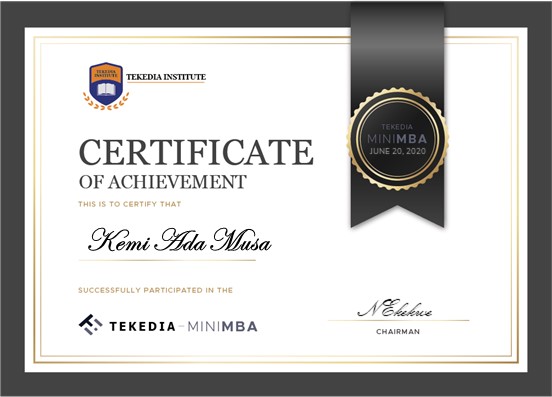
Meanwhile, Edition 2 members, please write Admin and request for your certificate. We will begin batching distribution from Oct 29th. If you were in Edition 1 and yet to receive yours, let us know also.
Tekedia Mini-MBA is an innovation management multi-week program, optimized for business execution and growth, with digital operational overlay. It runs 100% online. The theme is Innovation, Growth & Digital Execution – Techniques for Building Category-King Companies. All contents are self-paced, recorded and archived which means participants do not have to be at any scheduled time to consume contents. Register for the next edition here.
Nigeria’s Co-creation Hub (CcHUB) has announced its acquisition of eLimu, a leading EdTech firm and digital educational content provider in East Africa. This is part of the evolution of ccHub which continues to change its playbook, from a technology square to a consulting firm, and now a builder of digital empires. It has great digital properties in Kenya and Rwanda. This is the “Dangote of Digital” in the making, from your beautiful Nigeria.
From CcHub press release announcing the acquisition.
The goal of the acquisition is to transform eLimu into the Digital Education Platform arm of the company. eLimu will continue to focus on leveraging cutting edge technology to create interactive and engaging learning content customised to the African context which will be initiated using the existing apps. The acquisition will enable it to scale these apps beyond Kenya.
With an existing audience of approximately 500,000 teachers and learners (and COVID-19 accelerating the pace of growth of eLearning), eLimu is one of many players in the EdTech industry that has seen growth at unprecedented rates. This acquisition presents a significant opportunity for digitizing the learning experience and increased investment in innovation.
eLimu (e-Limu.org) is one of the most talked-about EdTech firms in Africa and the leading digital educational content provider in East Africa. eLimu’s revision and literacy platforms make learning fun and engaging for curious children both at school and at home. By combining engaging content with proven pedagogies, eLimu has seen learning outcomes improve dramatically for over 500,000 learners to date.
The literacy apps for 6 and 7-year-olds include dozens of stories written by Kenyan teachers, illustrated by artists across East Africa, and read by voice actors and celebrities, such as Caroline Mutoko. Each story includes letter tracing, spelling and sentence making exercises. Together they form a scientifically-proven pedagogy called Reading to Learn, which has shown to improve progress in reading and writing 4x faster than traditional methods. The platform has been deployed in English, Swahili, Somali, and Lugbarati. An independent study in Dadaab refugee camp showed progress in reading fluency 3 times faster than the control group.
Update: someone from Kenya noted that e-Limu may be a sick company. We do not know. We leave that to the community to figure out. We just reported based on the press release shared by CcHub.
Prof, this your report is totally untrue. eLimu hasn’t paid staff in months. They were looking for an out. They were already collaborating with CcHub on a project so CcHub knew the situation and had already started poaching their staff. This ‘acquisition’ happened for next to nothing. They already let go of all staff and asked them to reapply. Dangote of Digital is an extremely untrue way to describe what just happened.
For more than three months, the stakeholders in the University of Ibadan and the general public have had the cause of understanding who is likely to become the new Vice Chancellor of the country’s oldest University. The position becomes vacant because the current Vice Chancellor, Professor Idowu Olayinka will cease to be the Chief Executive Officer of the University in November, 2020.
From application stage to the public debate, issues have emerged and addressed by the concerned stakeholders. With the less than a few weeks to the announcement of a new Vice Chancellor, a local campus news organisation reports that 6 out of 18 candidates have been shortlisted for final screening.
“The UI VC race reached its climax as 6 aspirants have been shortlisted to proceed to the final stage of the screening. The 18 aspirants for the position of the highest office in the University was pruned down to 6 at the screening conducted yesterday, Tuesday.
The shortlisted candidates include: Prof. Femi Mimiko; lecturer at the department of Political Science, OAU, Prof. Kayode Adebowale; DVC (Admin), and former DVC (Academics), Prof. Abideen Aderinto. The other three are Prof. Olusegun Ademowo of the College of Medicine, Prof. Olatunde Farombi; a professor of Biochemistry and Molecular Toxicology and Prof. Babatunde Salako; former Provost of the College of Medicine, UI,” organisation says few hours ago.
Our analyst had earlier conducted a series of analyses on the selection processes and concluded that the University needs a strong leader who will advance the current gains and bring more achievements for every stakeholder.
As the screening commences today, our analyst notes that the University must screen and select the best three candidates for the Presidency. This is imperative considering pre-screen allegations and counter allegations from some stakeholders. It is also important that the University sets the right pace for others in terms of choosing a new Vice Chancellor based on merit and capability to deliver the needed change to the University community and Nigerian higher education in general.
Congratulations Madam. Ngozi Okonjo-Iweala is largely and essentially the new director-general of the World Trade Organisation (WTO). She will wear many crowns, among them, the first woman DG of WTO. This is good for Team Nigeria – we need more wins out of this nation.
Yes, it is not official but it is actually official! Yes, since she has won more votes than her competitor, she is the new DG. The official announcement while necessary does not change the fact that she is the new DG. It is on this premise that we write that Sister Ngozi is the new DG of WTO, The official protocol will happen but the outcome is known: Dr Okonjo-Iweala is the new boss.
Yes, while a game remains 2 minutes and home team is winning by by 7-2, it is fair to write that home team has won even though 2 minutes remain in the game. It is factually incorrect but contextually valid.
Like other countries that gained independence from the United Kingdom, France, Germany, among other countries that scrambled for African nations and partitioned them into different protectorates, Nigeria has been led and still be led by a mix of baby boomer generation and generation X.
In the Nigerian context, the modern Nigerian state, according to a number of sources, was laid by the baby boomer generation [born between WWII and country’s independence in 1960]. Those born between 1960 and early 1980s, popularly known as Generation X, [including those in the baby boomer generation] have been constituting the bulk of people at the helms of affairs in the last two decades.
According to a number of youths, including Abideen Olasupo, who speaks with our analyst, believe that Generation X is finding it difficult to change the existing governance structure. This is largely due to the fact that the baby boomer generation still holds on to power. Generation Y, those born between 1981 and 1999 do not pay much attention to politics until recently when unemployment rate and socioeconomic issues started staring at their faces. Some weeks ago, they held protests across strategic cities in the country, calling for generational shift. Instead of the shift, Abideen Olasupo, a youth advocate is of the view that the youths only need to call for realignment of the generational balance of power not generational shift.
Excerpt
Abideen Olasupo
Tekedia: With the youth leadership ecosystem in the last two decades, how you would describe the youth’s readiness for sustained contribution to development?
Abideen: More than ever, the Nigerian youthful population assumed that if they work together, regardless of ethnic, religious or political belief that they can achieve a just cause. So, as soon as am concerned, the youth’s readiness for sustainable consideration is on the increase on a daily basis. We have seen it with different campaigns that has been started by youths and are achieving the results.
We have the “Enough is Enough campaign”,
We have the “Not too Young to Run campaign”,
We the “Vote Your Future campaign”,
We have the “Make Naija Stronger campaign”
We have the “OpenNass campaign”
All these campaigns have been talking about has yielded results and it really shows that among the youths who are looter and who are corrupt. We still have inter-generational youths who are intelligent and brilliant and ready to chant a way forward for the betterment of Nigeria, Africa and the whole world at large.
Tekedia: Now that youths have led one of the significant protests in the country’s history, can they be considered by the older generation for inclusive political participation henceforth?
Abideen: That’s why I’m proud as a person and as a member of the campaigner and a state coordinator for the “Not Too Young to Run campaign”. The time is now for us to encourage youth full political participation. It’s beyond just giving youth, senior Legislative Assistant or a Personal Assistant.
Give them the opportunity to be a member of the Parliament, give them the opportunity to govern a State, give them the opportunity to hold a local government, but there is a caveat in giving them platforms, give youths the track record and opportunity to rule.
Don’t just because youths have been clamouring for youth political participation and then use a methodology of reward for loyalty to give youth who don’t have capacity, so that there will be an opportunity for the older generation to tongue lash us. There is politics in everything. Given them the opportunity without giving the right youth who will really change the trend of things. They will only give the youth whom they know does not really have that capacity, so that, they will have opportunity to tongue lash the young person tomorrow. The older generation will come, oh you asked us to give you the opportunity.
Tekedia: Do we need to totally send older generation out of the leadership positions? What are the likely gains and losses?
Abideen: I think this is democracy, I don’t subscribe to the advice of chasing the whole generation and people out of the space, this is democracy, we are just trying to say, if young person contributes more than 60% to the Nigerian population, they should be given an opportunity to contribute to their own quota in a meaningful way. Look at the age bracket, the median age of Nigerian governor, it is more than 30 and at the national youth policies is saying the youths age stops as 29.
So, it shows as a country, we are not really serious with the definition of our youth or involvement of people. If democracy is all about participation, if democracy is all about engagement, if democracy is all about involvement, then the youths who contribute to the largest majority of population should not be edged out. I’ve always told people, if you are not called to the table as a young person, we need to strategize on how we are going to force our way to that table, break that table and ensure that we are on that table as well in an ethical way.
Personally, I don’t subscribe to the idea of sending older generation away. We also need them. We need their guidance. We need them to exchange and cross fertilize ideas together as well. So, gains of chasing them, out of course, we have the opportunity to say, oh we now have young people, but the loss of chasing them out is also there.
There is always an adage in the part that I came from in Nigeria, “Eniyan le laso bi Agba, kole ni Ekisa bi Agba”. This adage means that the experience of the older generation still matters to us. Therefore, I wouldn’t subscribe to the idea of chasing them away. They are needed as a partner in progress as well. We can all build this country together.