From the classrooms to the fields, stakeholders have always been interested in understanding issues and needs of users of products and services through case analysis. Over the years, the students of business administration and management courses have had the cause of analysing businesses with the specific focus to their downs and ups with the intent of revealing varied learning curves for the managers and employees.
Some days ago, Professor Ndubuisi Ekekwe announced the readiness of his Tekedia Institute to make 200 business cases available to scholars of the Institute. After the announcement, I sent an email message, communicating my interest in developing a number of case studies for the Institute’s Case Study Handbook.
However, communicating the readiness on my LinkedIn page with the inclusion of two of the expected brands has generated positive and negative reactions. These reactions were communicated to me via LinkedIn’s message section and calls. This piece aims at clarifying some of the reactions, especially those communicated by the employees [who questioned the reason for taking interest in their brands without formal communication].
It is imperative to understand that case study is “an up-close and detailed examination of something your business did. It includes a beginning, an explanation of what happened next, and a resolution that explains how the company solved or improved on something.”
Based on this definition and others, many businesses have made themselves available for external analysis that explores the case study approach because of the inherent value that would accrue to them directly or indirectly.
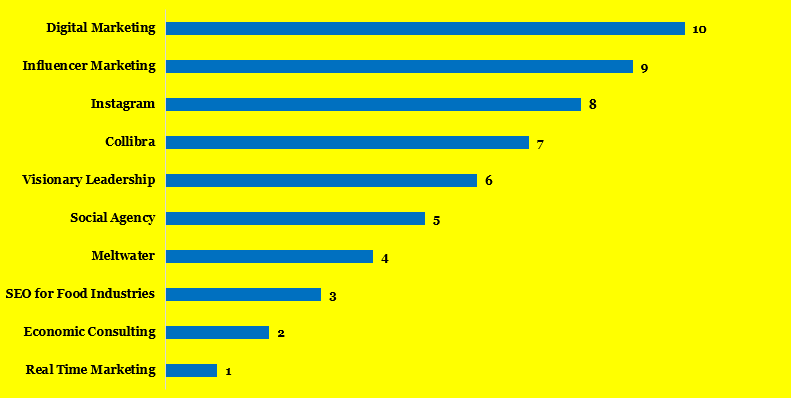
In our experience, we have realised that people across the world developed a significant interest in knowing brands within case studies [see Exhibit 1 and Exhibit 2]. We found a 34% stronger connection in global interest in discerning case studies within industries, and education sector. On average, people interest in case studies within industries has been 34%, while it remains 60% as at the time of writing this insight. From marketing to leadership strategies, public want to learn from successful and unsuccessful businesses [see Exhibit 2].
Exhibit 1: Global Public Interest in Case Studies within Education and, Business and Industrial (2015-2020)
Source: Google Trends, 2020; Infoprations Analysis, 2020
Exhibit 2: Top Focus Areas (2015-2020)
Source: Google Trends, 2020; Infoprations Analysis, 2020
From the insights, it is clear that having your brand in the forthcoming Case Study Handbook remains one of the best things that should happen to your business. The Institute’s mini-MBA is an accelerated one that considers students’ specific needs. Apart from this, it is industry-centric. It is a programme that has captains of industries as faculty members. It is a programme that leverages online community for the dissemination of tacit knowledge. Already, a number of previous and current participants are giving testimonies regarding what they have accomplished personally and for their brands.
As global investors and customers continue expanding their interest in Africa, is it not going to be a huge plus to your brand? With the Case Study Handbook, you have the opportunity of turning your brand into a compelling story and use as an effective content tool. As a matter of fact, Case Analysts should be seen as your Brand Evangelists, who have the intention of increasing your recognition and business-to-business influence.
Paypal Holdings Inc has delved into the digital currency market. The fintech company announced Wednesday that its customers could now buy, sell and hold bitcoin and virtual payments using the company’s online wallets.
The announcement resulted in the surge of bitcoin price on Wednesday. The company said its customers will also be able to use cryptocurrencies to shop at the 26 million merchants on its network starting in early 2021.
Under its cryptocurrency platform, US account holders will be able to buy, sell and hold cryptocurrencies in their Paypal wallets over the coming weeks. Consumers will be able to convert their selected cryptocurrency balance to fiat currency, with certainty of value and no incremental fees. The company said it plans to expand to Venmo and some countries in the first half of 2021.
“Paypal merchants will have no additional integrations or fees, as all transactions will be settled with fiat currency at their current Paypal rates. In effect, cryptocurrency simply becomes another funding source inside the Paypal digital wallet, adding utility to cryptocurrency holders,” the company said in a statement.
Paypal president and Chief Executive Dan Schulman said the company hopes the newly introduced service will encourage global use of virtual coins and prepare its network for new digital currencies that may be developed by central banks and corporations.
“We are working with central banks and thinking of all forms of digital currencies and how Paypal can play a role,” he said.
Many central banks around the world, including China, are planning to develop digital currencies alternative to their fiat currencies.
“The shift to digital forms of currencies is inevitable, bringing with it clear advantages in terms of financial inclusion and access; efficiency, speed and resilience of the payments system; and the ability for governments to disburse funds to citizens quickly,” said Schulman.
Paypal has 346 million active users around the world and a record of $222 billion processed payment transactions in H1 of the year. The company believes its widely used platform will offer users around the world a chance to carry out cryptocurrency transactions as more countries embrace the national digital currency idea.
“Our global reach, digital payments expertise, two-sided network, and rigorous security and compliance controls provide us with the opportunity, and the responsibility, to help facilitate the understanding, redemption and interoperability of these new instruments of exchange,” added Schulman.
Paypal plans to feature Bitcoin, Ethereum, Bitcoin Cash and Litecoin, directly within the Paypal digital wallet. The financial service provider plans to develop the new platform through a partnership with Paxos Trust Company, a regulated provider of cryptocurrency products and services.
To offer the digital currency services, Paypal secured a “first-of-its-kind” conditional Bitlicense from the New York State Department of Financial Services (NYSDFS). The Bitlicense means Paypal with commence cryptocurrency services in New York.
The company said it will provide account holders with educational content to help them understand the cryptocurrency ecosystem, the risks and opportunities related to investing in cryptocurrency, and information on Blockchain technology.
Paypal said the idea will be developed through partnership as it tries to explore the next generation of digital financial services infrastructure and enhancements to digital commerce through an internal blockchain-focused research team.
The company had in 2019, invested in TRM Labs, a company focused on helping financial institutions prevent cryptocurrency fraud and financial crime, and Cambridge Blockchain, a blockchain-based identity management and compliance software company. It was also a partner inFacebook’s Libra, though interference by US regulators forced it quit.
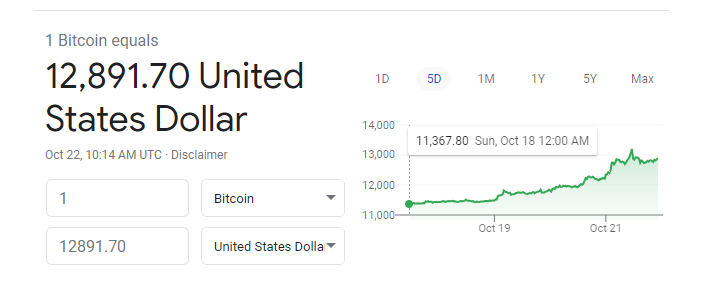
Meanwhile, bitcoin surged more than 5 percent to over $12,400, the highest level since July 2019, taking its total gain since last week above $1,000.
The leading cryptocoin has continued to gain since its halving in May. Analysts believe the growth is a result of economic uncertainties created by the coronavirus pandemic, which has pushed investors into search for a secure place to hide their money. Gold has proved to be a place of refuge for investors, and recently cryptocurrency, though analysts said investors should be wary of its volatility.
It is true that when one’s house is on fire, everybody gets to feel the impact. We can no longer remain at ease, when our house is ablaze.
For some weeks, there has been a rise in public outcry over SARS, a group created to fight against robbery, and which initially lived to its expectations. However, in recent times, it seems some members of the group have resorted to using force, and going extreme in the way they handle suspected individuals. Only a few who survive in the hands of these ones live to tell their stories, as some of these officers usually resort to cruel methods which often result in death. Thus, the emergence of different viral videos on this has led to the demand by youths to have this group disbanded. One of the scenarios that led to increase in the protest to end SARS was the killing of a young man in Delta State (one of the Nigerian states) by suspected officials of the SARS group, who left with the man’s Lexus vehicle.
It is so unfortunate indeed. Over the years, there has been a lot of outcry against brutality by security operatives in Nigeria. It seems once the operators are given guns, some of them see it as an opportunity to intimidate others, sometimes resulting in the death of the victims. Travelling by road to other states sometimes leads to fear because some of these operatives on the highways, sometimes harass those who fail to give them some money for protecting the road. Some even have their lives threatened coupled with the fact that most of the security checkpoints, especially of the Nigerian police, would demand for some form of monetary compensation or tips. Failing to comply would show that you are not grateful, and you may not want to be seen that way.
The SARS group is one of the most dreaded units in the Nigerian Police Force. There has been so many cases of harassment by officials of this group, as once you are seen with some dreadlocks, laptop, an iphone, or more than one expensive phone, you would become a potential suspect. It is worse as in some of the cases, these officials carry sophisticated guns in public, without wearing the SARS uniform, and also shoot at will, thus raising questions on whether they passed through the Police training or are thugs with government recognition.
The shooting of peaceful protesters at Lekki Toll Gate on October 20, 2020 has been widely condemned by many, both within the country and in the international scene. Witnesses said that the men who dressed as Nigerian Soldiers began shooting at protesters immediately the power supply in the arena went off. Some also claimed that some of those shot down were carried away by the soldiers, and essential services such as ambulance services providers prevented from accessing the victims. Although the protesters had defied the curfew placed by the Lagos State government, the unarmed protesters were still shut despite singing the national anthem, and holding the Nigerian flag, thus having the flag stained by blood.
The Army headquarters had denied having soldiers at the scene of the protests, even as the Lagos State Governor stated that the powers were beyond his direct control. This therefore raises questions as to the true personalities or cabals holding the country hostage. Before now, there has been some petition by different persons and groups such as IPOB, IMN, and others, on the brutality meted out on their members by security operatives.
The Leadership in Nigeria has so many fault lines. Some of those who are meant to fight corruption have been portrayed in recent times as the law breakers. Election in public offices is almost a do or die affair by some politicians, as they hire thugs to disrupt voters. These thugs are enticed with money to unleash mayhem on citizens. With the Boko Haram terrorists fighting ruthlessly in the North Eastern part of the country for almost a decade despite all the funding and officials deployed against the insurgency, there is also Banditry violence and attacks at the North Western part of the country.
The North Central part of the country is not entirely peaceful as in recent times, it has become the center for an increase in violence arising from armed herdsmen (whom the Nigerian government had claimed were foreigners) and farmers. The South Eastern part of the country has seen renewed demonstrations for a referendum and a separatist state, even as the region has claimed a lot of favouritism for other regions over the region by the Nigerian government since the end of the Nigerian – Biafran civil war (in which millions of Biafran children and adults died due to starvation). This favouritism includes admission into public institutions, budgetary allocation for roads and other infrastructure, as well as in the appointment of key officers into strategic areas of government (such as the Military, etc).
The South Southern part of the country has remained relatively peaceful since the commencement of the amnesty program for the Niger Delta militants. And now, with the recent protests in majorly the South Western part of the country, the country may not be able to handle the complex issues it faces. More so, the disregard for human rights in the country could increase the rate of violence in the country (as seen from widespread killings in places such as Kaduna, Jos, Benue, Kogi, and others) and could make the Nigerian project unworkable in the nearest future if this persists. In recent years, the calls for structural reforms through restructuring and decentralization of power in the Nigerian state do not appear to have progressed especially due to the opinion divides among different elected representatives in the National Assembly.
The fault lines in the Nigerian leadership structure not only consist of endemic corruption in almost all the country’s institutions, but also includes varied opinions from different zones which have led to delays in implementing budgets and projects. The issue of human rights abuse is not to be overlooked as well, as people are kept in prisons for so long without being on trial, as the government even fails to comply with courts’ directives to free some of those in custody. There are also cases of the government negotiating with internationally certified terrorist groups like the Boko Haram, while IPOB – which is seen as a peaceful group is labelled as a Terrorist group by only the Nigerian government, and some of its members still in prison, while the members of Boko Haram are freed and rehabilitated.
This has raised questions as to the sincerity of the Nigerian government. The Nigerian situation is quite peculiar as leaders sometimes deny some reports and only admit to a part of them when there are videos and concrete evidence that proves them otherwise. Sometimes, it is their words against those of the citizens, and vice versa. Another faultline in the Nigerian leadership is the inability of leaders to understand those they lead, and their failure to listen to them. There are also cabals or godfathers who lead at the background, telling some of these leaders what to do. These cabals do the devil’s bidding in secret, and have some of these leaders execute them in the open. Failure to listen to some of these cabals would be seen as rebellion, thus leading to a serious opposition against the leader which may eventually lead to the ousting of the leader or the political decline of the leader in question after that tenure.
As the giant of Africa, it seems its so-called lazy youths (as stated by their number one citizen) have risen to awaken the giant. The protest is a clamour by Nigerian youths to awaken the conscience of the leaders who value material gains over human lives. It is the country where its citizens earn among the least in the world, while its Senators earn among the highest in the world, even more than the most developed countries of the world. The leaders discourage medical tourism and academic tourism overseas, but are the ones who patronise foreign countries more than the Nigerian citizens (as their children and families reside in estates overseas while the hospitals and schools in their home towns are in a dilapidated state).
So, I spent the weekend working on a case study on how Interswitch became a billion dollar business. The case study goes live soon, but since I’m really not permitted to be humorous and make as many analogies as I would love to (because its serious stuff), I decided to document some of my notes separately and share them as a separate article.
I’m sharing some stuff I learnt studying Interswitch’s business, and what every Nigerian startup can learn on their way to becoming a billion dollar business (because we need more of those).
Market size and the Mystery of Total Addressable Market
There are apparently hundreds of startups in Nigeria, with a majority of them based in Lagos alone, yet we’re clamoring on the streets because of only two startups that have crossed the billion dollar mark; Jumia, and Interswitch, why? Because of the myth of total addressable market.
Nigeria is not Silicon Valley. When people dole out Nigeria’s market size as 200 million people, it makes me laugh. Our population is 200 million, your market size is likely not anywhere close to that. The only businesses that can even boast of a market size above 100 million, are extremely essential businesses, like water, food, telco guys etc. Most people in tech are operating in very small market segments, What I like to call niche markets. Think of this; you’re in an office where the founding team of an agritech company is pitching their idea of using technology to make farming more efficient and productive. So, you ask them what’s your total addressable market? And they say all the farmers in Nigeria, for a product that costs maybe $30 a month to subscribe to, in essence they’re saying all the farmers in Nigeria can afford to pay N11,400 a month for your high tech product that they may not even understand?
When I was in school, my landlord had a small farm beside his house where he planted cassava. That man was in no way tech-savvy, I’m not even sure if he made up to N11,400 every month from farming, if you gave him a business that made him 11,400 every month, I’m sure he’d pray for you.
Stripe recently acquired Paystack reportedly for around US$200 million, and the whole Nigerian tech space was on fire, someone even saw a post on social media where a girl said they’re now interested I’m dating tech guys. But if you give the acquisition details a closer look, you’ll see something alarming; Paystack only had about 60,000 users, only 60,000? For a 5-year-old startup, why? Because Paystack’s addressable market is small.
If you’re building a business in Nigeria, you need to understand market segments. Not everyone in Nigeria can afford the latest iPhone, so we have Tecno phones, not everyone can afford Banana island, so we have Iyana Ipaja, and not everyone can afford a brand-new car, so we have tokunbo (foreign used cars), second hand cars, third hand cars, and cars that have changed ownership so many times, we’ve lost count.
Most founders don’t understand the dynamics of market segments, so they build products for the imaginary 1million total addressable market they think they have, then they launch the product, and learn the hard way that their total addressable market is probably not up to a hundred thousand.
Because there’s a need for a product does not justify building it, if there aren’t enough people in your market segment who need your solution that can afford it, then don’t build it. Do you know how many people reading this post would love a brand new Rolls-Royce? Is that a justification for Rolls-Royce to open an official dealership here? I think not.
Most Nigerians like good stuff, they just like the good stuff that’s cheap. So Apple’s AirPods Pro retail for around N95,000, a cheaper option is Transsion owned Oraimo Freebuds that retail for N20,000, and if you really want to know, there’s probably a guy not too far from where I live that can retail a couple of unbranded white AirPods looking buds for N3,500. Your call.
You need scale to prosper; building a product in a highly competitive niche market is like trying to replicate fast and furious on third mainland bridge. I hope your car can swim.
What Real Innovation is
AI, Blockchain, IoT, AR and VR are all nice buzzwords, they’re all innovative solutions, they are, I even use some of them when I talk to foreign contacts, but in Nigeria, all that AI stuff is just grammar. Unless you’re in the B2B space, where offering technical expertise is your core business, I do not think using any of those technical jargon will get you anywhere. I’m serious, I was on a call with an old classmate who works with a fintech startup in Lagos the other day, and when he started breaking down all those technical fintech jargon for me, It was something.
You think Mama Sikira cares about API’s and UX? Mama Sikira’s major concern is that the POS worked, how it worked is none of her business. Leave all that jargon for the engineers, my point is this; innovation isn’t really about tech here, I think it’s about pricing.
Your total addressable market is low not because your product isn’t valuable or useful (even though some products fall Into this category), but because you don’t really have the right pricing mechanism to extract value from your users.
Interswitch charges a very small fee per transaction that scales based on volume, and they don’t charge you directly, they charge your merchant, who then charges you. The fee is small but when you consider that maybe 40 million transactions were processed that month, you’ll understand why Interswitch is a unicorn.
Some of the biggest businesses utilize a double play B2B model that allows them cash out based on number of users, data generated, or some other obscene metric.
Who pays for your Facebook and/or YouTube usage? You? Or the thousands of advertisers that spend hundreds of thousands, and even millions of dollars to serve you ads?
Nigerian startups need innovation in this space if they’re going to grow their total addressable market, unlock more value, and evidently create at least a billion dollars in value.
Oh, and try to build for more than one market segment. B2C (Business to Consumer) is legit, but the real money, especially in Nigeria is in B2B (Business to Business), that’s where the big boys play, and don’t get me started on B2G (Business to Government), winks my Abuja people.
Partnerships and Alliances
If you have a business, then you (hopefully) have a problem you want to solve, and aren’t just doing it for the money. If that’s the case, then you have a vision, and you can’t push that vision alone. You need partners.
You may be competitors, but as long as they have something you want at that specific time that can push your vision forward, you should seriously consider partnering with them.
Partnerships are key, don’t trivialize them.
Interswitch partners with so many businesses, even Visa where they apparently compete (think Verve) in their card division.
Conclusion
Understanding market segments, and what your total addressable market is, finding a way to innovate on pricing, and making effective partnerships are some key strategies employed by Interswitch to become a billion dollar business.
Employing these strategies could help you scale up your business to billion dollar status, rather than bleeding investors money to nowhere.
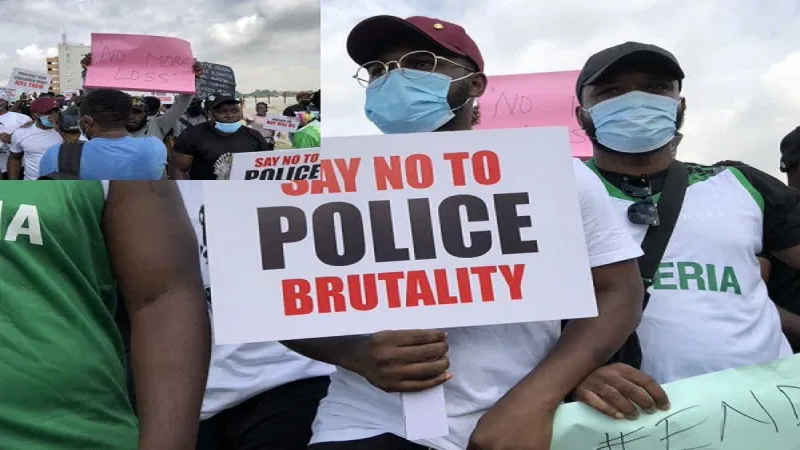
For years, Nigerians have endured all forms of uncivilized behaviour of Police Officers across the country. Some days ago, a number of youths started protesting against police brutality. From the southern region to the northern region, the narrative has been that police officers attached to the Special Anti-Robber Squad have maimed and killed several people unjustly.
These youths, according to available information, employed protest instrument when it is obvious that recommendations of previous reports of panels on the Nigeria Police reforms are not implemented. In one of our previous analyses, factors that contributed to the inability of the recommendations have been documented.
At the early stages of the protests, the youths received support of people [locally and internationally] and businesses. Information indicates that Nigerian companies and individuals raised funds for the protesters. For example, Flutterwave received N10,262,703, $6,040, £583, CAD1,300, GHS715, AUD105, ZAR400, EUR675, CZK500, and AED100 from companies. With the financial and kind supports, an online news medium says “the #EndSARS campaign has shown the power of the Nigerian youths. Much more, it has shown the possible impact of collaboration among the Nigerian business community. It was pretty spontaneous, but the organization has been impressive and the impact is unprecedented.”
Having seen the impacts on the economy and how the global community is supporting the youths cause, the Nigerian government through the Nigeria Police Force announced the disbandment of the SARS with the assurance of dealing with the past cases of brutality by the Police Officers. Lagos, as the epicentre of the protests, also announced some strategic measures to calm the protesting youths.
However, the protests have been hijacked by political thugs and hoodlums. Consequences of the hijack are being felt in Lagos, where a number of private and public property have been set on fire.
As the tension increases in Lagos and other parts of southern Nigeria, our analyst examines Nigerian Twitter community and the conventional newspapers’ place in the protests. From over 136,000 used by those protesting on the Twitter, more than 9,000 words were used to explicate the protests and the issues associated with governance in the country. endsars and endswat were the predominantly used words. These words strategically connected with #endpolicebrutalityinnigeria.
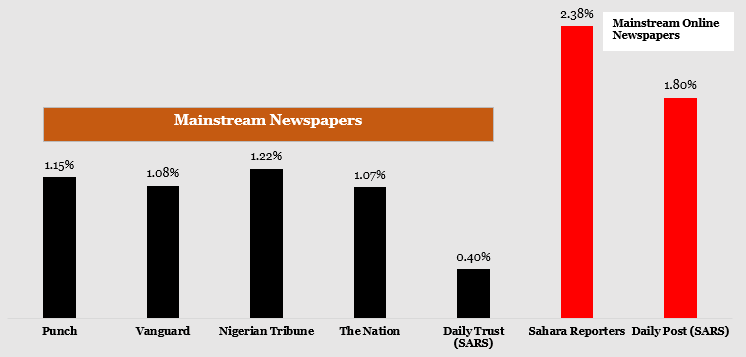
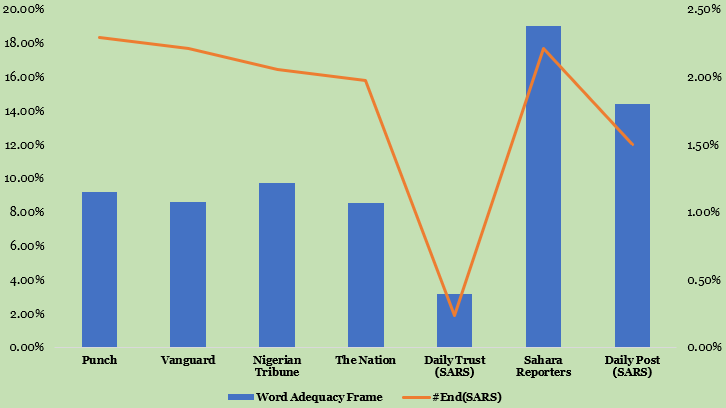
Looking at the media coverage of the protests, analysis shows that Sahara Reporters and Daily Post have deployed more words for the reportage on their home pages [websites] than other newspapers. Apart from employing generic words for the coverage, the two newspapers have equally employed the protests’ hashtag [#EndSars] than other newspapers [see Exhibit 1 and Exhibit 2].
Now that the protests have led to casualties on both sides [the government and the protesters], our analyst notes that the media need to deescalate issues with the tendency of increasing aggression from any side. The media also need to pay attention to the illustrations and images that would be used to portray the two dominant actors.