Around the world, the drums of innovation are beating louder. The resulting lyric is transformational as technological innovation continues to facilitate the process of socio-economic developments of nations. The anchor driver, ICT, is enabling new ways of exchanging information, and transacting businesses, efficiently and cheaply. It has also changed the dynamic natures of all major industries and provided better means of using the human and institutional capabilities of nations in both the public and private sectors, radically altering the ordinances of trade and commerce, at regional and international levels.
As ICT transforms economies into knowledge-based economic systems, and data societies, made of citizens, firms and states, entwined in electronically linked interdependent relationships, the constructs of market systems will never be the same.
This year, I have the honour to be coordinating for the Nigerian people through the Nigerian Economic Summit Group a design for e-Nigeria. We are looking at many digital anchors towards transforming the architecture of the Nigerian economy.
For example, while it may not be popular, markets could be more effective in delivering some services which the government is doing now. So, using public-benefits companies, are there ways we can simultaneously improve delivery- and cost-efficiency for the citizens? The U.S. has Equifax, Experian and TransUnion to keep records of financial transactions of Americans, and then use the data to anchor a credit system in America. Besides the citizen identity, what model do we adopt for the application utilities across our sectors?
LinkedIn is my Lab and I am reaching out to the community.
1. What three sectors, domains or initiatives do you expect Nigeria to focus within the broad construct of digitalization? The goal here is to improve our capacity to combine and recombine factors of production and serve markets, companies and citizens better as a nation.
2. How can Nigeria execute any national digital initiative it commits to within cost and time?
I have accepted to speak at The Institute of Chartered Accountants of Nigeria (ICAN)’s Accountants Conference which is scheduled on Nov 17/18 2020. The first professional body which I joined upon starting my bank job, a few days after NYSC, was ICAN. I have read all the profiles of bank executive directors and CEOs and noticed one common factor: most were chartered accountants. So, I reasoned, if this bank job was to take me to the top, passing ICAN must be part of the immediate playbook.
I went through the Foundation level. Did well on the Intermediate level, and was in the Professional Exam 1 when I left banking back to electrical engineering. Largely, the ICAN certification was never to practice accounting. I saw it as an exam which could be passed after diligent studies, and in a banking ecosystem, though in the IT business, having that would not hurt.
Why this torture? Diamond Bank was paying for everything. They paid for the Cisco and Microsoft certification exams. They paid for the ICAN Intermediate exam which I had added in case I had to remain in Nigerian banking. (My matrix of Nigerian bank executives showed most had ICAN; so, I assumed, to get to the top, it made sense to get mine. I never completed ICAN before I left Nigeria. But I did well in the Foundation and Intermediate phases.) Diamond Bank HR people liked me. I had my nickname “Prof” which Ohis Ohiwere (now an Executive Director with GTBank) gave me while in the training school.
I see accountants as the high priests of markets because they help nations understand the pulse of the private sector. I look forward to Nov 17.
In July, the US’ tech “big four”, Google, Facebook, Amazon and Apple were grilled by the Congress Committee in one of the biggest antitrust inquiries in the United States, which started 16 months ago. The inquiry was prompted by allegations of monopolistic practices against the “big four”, which is on the verge of totally eliminating competition.
The CEOs of the Silicon Valley giants, Mark Zuckerberg, Sundar Pichai, Jeff Bezos and Tim Cook drew lines of defense for their practices by excusing what the Committee pointed out as obvious actions to muzzle competition, including buying other companies with competitive potentials.
“Their answers were often evasive and non-responsive, raising fresh questions about whether they believe they are beyond the reach of democratic oversight,” said Rep. Jerrold Nadler, who leads the House Judiciary Subcommittee on antitrust.
“Although these four corporations differ in important ways, studying their business practices has revealed common problems. All are gatekeepers over key distribution channels; all use their gatekeeper position to maintain market power, and all have abused their role as intermediaries to further entrench and expand dominance,” he added.
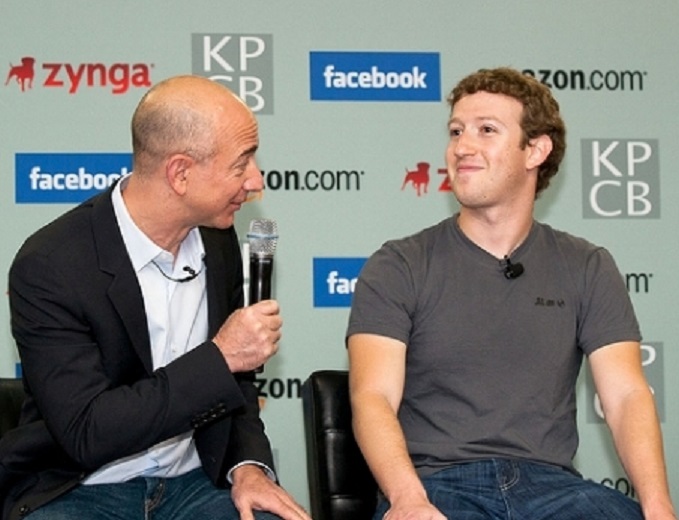
Founders of Facebook and Amazon
The case of Facebook buying WhatsApp and Instagram was a typical example of bullying to dominate the market. And for the others, they play gods in their respective fields that no other company measures up to their scale.
Facebook controls the social media realm with Instagram and WhatsApp. Apple and Google control mobile app markets. Google rules supreme in online search while Facebook and Google dominate online advertisement. Amazon’s online shopping platform controls 75% of online sales.
These records confirm the fears of those concerned about the powers the tech companies are wielding, and lends credence to the call of Democratic Senator, Elizabeth Warren to break up the big tech companies.
In August, antitrust experts weighing in on the matter said the US regulators are already late in curtailing the powers of the tech giants. The more time they are allowed, the more power they acquire. And three among them have similar patterns of crippling rivals.
“Three of the companies [Amazon, Facebook, and Google] basically have the same set of accusations against them, which is that competitors come on your platform, you take their information, you preference your own results, compete against them, drive them out of business, or buy them cheap,” Gary Reback who convinced the US Department of Justice to file antitrust suit against Microsoft in the 1990s told Venture Beat.
Reback said the solution lies on two lines of action – antitrust enforcement on these companies or a new legislation that will enforce a single line of business.
“If we can’t get antitrust enforcement on [these companies]… we need legislation like the type Elizabeth Warren is suggesting, where if you own the platform then you can’t own anything on it. That would be a big change, but if there’s no way to police the [current] situation so that competitors get a fair shot and you don’t run everybody else out of business by using their data against them, if there’s no way to police that, then you don’t have any alternative but new legislation,” he added.
Following the surging anti-competition and antitrust complaints leveled against the big four, corroborated by leaked internal discussions within the companies that reveal oppressive business intents, the Subcommittee, which has just concluded its inquiry, thinks It’s time to break up the big tech.
The Subcommittee is expected to publish its report this week and there has been unusual support from Republicans, backing the call for a breakup of the big tech firms, to make it harder for them to buy smaller rivals.
Democrats have been leading the charge to disintegrate the giants, now draft from the Committee published earlier by Politico, which Reuters got Ken Buck, a Republican Representative to confirm its authenticity, shows that Republicans are backing the call and may likely take a step further to make it real.
Buck said he agreed with the Democrats in many fronts, particularly on the power the big tech firms wield, with their Penchant for “killer acquisitions” to eliminate rivals and self-preferencing in guiding customers to their other products. But he also said he disagrees with the majority’s approach; for instance, the plan that requires the firms to delineate a clear “single line of business”.
Each one of the big firms has subsidiaries that have become integral part of them. delineating a single line of business will be a difficult decision to reach by lawmakers.
“The proposal is a thinly veiled call to break up Big Tech firms. We do not agree with the majority’s approach… the report offers a chilling look into how Apple, Amazon, Google and Facebook have used their power to control how we see and understand the world,” Buck said.
It is not clear how many Republicans are on board the breakup idea recommended by the report, what is clear is that the US Congress is closer to the idea now more than ever before.
Great companies build and accumulate capabilities, and then find ways to compound their impacts. Indomie Noodles which we have used as a case study in Tekedia Mini-MBA has a lesson for us. Has your startup passed the Indomie Noodles Test? Has your insurance company passed the Indomie Noodles Test? Has your business passed the Indomie Noodles Test? Watch this video. Accumulate capabilities. Go upstream. And Protect your castle via leverageable moats.
In this videocast, I explain how the makers of Indomie noodles used the same strategy Dangote Group had deployed across industrial sectors to defeat Dangote Noodles. The accumulation of capability which Dangote Group uses to crush competitors did not work because Dufil Prima Foods (makers of Indomie) did the same thing from electricity generation to production, for its noodles business. With their vertically integrated business, there was no left efficiency which Dangote could exploit to improve quality and reduce price. At the end, an established brand won and Dangote Noodles could not dislodge them. Dangote Group later sold its noodle business to Dufil Prima Foods. This shows a practical model anyone that wants to compete against Dangote Group can deploy. Beware: you need to be very solid!
She is a highly skilled Learning and Development Consultant with 12+ years’ experience facilitating Soft Skills training. A change management consultant who earned organizational insights, from working with a broad variety of highly specialized work cultures and professions.
A master’s degree graduate of the University of Aberdeen, she heads the Youth Engagement & Learning unit in the industry-king, and digital recruiter Jobberman. Precious Ajoonu will teach during Tekedia Mini-MBA Career Week, scheduled Nov 2-7 2020. This career week is not designed for finding jobs. Rather, it is structured to TRANSFORM workers, founders & entrepreneurs into business leaders and champions of innovation in their companies.
All past and current Tekedia Mini-MBA members, including those who have registered for Edition 4 (Feb 8 – May 3, 2021) attend free. We have 13 courses, videos, cases, etc on how we can plan our careers during this time of disruption.
Join Precious, and learn how to remain a valuable professional as you advance your career.