DD
MM
YYYY

PAGES

DD
MM
YYYY

spot_img

PAGES

Home Blog Page 6381

Tekedia Mini-MBA (June 22 – Oct 22, 2020)

92

Registration has ended for edition 2, register for next edition 


Invent, innovate and drive organizational transformation, performance, and growth. Capture emerging opportunities in changing markets while optimizing innovation and profitability. Digitally evolve your business or functional area, turning digital disruption into a competitive capability and advantage. Master the concepts of building category-king companies, and thrive. 

After the highly successful first edition of Tekedia Mini-MBA, we have launched the second edition. I invite you to register ($140 or N50,000 naira) . This program is a 4-month weekly program, beginning June 22, 2020 to end Oct 22, 2020. It will comprise videos, flash cases, written materials and webinars delivered online. When we finish, we will issue a certificate from the Tekedia Institute USA.

Register and join us. You will emerge transformed with tools and capabilities that engineer confidence, performance and growth.  Accelerate your leadership ascent with us and have access to speak with me on your career and professional development! More so, we have new courses and will be using a new global faculty team to deliver them. Also, we are providing capabilities to grade participants’ Labs besides feedback we provide in the Discussion boards.

Tekedia Institute offers innovation management 4-month programs, optimized for business execution and growth, with digital operational overlay.

How To Register: 

  1. PayPal: follow this link and pay $140 US dollars. It supports most global currencies.
  2. Bank transfer (Nigerian naira): Pay N50,000 into any of:
    • GTBank 0114016493
    • UBA 1019195493
    • Account owner: First Atlantic Semiconductors & Microelectronics.
  3. Flutterwave: follow this link (naira) or this one (USD) to use your Verve, Visa, Mastercard, Amex, etc cards across Africa and beyond.
  4. Automatic Access: Pay via this Tekedia link for self-automatic enrollment with username.

After payment, email tekedia@fasmicro.com with participant’s name and email to complete the registration.

Add extra (optional) $30 or N10,000 if you want us to review and provide feedback on your labs.

Early Bird Registration Benefits Do NOT END (you get the benefits anytime you register)


Video presents overview of Tekedia mini-MBA


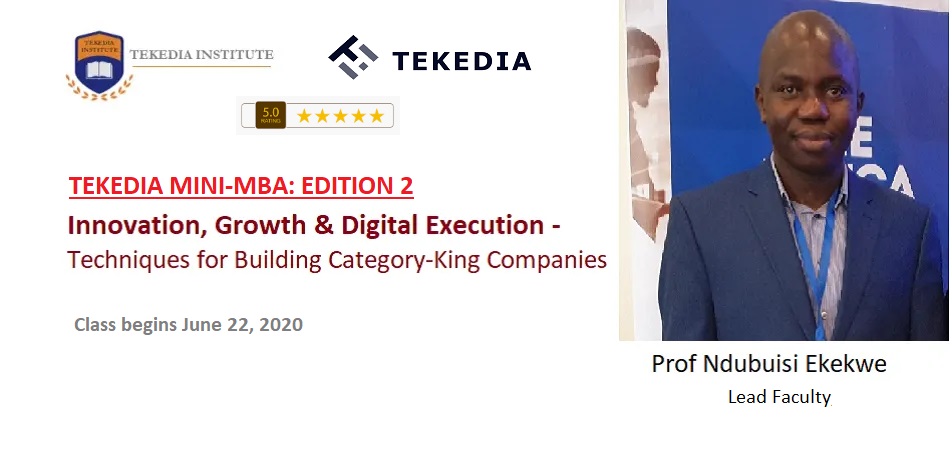
Theme: Innovation, Growth & Digital Execution – Techniques for Building Category-King Companies

Introduction

Over the last few decades, digital technology has emerged as a very critical element in organizational competitiveness. It has transformed industrial sectors and anchored new business architectures, redesigning markets and facilitating efficiency in the allocation and utilization of factors of production. The impacts have been consequential: nations like Nigeria are moving towards knowledge-based economic structures and information societies, comprising networks of individuals, firms and states that are linked electronically and in interdependent relationships. In this program, we will examine this redesign within the context of fixing market frictions and deploying growth business frameworks in a world of perception demand where meeting needs and expectations of customers are not enough.

Program Time: June 22, 2020 – Oct 22, 2020

Venue & Format: Online via videos, articles, webinars, and flash cases. Program is self-paced which means you consume the materials at your own time and pace.It is completely online. You will have something to complete within 7 days. You decide when you do that within the window. Where you live or your time zone would not be an issue as program is not live-delivered.

Cost: US$140 (N50,000 naira) (20% discount for bulk registration of at least four). We have payment plan, i.e. installment payment plan.

Program Structure: The program structure is presented below; we will add the current faculty in coming days.

TEKEDIA MINI-MBA CURRICULUM
Theme: Innovation, Growth & Digital Execution – Techniques for Building Category-King Companies
Week Focus Components
1 Growth and Innovation of Firms – Prof Ndubuisi Ekekwe Reading (R), Flash Case (F), Video (V), Challenge (C)
2 Business Playbook, Manual and Execution – Prof Ndubuisi Ekekwe

Exponential Technologies and Business Opportunities in the Age of Singularity – Transdisciplinary Agora for Future Discussions, Inc (TAFFD), Georgia, USA . TAFFD team developing session: 

Edward Hudgins, PhD
Chogwu Abdul, PhD
Gennady Stolyarov II 
Brent Ellman

R, F, V, C
3 Modern Business Models and Growth  – Prof Ndubuisi Ekekwe


Reading, Flash Case, Video, Challenge
4 New Technologies, Growth, Disruptive Innovation

–         Cybersecurity – Adetokunbo Omotosho, CEO, Infoprive

–         Blockchain – Franklin Peters, CEO, Bitfxt

–          AI &  Cloud – Wale Olokodana, Azure Business Group Lead, Microsoft

–          Data Management, Big Data & Analytics – Dr Adewole C. Ogunyadeka, esure Group Plc

Reading, Flash Case, Video, Challenge
5 Effective Organizational Change Management, Omowunmi Adenuga-Taiwo (most recent role as a Strategy Consulting Manager with Deloitte)


Stimulating New Markets Through Innovation And Perception Demand – Prof Ndubuisi Ekekwe

Reading, Flash Case, Video, Challenge
6 Investing and Fundraising – Victor Ndukauba, Deputy Managing Director, Afrinvest West Africa


Personal Finance and Wealth Management – Japheth Jev, CIMA(UK), CGMA, ACA, Japheth Consulting


Sector Innovation and Focus: Case Studies

– Logistics – Samuel Akinniyi Ajiboyede, CEO, Zido Logistics

– Ecommerce – Olufemi S. Aiki, Co-Founder, Foodlocker

– Fintech – Olugbenga GB Agboola, CEO / Co-Founder, Flutterwave

– EdTech – ‘Dimeji Falana, CEO, Edves

– Agtech –  Ndubuisi Ekekwe, Founder, Zenvus

– HealthTech – Enoh John, CEO, Lafiya TeleHealth

– Supply Chain – Ayodele Adenaike, COO, GIG Logistics

Reading, Flash Case, Video, Challenge
7 Sales Management, Marketing and Growth – Moby Onuoha, Queen’s University

Supply Chain Management, Global Partnership & Contracting – Adebayo Adeleke, ex-Chief of Contracting and Deputy Chief, Business Operations Division, US Army

Lab #1 – Tekedia Institute

Reading, Flash Case, Video, Challenge


Instruction { Report Output}

8 FMCG New Product Launch and Product Strategy – Mohammad Ibrahim, Managing Partner, Stochastic Institute

Effective Supply Chain Management –
Luiz Paulo Silva Barreto 

Execution – Business Objectives and Technologies, Nnamdi Onyebuchi, CEO, Weco Systems Group 

Reading, Flash Case, Video, Challenge
9 Media, Communications, and PR – Grace Akinosun, CEO, smepeaks


Branding and Advertising – Akachi Ngwu, Executive Director/COO, Luzo Digital Network & Media


Product Design and Packaging – Kemisola Oloriegbe, Manager, Nigerian Breweries Plc

Reading, Flash Case, Video, Challenge
10 Business Process and Leadership –  Prof. Ayodeji Oyebola, Saint Mary’s University of Minnesota


Process Improvement and Operations Management – Rasheed T. Adebayo, Operations Manager, Schlumberger


Quality and Asset Management –Michael Odigie, Vice President Technical Services, Delek Logistics

Reading, Flash Case, Video, Challenge
11 Digital Transformation, Innovation & Strategy – Jude Ayoka, Manager, Access Bank Plc


Leading and Managing Teams, Stakeholder Management with NICER Model  – Dr. Chisom Ezeocha, Project Delivery Manager, Shell

Reading, Flash Case, Video, Challenge


12 Accounting, Building Sustainable Enterprises – Ndubuisi Umunna (ACA), Head Finance Accounts & Admin, Royal Exchange

Risk Management –  Akeem Rasaq, Head Of Risk Management, Chapel Hill Denham

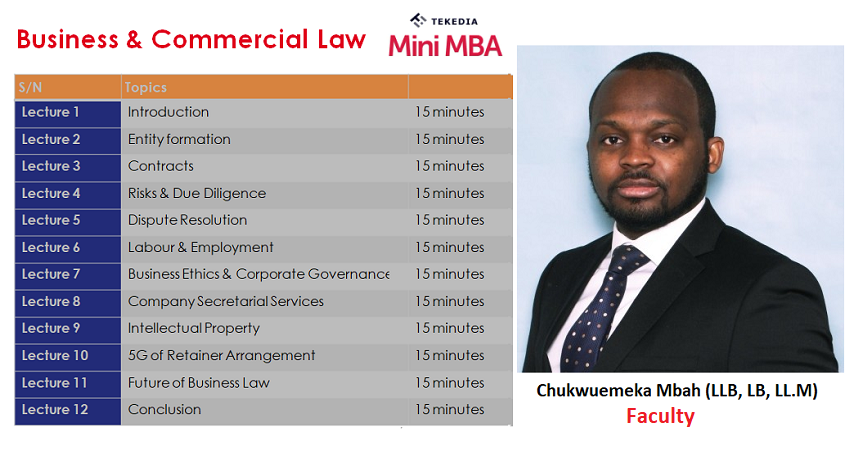
Business & Commercial Law  – Chukwuemeka Mbah (LLB, BL, LLM) Law, Manager, Sherwin Williams

Reading, Flash Case, Video, Challenge
13 Lab #2- Tekedia Institute

Special Series on Winning in Business (all videos) – Prof Ndubuisi Ekekwe

•              Session 1 – Readiness for The Frictions of Nations

•              Session 2 – The Six to Unlock Values in Markets

•              Session 3 – The Two Critical Playbooks

•              Session 4 –  Mechanics of growth & Investment Options

•              Session 5 – Finding the Edges and Market Opportunities

•              Deep Conversations – Answers to Big Questions


Sustainability Strategy and Social Innovation – Temitayo Ade-Peters, CEO, We For Good

Instruction {Report Output}

Video

14 LIVE SESSION: Building Your Business Financial Models (templates included) – Michael Olafusi, Financial Analyst Fellow, Brightmore Capital; Lead Consultant, UrBizEdge

Human Resources Management .- Adora Ikwuemesi, Director Kendor Consulting

R, F, V, C


R, F, V, C

15 Auditing, Forensics, Policies and Controls – Yusuf O. Sanni (ACA), Chief Internal Auditor, BUA Cement Plc


Contracting, Negotiation and IP – Jeff Chineme Maduka (LLB, BL, LLM), Snr Legal Manager, American Tower

R, F, V, C
16 Driving Profitable Growth, Marginal Cost, Scaling – Prof. Ndubuisi Ekekwe


Effective Financial Planning and Management – Okpaise Kenneth, Financial Advisory Manager, AIICO Insurance Plc


Capital Market Operations – Azeez Lawal, CFO, TrustBanc Group

R, F, V, C
17 Lab #3 – Tekedia Institute


Innovation Lessons: 5in5 (5 Firms in 5 Sectors) – Africa/Global – Aderinola Oloruntoye, Dean, Workforce Group


Disruptive Sustainability Innovation for Long Term Business Growth – Eustace Onuegbu, President, incsr.org

Instruction {Report Output}


R, F, V, C

18 Effective Project Management – Taiwo Abraham, Project Manager, Horizant 

The Call to Execution (Summary) – Prof Ndubuisi Ekekwe

R, F, V, C

Reading , Video

Report , Closure
Lead Facilitator: Prof. Ndubuisi Ekekwe

*(All Saturdays have Discussion Webinars of one hour; the contents would be recorded for replay). **In some names (law, accounting, etc), we have to put the professional titles due to the regulatory nature of the fields.

Testimonials on Tekedia Mini-MBA


Career Week: To Transform Workers into Leaders and Innovators

Our Career Week (Nov 2-6 2020) is not designed for finding jobs. Rather, it is structured to TRANSFORM workers, founders & entrepreneurs into business leaders and champions of innovation in their companies. The sub-theme is Nurturing Innovators: Career Planning & Resilience During Disruption. It will be packaged under the Tekedia Mini-MBA theme of Innovation, Execution & Growth. Our knowledge experts for the Week include human resources experts and leaders from MNCs and startups, across industries and global regions:

  • Dupe Akinsiun – Head, Leadership & Capabilities Center, Coca Cola HBC
  • Nnenna Jacob-Ogogo – Head, Alpher, Union Bank
  • Precious Ajoonu  – Manager, Jobberman
  • Bukola Kogbe, Regional HR Director – Africa, Barry Callebaut
  • John Wesey – CEO, Psyntech
  • Dr Akanimo Odon – CEO,  Envirofly Consulting UK 
  • Antonia Adeyemi, CIPD – Managing Director,  StatsXperts Consulting
  • Dapo akinloye – COO, Emerald Zone, ex-HR Head, Lafarge CBG
  • Dr. Fatai Olajobi – Partner, Neo-Neurons Concept
  • Dotun Jegede, Senior Partner, Dee Bee Consulting
  • Elizabeth (Ayeni) Nyah, Human Resources Business Partner, VDT Communications 
  • Ezra Anajonu – CEO, Save’N’Fflex
  • Capt. Ola Olubowale – Manager, Viva Energy Australia
  • Abraham Owoseni.com – Principal Consultant, MindMould

Video presents overview of weekly session

Target Audience: This program is designed for professionals across functional areas like sales, marketing, technology, administration, legal, strategy, finance, etc across all business sectors and domains.

Learning Objectives: To innovate is to set a new basis of competition in an economy, business sector or market. Most times, it results to disruption. This program is designed for private (large, SMEs, startups) and public institutions. Participants will:

  • Master the mechanics of digital growth – the reward of innovation – through frameworks, cases and evolving strategies.
  • Understand how to undergo digitization journey that is fully aligned with corporate objectives through measurable and realizable benchmarks.
  • Acquire business capability tools that do not just RUN their firms but can TRANSFORM them.
  • Design corporate growth experiments in Lab sessions based on One Oasis Strategy, Aggregation Construct, Double Play Strategy, Accumulation of Capability Construct, and more.

Facilitator:  Prof Ndubuisi Ekekwe invented and patented a robotic system which the United States Government acquired assignee rights. Dr Ekekwe holds two doctoral and four master’s degrees including a PhD in engineering from the Johns Hopkins University, USA. He earned undergraduate degree from FUT Owerri where he graduated as his class best student. While in Analog Devices Corp, he co-designed an accelerometer for the iPhone. A recipient of IGI Global “Book of the Year” award, a TED Fellow, IBM Global Entrepreneur and World Economic Forum Young Global Leader, Prof. Ekekwe has held professorships in Carnegie Mellon University and Babcock University, and served in the United States National Science Foundation Committee. The South African press called him “a doctor of innovation” for helping organizations on the mechanics of business innovation, strategy and growth. Since 2009, the Chairman of Fasmicro Group which controls many startups and entities has been writing in the Harvard Business Review.

Reliance Infosystems Sending 40 Staff To Tekedia Mini-MBA, Enjoys Group Benefits

Support of Tekedia Non-Resident Fellows

The Founders’ Question – And Unveiling of Tekedia Non-Resident Fellows

Our sample certificate which will be awarded to participants


Tekedia Mini-MBA Corporate

Tekedia Mini-MBA Corporate is a customized version of the general Tekedia Mini-MBA. It is  designed for private and public institutions by sector, phase of growth and organizational structure. It focuses on the same theme of innovation, growth and digital execution. But unlike the 4-month general Mini-MBA, the Corporate vision goes for 6, 8,10 or 12 weeks. Email for a quote.

More Features of Edition 2

Besides the core features of our program, we have the following for the Tekedia Mini-MBA.

  • Tekedia Innovation Summit: An annual physical summit at no extra cost to participants of Mini-MBA in the specific year, in Lagos. The summit will also be webcasted.
  • Co-Innovation Idea Circle: Offers the ability for members to share product and service ideas, and get feedback from the Mini-MBA community.
  • Funding Club:We have a partnership to help participants from start-ups and established companies connect with investors, rewarding market innovations.
  • Partner Marketplace: Opportunities for member-firms to offer free products and services to the community as a way of getting some of their products before users and potential customers. These services could include web hosting, product samples, books, business legal services, etc.
  • Innovation Book:During the planned 2020 Summit, we will unveil a book – Innovation for Growth: Techniques for Building Category-King Companies.


Email: tekedia@fasmicro.com


Selected Testimonials

“Sir, I am overjoyed. I just received a promotion. On Thursday, I sent to my CEO a Covid-19 Continuity Plan, using the template you made available in Tekedia mini-MBA class. Early today, management asked me to present it via video. Ten minutes ago, I received an email from Head Admin that management wants me to execute that template, and they also promoted me. I am also getting a refund for my personal investment on this training. I want to say thank you to all the faculty for this service.”

  • A participant received funding after using ideas from our session on fundraising.

“I discarded my business plan and used the Week 1 business canvas on the Challenge Assignment. Today, I am happy to share that less is indeed better: we received $25,000 from an investor. I want to thank all the faculty especially Mr. Azeez Lawal. His course on Fundraising with African sense is the best ever. I also thank you for a statement in one of the class videos, “Your customer can be your investor. Believe this… the best investors are customers”. This investor is a customer and we will begin by serving his company even though we are a separate company.”

We continue to profile our Faculty and Courses on Tekedia homepage

 

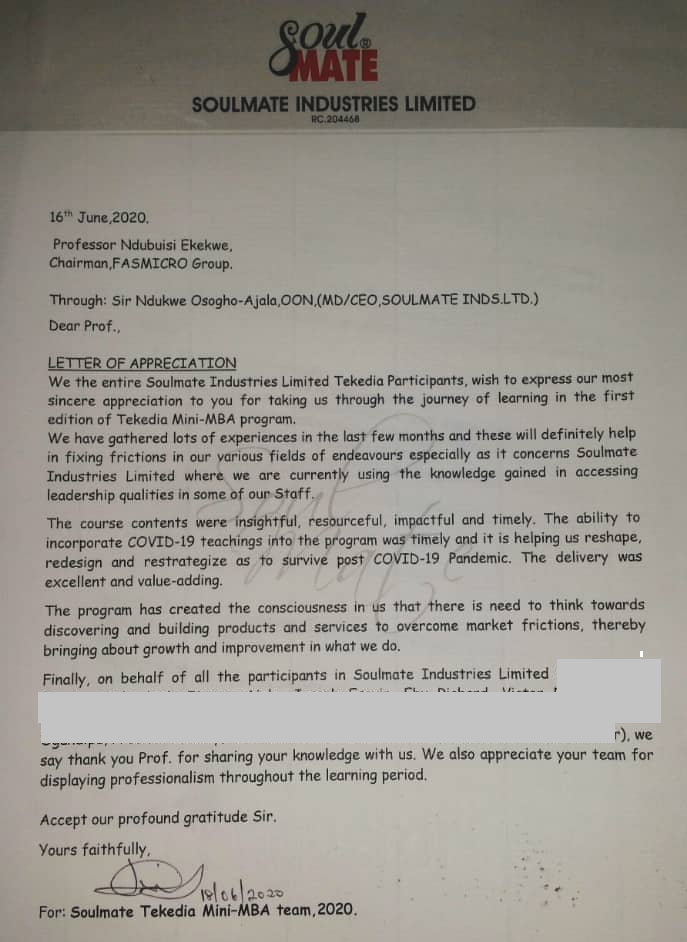
Testimonial from Soulmate Industries Ltd

Free for all Mini-MBA edition 2 participants

The Strategic Value of Facebook Messenger Room Video Meeting

0

I know you’ll succeed on a massive scale, that’s if only you know this.

Success in single means success in multiple. That’s what Dr. Tension told me a few months ago. I struggled to understand what he really meant.

I will ask you to meditate on it and tell me what he meant by ‘Success in single is success in multiple’.

Anyways, as a curious person I asked him what he meant by those complex and vague lines.

He started to tell me about some fantastic stories of great companies and their founders.

Let’s talk about Facebook inc and its founder Mark Zuckeberg. This guy actually had the idea of online socialisation. At that time he was pursuing a degree program in Harvard.

It may also be true that aside from the online socialisation idea, he had other plans to pursue plus his education at that time.

Look, he forgot other things and focused on the realisation of the Facebook dream. He devoted his time and effort to build the company. He only had a promising social media site without messenger, WhatsApp and Instagram.

What happened next? He succeeded in building Facebook into a million dollar worth company. That’s what I mean by success in singles.

Then he proceeded to pursue other goals such as acquiring other similar companies such as WhatsApp, Instagram and he built other features such as Messenger on Facebook. That’s what I mean by success in multiple

Truly, great entrepreneurs of today actually had success in one pursuit and the chain reaction was always success in other pursuits.

That’s the way to go by pursuing one first when you succeed you’ll have the capacity, experience and resources to pursue multiple dreams.

That’s why this analysis is about a new innovation on Facebook called the Messenger Room.

We shall draw many insights from the business strategies of Facebook which will be of immense help to your business and career.

The Facebook Strategies for Messenger Room Videoconferencing

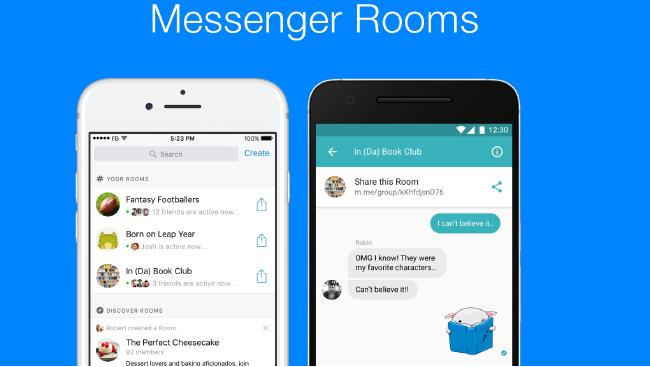
The new feature launched by  Facebook which forms an integral part of the Messenger is called Messenger Room. The messenger room is Facebook’s innovative response to the videoconferencing competition in the tech industry.

The Messenger Room is a feature on messenger that can be used for hosting free video meetings for both Facebook users and non users.

Here are the strategies that Facebook is leveraging on to develop this new value proposition on Facebook.

Already existing market

According to Statista an estimated 1.73bn people use Facebook on a daily basis. That’s absolutely mind blowing as digital businesses thrive on traffic. This is not just users to Facebook instead it is its core asset and infrastructure.

On Facebook we have messenger, WhatsApp and Instagram. Users can chat, upload both images and info graphic materials, call and do video calling etc.

The video, audio functions on messenger and WhatsApp are actually potential markets of video products to be explored by Facebook.

So, there is an already existing market for the video meeting feature. It’ll be easier to host meetings on Facebook than on other places since almost everybody is on Facebook. All they need to do is to join without downloading a new app.

Second Mover Advantage

I used to believe in what is called the first mover advantage until I noticed that sometimes the second mover advantage can be a very beneficial strategy in business too.

The second mover advantage is the advantages and benefits you have when you learn from  the mistakes, loopholes, milestones and limitations of the first movers in the market.

This is exactly what Facebook is doing. In this time of coronavirus pandemic, zoom has been the videoconferencing market leader.

The Zoom application has some technical and security flaws. This had brought massive criticisms and negative reviews to the business.

According to Mark Zuckerberg in a livestream while launching the feature said that the  company has been “very careful” and tried to “learn the lessons’ ‘ from issues with other video conference tools in recent months.

Second mover strategy allows an entrepreneur to leverage on the research, knowledge and limitations of the existing players in an industry for his business innovation.

Freemium Strategy

In one of my analyses I wrote why freemium is not strategically free. As you know already that some of the big tech companies leverage on freemium as means to an end.

Facebook is completely free to use provided you have an account with them. Instagram  and WhatsApp too are also completely free to use provided you have the mobile applications and you are registered.

The aim of freemium for Facebook is to mine data for their advert revenue model which is how the business makes money.

So, the same strategy is applicable to the  messenger room. The service is free for 50people meeting and it’s unlimited time. It can be used for free by Facebook users and non Facebook users.

With this Facebook users will increase and the service will also record high usage.

An Expansion of Already Existing Niche

Bringing people together online  to achieve a particular goal has been the business of Facebook since the first day the platform was launched.

So, with a messenger room, Facebook will succeed in bringing people together for the purpose of holding meetings virtually.

Entrepreneurs are people that are really needed in every economy because of one simple thing they do which is solving problems through innovation thereby keeping the fabrics of the economy running.

We can see how entrepreneurs are developing solutions to help businesses, teams and individuals stay in touch virtually which is a response to the social distancing measure for covid-19 containment.

Truly, success will be massive in scale when we learn to succeed first in one thing.

You may also be interested in How the  Zoom business model fits the coronavirus economy.

Nigeria’s N850 Billion Domestic Borrowing and Local Implications

2
Naira

At the Nigeria Treasury Bills (NTB) Primary Market Auction, held on the 29 April, 2020, the Debt Management Office of Nigeria (DMO), through the Central Bank of Nigeria (CBN), successfully rolled over N131.53 billion or $365.36 million worth of Nigeria Treasury Bills (NTB) across the 91, 182- and 364-days tenor. The auction result indicates that total subscription on the 1yr bill (364 day) was N148.99bn, with a range of bids from 3.38% to 12.80%. The stop rate cleared at 3.84% – true yield of 4.00% (16bps lower when compared to previous auction) at which a total of N71.07bn was allotted on the 1yr bill.

This decline in the stop rate on the 1yr bill to 3.84% is the lowest we have seen since 9th Sept 2010 when a 1yr bill cleared at 3.78%.

The timing of this auction coincided with the news that the Senate had approved the request of the FGN to borrow N850 billion from the domestic market as against borrowing the same from the foreign market. Although this has not been finally approved with the president’s signature, this news may have triggered some expectation of a higher yield at the auction considering the wide range of bids for the 1yr bill.

Borrowing $2.36 billion (N850bn) externally through Eurobond issuance would have been very expensive. Investors would have factored Nigeria’s credit ratings downgrade, the Coronavirus pandemic effect on our economy, with our reliance on crude oil export for foreign exchange earnings, the pressure on our foreign reserves and exchange rates, and the most devastating situation in crude pricing; which has seen the NNPC struggling to sell our very sweet Qua Iboe crude (Brent) oil even at a discount of $10 a barrel, about $7 per barrel below production cost, if we accept that our crude oil production cost per barrel is $17.

Most bond traders forecast that investors would have priced Nigeria’s new Sovereign yield at 15.25% on account of the current situation numerated above and amid concerns on dollar liquidity when more productive activities resume after this COVID-19 pandemic subsides.

Therefore, the current low yield environment in Nigeria means the DMO can borrow this amount locally at a single digit. Going by the trend on 1yr bill, the DMO can over 6 auction sessions raise N850 billion at an average cost of 5.55%, I do expect the lowest bid rate for the 1Yr bill to increase by at least 100bps should the DMO opt to raise this amount using the 1yr NTB next month.

The decision by the apex Bank in 2019 to differentiate the NTB segment for debt/borrowing from the OMO bills issuance strictly for liquidity management and exclusion of local corporates participation has led to the current low yield environment. The positive effect has been felt by banks in the last quarter from increases in net interest income mainly from their increased low-cost deposits and higher treasury bills yield.

However, this is about to change, as disposable income reduces as a result of months of non-productive activities within the economy occasioned by COVID-19 pandemic, lockdowns and restrictions, the cost of funds is expected to head north.

Interestingly, the prospect that its cheaper for the Federal Government of Nigeria to borrow internally to fund her deficit budget is a testament to the resilience of the Nigerian financial and capital markets amidst this COVID-19 global pandemic. The results of painstaking resolve by the FMDQ, the Financial Market Dealers Association (FMDA), CBN, SEC, FDHL-training, and others, over the years to deepen our markets and provide capabilities in the financial and capital market is yielding results.

The very active FMDQ E-bond (fixed income securities secondary market) which cannot be tamed by this COVI9-19 pandemic has created viable opportunities for Nigeria’s local corporates to contribute to nation building, while expanding investment opportunities across all sectors of the economy.

The expected increase in cost of funds will likely drive yields upwards to maintain positive spread that can sustain liquidity for economic activities in different sectors of the economy to reduce the adverse effect of the expected recession. The monetary authority should consider reverting to using OMO bills to manage liquidity and pressures on the foreign exchange market rather than the current situation of using the CRR. This could be temporary pending improved dollars inflows. This will also benefit Nigeria’s local corporates who have remained committed when their counterparts-FPI’s take flight from Nigeria.

With Nigeria’s current inflation rate, foreign reserves, and melancholy economic prognosis, liquidity is key to restarting the economy and reduce the effect of the COVID-19 pandemic. Nigeria’s treasury-bond market price efficiency means the market is in a better situation to manage liquidity more effectively. This liquidity is vital to all segments of the money market and capital market, including non-sovereign securities.

The current widening yield differentials between the primary auction issuance of NTB and OMO Treasury bills (NTB-3.84% Vs OMO- 12.64%) is not efficient and does not reward our local corporates who have remained steadfast with our economy. Market forces of supply and demand within the OMO bills space with participation of local corporates can close this widening gap and provide the optimal liquidity position to continuously manage inflation, foreign exchange pressures, and ensure price stability.

As positive news keeping coming in on the possibility of a vaccine for COVID-19, it’s only a matter of time before the FPI’s started returning to emerging markets, and, as more capabilities are developed, especially in our manufacturing sector, Nigeria should be able to depend less on external influences for economic growth and development.

How To Make An Intro Video For Your YouTube Content That Will Instantly Attract Viewers?

0
A picture shows a You Tube logo on December 4, 2012 during LeWeb Paris 2012 in Saint-Denis near Paris. Le Web is Europe's largest tech conference, bringing together the entrepreneurs, leaders and influencers who shape the future of the internet. AFP PHOTO ERIC PIERMONT (Photo credit should read ERIC PIERMONT/AFP/Getty Images)

A good introduction is something all of us yearn for, even in our personal lives. The right start to any aspect of our lives provides us the momentum and confidence to carry it forward with a positive mindset. Your YouTube content deserves the same. A nice introductory video or simply an Intro. It’s the best way to start your content and get the viewers initiated about you and your brand. And if they are amazing, then they have the potential to turn your viewers into your customers. Let’s get started with the bits and pieces of making a YouTube intro video and learn to make the best ones using an intro maker.

The significance of YouTube intros

Let me put it this way; YouTube videos have the ability to make or break your YouTube channel. It’s basically the foundation that you’ll be laying for your channel to spread across. Also, remember that you’ll be using that Intro a lot, almost for every content, so it needs to be visually stunning and contextually engaging at the least. It’s something that requires a bit of your thought process to engage in. Make a stunning one, and your videos are bound to be seen, your channel bound to be subscribed to. It might seem like a humongous task, but with the help of the correct intro maker, it’s nothing that can’t be achieved. Making the perfect YouTube intro is a very procedural task with an artistic and creative thought process. Read on to find out the basic guidelines that need to be followed while making one, a fantastic one that is.

How do YouTube Intro videos work?

Intro videos for YouTube content are generally introductory clippings that must be short and appear at the start of the YouTube content. The information conveyed through YouTube intros consists of the Title of the channel and theme of the video along with the name of the channel founder along with other people involved with the channel. These are accompanied by the brand name and logos with some snippets of music and colorful animations. This way, the viewers get introduced to the content as well as its creator and the brand all in a matter of seconds through interesting animations and sound, thus getting them hooked onto the rest of the content.

Making a YouTube video intro using an intro maker

Through a quick search on the internet, you’ll find tons of free intro makers for YouTube videos. Through a smart search, you’ll probably find the right one that suits your requirement. Usually, it’s the interface that facilitates ease of usage and the improved features that render effective video making. We shall choose one such intro maker named Canva and learn the steps involved in making such an intro.

  1. Select a video template or begin from scratch

One beneficial aspect of an intro maker is the numerous video templates on offer. One can choose a suitable template from a wide range of video templates available on Canva and begin customizing the same as per requirement. Moreover, lots of them are using free video editors that also provide templates for intros.

  1. Edit your design

The next obvious thing to do is edit the video design. Change texts and put down your channel tagline and Title. Play around with fonts, size, and color to achieve maximum effect. Canva o0ffers a large glossary of free photos, illustrations, and graphics. You can choose your image from that or insert your own photo for the YouTube intro video.

Next, you need to shoot your own intro video and upload it to the design. There’s also a video library you can choose from and find a suitable video clip that might suit your requirements best. Lastly, you can add some tune to your video by choosing from the existing library or adding your own snippet to the video template.

  1. Download your Intro and publish it

Now that you have edited your design and are content with it all, there’s left to do is download and publish it. It can also be shared on various social media platforms such as Facebook, Slack, or Twitter. You can avail of that option if you want to.

  1. Remember to choose the correct file type and dimension

When publishing your YouTube video intro ensure that you have selected the correct file type and video dimension. The aspect ratio for a standard YouTube video is usually 16:9. The highest resolution at present is 4K at around 3840×2160 px. Make sure you select the correct dimension for your Intro. Also note the common file formats supported in Canva are .mp4, .wmv, .AVI, .MOV etc. Select the correct one for your video as well.

Useful tips you must keep in mind while making YouTube Intros

  • Keeping it concise. Always remember to keep your Intro short and crisp so that the viewers remain engaged to the rest of the content. Around 10 seconds is long enough for a suitable intro.
  • Include visuals that are eye-catching and attractive. Even if you run the risk of making them flashy, opt for eye-catching visuals for the Intro. Bold animations, pops of colors with video clips will pique the viewer’s interest in looking beyond your Intro to the content.
  • Establish the brand and its tagline. Branding of your Intro is an essential aspect that people often forget amidst all the decorations. Use the brand name subtly and the brand logo aggressively so that viewers know who all are behind the video and what to expect from them.

Well, there are lots of free YouTube intro creators available out there, but Invideo stands out for the following reasons.

  1. Easy and quick interface
  2. An abundance of video templates.
  3. No burden of watermarks.
  4. All content is created and published through an online platform.
  5. It’s completely free.

Flutterwave 2.0 – Unleashing A Double Play Strategy With Ecommerce

1

In the emerging world, no great ecommerce company has been birthed without a payment solution; pick India’s Flipkart with PhonePe, and China’s Alibaba with Alipay. You can flip that construct: it would be hard for any paytech company to live sustainably in the developing world if your strategy is simply to win checkout pages of companies. Yes, dropping your lines of codes on websites of merchants cannot take you to the mountaintop.

The path to growth is simple: you must control the pipelines of transactions. That was what made OPay a formidable player with its amalgam of bikers, before it was muted by a change in Lagos state’s regulation. OPay was generating tons of transactions, $10 million a day, through the clusters of activities like loss-making ride hailing in its ecosystems. I have called that strategy a Double Play Strategy: you earn competitive positioning in tangential things which may not be evident to direct competitors. Competing against OPay as a fintech without compensating for the huge transaction funnels via ride hailing would end badly.

Today, we are learning that Flutterwave has unveiled Flutterwave Store. That is a brilliant move. Simply, the company and its partners will handle your deliveries (in some markets) while you focus on making sales after listing your products in the digital store.

Flutterwave Store is quite simply the best and easiest way to launch and manage an e-commerce business that accepts payments from anywhere in the world without creating a website, knowing how to code etc.

Flutterwave Store allows you to upload products, set prices and (in some markets) have our integrated delivery partners pick up when you have an order and deliver to your customer. “Buy Online, Pickup Curbside” store if you like.

Do not look far: Flutterwave has now an ecommerce marketplace. Yes, it has a double play since it can funnel transactions into its  own payment solution, making it a better company. The launch of Flutterwave Store elevates  the company as it can now defend its castle through leverageable moats, built on merchants and store business owners. This provides the company a stronger competitive positioning, away from the hardest job in paytech – competing for checkout pages of websites.

We use Flutterwave on this site. It is an amazing product – they keep making it better. Yesterday, we had a 100% transaction success, implying that all the people who tried to pay went through! Provided that percentage stays at triple digit, we will gladly keep paying our “tax” to it.

Flutterwave’s promise to deliver the items means that great things are on the horizon for merchants and small business owners. Of course, the company has to manage the risks well since logistics is a very expensive business in Africa as scale does not necessarily reduce marginal cost. The implication is that you can just be raking loses in the process. Yet, if the loss is compensated by the “taxes” collected on paytech commission, you can upgrade the size of the party hall!

Flutterwave 2.0 – using ecommerce to play a double play on fintech. This is a new company, across all metrics, because it can create a virtuoso circle and a positive continuum that will empower communities as it ramps up. Gaskiya!