DD
MM
YYYY

PAGES

DD
MM
YYYY

spot_img

PAGES

Home Blog Page 6500

Igbo Language – And The Lost Sounds

0

I smile – machines are not pronouncing Nigerian native names very well. Yes, the Tekedia Audio reading feature does not pronounce my name well (click to listen). Nothing big there: Igbo alphabets are yet to be digitized  for training machine learning tools. No major audio software understands “d” coming after “n”, contextually, and when you have “kw”, as in my last name, circuits break, from an Igbo phonetic point of view!

The A, B, CH…. Igbo alphabets are not in digital systems. The problem is evident: since Prof FC Ogbalu and Prof Tony Obesie (author of “Isi akwu dara n’ala” and “Ukwa ruo oge ya”) died, we have experienced stunted developmental growth in Igbo language.Those legends are celebrated UNN professors who pioneered many things in written Igbo language of today. Of course, they lived when schools were funded in Nigeria!

In 1978, Igbo language scholars laid down the foundation of modern written Igbo during the first Igbo convention. After successive works, the Igbo Izugbe (general Igbo language) moved from A, B, GB… to A, B, CH… As a secondary school student, and later as an engineering undergraduate in FUTO, I had followed the trend. It was an intellectual excursion; I passed Igbo language with distinction in SSCE/WASC.

Prof Chinua Achebe had edited Okike – the journal of creative writing – and contributed in the formulation of many elements for the growth of Igbo language. In short, Achebe wrote in his native (Anambra) dialect which was problematic. Why? Those works were not easily accessible to other Igbo scholars. At the end, they agreed and converged to Igbo Izugbe drawing heavily from Igbo used in Abia and Anambra areas. 

A challenge to Igbo language came when the Imo State government stopped funding Ahiajoku lecture – an intellectual gathering of Igbo scholars. More so, with limited budgets, in celebrated Igbo research universities (UNN and ABSU), the advancement of the language has stunted. As that remains the case, pronouncing Igbo names will remain challenging for digital tools and technologies. It is not going to be solved by hack – tell the system how to pronounce “Ndubuisi”. It would be solved by the machines understanding many things contextually so that when they see “Ndukuba”,  without already having it hacked, it can get it right. Simply, unless we build the libraries and digital marks, machines will continue to struggle with Igbo reading!

 (This observation applies to other Nigerian languages. But it is important to note that Hausa is the most advanced in terms of digitization with a dedicated teams in BBC and other news organizations improving it. Hausa has marketable audio value through BBC Service and other channels. The largest researcher in Nigerian languages today is Google, and technically holds the ace to advance  everything I have noted here. Just as Harvard budget is 3x the ministry of education budget of Nigeria, Google eclipses all indigenous works here. Yes, it holds the ace to pronounce Ndubuisi digitally!)


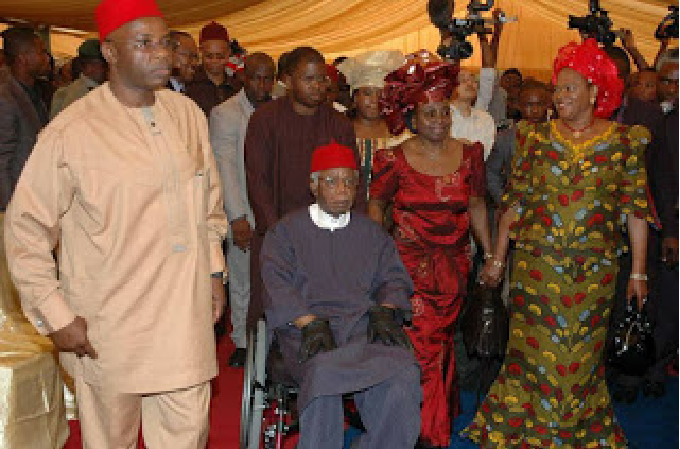
Photo – Achebe’s last Ahiajoku lecture. (Politicians have de-funded Ahiajoku.)
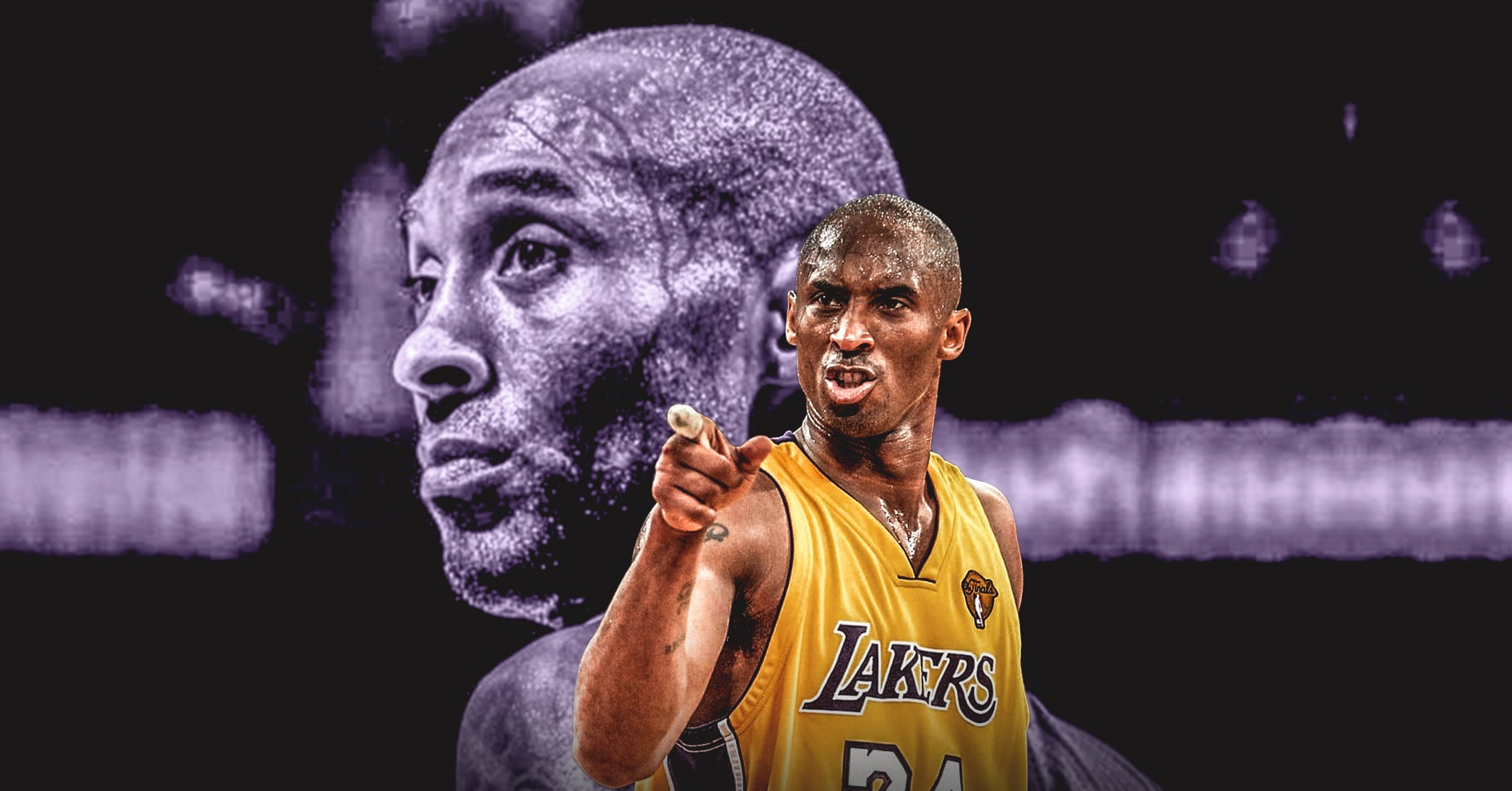
The Star Falls from the Sky – Kobe Bryant

0

As I watched smoke went up from the wreckage of the helicopter, reality beckoned on me that the world will never see Kobe Bryant and his daughter, Gianna in the court again. The 26th of January is a day that the world of basketball will never forget, and the rest of the world will remember it as sad.

Kobe was aboard a helicopter with eight others when it crashed in Calabasas, Los Angeles. The National Transportation Safety Board has commenced investigation into what happened to the SikorsKy S-76B. The tragic event happened on a hillside in Calabasas, about 30 miles northwest of downtown Los Angeles.

Orange County baseball coach, his daughter and wife, Gianna’s teammate, the teammate’s parents were among those killed. They were flying for a basketball game that’s scheduled for Sunday afternoon in Thousand Oaks.

Bryant was born in Philadelphia and showed his basketball prodigy while in high school. He was snapped up immediately after high school to join the NBA, making him one of the youngest players in the league’s history. He took the NBA by storm. At 34, Bryant made history; he became the youngest player in basketball history to beat the 30,000 point mark.

In 1996, Bryant was the youngest player in the NBA at the time, at 18 years, 2 months and 11 days. He went on to win two Olympic gold medals for men’s basketball, and five NBA championships.

In 2018, Bryant became the first athlete to win an academy award and a basketball championship. He won the academy for his film ‘Dead Basketball’ which was based on a poem he wrote.

At 41, he has become a force to be reckoned with, and a great role model for many. Though his legacy wasn’t unblemished, he had some controversy. In 2003, Bryan he was accused of sexual assault by a 19 years old hotel attendant. He was arrested, but the case was eventually dropped and settled out of court, with Bryan issuing a public apology; saying he didn’t know that the girl “didn’t view this incident the same way I did. After months of reviewing discovery, listening to her attorney, and even her testimony in person, I now understand how she feels that she did not consent to this encounter.”

He retired in 2016 after 20 years in the courts, and has been a great father to four daughters: Gianna, Natalia, Bianca and Capri. He was married to their mother, Vanessa.

Upon the news of his death, eulogy and condolence messages have poured in from around the world.

The US president Donald Trump called it “terrible” news: “Report are that basketball great Kobe Bryant and three others have been killed in a helicopter crash in California. That’s terrible news. Kobe Bryant, despite being one of the truly great basketball players of all time, was just getting started in life. He loved his family so much, and had such strong passion for the future. The loss of his beautiful daughter, Gianna, makes this moment even more devastating. Melania and I send our warmest condolences to Vanessa and the wonderful Bryant family. May God be with you all.”

Former president Barack Obama tweeted: “Kobe was a legend on the court and just getting started in what would have been just as meaningful a second act. To lose Gianna is even more heartbreaking to us as parents. Michelle and I send love and prayers to Vanessa and the entire Bryant family on an unthinkable day.”

Former president Bill Clinton and his wife said: “Hilary and I are deeply saddened by the tragic loss of Kobe Bryant, his daughter Gianna, and all those who died in today’s helicopter crash. Kobe brought excitement and joy to basketball fans not just in Los Angeles, but all over the US and around the world. He was also a leader off the court, including in his advocacy for young people, especially the vulnerable and homeless – a passion I saw firsthand when I joined him and Vanessa for the opening of a housing project they and their foundation supported. Kobe Bryant lived a very large life in a very short time. But above all, he loved his family. Our prayers are with Vanessa, Natalia, Bianca and Capri, and all those who lost loved ones today.” The Clintons said.

Athletes from around the world are also sending their encomiums. Golfer Tiger Woods said: “The fire. He burns competitively hot and desire to win. He brought it each and every night on both ends of the floor. Not too many guys can say that throughout NBA history. He would lock up on D. obviously; he was dominant on the offensive side. But any time he was in the game, he would take on their best player and shut them down for all 48 minutes. That was one of the more impressive things throughout his entire career. Then when he ruptured his Achilles and went to the foul line and made his shots, that is tough.”

Barcelona and Argentine footballer, Lionel Messi did not hide his sorrow at the news. He said: “I have no words… all of my thoughts are with Kobe’s family and friends. It was a pleasure to meet him and share good times together. A real genius has left us.”

Kobe Bryant was indeed a genius who got the world to stare at his moves, he will be greatly missed.

Improving digital access offers greatest investment opportunity in achieving SDGs in Africa

0

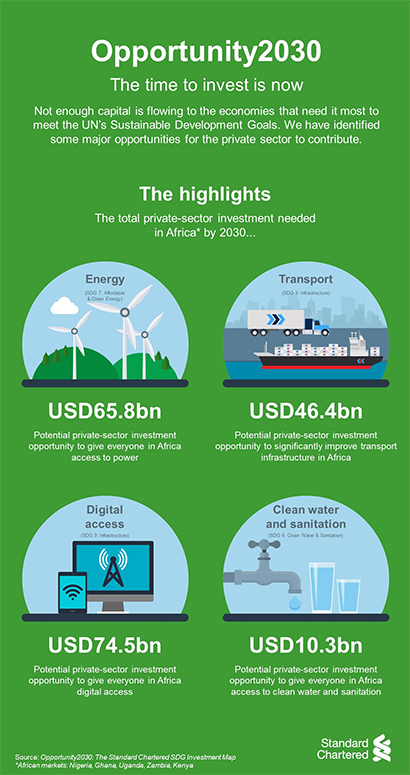
The Standard Chartered SDG Investment Map reveals a USD197 billion opportunity for private-sector investors in five high-growth markets in Africa to help achieve the UN’s Sustainable Development Goals (SDGs), with improving digital access making up USD74.5 billion of that total.

The study highlights opportunities for investors to contribute to three infrastructure-focused goals between now and 2030: SDG 6: Clean Water and Sanitation, SDG 7: Affordable and Clean Energy and SDG 9: Industry, Innovation and Infrastructure across emerging markets.

Across all the world’s emerging markets, Oportunity2030 identifies a USD10 trillion opportunity for private sector investors. This represents around 40 per cent of the total funding required to meet specific indicators within the three SDGs – allowing for population growth as well as maintaining current access – with public funds expected to provide the bulk of the investment.

Five African countries are included in the study: Ghana, Kenya, Nigeria, Uganda and Zambia. Key highlights include:

  • Providing universal digital access represents the greatest investment opportunity for the private sector by 2030 (USD74.5 billion), followed by universal access to power (USD65.8 billion), transport infrastructure (USD46.4 billion) and access to clean water and sanitation (USD10.3 billion)
  • The biggest single opportunity across the African markets in the study is in increasing digital access – a combination of mobile phone subscriptions rates and internet connectivity – in Nigeria (USD47.4 billion). Driven by its large and growing population, Nigeria also offers the greatest overall opportunity across the SDG indicators measured (a total of USD114.2 billion), followed by Kenya (USD40 billion)
  • Zambia and Kenya present a big opportunity to make an impact on SDG 6 (Clean Water and Sanitation): With an average of 43 per cent and 56 per cent of the population respectively currently lacking access to clean water and sanitation, there is a USD0.7 billion and USD2.3 billion private-sector investment opportunity to help close the gap by 2030
  • Uganda presents a meaningful opportunity to make an impact on SDG 7 (Affordable and Clean Energy): with just 22 per cent of the population that have access to electricity, there is a USD6.1 billion private-sector investment opportunity to help achieve universal access by 2030
  • The greatest investment opportunity in Ghana is in achieving and maintaining universal access to electricity (a key SDG 7 indicator), representing a USD7.8 billion private-sector opportunity

Sunil Kaushal, Regional CEO, Africa & Middle East, Standard Chartered, said: “The UN Sustainable Development Goals are amongst the most ambitious projects humanity has ever attempted. As well as offering our best hope yet of tackling the world’s most serious challenges, they also offer a unique opportunity for the private sector. For the goals to be met in Africa, the private sector must play a central role in deploying capital to get projects off the ground. Opportunity2030 provides a map of these opportunities, revealing the sectors and markets where investors can best contribute to the SDGs whilst achieving sustainable returns.

“Currently, not enough capital is reaching the countries that need it the most. With the UN’s 2030 deadline for achieving SDGs just 10 years away, the time to act is now.”

With Standard Chartered’s experience and reach into Africa, the Bank uses banking knowledge, products and its unique footprint to fund sustainable development where it matters most. In June 2019, we launched our first Sustainability Bond, raising EUR 500 million to fund projects aligned to the SDGs in emerging markets, and have worked with clients and partners to create a number of important landmark structured solutions to support the SDG’s. The Bank has also launched its digital bank in nine markets in Africa, as part of the Bank’s digital transformation strategy for Africa. The digital banking solution provides Standard Chartered customers with affordable, fast and easily accessible banking services that is supporting financial inclusion in the markets.

Opportunity2030: SDG private-sector investment opportunities by African countries in the study:

Market Water and sanitation (SDG 6) Access to power
(SDG 7)
Transport infrastructure (SDG 9) Digital access (SDG 9) Total
Nigeria USD5.7bn USD32.3bn USD28.8bn USD47.4bn USD114.2bn
Kenya USD2.3bn USD15.6bn USD9.1bn USD13.0bn USD40.0bn
Ghana USD0.8bn USD7.8bn USD4.1bn USD6.9bn USD19.6bn
Uganda USD0.8bn USD6.1bn USD2.8bn USD4.0bn USD13.7bn
Zambia USD0.7bn USD4.0bn USD1.6bn USD3.2bn USD9.5bn
Total USD10.3bn USD65.8bn USD46.4bn USD74.5bn USD197bn

You can download the full Standard Chartered Opportunity 2030 report here

Source: SC Press Release

This Week in the Nigerian Capital Market (20-24/1/20): Rates, MPC, CRR

3

It’s no longer news that Guaranty Trust Bank (GTB) crashed interest rates on its Quick Credit loan by 24% from 1.75% to 1.33%. This monthly 1.33% for 12 months will give an annual interest rate of 15.96%, if you factor in inflation at 11.98%; the real return that will go to the bank annually per customer is very thin at 3.98%. That’s too low by Nigerian lending standards; clearly, GTB has more in mind than profit/spread. They have disruption in mind. Now, who is disrupting who?

We will come back to the disruption topic. Currently, banks are battling with two forces, market forces and Central Bank of Nigeria (CBN); market forces led by interest rates and CBN through LDR (loan-to-deposit ratio). While LDR is saying you must lend businesses and consumers money, interest rate is shouting you must lend cheap. The hands of banks are tied, tied by crashing yields across all government securities – what can be likened to a ‘coup of rates’ on the banks by the government.

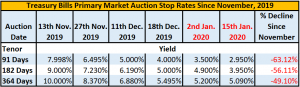
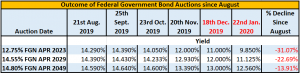
The average decline in treasury bill rates across all tenors in the last six auctions is over 55%.

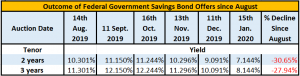
FGN (Federal Government of Nigeria) savings bond yields are down by over 29%.

As for FGN Bond, the decline is over 22%. Taking a closer look at the trend (especially from November 2019), clearly, the government has a plan, something like a ‘coup of rates’. Despite these declines, banks, fund managers and PFAs (pension fund administrators) are still desperately after these government securities.

Government is saying we don’t need your cash, invest them in the real sector via loans. For the moralists, it won’t be wrong to ask “Why are we so keen on funding the inefficiencies of government when we complain of the same inefficiencies?”.

The first FGN Bond Auction for the year held on 22nd January 2020 recorded an oversubscription of more than 300%. Subscriptions received through competitive (N624.5b) and Non-competitive bids (N1.83b) totaled N626.33 billion. Following the auction, only N411.822 billion was allotted leaving another N214.508 billion stranded. Already, we have over a trillion stranded from other maturities and more will join them soon.

Conservatively, we can say hundreds of billions are stranded in the system but don’t be surprised when bankers argue in the line of ‘trillions’, anytime these debates take place, expect the CBN.

CBN raise CRR to 27.5%

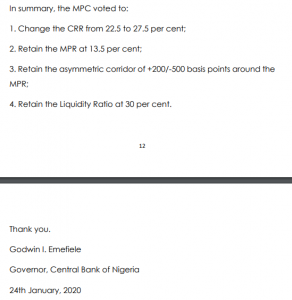
Yes, CBN turned up. At the first Monetary Policy Committee (MPC) meeting of the year held on 23rd and 24th January 2020, the CBN raised Cash Reserve Ratio (CRR) by 500bps to 27.5% from 22.5%. What’s CRR again?

CRR is a specified minimum percentage of the total deposits of customers, which commercial banks have to hold as reserves in cash with the CBN. The required reserve ratio is sometimes used as a tool in monetary policy, influencing the country’s borrowing and interest rates by changing the amount of funds available for banks to make loans with.

Simply put, CRR is a monetary policy tool of the CBN used to ‘lock up excess cash’. You may want to ask why is CBN locking up cash when I need loans for my business?

“The Committee is confident that increasing the CRR at this time is fortuitous as it will help address monetary-induced inflation whilst retaining the benefits from the Bank’s LDR policy, which has been successful in significantly increasing credit to the private sector as well as pushing market interest rates downwards.” MPC

Deposits of customers with banks are currently estimated to be over N16 trillion and growing, a 5% (500bps) increase in CRR will take less than a trillion naira from the system, as a result, we do not expect the increase in CRR to immediately impact the current status-quo.

Expect more insights on the outcome of the MPC during the week.

Selected Tekedia Posts Now Have Audio Play – Listen Without Reading!

0

I am very happy to report that we have successfully integrated a text-to-speech technology on Tekedia. We cannot be going to co-learn and co-share “innovation” without demonstrating that element in the training itself. Simply, when you arrive at the page, you will see an audio link at the top of the page; click that audio button and play the post. 

I just activated a post (click to listen) to give you an idea. With this tool, you can “read” (yes listen) to the contents while driving via your phone, at work with headphones, etc.

(Do not worry how the technology pronounces names!)