DD
MM
YYYY

PAGES

DD
MM
YYYY

spot_img

PAGES

Home Blog Page 6511

How Transsion Holdings Became A $4 Billion Company by Leveraging On Design

0

For the uninitiated, Transsion holdings is the parent company of Tecno, Infinix and Itel. Recently, they had their IPO (initial public offering) on the Shanghai STAR exchange, a Chinese based exchange reserved for companies in the tech space and they raised 393 million USD, valuing the company at 3.95 Billion USD. Transsions IPO prospectus reveals some surprising facts, one of which is that 2018 revenue was 3.29 Billion USD, and they hold a whopping 64% of the feature phone market in Africa, with Nokia following them as a distant runner-up with 10%. In terms of unit sales, the three combined Transsion brands (Tecno, Infinix and Itel) control a combined smartphone market share of 36.2% with Samsung coming in at second at 23.9% and Huawei at 11.4%. 

The big question, however, is how did a Chinese company that was relatively unknown about 12 years ago end up having such a hold on the African Smartphone and feature phone scene? The Secret is in Design.

Design

In an article, I wrote about what design meant to me, and how design is much more than the product of design (well designed logo or banner, software user interface or a Hardware Product) but more about the process of design, or what has now been popularized by the term “Design Thinking”.

Design thinking is a five step iterative approach to problem solving used by designers and popularized by the team at global design Consultancy IDEO. Design thinking in essence has five steps; Empathize, Define, Ideate, Prototype and Testing. The Success of Transsion Holdings was made possible by the efficient execution of one of the five design thinking steps; Empathy.

Empathy

 Design is human and people centered, therefore the foundation of Design is Empathy. Empathy isn’t assuming you know why and where the shoe hurts, Empathy is about wearing the Shoe, and finding out for yourself where it hurts. Your chances of building products that connect with people are heightened when you develop true Empathy for your users and consumers, because not everyone that is frowning their face is angry. Some are hungry. Empathy will help you know the difference.

Design doesn’t try to influence human behavior, it adapts to it.

At the root of Transsion’s success is Empathy. Transsion’s understanding of the Nigerian (and by extension African)market and consumer has empowered it to position its product in the right place to solve the Jobs to be done (I’ll get to this later) of the Nigerian and African consumer. Here are some steps they took:

Dual Sim

 Transsion originally started with one brand; Tecno. And at the initial stages what they made were primarily feature phones, their phones weren’t necessarily high quality, and as for those who remember those days, those phones were nicknamed ‘Chinko’ phones. Be that as it may, Transsion noticed a gap in the market; the average Nigerian consumer liked having two phones, so, they took advantage of that information and began to design dual sim phones, today the rest is history, almost every new feature phone and/or smartphone launched into the Nigerian market comes with Dual sim capability. Transsion pioneered it in Africa.

Pricing

The average Nigerian is price conscious, very price conscious, if you sell a product in Nigeria for an exorbitant price that doesn’t already have a solid brand, and your market is the Average masses, you may need to re-strategize if you don’t want to go under. The average Nigerian is willing to choose one product over another based on a N1,000 ($2.78) difference in price. Transsion understanding this consciously made an effort to keep their phone prices down. Five years ago, at the end of the road for BlackBerry, people began migrating to either Android or IOS devices, but there was a problem, it was pricing. The two major Smartphones then were Samsung and Apple, which really didn’t solve the pricing problem (they exacerbated it). This was where Transsion saw an opportunity and grasped it. The first batch of Tecno hardware was so cheap, I remember a specific model was so cheap it costs one third of a hundred dollar!!!!.

Focus on what matters, ignore what doesn’t

There are very few technology companies as focused as Transsion. To achieve the right pricing, Transsion has to be focused on making sure that their phones don’t carry specs that are not necessary, and since they understand their market, it hasn’t been difficult to do. Being focused means not putting specs that are good on paper, but add little or no noticeable value to the user. To cut down on processor cost, they use Mediatek chips instead of Snapdragon, which are more cost effective for managing mid to low range Smartphones. They know you don’t need a high resolution OLED display, you also don’t need a 90Hz screen refresh, so it’s not included to avoid bumping up the retail price, wireless charging is nice, but for now it’s not a deal breaker, Phones are made of plastic as against Glass to save cost, in the end efficiency and good decision-making is really the backbone of their strategy. Things like the face unlock, all screen displays, fast charging and even a fingerprint scanner all have considerable value to the end user and are added to the product. Whatever is primarily a buzzword feature stays far away.

It’s a Numbers Game

Business executives love numbers, so do Nigerians. Although Transsion is a focused brand, they know when to play with numbers to attract your attention. Quadruple camera setup (4 Cameras in a phone), 32megapixel front facing camera, 4000 mah battery, 4gb of RAM, 64gb of internal storage, these are largely designed to draw the end users attention. In reality, the number of camera’s doesn’t determine how good a photo is, the Google Pixel 3, arguably one of the best photography Smartphones in the market has only one camera, most of the heavy lifting is done by computational software. Transsion understands well enough where to put numbers to draw the users attention and makes the most of this.

Some other strategies employed by Transsion include having a portfolio of three brands, meaning customers have a wide array of products to choose from instead of being stuck to one product from one brand.

How Does this Help me?

Empathy is the first step in Design thinking, if you will succeed in business, you must apply the principles of Empathy. Without a deep and thorough understanding of your consumers, and the market you intend to operate in, you run the risk of providing products and services that people don’t need or find valuable

 People do not buy products because they want to, they buy products because they want to “be”. There’s something we call the Jobs To Be Done Theory, your product isn’t just a ticket to perform an action by a user, it’s a way to bridge a gap between where a user is now and where he intends to be. Your product bridges that gap. Transsion bridges the gap of affordable premium, and democratizes the Smartphone experience. If your product will be successful it must locate a specified gap and bridge it for the intended user.

Conclusion

Empathy is key to success in business, if you can’t see from the eyes of your users, then you really can’t see at all. 
Tekedia Mini-MBA Webinar for Week 1 – Now 4pm Lagos Time Today (Feb 15)

1

Update: This event will now take place at 4 pm Lagos time today. We have figured out a way to run this via in-browser with no installation. Link provided in the class Digital Board.

Original Post

The Webinar link for Week 1 of the Tekedia Mini MBA is active; it begins at 4 pm Lagos time today. This week has focused on the The Innovation of Firms. We would be discussing the feedback, questions, comments and your live questions. Everything will be recorded in case you cannot make it. But where you have time, go to Week 1 Digital Board to connect to the Webinar.

Tekedia Mini-MBA continues to welcome new registrations. Our program is designed in such a way that you can join at any time. We have archived and recorded all materials. Visit here to register using any of the registration options.

The 360-Degree Team

3

Two Questions from Tekedia Mini MBA Discussion Board

  1. A Founder who is more focused on the technical aspect in building his project could find it quite hard to integrate the business model canvas template for his growing start-up, why is it so?

  2. Do you think that he should focus more(as a CTO) on the technical part, and hire more business-inclined personnel to do it for his start-up?

My Response here:

On the questions, it is always recommended for technical-only founders to have business-skilled people around them since they have limited business skills. Technology is very important; yet, it is nothing but a tool. It does wonders when there is what I have called “friction-purpose” superimposed on it. Simply, you want to be sure the business model is sound based on many factors. Most times, tech-only founders cannot deliver on that. 

Yet, this is not a binary: you can be a techie and still understand business very well. But where that is not the case, get help by hiring someone that will complement you from the business side. Bill Gates had Steve Balmer in Microsoft, Mark Zuckerberg has Sheryl Sandberg in Facebook, Google boys had Eric Schmidt.

In some cases, the business mentors could be invisible but someone is playing the drum for the music the Aneke bird is seen dancing by the roadside.

You need a team that is complete with capabilities on tech and business strategies: the 360-degree team. Next week lectures will focus on those strategies and I am sure working on the canvas will become easier.

https://www.tekedia.com/mini-mba/

The FCMB’s Scholarship to Dele, and the Failures that Enabled It

0

On the 5th of February, a photo of a little girl doing her home work with First City Monument Bank (FCMB)’s ATM light surfaced online and went viral. The little girl identified as Dele has gone to the ATM in Ondo City as darkness has taken over her environs, and the ATM proved to be the only source of light that could enable the vision she needed to do her homework.

The viral tweet caught the attention of FCMB and the bank declared her wanted.

On Thursday, the bank issued a heartwarming statement that got everyone talking.

“FCMB is pleased to announce the award of full scholarship to Fathia Dele Rasheed, the 7 years old girl who was recently spotted using lights from the ATM Gallery at our branch in Ondo City to do her homework. The scholarship will cover Dele’s education from her current primary Grade 1 to higher education level in a Nigerian institution.

“We commend Dele’s determination, as well as that of other young Nigerians just like her, who aspire to a better life and are relentless in their pursuit of it.

“As a caring and inclusive Brand, FCMB will continue to empower individuals and communities by championing and executing initiatives that enrich the life of Nigerians,” the FCMB’s statement said.

Fathia has become fortunate beyond everybody’s imagination. Her determination to finish her homework has got her a scholarship she didn’t see coming, and took a load of financial responsibility off her parents’ shoulders.

On the other hand, FCMB has made a difference where it is uncommon. This style of Corporate Social Responsibility (CSR) has an inspiring impact that goes beyond a push for brand recognition. It came with a touch of humanity that may be replicated in the future to impact other aspiring youngsters.

But beneath the celebrations and encomiums that have followed the development, Nigerians see hurting truth; it is a systemic failure that resulted in poor infrastructures like poor electricity supply that has kept many in dense darkness and stymie their aim to do better in their endeavors.

In the past, corporations had made provisions to help students to attain their academic goals. In 1948, UAC introduced the Secondary School Scholarship Scheme, to foster students of its serving and retired employees. The Nigerian National Petroleum commission (NNPC) introduced the annual national quiz competition for secondary schools across the country. These gestures were seen as encouragement, opportunity for students to overcome the hindrances in their pursuit of education.

As time progressed, the vacuum in the education sector of Nigeria kept getting bigger that these corporations started seeing reasons to do more. These companies budget a handful of money to help schools in different host communities where there is a wide gap in lack of education facilities as a result of government’s negligence. From banks to every other private institution, the engagement in fostering school activities became popular that it is gradually becoming a requirement.

This is evidence that CSR has taken the place of the government in education. A study conducted by Thistle Praxis, a consultancy outfit said: “The past few decades have seen a steady evolution of the practice of CSR from a form of corporate philanthropy to a more structured and all-encompassing model…there is reason to believe that there has been an increased interest in CSR, and that Nigerian corporate establishments have begun to take CSR seriously.”

Specialists in education believe that these companies are shouldering education responsibilities because the government has failed to measure up to UNESCO’s standard that encourages allocating 26% of the country’s budget for education.

While it has become acceptably the case in the education sector, other issues of infrastructure happening outside the academic environment has begun to expand the corporate social responsibility of these companies beyond the school corridors. Dele was at the FCMB’s ATM because there was no light at home when she needed to do her homework for school the next day. She was only discovered because someone took a picture of her while she was at it and posted it online.

While the little girl showed determination to succeed by going extra mile to do her school work, people are saying that she is not alone; there are millions of school kids like her across the country whose only wish is light and other basic amenities to succeed in education. But her story, like in other cases, exposes a system decay that has gone from a government’s failure to a collective shame.

How to use Freemium Model to Unlock Value

3

Your money is in the hands of the people you meet daily, both online and offline. The business legend continued, how will you get this money from them? I pondered on these words. He said value is good but business models are better. That is how entrepreneurs get money from people. 

So, it was nightfall, I was going home from my office. I stopped by to buy Suya (Nigeria roasted meat) from a Suyaman (Suya Seller). The first thing the seller did was to cut a piece of the roasted meat for me to taste. The meat was very inviting. I took it from the seller and ate it in order to test how delicious it is. Guess what happens after that, I bought more than I wanted to buy. 

While I reasoned the business application of this experience, I discovered that this is simply a freemium model. So, you can unlock value in your business after going through and digesting this article. But, how? See how. 

The Two Components of Freemium Business Model:

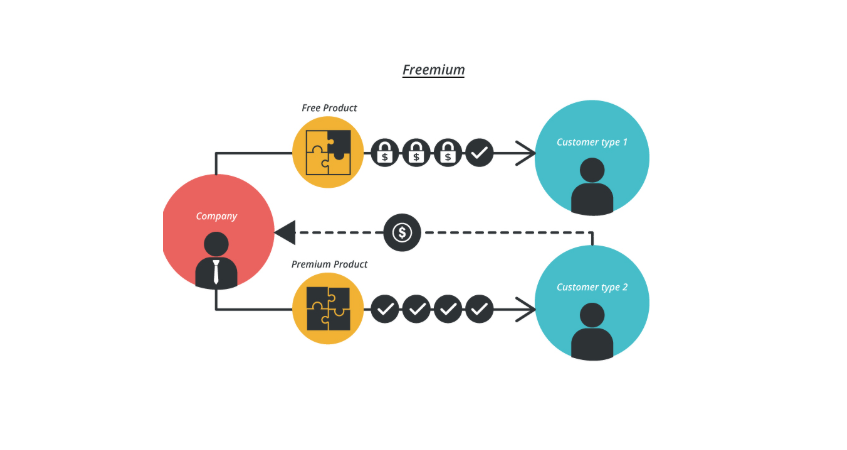
According to Harvard Business Review freemium model is a business model that combines free services and premium services. The Entrepreneur has explained that Freemium business model works in two ways;

  1. If it’s combined with the launch of your company, because being “new” will bring some intrigue, and a free introductory version reduces barriers to entry.
  2. If your product or service is established and so loved by users that they’ll pay for something before losing access to it.

So, the two components of freemium business model are;

Free Component

The business gives perfectly free services to the customers and the customers derive huge value from these services. I will explain how this works in the next section of this article.

Revenue Model

The business offers higher services to the same users that they will pay for. This is how the companies that operate on the Freemium model make money.

How Three Modern Companies Apply this Freemium Model Effectively?

We shall be considering how three leading companies in tech adopt the freemium model and these businesses are growing in the now and will continue to thrive. Here are the insights;

  • Google Search Freemium.

Google is a business under Alphabet Inc. I will analyse these businesses under the free Service component and revenue models headings.

  • Google Search Free Services:

Google provides the world’s information and makes it universally accessible and useful. This information can be accessed by anyone across the globe without having to pay for making a search query. You will agree with me that the information on Google is very useful to your day to day activities. The value of Google Search free service is enormous. I feel you can testify to that.

  • Google Search Revenue model:

While you search for information on Google Search, they mine your data. They use this data to provide advertising services to other companies in the form of Google Ads, display adverts etc. For you to advertise your business on Google you’ve to pay to rank for relevant keywords. This is how Google makes money.

  • Youtube Freemium:

YouTube is Google Search engine for virtually any form of video contents. The platform has created great value. How does its freemium model work?

  • Youtube Free Services:

You can watch videos free of charge. All you may need is your smartphone or device and data subscription. Many people have become professionals and experts in different things by watching free video tutorials on Youtube. What a great value!

  • Youtube Revenue Model:

Youtube revenue model is similar to that of google search. It uses the activities of users to provide advertising services to companies and individuals that need marketing. 

  • Linkedin Freemium

Have you been charged since you started using the Linkedin platform for networking? Have you seen great value in a platform that is for professional connection? You see the caliber of people you’ve met, how grateful are you for that? This is how the Linkedin freemium’s free component works;

  • LinkedIn Free Service:

In the book “3S Rules” Reid Hoffman has a principle which states that humans are social animals that they find fulfillment connecting with other human beings. So, on Linkedin you get access to great experts and professionals that you could network with without payment for the value. You can join great groups, write and connect with people and organizations

  • LinkedIn Revenue Model:

Linkedin offers other services that are only accessible to people that subscribe to premium services. Some of the examples are; learning on Linkedin, having access to people that view your profile etc. They also advertise using your activities on the platform. This is how they make money.

Freemium model can be a business model to a certain business and can also be used as a marketing strategy by other businesses. But the goal is that users or people graduate from the free services to premium just like the Suyaman’s example or find a way to monetize their activities as Google and YouTube are doing.

What do you think about this interesting business subject? Do you plan to adopt this business model? Comment below.