DD
MM
YYYY

PAGES

DD
MM
YYYY

spot_img

PAGES

Home Blog Page 6551

Babcock University: Redesigning Stakeholders’ Engagement in the Face of Emerging Technologies

1

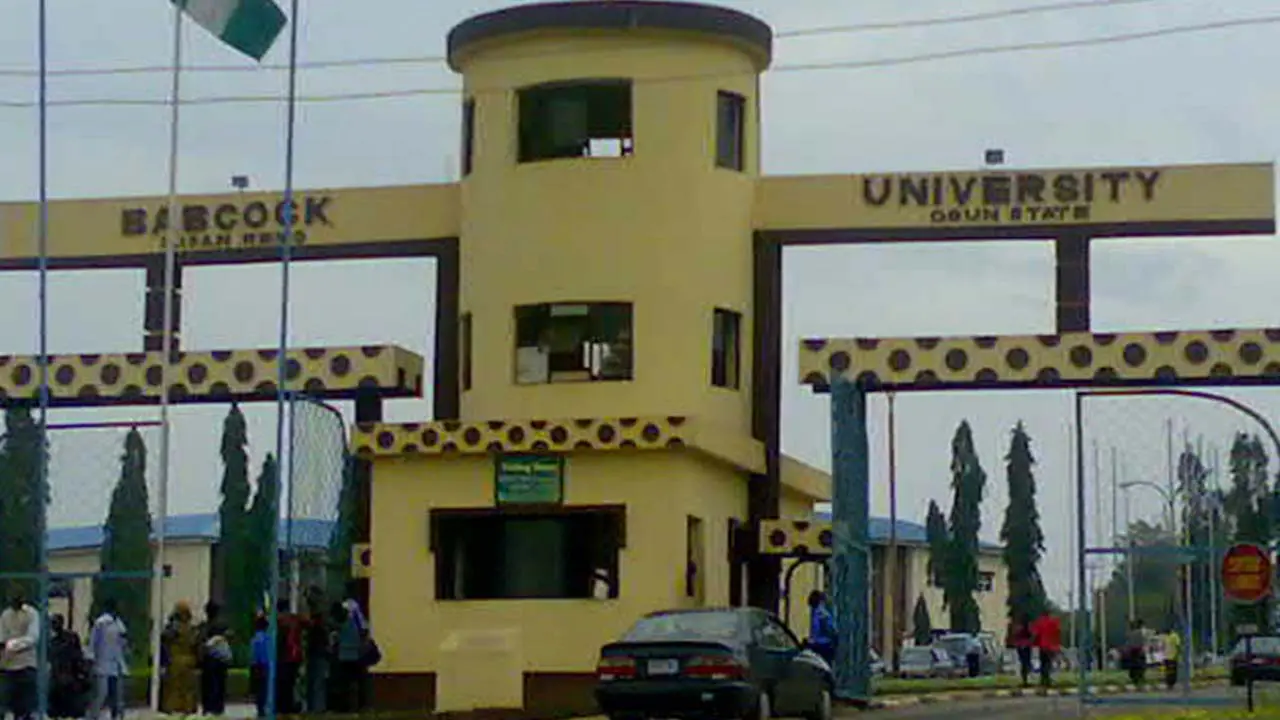
Recently, Babcock University was in the news. Two ex students of the university were seen engaging in sexual intercourse in a video that went viral online. The university authority took the bull by the horns. The female student was expelled. Her male partner had earlier been sent away from the university on the basis of his abuse of substances. Reactions followed the university authority’s decision. The aim of this piece is to draw out six takeaways for both students on internet usage and the management of universities on how to handle such matters going forward.

# Digital Native Undergraduates. First, it is high time that management of universities understood that the demographics of undergraduates have totally changed. The demographics have changed over time. From digital migrants to digital natives, the undergraduate ecosystem is replete with students born shortly before the arrival of or during the millennium. The average age for admission into Nigerian universities is 16. The implication of this age bracket is profound. But, it simply signifies that most of the students are digital natives. Digital natives are the generation of young people who are “native speakers” of the digital language of computers, video games and the internet. These sets of young people are reported to have lower anxiety scores about the internet and higher web, email and social media usage.  Generally, digital natives are considered to be intuitive learners, social, empowered by the internet and impatient. This calls for more appropriate ways to manage these students in their learning, character building and even crimes. Every generation has its own issues. Unfettered access to the internet and the quick get-it-online syndrome is the undoing of this generation. From Babcock to FUTA to Queen’s College, it is obvious that the share it online rule is prevailing among the youths. And those charged with the responsibility of managing them must understand this clearly.

#Digital Public Relations.  This is related to the first takeaway. It still bothers on the management of the generation also popularly called Generation Z. This particularly concerns those who manage information in educational institutions in Nigeria. Students are key stakeholders in any educational setup.  What they do and do not do reflects on the image of their schools. This is why despite the fact that the sex video has no logo that links it with Babcock. The culprits were identified students of the university. And all hell was let loose. There was a dip in the university’s goodwill both online and offline. People have a tendency to relate the students’ conduct with the moral standing of a school. A learning place is a socialization agent in the society. Therefore, PR practitioners should begin to strengthen their digital capabilities to monitor activities of their students online so that they can be better placed to handle crisis when they occur. This generation does not look like one that will not rock the boat online either for genuine reasons or pure carelessness as we had in the case under review. As at the time of writing this, attempts to search for Babcock online links one with the sex tape scandal.

This implies that Google has normalised the search for sex with Babcock University. For instance, the first 5 related queries when people searched for Babcock University online from 20th- 29th November, 2019 were Babcock university video, Babcock University student, Babcock University student video, Babcock news and Babcock University girl. Similarly, the top 5 terms people searched for online after searching for sex within that same period were Babcock sex, Babcock sex video, Babcock University sex video and Babcock student sex video. This has a lot of implications on the goodwill of the university. The communication unit of the university must, as a matter of urgency, rev up positive content that speaks to the core values of the university. They have to generate positive value for the university by popularising such online if they desire to see the negative trending online abate.
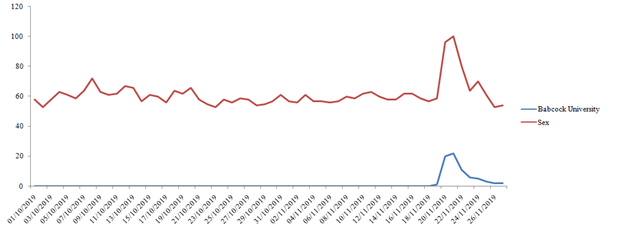
Source: Google Trends, 2019; Adebiyi, 2019

#Digital footprints hardly go away. This concerns students and other youths of this generation.Since they grow up with digital devices, they are wont to leave their footprints online. This is especially common for social media platforms. This is a generation that wants to capture every moment of their lives in photos and videos. They value the likes, the shares and the comments. They are the meme tribes. However, they pay little attention to how their footprints are stored on the internet and for how long.  With the recent scandals we have witnessed, these sets of youths must be informed that the Internet of Things does not forget the footprints impressed on it. It should be understood that if it has not been shared, it is within control. Once it gets online, it is totally out of control.

#Popular wisdom is not  real wisdom. The generation suffers from the paradox of access to information. Even though there is so much information available, they are less familiar with the accumulated wisdom of humanity. The tendency is for them to join the crowd. The crowd mentality is supreme. When they see what others do, the Generation Z is likely to copy. They crave attention. But, they should be made to understand that life is not lived by comments and likes.

#Every freedom has its own limitation. The digital natives have access to technologies and digital devices. This gives them the freedom to express themselves in words, images and videos. They find it difficult to separate public from private  issues. That is where the problem is. Youths of this era should take heed: freedom has its own limitations. And in this case, the consequences are graver than they could think off. While click, post and share rule their world, there is wisdom in exercising restraint before any act is recorded and shared. Questions to consider include: would I be happy if this gets to the public? Will my parents and family members be proud of that post or picture? Will the consequence not come back to haunt me? Youths should learn to think before they click. Thinking appears no more fashionable in this fast internet driven world. Yet, it is a virtue highly needed now more than ever before.

Before Nigeria Takes The $30 Billion External Loan

4

Nigeria wants to borrow $29.96 billion externally. That is actually a good thing if we have institutions that would give us that money under fair market terms. The problem is never more money – the challenge remains the low efficiency in the utilization of the factor of production. So, this is my humble request: the federal government should post all receipts and invoices (above N10 million or $30,000) that are associated with this loan online for Nigerians  to monitor and track. If we do that, we can be certain that this money will work for the Nigerian people. Also, that would go with this roadmap of dealing with procurement corruption in Nigeria. Yes, it is time to implement that our anti-corruption tech-driven strategy for public procurement.

 We will build a corruption-free nation where it would be extremely impossible to perpetuate corruption because technology will make things obviously transparent. All government systems must be structured to be corruption-resilient so that people that want to perpetuate corruption will fail. We will publish any government expense that is more than N10 million in a web diary which all citizens will have access to. This applies to all levels in the federal government, from ministries to agencies. For national security reasons, a segment will be available to the civil society and accredited press team. Our government will improve business systems and make doing business in our nation easier.

This Anti-Corruption Technology Will Eliminate Procurement Fraud In Nigeria

The Nigeria’s New $29.96 Billion External Borrowing Plan And Incubation Of External Debt Crisis

0
Buhari New Appointments
Mr. Buhari, President of Nigeria

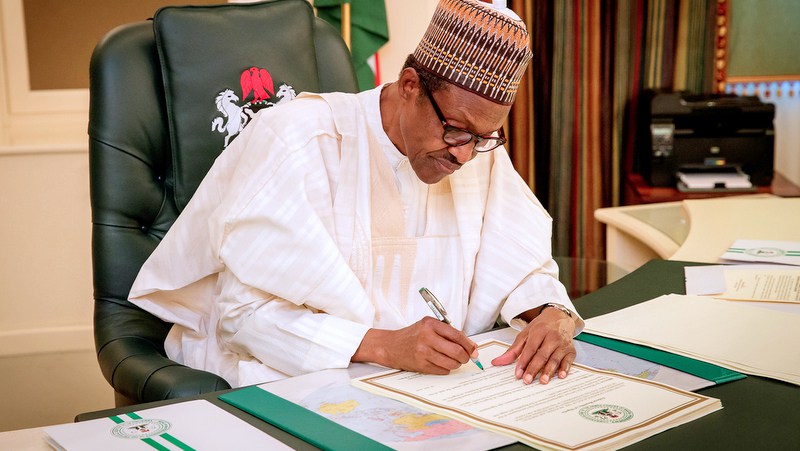
On Thursday, President Muhammadu Buhari resent the $29.96 billion external borrowing plan to the senate for approval.

The borrowing plan was previously sent to the 8th Assembly in September 2016, after being approved by the Federal Executive Council (FEC). Buhari has asked the 8th Assembly to approve the plan to enable the Federal Government to fund infrastructure from 2016 to 2018.

But the 8th Assembly, led by Bukola Saraki rejected the plan since there was no detail on how the fund will be utilized.

On resending the plan to the 9th Assembly, Buhari explained that the preceding Assembly only approved a segment of the loan plan, which resulted in infrastructural decay due to lack of funds by the Federal Government to execute projects across sectors like power, health, agriculture, water and education.

The letter, dated November 26, 2019, reads thus:

“Pursuant to Section 21 and 27 of the Debt Management Office (Establishment) Act, I hereby request for Resolution of the Senate to approve the Federal Government’s 2016 – 2018 External Borrowing Plan, as well as relevant projects under this plan.

“Specifically, the Senate is invited to note that while I had transmitted the 2016 – 2018 External Borrowing Plan to the 8th National Assembly in September 2016, this plan was not approved in its entirety by the Legislature. Only the Federal Government’s Emergency projects and one (1) China Exam Bank Assisted Railway Modernization projects for Lagos-Ibadan segment) were approved out of a total of thirty nine (39) projects.

“The outstanding projects in the plan that were not approved by the Legislature are, nevertheless, critical to the delivery of the Government’s policies and programmes relating to power, mining, roads, agriculture, health, water and educational sectors.

“These outstanding projects are well advanced in terms of their preparation, consistent with the 2016 Debt Sustainability Analysis undertaken by the Debt Management Office and were approved by the Federal Executive Council in August 2016 under the 2016 – 2018 External Borrowing Plan.

“Accordingly, I have attached, for your kind consideration, relevant information from the Honourable Minister of Finance, Budget and National Planning the specific projects under the 2016 – 2018 External Borrowing Plan for which legislative approval is currently sought.

“I have also directed the Minister to make herself available to provide any additional information or clarification which you may require to facilitate prompt projects under this plan.”

The implementation of the projects and programmes was broken into varying costs that totaled $29.960 billion. The projects and programme loan stands for $11.274 billion. Special National Infrastructure Projects is $10.686 billion, Eurobond, $4.5 billion and Federal Government Budget Support, takes $3.5 billion.

The Federal Government maintained that the loan is necessary for the implementation of needed infrastructural development nationwide. And that positive technical economic evaluation and the presumed contribution to the economic development of the country was conducted before the projects, which varies from railroad, electricity to roads etc. were selected.

President Buhari also acknowledged the receipt of the sum of $575 million from the World Bank. He said the World Bank loan is geared toward specific social programmes such as Polio Eradication Support and routine immunization project, which will take $125 million, Community and Social Development Project, which will take $75 million.

There are also the Nigerian states Health Programme Investment Project, which will take $100 million, Nigerian Youth Employment and Social Support Project, which also will take $100 million, and Fadama III project that will consume $50 million.

However, the recent move has attracted uproar and condemnation. Economic groups and concerned Nigerians say the loan attempt will further burden on the increasing external loan profile.

The BudgIT Nigeria says the FG external debt has grown from $7.34 billion in June 2015 to $22.87 billion as at June 2019, a 211% growth in four years.

Additional $29.960 billion will do more than double the figures in a short time. It’s noted that the figures in the borrowing plan is a little more than Nigeria’s entire budget, which is suggesting that Nigeria is broke and unable to fund the 2020 budget, and so resorts to borrowing.

The Lead Director, Center for Social Justice, Eze Onyekpere, said reliance on loans to fund projects is not a course of action that will sustain Nigeria’s economy.

“At the end of the day, if there is a shortfall in revenue, salaries and overheads will be drawn down, debts will be serviced whilst capitalist projects suffer.

“At 23.74 percent of overall expenditure, the debt service is high and it is higher than capital expenditure. When the sinking fund of N296 billion is added to debt service, it comes up to N2.746 trillion which 26.61 percent of the overall budget,” he said.

The Registrar Chartered Institute of Finance and Control of Nigeria, Mr. Godwin Eohoi, also warned that the Federal Government is spending about 20 percent of its budget servicing debt, any further attempt to increase the country’s debt profile might lead to debt crisis.

Many have also concluded that the latest loan plan by the FG is an evidence that the claims by various agencies of the Government, like the Nigerian Custom Service (NCS), which claims it’s generating over N5 billion daily, since the border closure, and the Federal Inland Revenue service (FIRS), which claims it generated N5.3 trillion in 2018, and thus set for itself, a target of N8 trillion in 2019, are more of propaganda.

My Candidacy for the Coach of Arsenal FC

0

Who will coach Arsenal?

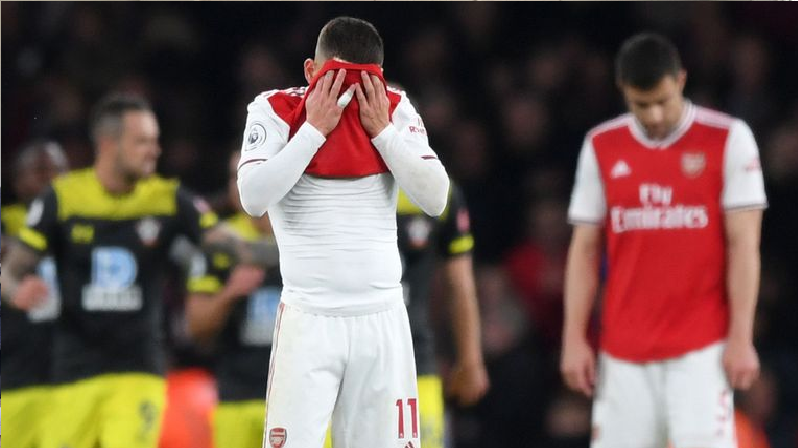
Arsenal has parted ways with Coach Unai Emery, the club announced in a statement. But the development has opened a void that the club will not fill in a hurry.

The past five weeks have been the worst in the coaching career of Unai Emery. The Spaniard who left French giant PSG to replace former Arsenal manager, Arsene Wenger, has been under intense pressure to do better.

Arsenal has struggled for years in both domestic and European leagues, a great cause of worry for their passionate fans who yearn for the glorious old days.

My humble self is the answer. My strategy is simple – in every game, score more goals than the opponent! If that is not a winning strategy, that is left for you. But seriously, I think Arsenal needs better “matured” players than just a coach to fix this team. A team built to turn a profit, not necessarily win medals, is learning that medals build English fans. And with fans, you make money. Leicester is the 8th most profitable club in European football (Jan, 2018) after its miracle year where it won the premiership. 

The most profitable team in English football is Tottenham Hotspur Spurs which has not won anything for decades. Spurs is a better business than Barcelona, Man City, Real Madrid, Chelsea and Manchester United even though it has no recent trophies. The investors smile to the banks while the fans continue to believe.

Football is a business – you define your playbook: $$$ or trophies. Only very few can combine both. Some clubs are incubators – they discover talent, they quickly sell; look at Atletico Madrid which keeps selling superstars, making shareholders instantly rich while fans are left to just believe.

Unlike former Arsenal Coach Arsene Wenger revered for discovering talent, Unai is not lucky. So, with no trophies or discoverable talent for sell, he has no business in the ball club.

Who Will Coach Arsenal?

Who Will Coach Arsenal?

0

Arsenal has parted ways with Coach Unai Emery, the club announced in a statement. But the development has opened a void that the club will not fill in a hurry.

The past five weeks have been the worst in the coaching career of Unai Emery. The Spaniard who left French giant PSG to replace former Arsenal manager, Arsene Wenger, has been under intense pressure to do better.

Arsenal has struggled for years in both domestic and European leagues, a great cause of worry for their passionate fans who yearn for the glorious old days.

Though revered, Arsene Wenger took a bow when it was obvious that his tactics and style weren’t going to deliver the needed result. Emery stepped into the shoes, but they certainly appeared too big for him.

The Gunners have not won any match since the 24th of October, a situation that instigated the #EmeryOut hashtag, and the subsequent booing at the Emirate Stadium following last Saturday’s 2-2 draw with Southampton.

Emery knew his days were numbered, but was hoping for a miracle to save his career. Thursday night’s 2-1 defeat to Eintracht Frankfurt killed whatever was left of his hope. That’s a run of seven games without a win.

Arsenal have only won four of their 13 league games which places them at eight on the table, just below the underdogs, Sheffield United and Burnley.

On Friday morning, Arsenal issued a statement. Speaking on behalf of Arsenal board and our owners Kroenke Sports & Entertainment, Josh Kroenke said:

“Our most sincere thanks go to Unai and his colleague s who were unrelenting in their efforts to get the club back to competing at the level we all expect and demand. We wish Unai and his team nothing but future success.

“The decision has been taken due to results and performances not being at the level required. We have asked Freddie Ljunberg to take responsibility for the first team as interim head coach. We have full confidence in Freddie to take us forward.

“The search for a new head coach is underway and we will make a further announcement when that process is complete.”

Arsenal’s struggle dated back to the days of Wenger, especially the 2016/17 season when they failed to book a spot for the Champions League. It wasn’t something the North London club was proud of, so Emery was hired to change that.

But he didn’t only fail to qualify the Gunners for Champions League, he also failed to bring the Europa League home, the closest Arsenal did get to a major trophy in years. Arsenal lost the Europa League final to London rivals, Chelsea, dashing the hope of millions of fans around the world.

But the search continues for those who will wear the cap. Apart from Ljunberg who has been appointed to coach the club in interim capacity, other names are being mentioned also: Man City coach Pep Guardiola, former Arsenal player Mikel Arteta, and the recently sacked coach of Tottenham Hotspur, Mauricio Pochettino.

The long season beams with uncertainties, and surprises are an integral part of it. Big names no longer guarantee winnings, just as it’s evident with Jose Mourinho and Manchester United.

Great coaches are highly priced, Arsenal is notorious of its close-fistedness, and that keeps Guardiola out of the possible successors. Pochettino has similar trophyless record like Emery, hiring him will make little or no difference.

Arteta has little or no experience to compete with the big fish, though Lampard is an evidence that you can’t rule everyone out. So the search is likely to extend beyond English shores, unless Ljunberg turn things around to convince the fans that he has what it takes to lead the club to the expected result.

Arsenal will be facing Norwich this weekend and that would be Freddie’s first test. If he scales it, and takes on the subsequent games with the same mentality, he may have a chance. If not, Arsenal will have to update the list of its potential coaches to include Nunu Espirito, Allegri, Ancelotti, Rafa Benitez and Eddie Howe.

The hunt for Emery’s successor is as always, a difficult decision, but whoever succeeds him will have a big shoe to step into.