DD
MM
YYYY

PAGES

DD
MM
YYYY

spot_img

PAGES

Home Blog Page 6555

Distribution: What Makes The Addressable Market of Nigeria Tough to Navigate

2

Reminiscing of Dr. Ola Brown’s article on Nigeria market size in Nigeria for all who cares to know, and the recent comment of Tosin Olaseinde about “massive market for affordable, simple, ready furniture and home décor” in Nigeria, it appears to me that there seems to be a lag in articulating what market size in Nigeria.

Tosin compared 5 million customers to be somewhat about one-third of the population of Zimbabwe’s market in reply to Dr. Brown. While that might sound juicy on a face level a further breakdown of the distribution of 5 million market size from a population of about 200 million will reveal a thing relative to a market size of 5 million with a population of 15 million.

Let’s think about it this way, what is the addressable market per land mile in Zimbabwe relative to Nigeria?
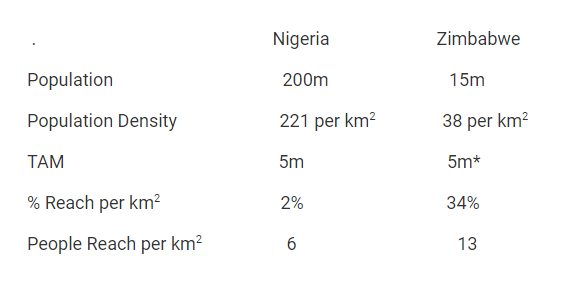
*NB: this is assuming 5m as the Total Addressable Market of Zimbabwe.

As our data reveals, per km square travel in Nigeria, you will meet approximately 6 of your customers, while the same distance travelled in Zimbabwe will bring you close to 13 of your addressable market. This is highly important especially when you factor in the concept of distribution cost. What will it cost you to reach your last mile customer? This dilemma of what to characterize as one’s customer plagues the e-commerce ecosystem in Nigeria and it simple anchored on a broken distribution system.

Moving on to distribution cost with from a perspective of last-mile delivery. Think about what distribution option is available to cater for our addressable market. The last-mile delivery cost in Nigeria is greater than 3,000 naira (about $10 – by extrapolation). While it will cost much less in Zimbabwe – I can simply conclude on this based on my calculation on % reach per km square which is higher than that of Nigeria. But a comparison of Zimbabwe with Nigeria is not the focus of this article.

Now note that what the addressable market participants are purchasing here is key and there is a point in which it is not economically viable to make purchases where distribution cost is involved. Take this, for example, let’s say an item cost of production is N3,000 and an e-commerce platform chose not to make a profit on this item if purchases are made on her platform i.e. sale at total full cost if you but on say Jumia. The same vendor chooses to make a 30% margin (N3,900) in retail outlets. Invariably, it means the total cost of making purchases online cannot be more than N3,900 or it will be absolutely off point to make purchases online than the kiosk beside my house.

The truth is what it will cost to reach the last mile customer in my scenario will be way above the price ceiling of N3,900 (it will actually cost + or – N6,000). And in effect, the erstwhile person mapped as part the addressable market will be automatically ousted from the cluster. 5 million minus one already and minus one more and more.

The above analysis begs the question of the addressable market in Nigeria, especially where physical delivery of goods is required (mainly e-commerce). What really can be regarded as Total Addressable Market (TAM) in Nigeria?

Broken Logistics, Nigeria Business Bane

In my time of working with Opeoluwa Shea Butter, one of the major issues we have to constantly battle is logistics; balancing cost with value. The selling price of the product cannot allow us to utilize formal logistics outlets like GIG Logistics (even though they were ready for concessions). Hence, we had to constantly innovate around our distribution cost and delivery. In the end, we refuse to take up some order because it is not economically viable to do so. The problem we faced at Opeoluwa is faced by all businesses in Nigeria and we all attend to the challenges differently.

In light of a broken logistics system, the question of TAM becomes more fluid, what will constitute an addressable market to one will be different to another even if they operate in the same industry.

What a lot of e-commerce (and other businesses) has done to mitigate the downside of last-mile delivery is to limit the circumference of operation, in other words, limit their addressable market. Yes, that may look like, why will you limit the number of people you want to potentially sell to. But when you factor in the cost of selling to that person relative to what the person would get it for otherwise, you realize that it is not an adventure worth pursuing. In effect, the addressable market of Nigeria is not as huge as we may think it to be based on distribution cost paralysis.

While thinking about the associated cost of running an e-commerce or any business that requires physical delivery of goods that utilizes technology or otherwise, this video by Ndubuisi Ekekwe detailed out a breakdown of your adventure and needed considerations while providing more perspective into why e-commerce is not yet a viable adventure in Nigeria.


Using Cell Phone Tower Data To Monitor Traffic Congestion In Lagos

0

Imagine a scenario where you are able to obtain real time traffic information from your mobile operators (on your mobile device) for various travel routes, as a service. This would no doubt save you time, enable you to decide whether to work from home or step out and prevent you from being stuck in traffic.

A common sight that meets the eye in Lagos is the proliferation of cell towers within the city. This is obviously an attempt by mobile operators to achieve a universal wide coverage within the city. Infact, the Nigeria Communications Commission (NCC) recently disclosed that the country has achieved a 90 percent coverage in terms of 2G (Global System for Mobile communication (GSM)).

Can we therefore put to good use the data being gathered from these cell towers, scattered at various locations within the country? The answer is in the affirmative.

Data from cell phone towers could be used for various applications e.g. monitoring of traffic congestion on Lagos roads. Traffic monitoring can be achieved by understanding how mobile phones communicate with cell phone towers.

Usually, when a phone is either in use or not (sleep state), the phone constantly transmits or receives radio signals from cell towers (antennas). For example, if a cell phone tower, say tower A, is located on Ikeja road, all users close to Ikeja road would communicate via tower A. This means that, using tower A’s data, one can easily predict that there is a large/fewer number of road users on Ikeja road, at a particular point in time.

Also, the road user would typically be connected to the closest tower (tower with the least distance from the user) and this implies that on a congested road, say Ikeja road, all road users’ phones would be communicating with tower A, assume tower A is the closest tower on Ikeja road.

Now, when users move at high speeds, which occurs when there is no traffic, the closest cell phone tower (tower A) hands over to the next closest tower to the user (say tower B); whereas, when users are stationary for a long time, hand over does not occur, i.e. their phones would continuously communicate with Tower A.

In essence, by observing the data of road users (anonymised, in order to obey data privacy laws) communicating with various towers and specifically monitoring the rate of handovers between towers located along a specific road and the volume of data handled by the cell tower located on the road, all within certain time frames, one can easily predict whether there is traffic on a certain road or not.

With the advent of 5G which would involve a densification of antennas within traffic hotspots, indoor areas, public areas etc., the accuracy of tower data obtained to predict real time traffic update would significantly increase.

Of course, this idea may require testing, modifications, some clever design from MNOs to perhaps aggregate such data, where it could easily be mined/analysed, and an output where such information can be communicated to road users, at a specific charge.

If implemented, this service would help road users avoid traffic hotspots, take alternative routes and assist MNOs in generating additional revenue.

Softcom Is Connecting Nigerians With Meaningful Innovation for Socio-Economic Development

0

Softcom is a forward thinking company which has acquired deep capabilities over the past 12 years to connect people and businesses with meaningful innovation by designing and implementing customer centric solutions for its clients, in the public and private sectors, while adding value and accelerating the adoption of technology enabling visibility, accountability, cost savings and effective decision making.

It believes in an inclusive and connected Africa where all its citizens can access opportunities for their socio economic development, and is focused on fixing frictions in Identity, Education, Payment and Data.

Its product offerings include:

Koya

As digital technology is transforming how people access education for their personal development and with the African scenario in view, Koya is a platform which is redesigning the delivery of quality, personalized learning experiences for individuals, enterprises and governments. It aims to provide lifelong learning  which will help in changing the continent’s narrative from commodity to knowledge-driven.

Data Beaver

Data Beaver is an integrated data collection platform which provides the enterprise with a means of collection and analytics of various data sources such as Biometric Data, Geographic Data, Demographic Data, Images and Video(Multimedia) Data and Textual and Numerical Data, etc. It helps in making informed decisions, powering growth and entry into new frontiers, defeating the competition and optimizing internal processes. Data Beaver’s capabilities include

Guarantee of Data Integrity: Each data point collected by Data Beaver is submitted in a non editable format with a geotag and timestamp. As entries are submitted by field agents, they are validated based on metrics set by the organization with instant notification to agents once the entry is accepted or rejected.

Offline and Online Data Collection: Data Beaver enables data collection in underserved communication infrastructure areas. The data submitted offline is stored locally on the mobile device and its sync feature enables the synchronization of offline entries once the field agent is able to access broadband connectivity on the mobile device.

It enables agents and organizations to access and work on multiple projects simultaneously. The Data Beaver admin platform empowers organizations to create and manage the end to end delivery of  data collection project.

Automated Payment System: Data Beaver enables integration to Eyowo, a digital wallet which enables transactions using only your phone number to agents on the go.

Eyowo

Eyowo is a peer to peer payment system which allows people to save, spend and receive money using only their phone numbers which will provide quicker, seamless and secure payment experience for individuals and businesses across Nigeria aimed at deepening financial inclusion and economic empowerment for everyone. Over 3.5 million have received financial value since it launched operations.

Pass ID

Pass ID enables seamless, enrolment, validation and verification of identities within any given ecosystem. It has engineered capabilities in Unique Identity Recognition, Offline Capabilities, Onboarding, User Management, Insights and Analytics amongst others.

Nigeria’s state owned identity management agency, National Identity Management Commission has granted it the ability to issue National Identity Numbers or Cards, enrolment and verification of any identity and it also supports harmonization and integration with other organized identity networks.

Softcom’s Value Adding Programmes

Softcom Value Centres: Softcom’s value centres are physical structures in underserved communities where Nigerians can walk in and access critical services across its four focus areas(Identity, Learning, Payments and Data). These value centres were established with the objective of giving every Nigerian equal access to opportunities for him to succeed.

Softcom believes in the right of every Nigerian whether they are out of school children, jobseekers, undergraduates, potential entrepreneurs or young adults seeking paid employment to be able to access quality education to significantly improve their lives and chances at success. It’s aim is for every Nigerian to be able to access financial services i.e deposits, withdrawals, access interest free loans and single digit medium term loans to significantly grow their businesses and livelihoods thereby increasing their quality of life through the Value Centres in their various communities.

It also aims to provide every Nigerian with important growth data, business trends and economic indices which is understandable and inaccessible for those at the bottom of the pyramid.

Correct Life: This initiative was launched to fix the friction which exists between the non inclusion of informal economy which constitutes over 80 percent of the workforce in Nigeria and an annual growth of about 9 percent into government economic policies and decision making which has resulted in loss of levies and taxes from them by empowering and developing them to create value for the government.

Future Ready Initiative: The Future Ready programme is a model of an ideal environment aimed at improving the learning outcomes of the 21st Century tertiary education student by meeting their needs with relevant content to increase their capabilities for productivity.

The Future Ready ecosystem consists of a student connected to digital(hardware, networking, software and content) capabilities for effective monitoring and mobile access to resources for best learning outcomes. The role of the Teacher is now redesigned to that of a facilitator or instructor effectively delivering knowledge unbounded and unconstrained with innovative, collaborative methodologies assisted by smart technology.

Softcom needs to double down on its efforts in its four key areas of focus while expanding into new frontiers to unlock the potential for economic transformation and aiding in lifting millions out of the poverty trap in line with the UN SDGs.

Nigerian Hospitals’ Prejudice Against Victims of Arm-Violence

0

Earlier this week, Moradeun Balogun, a graduate of Obafemi Awolowo University (OAU) was robbed and stabbed in the neck around Gbagada area of Lagos. The report stated that Moradeun was rushed to a nearby hospital by passers-by but was denied attention because those who brought her couldn’t provide police report.

An eye witness recounts: “I was around the scene of the incident, the doctor came out immediately and on seeing the stab wound, he said they wouldn’t handle it in their hospital and she should be taken quickly to Gbagada General Hospital.”

This is just a situation of one case too many. Prior to 2017, it was the norm for hospitals in Nigeria to reject gunshot victims owing to police mandate that police report should be issued before treatment could be administered. The reason for such a rule was based on the claim by the police that hospitals were providing a safe haven for armed robbers who escaped with gunshot wounds.

It was a brutal rule that resulted in preventable deaths of many gunshot victims in Nigeria. In 2017, the 8th senate looked into the matter and enacted the Compulsory Treatment and Care for Victims of Gunshot Act 2017, mandating hospitals to attend to gunshot victims irrespective of police report.

Notable sections of provisions of the Act are highlighted thus:

Every hospital is to receive and treat victims of gunshot wounds with or without police clearance and/or payment of an initial deposit, but are duty bound to report to the nearest police station within two hours of commencing treatment on the victim.

The police may only receive a gunshot victim upon certification of fitness by the chief medical director of the hospital where he is receiving treatment.

The High Court of a State or the FCT may in deserving cases order a person convicted under the Act in addition to other penalties, to pay damages to the victims as restitution for injuries or loss sustained by the victim and such order is enforceable by the victim or by the prosecutor on behalf of the victim.

Any authority or person, whose omission results in the unnecessary death of a gunshot victim shall be liable to imprisonment for a term of not more than 5 years without the option of fine.

Any person who commits an offense under the Act, especially when the offense does not lead to death of victims but led to substantial physical, mental, emotional and psychological damage shall be liable on conviction to imprisonment for a term of not less than 5 years without the option of fine.

Where an offense (under the Act) is committed by a corporate body, the corporate head shall be prosecuted.

Post 2017, the Compulsory Treatment and Care for Victims of Gunshot Act, should have made cases of hospitals refusing to treat gunshot victims a story of the past, unfortunately, it didn’t happen.

In July 2018, the effectiveness of this Act was put to the test when a Channels TV reporter, Precious Owolabi sustained a gunshot injury while on duty covering the fracas between the Nigerian Police and members of the Islamic Movement of Nigeria (IMN). There was a public outrage over the incident for many reasons; one being that he was shot undeservedly by the people who should have protected him, two being that the hospital refused to attend to him because he was a gunshot victim – alas he died.

So the Act failed to protect victims of gunshot even though there are punitive measures stipulated thereof to deter hospitals and medical practitioners from flouting it. The questions many keep asking are: Why have Nigerian hospitals refused to comply with the Compulsory Treatment and Care for Victims of Gunshot Act 2017? Could it be that a section of it mandated hospitals to report a case of gun wound to the nearest police station within two hours?

Many claim there has been a little publicity about the law, and many hospitals don’t really know that it’s no longer business as usual. But that’s far from the truth. There have been many notorious instances of hospitals’ abandonment of gunshot victims that prompted police intervention and public clarification on the matter.

In 2018, robbers broke into one Mr. Akinwunmi’s house, shooting him on the rib before making away with his valuables. He was taken to two hospitals and each of them rejected him citing “police clearance” as reason. In the wake of the outrage that ensued, the police in Lagos publicly ordered hospitals to treat gunshot victims without prejudice, and that has been the case in many other states. There was also a presidential directive to re-echoing the order to hospitals.

The recent ordeal of Moradeun Balogun showed that it’s no longer about police clearance, that hospitals are deliberately abandoning weapon-violent victims to their death. It is believed that the impunity emanating from the lax of enforcement of the Compulsory Treatment and Care for Victims of Gunshot Act has emboldened hospitals to the abandonment of the victims.

And until the law becomes effective to a deterrent degree, many more people are going to fall victims.

The Lessons When The President Sees The Beautiful Art

4

In February, Eli Waduba made a pencil painting of the comedian, Kelvin Hart. He posted it on Twitter, tagged Hart and some other Twitter influencers and the painting went viral, catching the attention of Kelvin Hart, and there was a purchase deal.

In October, Osuolale Farouq proposed a new logo he designed for Innoson Motors and tagged the firm on Twitter. The new design caught the attention of the management and a deal was struck.

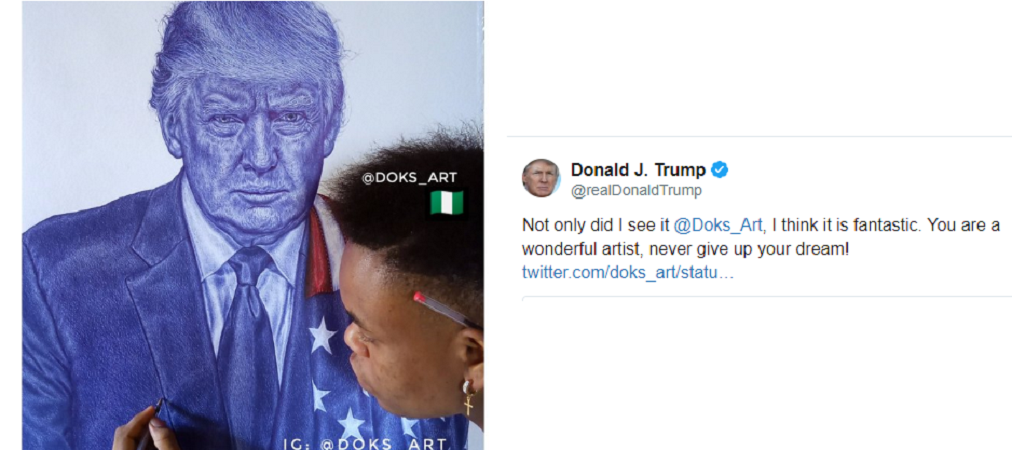
Barely two months after, another Nigerian youngster has used the same method to get the attention of the U.S President, Donald Trump. He made an artistic portrait of Trump and tagged him,  and Trump responded in the most encouraging way.

There may not have been a deal struck this time but there is a lesson. Just like Farouq and Waduba demonstrated, the key to being spotted lies on three things: 1. being good at what you do 2. doing a pro-bono job 3. taking advantage of the internet.

Being good at what you do

Practice is the secret of being good at what you do. Performance is a reflection of talent and skill, that means, you can improve on just about any task with a lot of practice. The quest to get better pushes one to learn more about what he is doing. And in order to maximize the quality of your knowledge, you have to develop the ability to explain things back to yourself.

Be open to entertain new ideas. Openness enables you to try new things and do something differently from how it is usually done. It reflects how much you are motivated to consider new ideas, concepts, and experiences. The most creative people are typically very open people. A new set of habits here and there create opportunity for improvement.

Asking questions has been a tested way of learning. Sometimes, people allow pride to get in the way and they deny themselves the opportunity to learn something new just because they feel it will belittle them to ask questions about things they don’t really know. It is a hurdle that may eventually result in failure.

Relying on one’s memory is also another way to improve skills. But sometimes, extracting the needed information from your memory becomes difficult. How then do you go about that? All you have to do is to ask your memory the question, and it will pull something up. Though it may not be the exact information you’re looking for, it will be just about it.

The most creative people don’t settle on a single way to think about a problem. Instead, they keep finding new descriptions to the problem while allowing their memory to explore more information to solve it.

When you fail, you can start afresh to practice the task, concentrating on the areas of your failure instead repeating the parts you have successfully executed. Learn one thing at a time; do not try to learn it all at once.

Getting a coach, a mentor is another way to improve your abilities. A coach can provide you with the criticism and feedback that you need to do things better the next time. Having a mentor will steer you in the right direction, help you to figure out exactly where you need to improve on and set the right goals.

Providing pro-bono services

The efforts you put together to get on top of your game usually comes at a high cost. Money spent on courses, sleepless nights and other sacrifices you must have made to improve yourself. Often, the intention of many will be to get a sort of compensation through high paying offers as soon as they are qualified.

But remember, you are not the only one who does what you do, and are very good at it. So personal development isn’t all you need to get the big gig. The competitive markets create unequal opportunity that you will have to go looking for clients instead of clients looking for you.

In that case, starting with free services becomes an option that may make the difference. Look for companies, people in your field of expertise and create what they need in a way that it has not been done before. It was a technique employed by Farouq and Waduba, and it worked out good.

Take advantage of the internet

Pushing your work to the notice of your target is a challenge that the internet can help with. Farouq got the attention of Innoson by merely tagging their twitter handle and asking others to retweet until they notice him. And so Donald Trump and Kelvin Hart’s attention was called to the art depicting them.

So social media offers you the opportunity to get in touch with people that it is quite impractical for you to reach offline: You create, you upload, you tag them and beg other users to help you push it to a viral point, although it doesn’t always have to be.

There is a possibility that your attempt may be ignored by and then discouragement comes in, considering the amount of time resources and creativity that have gone into the work. So before you put out any work, entertain the possibility of rejection and weigh other options in line with that assumption. Do not let it stop you from doing more work and reaching out to others, it may take only one successful pitch to turn your story around.