DD
MM
YYYY

PAGES

DD
MM
YYYY

spot_img

PAGES

Home Blog Page 6667

Google Goes After Predatory Personal Lending Apps

1

In a piece in Harvard Business Review, I noted that companies like Google, Amazon and Facebook are ICT utilities. In other words, they are the electricity and water boards that run the digital economies. The fear of these utilities is wisdom because without them, it is going to be hard to run an effective digital business at scale.

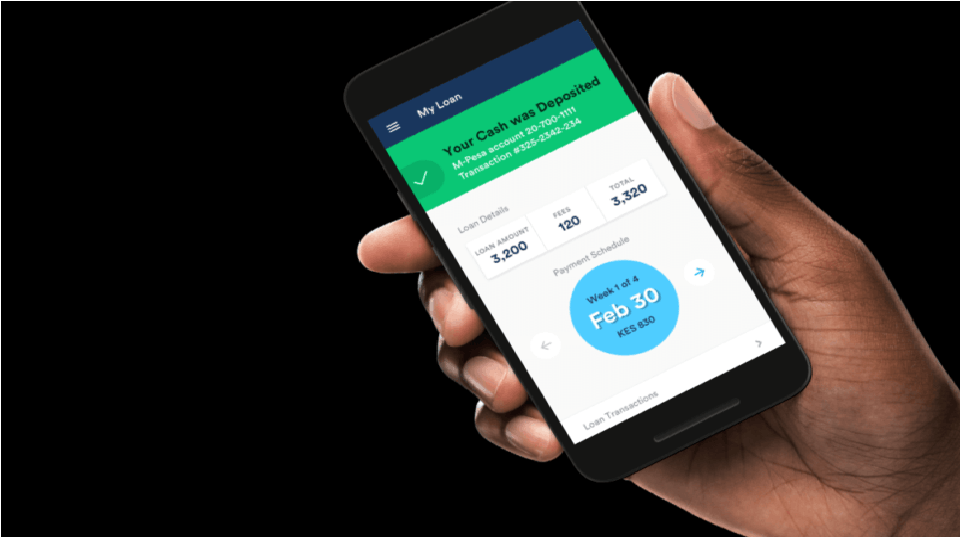
Now, Google is using that power to do good: stop predatory lending via apps in its Play store. Of course most African governments have seen 35% monthly interest rate as “innovation” – the very reason nothing has been done in that space. Technically, if you run the math in some lending apps in Africa, people are borrowing at effective annual interest rate of 250%!

Google now wants all mobile loan apps using its Play Store platform to ensure the repayment period for loans is not below 60 days. 

[…]

It said developers working on personal loan apps need to have data about the loan product in the metadata that allows it to verify the app is not charging astronomical interest, which is common with “payday loans’.

As typical, Kenyan parliament has called for review because Google has taken action. If you check, some of these apps are caging people despite the sound of liberation they beat; governments paid no attention for years. I hope Google follows through and fix this modern day shylocking!

Banks are forbidden to lend at more than 40% annual interest rate in some African countries; yet, people celebrate startups lending at 15% monthly as “innovators”. Some have received millions of dollars in funding to scale this pain to people. Let’s hope Google helps in a continent where consumer advocates are only there for collecting salaries and nothing more!


The Google Statement

Personal loans

We define personal loans as lending money from one individual, organization, or entity to an individual consumer on a nonrecurring basis, not for the purpose of financing purchase of a fixed asset or education. Personal loan consumers require information about the quality, features, fees, risks, and benefits of loan products in order to make informed decisions about whether to undertake the loan.

  • Examples: Personal loans, payday loans, peer-to-peer loans, title loans
  • Not included: Mortgages, car loans, student loans, revolving lines of credit (such as credit cards, personal lines of credit)
Apps for personal loans must disclose the following information in the app metadata:
  • Minimum and maximum period for repayment
  • Maximum Annual Percentage Rate (APR), which generally includes interest rate plus fees and other costs for a year, or similar other rate calculated consistently with local law
  • A representative example of the total cost of the loan, including all applicable fees

We do not allow apps that promote personal loans which require repayment in full in 60 days or less from the date the loan is issued (we refer to these as “short-term personal loans”). This policy applies to apps which offer loans directly, lead generators, and those who connect consumers with third-party lenders.

High APR personal loans

In the United States, we do not allow apps for personal loans where the Annual Percentage Rate (APR) is 36% or higher. Apps for personal loans in the United States must display their maximum APR, calculated consistently with the Truth in Lending Act (TILA).

This policy applies to apps which offer loans directly, lead generators, and those who connect consumers with third-party lenders.

MTN Rob Shuter’s Statement – “3G is much more relevant in most of our markets”

2

This is from MTN CEO, Rob Shuter: “3G is much more relevant in most of our markets” than 5G. He is a businessman in the real economy. He knows what moves the digits. All the hypes of 5G in Africa can wait!

“This is the technology that would be used for very specific cases. It would not be a technology for everybody because most people don’t need it, your phone works fine on just 3G,” Rob Shuter told Reuters at a telecoms conference in Durban. ..

“What we are doing now is to learn from the technology and get our network ready for it but I think 3G is much more relevant in most of our markets,” he said.

As you ponder that, I refer to this comment on on a recent piece on Tekedia. Learn from the legends, in Africa, and do not invest based on hypes from Beijing, London and California!

1. Africa has a demand problem and not a supply problem. 46% of pop is covered by 4G but only 9% 4G adoption.
2. Hence 5G will also be supply driven, and networks will be built even before users start using it.
3. While 5G is inevitable, it is not imminent. 2025 is a more realistic date for its mass market availability.
4. Globally, 5G rollout is not based on verifiable business case. Rather, it is dependent on market readiness. GSMA looked at 43 indicators of readiness for 160 countries and it is clear that African countries are not ready for 5G in 2019.
5. Leapfrogging is tantalising but unrealistic.

Now, that your AV, VR and esoteric Silicon Valley products must be calibrated with reality. Even if they build 5G networks, Nigerians do not have the urgency to update. Simply, if 3G  is stable and reliable, few will even care for 4G. 

My model is 2022 for immersive connectivity; 2025 seems fair for  5G at scale. We will be hoping for solutions similar to South Africa’s Rain network, as captured by TC Daily. Unfortunately, it will take time to have real demand to necessitate that in Nigeria.

South Africa’s youngest telecom, Rain, has launched a commercial 5G service, making them the first telecom to do so on the African continent. The newly launched service offers speed as much 700 megabytes per second and is only available in some parts of the country. Rain, a data-only network, has been working on the broadband infrastructure for quite some time. In February, it revealed that it had partnered Huawei, the Chinese telecom giant and leading 5G company, to help develop the capability. With no existing 2G and 3G infrastructure to maintain, Rain’s 5G service is supported by 4G infrastructure, and this allows it to leapfrog other telcos who need new spectrums to upgrade to the latest broadband

Alpha Mead’s Call2Fix App as a Disruption in Nigeria’s Facilities Management Industry

0

Like other previous decisions, the introduction of a mobile app to fix identified frictions in the building maintenance and other facilities across Nigeria by Alpha Mead Facilities, a strategic business unit of Alpha Mead Group, has shown that the company is actually ready to boost the growth of Facilities Management industry and inspire small businesses in Africa.

Bringing the product to the market is not surprising because a report has indicated that FM industry needs to be disrupted with the innovative products and solutions.  According to the report, “the industry growth depends on how the players and professionals collectively resolve issues within the processes, solutions, technology and people components of the industry.” The company has equally demonstrated that it could capitalise on its capabilities and competences towards the growth of other players, especially sub-contractors in the industry.

Call2Fix: What is in it?

Now, the question among the potential users and service providers is what is in the app? The Chief Executive Officer, Alpha Mead Group, Engineer Femi Akintunde briefly answered this question. “It is for the benefit of retail customers and SME companies who are unable to afford the FM contracts offered for their required FM services.” With this answer, it appears that the company is intensifying efforts on making people and small businesses understand the need for good facility management culture.

As an on-demand and round-the-clock digital application, users have the opportunity of calling building maintenance artisans with the capabilities and experience of handling their maintenance or repair services in homes or offices. Already, the company has trained 1,000 artisans and ready to leverage their many years of industry experience, size, technical, operational and financial capacity and the wide network of their operation across Nigeria and other African countries.

With Call2Fix, customers will be able to rate performance of the artisans assigned to them. This rating system is not just a function of remuneration for the artisan, it also determines how frequently work will be assigned to the artisans by the application. Meaning that the better rating an artisan gets, the more opportunity he has to be assigned a job by the app.”

Call2Fix and Sustainable FM Industry

As the company begins assigning artisans to the users within the initial coverage areas in Lagos, Engineer Akintunde believes that the app is a game changer in the industry because it brings more power, joy and peace of mind to numerous customers. “It is about comfort, security and efficiency of service.”

Is Call2Fix really a disruptive innovation as stressed by the CEO of Alpha Mead? The answer to this is best gleaned from the number of services expected to be sought by the users. From soft to the hard services, the app will definitely disrupt the Facilities Management industry in Nigeria and African countries, where it has presences.

In Nigeria, the emergence of the app has demonstrated that companies within the passive category, offering services such as electrical and electronic, civil works, plumbing, HVAC, cleaning, domestic helps, carpentry, home appliances, fire systems, gardening, waste management, swimming pool, relocation services, office equipment and scaffolding need to tweak their people and solution innovation processes towards sustainable value capturing from the app. There is no doubt; active participants (players offering integrated facilities management solutions) have been pushed to the wall. The expectation among the industry experts is the emergence of another app that will fix other frictions in the industry.

Long Road Ahead

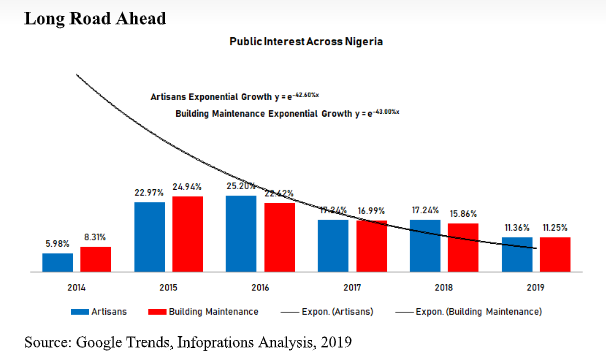
Meanwhile, despite the initial research about the target market by the company, analysis indicates that exponential growth of public interest in artisans and building maintenance in the last 5 years (September 1, 2014 to September 17, 2019) in Nigeria has been on the decaying threshold. The exponential growth rate of public interest in artisans is -42.60%, while building maintenance is -43%. A significant interest occurred between 2015 and 2016, analysis reveals. However, the choice of Lagos as the starting coverage area aligns with the growth of public interest in select services.

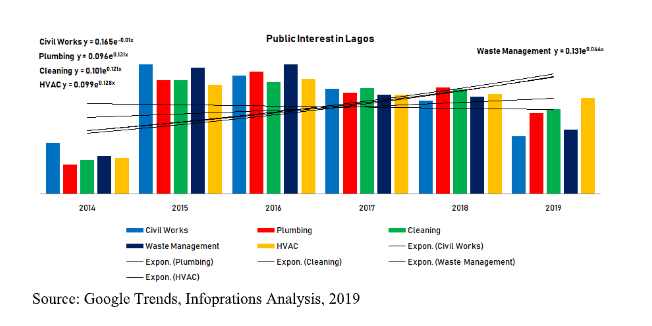
Analysis shows that interest in doing plumbing, HVAC, cleaning and waste management has been growing at 13.10%, 12.80%, 12.10% and 4.4% respectively. These results imply that the company needs to do more on marketing and communication of the inherent values of the app, most importantly through digital platforms. This is imperative because of the need to target a great number of internet users and app enabled-mobile phone customers.

Anthony Joshua Needs Focus To Defeat Andy Ruiz

0

Anthony Joshua may lose to Andy Ruiz Jnr again.

I know this is not good news for everyone connected to Africa, especially Nigeria. We always want to see our own people do well in every aspect of life.

Joshua, the former unified heavyweight champion will go against Andy Ruiz Jnr, who defeated him at the Madison Square, in the United States of America, in June. The match was seen as the greatest shock in the history of boxing and sport in general.

The rematch tagged, ”The Clash of the Dunes”, will take place in Saudi Arabia.

However, Anthony Joshua may yet suffer another defeat. A lot of people expect nothing but victory for the Nigerian-born British boxer, but the problem is – ”can Anthony Joshua handle the pressure?”

Andy Ruiz has nothing to lose as he’s seen as an underdog, which makes him more calm to do another damage on Anthony Joshua.

If Joshua doesn’t want to suffer another defeat, he should stay away from the media. Focus is the key and that’s all he needs. He should see the match he had against Ruiz many times, evaluate and learn from it. Then do a lot of work behind the scenes.

Staying on social media won’t help the British boxer. A lot of pressure is being mounted on him. The truth is, nobody is giving Andy Ruiz the credit he deserves. Everyone is seeing it as a fluke and expecting Joshua to reclaim his belts.

I hope Joshua is not going with this belief as well. Ruiz studied Joshua and attacked him at his weakest point. Joshua needs to rate Ruiz higher than any other opponent he’s ever faced because he was the one that handed him his first defeat.

Ruiz will come out stronger and better. If care is not taken, we might see a repeat of the first match. The worse, a draw may likely be the final result. But I do wish Anthony Joshua will win and reclaim his titles, else, it could be the end of his wonderful career.

Good luck to Anthony Joshua in Saudi Arabia on December 7.

Africans will be rooting for you!

That Microsoft Strategy on Linux

0

You are an industry leader in a market segment. Your competitor has launched and made its product largely free. You make money in some global regions, but in some other areas people are pirating your product – using it without paying for it. You have two game plans for the pirating regions:

  1. Make it harder for them to steal (using law enforcement or technology protection). But you do know that if you do so, the users will likely move to your competitor. That means, forever, that market is lost. You will not like that to happen.
  2. Allow them to steal provided that prevents them from using the competitor. But as they steal, have an immediate game plan to make the product extremely affordable so that they begin to think this needs to be paid for additional security protection.

I just described how Microsoft outclassed Linux in most parts of the emerging market. I will use China for illustration here even though that applies to most countries.

The software piracy in China which Microsoft largely ignored provided that kept Linux out was one of the reasons China is a Microsoft nation today. As most people used the pirated Windows,  everyone adopted Windows. Then over time, Linux was largely forgotten. Today, Linux looks like an enterprise focused product; in the past, the playbook included personal computing.

With time, Microsoft started preaching to users that for small fees, they could  get better security and protection from malware. Already used to Windows, most customers went for that, and magically Microsoft started making money in China. And later, it surprised the hold-outs, upgrading their stolen software with new versions but on the premise that they must register the solution. By the time people went through two update cycles, noticing the huge benefits, many became believers. 

Across markets, companies have different methods to win territories. Intuit has it own technique.

One company that has done that very well is Intuit, an American company that is known for selling tax software. A key attribute of Intuit is giving most things free. You can accuse the firm that it hates revenue. You see competitors building products and solutions on its platforms. But there is a catch: after a few years, the competitors become invisible. They become folded into Intuit business in the eyes of customers.

So, for decades, Intuit continues to swallow competitors without buying them. I have called its model the Fish Bait Acquisition Construct. It is a model where you give things free to competitors. As they come to enjoy the freebies, you trap them, and over time, they become weak. The end game is that at the end, they beg you to take over their assets.

We are also seeing OPay in Nigeria with a strategy.

Yes, OPay is running what I call the Invisible Layer Strategy. The Invisible Layer Strategy is a strategy where a company builds a product utilizing critical infrastructure of another competing company, in the same product line, but finds a way to under-cut that company on cost of services to end users. Today, OPay offers zero fee to customers who use it to pay for DStv services in Nigeria.

Simply, most things may not make sense to users – but companies know what they are doing. Some games intentionally make themselves easy to pirate as  part of adoption and growth strategy.

The Fish Bait Acquisition Construct