DD
MM
YYYY

PAGES

DD
MM
YYYY

spot_img

PAGES

Home Blog Page 6699

President Buhari’s Moment of Brilliance

12

Dear Community,

I got the feedback on this post here. My apologies for not being helpful. Largely, people expected to read the basis of my call. With the news everywhere, I had assumed we knew what was happening.

I have updated the piece. Understand that I call things the way I see them. Mr. President gets my praise (which is nothing) and also gets my criticism (which is irrelevant). 

But benchmarking what we do when local crises happen to the shame in South Africa, and how Nigeria has managed it, personally, I rate it “brilliance”. You do not have to agree with me – I do not write for that. But as many noted, I must provide the basis of my call. I have done it accordingly below.


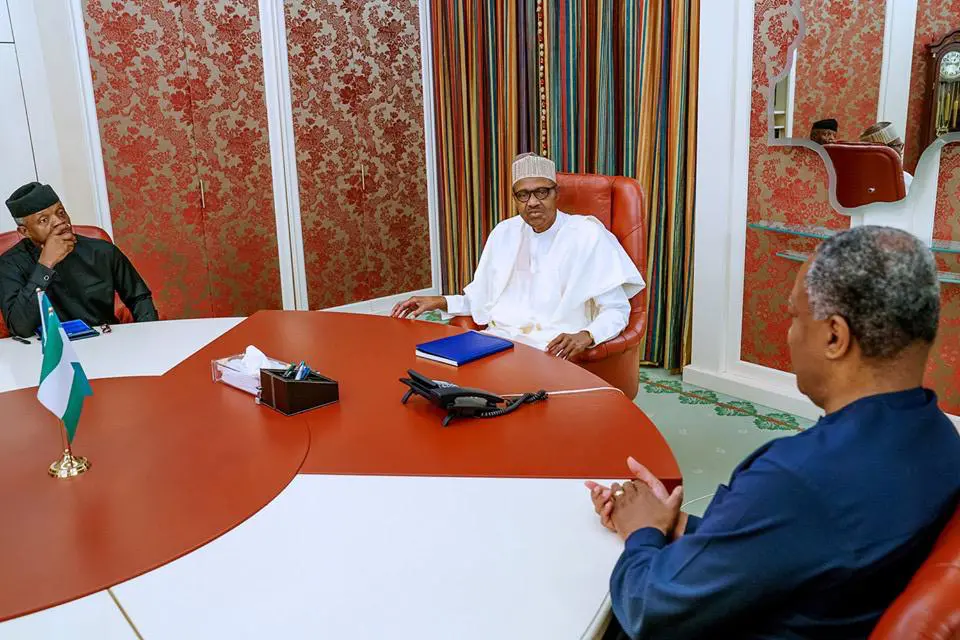
I want to use this medium to commend the Nigerian Government and President Buhari on how the nation has handled the shame in South Africa. This is governance at its best. I challenge our leaders to extend this level of quality to internal crises that take place within the nation.

To Minister of External Affairs, Nigeria’s Ambassador to South Africa, Speaker of the House and even the political parties APC and PDP, all of you just showed that you can all lead. Extend this brilliance to other areas.

These are things the nation has done well on this South African shame and where we have failed on parallel local issues. Let me list some areas the president has shown brilliance (on handling the xenophobic attacks in South Africa) and also failed on internal matters.

  • The president deployed a special envoy within hours of the South Africa’s shame. Typically, government uses days just to acknowledge an internal conflict.
  • The minister of External Affairs mobilized the African Union and other counterparts to build a pan-African condemnation. In parallel, no one knows if we have a minister of interior when bad things happen in the nation.
  • The president pushed immediately for compensation of victims. In parallel, no one would have heard from the president locally. Of course, when do you not even hear from the president, compensation is a wild imagination for citizens.
  • The Nigerian government suggested sending its security forces to support South Africa’s security system. Many Nigerians would wish for such a gesture on internal conflicts. Largely, we rarely see immediate action from government at such speeds.
  • Across all levels, Nigeria has put heat on South Africa to demonstrate a way forward to stop this. Imagine if the government could hold itself accountable at that level on local matters.
  • Nigeria elevated the conversation as they worked the press with the President speaking with Ghana’s leader. Locally, Nigeria may not even acknowledge the crises.
  • The House promised to provide funding to Nigerians in South Africa to seek redress. Locally, many Nigerians would wish for such after internal crises.
  • Then, Nigeria withdrew from the World Economic Forum Africa. In parallel, one would have wished some political campaigns and even government events were suspended to deal with some major internal crises.

Simply, there are many positive elements on how Nigeria has reacted and managed this shame in South Africa. I do hope we replicate the same in other areas. South Africa must pay for waking up the eagles because the eagles have left the nest.

God bless Nigeria.

Self-medication almost killed me

4

There’s a saying that goes thus, “Assumption is the lowest form of knowledge.”

I agree.

Especially when it has to do with your health, never assume. Instead, go for a test. Be sure about your health conditions rather than result in self-medication.

Last year, September 2018, I had a slight fever accompanied by headache and stomach upset.

“it’s malaria” – my assumption.

I quickly ran to a nearby clinic and explained to the pharmacist. I told him to give me some malaria tablets and a pack of Flagyl. Since I was having stomach upset, a pack of Flagyl would do well. He did sell everything I asked for and I used according to his prescription.

A few days after, it got worse. My health condition didn’t improve. I went for another type of malaria drugs and some antibiotics. Perhaps, those drugs I used were not working. It never cured my ailment. I continued managing my health. I assumed that the change of environment could be the reason why I feel sick.

Three weeks after, I couldn’t bear this anymore. I started feeling weak and almost fainting. I gave up on my assumptions and visited the hospital

The doctor immediately sent me for a diagnostic test. I was scared of the outcome.

Who knows what could be wrong with me?

The result – ”typhoid and enteritis”.

Wow! I have never heard of enteritis since I was born.

I Google searched and read many materials I found online. Hmmm, the way forward, I was asked to go for a scan. The doctor wanted to be sure if much damage hasn’t been done.

I went for a scan. Luckily, there was no damage done to my system, but I was still having internal pains in my lower abdomen.

However, I was not given any drugs because I had abused a lot of them while trying to treat myself based on my assumption.

My meal was changed totally. I was restricted from taking pepper. For nine months, I ate food without pepper. As an African man, it was weird. I had no choice.

I got healed completely in June, 2019.

Thanks to the support I got from Nonye Aghanya, a US clinician.

Here’s what I learned from the experience:

  • Never joke with your health
  • Stop self-medication because it kills faster
  • Stop prescribing drugs for yourself or anyone
  • Get tested for more clarification
  • Almost all the sickness starts with fever and headache.

Dear pharmacist, stop selling drugs to people without a doctor’s prescription.

Stop killing people just to make a profit.

Say No To Self-Medication!!!

Yes, Your Future Doctor Could Be AI; FREE Your Mind.

2
Care AI doctor

I am so surprised that many people are extremely troubled that AI could do some doctor’s works in the near future. In this Harvard Business Review piece, I explained how this will work. I do not have time to reply to each person that commented on my LinkedIn feed. So, this is my global response. Please also read this. Please free your mind and be open to the possibilities of the future. Do not just sit there and be vomiting why things cannot work. The limitations of today can be unlocked by technologies of the future.

The solution is called CareAi: an AI-powered computing system anchored on blockchain that can diagnose infectious diseases, such as malaria, typhoid fever, and tuberculosis, within seconds. The platform is engineered to serve the invisible demographic of migrants, ethnic minorities, and those unregistered within traditional healthcare systems. By bringing AI and blockchain together, CareAi uses an anonymous distributed healthcare architecture to deliver health services to patients anonymously.  This makes it possible for these invisible cohorts to get access to basic healthcare, and useful contextual information without compromising their identities, for fear of deportation. This is important, as without access to health services, these communities might pose health risks to the wider population.

Doctors are systems. You can codify every variable doctors consider and engineer machines that can do some of their works. This one in Brussels (I took that photo myself) does disease diagnosis and prints receipts of treatment strategies. This may seem like rocket science but it is not that hard. Our Medcera has a path to get to that mountaintop for Africa.

The Generalist Care AI Doctor Built on Blockchain

Care AI doctor

How New Technologies Could Transform Africa’s Health Care System -Ndubuisi Ekekwe – Harvard Business Review

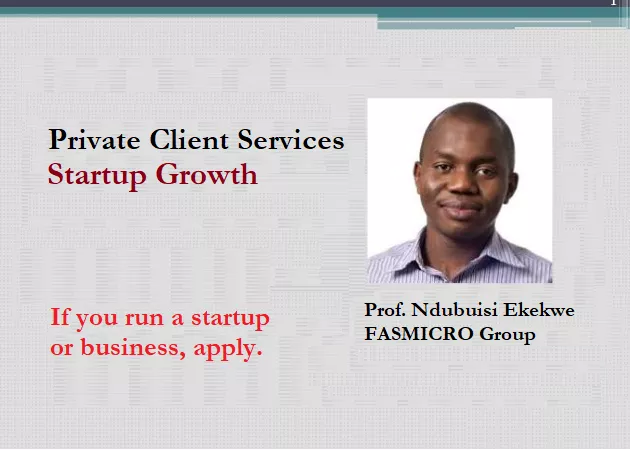
[Apply] Ndubuisi Ekekwe’s Private Client Services – Startup Growth; 24/7 Access To Me

3

I have a phone dedicated to startups and businesses we serve. It is a service we call Private Client Services: Startup Growth. It offers founders and entrepreneurs 24/7 access to me. We talk over hard business things, strategies, growth and wins. We bring our people, invisible but great, to make those wins happen.

We work with unrivaled tenacity, bringing all our assets and networks to ensure growth takes place. It is hard to get in because we do not accept payments; we win only when you have won.

As you build, we want to work with you. Though we come with humility to learn on what you do and have done, our value addition is unbounded.

We have advised and worked with amazing CEOs; the testimonies are everywhere. You will like to build with me and my team. If you run a startup that utilizes technology, and looking for an invisible growth-maker, click and email my team.

As we celebrate here [Goldman Sachs leading Kobo360’s $30 million raise], the best moment arrived when the CEO of Kobo360, Obi Ozor, dropped this line, this morning to me,  “Thanks for all your support and advice.” I am very proud of what Kobo360 has accomplished and even more optimistic that Kobo360’s mission to build a logistics operating system in Africa will advance our continent in the age of AfCFTA.

In the last 9 months, our portfolio firms have added (net) cumulative value in tens of $millions (yes, paper money). Join PCS, and have your personal professor: become a category-king founder with me.

Beyond TICAD7: Maximizing Opportunities for Africa’s Development

0

The Tokyo International Conference on African Development (TICAD), an initiative of the Japanese government aimed at promoting high-level policy dialogue between African leaders and development partners just concluded its 7thedition (TICAD7) at the Pacifico Convention Plaza, Yokohama, Japan. It was co-sponsored by the United Nations (UN), United Nations Development Programme (UNDP), World Bank and African Union Commission (AUC). TICAD7 focused on the theme, “Advancing Africa’s Development through People, Technology and Innovation”. The conversations focused on the shared passion for the future between Africa and Japan. The interesting part of the discussion is in the “shared passion”. While Japan, the convener of this conference is clear about its passion for Africa, I sincerely hope African leaders are also clear about their passion for the continent because only clarity of passion can spur African leaders to action.

At TICAD7, 120 Memoranda of Understanding (MoUs) between Japan and different African countries were signed. The Japanese Prime Minister, Shinzo Abe, promised that over the course of three years, Japan’s private sector will invest US$20 billion in Africa. Before we roll out the drums let us be clear on the channel of transmission of this money from Japan to Africa. This is fiat money backed by the Bank of Japan which has a balance sheet of over US$4.87 trillion as at December 2018. Reuters reports that Bank of Japan has assets bigger than the combined Gross Domestic Products (GDPs) of five emerging markets – Turkey, Argentina, South Africa, India and Indonesia.

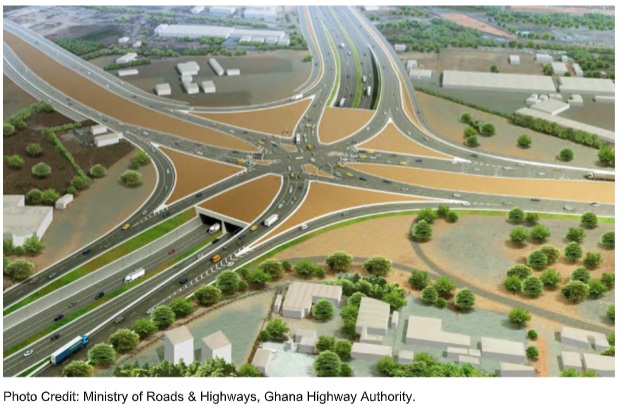
Japan has no intention of giving this money to any African government or African-owned private sector operator. The money would be strategically allocated to Japanese-owned businesses with interests in Africa. For instance, at TICAD7, Toyota sealed a deal to site vehicle assembly plant in Ghana with August 2020 as kick-off date. Ownership, operation and management of this assembly plant will be vested in Toyota. However, this greenfield investment is not without its benefits to the host country. Ghana should expect benefits such as employment and capacity development, expansion of government earnings via taxation (both personal and company income taxes), and welfare gains resulting from the elimination of an estimated 25-30% cost associated with freight and duty on automobile importation. Here’s why Japan’s investment in Ghana is strategic:

The image above is a model of the US$57 million Tema Motorway Interchange Project financed under a grant from the Japanese government and executed through the Japanese International Cooperation Agency (JICA). It is part of Japan’s West African Corridor Development Growth Ring Master Plan implementation being executed by Messrs Shimizu-Dai Nippon Joint Venture, with CTI Engineering International Co. Ltd as consultants. The expected date of completion is June 2020 while Toyota’s assembly plant kick-off date is August 2020. The plan is to make Ghana the automobile hub of West Africa with Nigeria (Lagos in particular) as the main target market.

For analytical convenience, let’s focus on Lagos. If you are wondering why Lagos, here are some indices:  Lagos has an estimated population of 22 million people, with an economy valued at US$136 billion in 2018, accounting for 30% of Nigeria’s GDP. If Lagos were a country, its economy would be the seventh largest in Africa, behind Angola but ahead of Morocco, Kenya, Ghana and Côte d’ Ivoire. The driving distance between Accra and Lagos is 412 km and at 100km/h, you will arrive in 4 hours 7 minutes. Other cities in West Africa such as Abidjan, Cotonou, and Lomé are all less than 425 km of driving distance to Accra. Ghana is maximizing these opportunities because Ghana was ready. How ready are other African countries as Japan and other donor agencies make the strategic policy shift from government aid to promoting private-sector led growth through private sector investment?

I conclude this piece with a quote by one of Africa’s finest technocrats and President of the African Development Bank (AfDB), Dr. Akinwumi Adesina – “Africa is not rising. African has already risen. Therefore, Africa should not be seen from a development lens but from an investment lens”. Africa, this is our chance, let’s seize the opportunity!