DD
MM
YYYY

PAGES

DD
MM
YYYY

spot_img

PAGES

Home Blog Page 6700

iDAF launches iAspire Data Science Fellowship Program in Nigeria

0

iDAF, a non-governmental organisation that focuses on creating an Artificial Intelligence (A.I.) empowered community in Africa, has introduced iAspire Data Science Fellowship Program.

Data Science entails a combination of data inference, algorithms, and technology that solves complex problems. The core of this technology is data that is initially raw, then is streamlined, and stored in a data warehouse. These vast amounts of data can help generate significant business values.

Today, leading organizations bring their Data Science and Business Intelligence practices together, providing them with timely and centralized access to corporate data.

To cue Nigerian businesses to emerging business models require skilled data scientists.  To this end, the iDAF’s flagship program aims to train and prepare Nigerian bright minds to use Artificial Intelligence and advanced machine and deep learning concepts to tackle business and social problems.

The program is a two-year program that includes six-month comprehensive data science training and 18 months of professional work as a data scientist consultant with iDAF’s partner, Data Wrangling.

In addition, successful graduates take a cloud certification in AWS, Azure or Google.

Participants on the two-year journey will also enjoy sleuth of mentors from the industry and academia that brings all the interaction, social learning, localized capstone project and a globally accepted cloud certification.

Speaking to the press about the program, the Co-founder/CEO of iDAF, Theophilus Medeiros, said that the data science program offers a comprehensive curriculum for participants and designed for the industry.

“iAspire Data Science Fellowship is about the only data science program in Africa that offers the most comprehensive curriculum and a guaranteed Cloud Certification. Curriculum designed & being constantly updated to cater to industry needs by experienced data science practitioners and professors

“The program creates a portfolio of 10 mini-projects and a capstone project across industries of your choice to showcase your skills and knowledge and will definitely offer participants knowledge about the theory of current data science technologies with hands-on experience”.

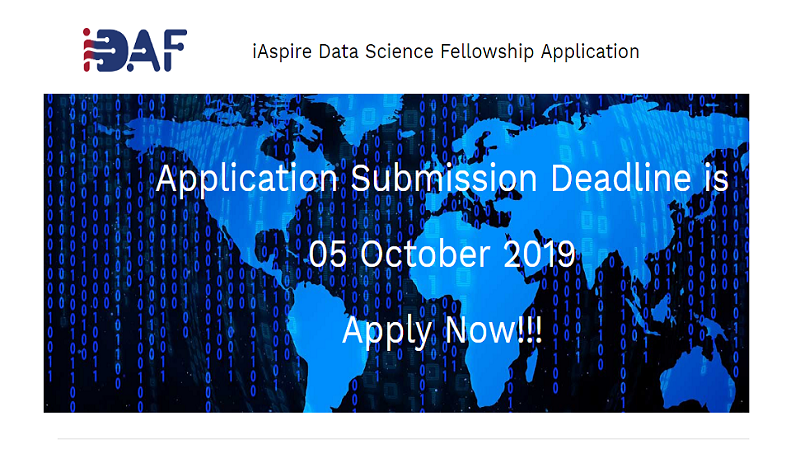
To participate in the program, interested candidates are to visit iDAF’s website (www.idaf.ng/apply) and submit their application not later than October 5, 2019.

“Therefore, we get you up to speed as quickly and deeply in just six months of current topics. Interestingly, the faculty is a mix of Top Data Scientists working for Fortune 50 companies who are passionate in teaching,” the Founder added.

Also commenting, iDAF’s Co-founder, Prince Ogwuru, advised the government to develop policy frameworks and structures on which artificial intelligence can thrive, and position Nigeria as the leader of Artificial Intelligence in Africa.

How to participate:

To participate in the program, interested candidates are to visit iDAF’s website and submit your application not later than October 5, 2019.

You will be required to perform an online assessment after your submission to help iDAF’s team understand your readiness for the program or determine area to improve before and during the program.

To partner and have iDAF work on your business challenges using Artificial Intelligence, contact the organisers at info@idaf.ng

See the programme schedule for further details.

Troubling Increase in Number of Mentally Deranged People in Nigerian Society

1

When I was younger, we were always afraid of mad people. In those days, we take to our heels once we sight any of them. We don’t have to wait to see if he’s aggressive or not. Then, mad people were not allowed to live near ‘normal’ people. They find their homes in abandoned buildings, uncompleted buildings, markets, churches and so on. As soon as any of them enters an area, the occupants do all they could to send him out of there before he becomes a comfortable co-inhabitant. Nobody wanted anything to do with them.

In those days, every mad person in town is known and given a name. In fact, they are unofficially registered and given tags by the communities they live in. We children were always warned to stay away from them because of their harmful nature. I could remember that parents used their presence to get their children to behave well or the mad person will be called to take them away. If you want to insult someone, just tell him that he is a brother to that madman that dances in front of your school gate and trust me, you have succeeded in adding an extra enemy to your list.

But today, the number of mad people in our towns and villages are increasing rapidly. They keep dropping in everyday. You can wake up in the morning and meet a mad person in your street and no one can say how he got there and where he came from. There is one currently living in my area that some residents claimed was dropped off one early morning by a lady in a black SUV. No one can tell because this woman can’t answer for herself. She has automatically become a member of the community and as far as Nigeria is concerned, there is nothing anyone can do about it.

Some causes of madness have been given by the medical professionals. Looking at these causes, one will have no other option than to agree that they can increase the number of mad people in our society. Some of the medically proven causes are:

1. Stress: Lack of good stress management technique can actually cause some form of mental illness. Stress, they say, is good to some extent. But when it becomes chronic, mental disorders can creep up.

2. Narcotics and Alcohol Abuse: I always believe that these two are the highest contributors of this problem to the society. Some months ago, a young man was seen early in the morning lying very close to our compound’s gate. He was in deep sleep when I saw him around 8am and was still in that state when I returned around 1pm. By then, his ‘friends’ have rallied around him and were trying to revive and take him home. I asked and was told that he took a combination of marijuana, Tramadol and cheap local gin around 10pm the previous night and couldn’t find his way home. That was speculation anyway because I wasn’t there. But I believe we all know how people abuse narcotics and the effects they could have on them.

3. Hereditary: I have heard so much about this, though I haven’t really seen those affected by this factor. But I know that Igbo people agree so much with this because they don’t allow their sons and daughters to marry into families where a mad person has been detected. This, according to Igbo culture, is because madness runs in their blood.

4. Trauma: Some traumatic experiences could result to mental illness. Examples of such experiences include the loss of a dear one to brutal death (especially if the person witnessed it), eyewitness and involvement in fatal accidents, armed robbery attack and so on.

5. Injury: Some victims of untreated head injury may end up mentally deranged, according to scientists, because the injury could lead to brain damage. Head injury could be caused by someone being hit hard on the head with hard objects or by having an accident that involved the person hitting his head on the road.

Despite these proven causes given by our medical practitioners, most Nigerians still cling so much to some unproven factors. I believe we should look into these here and hopefully, those that have the resources can turn their searchlights on them to find out how true or not they are. Some of these assumptions are:

  • a. Repercussion: Most Nigerians believe that mad people are paying the price of something bad that they or their ancestors did. This thing I’m saying here isn’t how Nigerians used to see it then; it is how Nigerians see it now. Repercussion here could be because the person (or his ancestor/s) owes someone some amount of money (amount is trivial by the way), broke a love affair without the consent of the other party, directly or indirectly brought about someone’s death, stole from someone, scammed or cheated someone, intimidated and collected properties from an underprivileged, and so many others.
  • b. Cursed by Someone Else: Yes, it is also believed that someone’s enemies may do juju to get him mad (that is to cast a spell on someone using charms and other fetish rites). This is why it is highly believed in Igbo land that people should ‘keep their hands clean’ so that the work of their enemies will not affect them.
  • c. Ritual: I heard this one recently. This man tried to prove that he knew someone that went mad because it was one of the stages in his money-making ritual (go figure). According to him, when this person finished his ‘madness tenure’ he immediately left the area and started living his normal life. Honestly, if you pay attention to this assertion, you will see it as a reason mad people appear all of a sudden in an area, and then disappear without trace later in the future. Well, this one pass me.
  • d. Cover: This assertion tries to state that some mad people on our streets and roads took up that personality as a cover to carry out heinous crimes such as kidnapping, stealing, selling narcotics, and harvesting and selling human body parts. This part scares me a lot. A lot of stories go round about this. What this means is that it is not every ‘madman’ you see on the street that is actually mad. Some use the fact that people pay little or no attention to mad people to ‘wear’ a madman’s outlook to carry out their ‘businesses’.
  • e. Evil Forces: Yep, that’s true. It is also believed that some mad people were possessed by evil spirits. Don’t ask me more about this because I don’t know. I only state what I hear and see.

Well, no matter the cause of the madness of these mentally ill people, something has to be done about them (after all, they too are Nigerian citizens like us). If you ask me, I’ll suggest the following:

1. A section should be created in government owned psychiatric hospitals for them. I mean, if these hospitals are owned and funded by the government, shouldn’t they also take care of the citizens that couldn’t pay? If such sections already exist, the hospital authorities should be made to do their works properly.

2. Homes should be created by the government for these mentally deranged persons, until they are healthy enough to be released back into the society. Let our government start taking care of her citizens.

Well meaning Nigerians can also join here. They can establish foundations for this. I believe a lot of Nigerian homes will be happy to have a facility like this, where they are sure that their mentally challenged loved ones can be properly looked after.

However, if such facilities already exists in this country (and are functioning), much publicity should be created about it. There are so many that really need it.

3. A special task force should be created to ‘arrest’ every mad person on the loose. If this takes effect, those that use that illness as a cover to commit crimes will be forced to think of other occupations.

4. More psychologists should be recruited into the system. The best way to do this is to create a psychology department in every office. Trust me, we all need these people.

5. NGOs should be encouraged to go into helping to reduce the rate of madness in our society.

6. There should be increase in campaign on the causes of madness. Believe me, most people don’t even know when they are pushing towards the edge.

7. More efforts should be made to battle sale of hard drugs in our country. It is causing more harm than good.

As we await our government’s decisions, and that of well-meaning individuals, to swing into action that will reduce the increase of mad people in our streets, let us remember to take care of our mental health and that of the people around us.

And let us always remember that, that dirty rag-clothed or naked madman is a citizen like us, and has his rights just like we do. So, we should do our best to avoid him, but never to harm him.

South Africans are not on the same page

0
South African flag

As at last month, up to 55 countries of Africa (including South Africa) have signed on to the Africa Continental Free Trade Area (#AfCFTA) agreement of the African Union (AU). And the preparations for the operationalisation of this agreement have commenced.

This AfCFTA agreement primarily seeks to promote trade — free movement of goods, services and people — within the African continent.

But the xenophobic (and opportunistic criminal elements in) South Africans are not on the same page: They do not have grips on emerging realities. Instead, they are attacking and killing African nationals — destroying their businesses and properties in their country.

Contradiction. A big one at that.

But on the flip side, since South Africa already largely attracts other African nationals, AU as a matter of policy must work with the government and people to tackle the socio-political and economic problems manifesting as deadly xenophobia! AU should come up with an intervention!

This problem — particular in line with the AfCFTA — should be addressed as regional problem. Obviously, the South African government, cannot be said to have grip on it.

Philippe Coutinho and Emre Can Show The Grass Is Not Always Greener At The Other Side

0

Have you ever feel like you need a change?

Perhaps, you think you’d do well if you jump the fence.

Emre Can and Philippe Coutinho were two Liverpool players. Both were celebrated and assured of regular playing time at Liverpool. But a few years after, they opted to leave for greener pastures.

Jurgen Klopp did everything to persuade both players to stay with him. After all, they are both appreciated and celebrated by the club and fans. However, they turned deaf ears as both players left when they were needed most.

Emre Can joined Juventus, Italy, while Phil Coutinho left for Barcelona, Spain.

As usual, everyone moves on. But things were never the same for both players. They moved from being a first-team to a bit-part player at their respective clubs. To worsen the matter, Emre Can was not included in the Champions League squad for Juventus, Italy, and Phil Coutinho was offered to PSG, France, as part of Neymar deal before being shopped to Bayern Munich, Germany.

Although both won titles at their new clubs, they were never appreciated. In fact, they were only tolerated. Since they left, Liverpool has won the Uefa Championships League and Uefa Super Cup. An interesting part of the story, Coutinho claimed to have joined Barcelona to win the Uefa Champions League. However, he’s deemed surplus to requirements at Barcelona.

What can we learn from this story?

The grass is not always greener on the other side. Sometimes, you might only need to embrace your present situation and see the positive side of life.

Are you tired of your work?

You don’t need to quit. Make more friends at work, go for lunch with colleagues, change your mindset towards your boss. Change your attitude towards work.

Happiness comes from fulfillment. Fulfillment comes from within. While you sit and complain about what you don’t have, appreciate the ones you have.

The grass is greener where you water it.

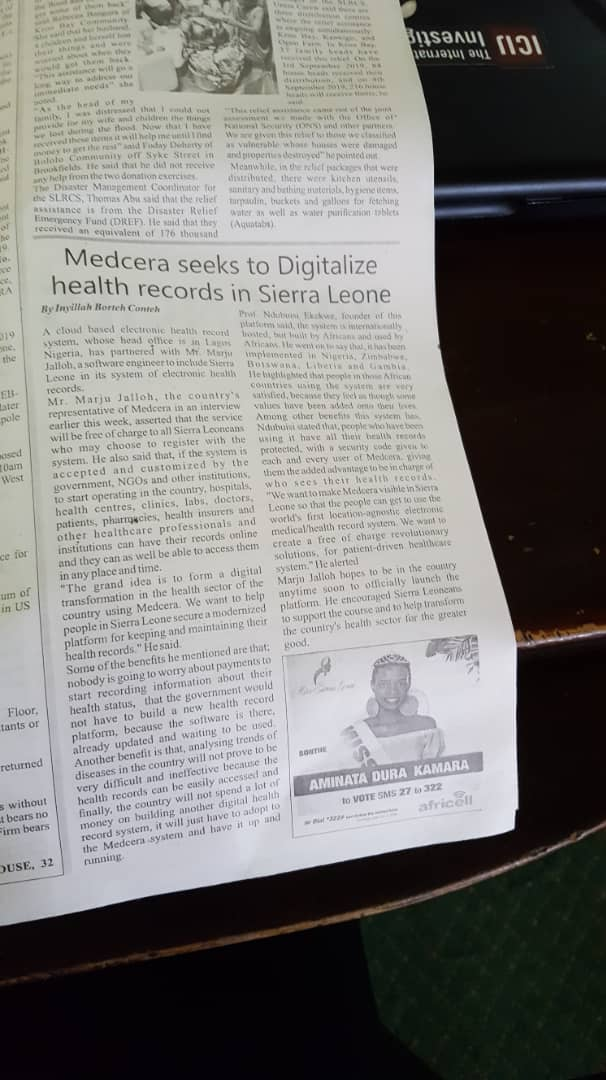
Medcera Begins Digitizing Health Records in Sierra Leone

2
Medcera in local newspaper

Medicine is a great profession but it is also a lousy scalable call. A doctor has the worst marginal cost paralysis in all the elite human professions: you cannot scale your specific individual services irrespective of demand because your “customers” (yes, patients) are different across all major variables. So, at anytime it is one doctor per patient and that means a doctor is bounded by time and geography. There is a reason for that: doctors are called for greater missions because they have the zenith of all missions – lives and human wellbeing. And you cannot give them anything more than that.

But as Africa continues to see the exodus of its doctors out of the continent even as the population expands, we need to fix the marginal cost paralysis in medicine. How can one doctor treat thousands of clients at the same time? In other words, how can you scale the care doctors deliver to the world?

At Medcera, we are working to make that promise possible, and very soon, Medcera CareAI will serve as “digital doctors”. Put your symptoms, our AI will diagnose basic ailments and make recommendations bounded by our statistically confidence interval. Where we do not have high confidence, then a human doctor will take over.

Sierra Leone loves this future and it has gone Medcera. We are scaling across Africa; join our mission – one African, one Health record, one Medcera.

We are excited to be in Sierra Leone to begin digitizing the health records of the good people of Sierra Leone. We are confident that we will improve health outcomes and help our partner clinics and doctors in saving lives.

Medcera in local newspaper

The Vision of Medcera CareAI for Africa