DD
MM
YYYY

PAGES

DD
MM
YYYY

spot_img

PAGES

Home Blog Page 6749

The Choice To Be Somebody That Matters

0

There can be just one president for a nation at a particular time, there can be just one vice president, so also one governor for a state, and just one leader for a role for a period of time. So where do we fit in? Those of us who also want to be presidents, those of us who want to be governors, those of us who want to be leaders, and those of us who want to own companies.

Is there any space left for us to occupy? Can we build the next Facebook and send Zuckerberg home? We all want to matter; we all want people to notice us, to give us respect and honour the big guys have. But how are trying to get it? Now, I would say this as mild as possible. You cannot overthrow the president while he’s on seat by attacking him, you cannot throw away the governor on seat by facing him head on.

You cannot send Zuckerberg home by building the next social media. I’m so sorry but you’d fail before you start and I’ll tell you why and what you need to do. The reason is simply because it’s totally impossible to come into a tribe and seat on the throne by throwing away the leader while the tribesmen watch you. Matter of fact, they would rebel against you. The leader has won their trust over time and trust is all you need to rule. You need their loyalty else they sneak up at night to kill you or escape from the town.

These big businesses you want or wish to overthrow have millions and billions of loyal tribesmen (customers). I call it tribesmen because they have for years successfully gained the attention, trust and loyalty of those customers making them part of the brand, community, state and even area. You would need more money, more magic to win in this case. So does this mean you cannot still be a president or governor or leader? You can! Absolutely!

Here’s what you need to do: You need to seek a small group of people that you matter to. It’s a choice. You choose to become the president of the blind and make them recover their sight, soon enough every blind person who has recovered their sight becomes loyal to you. Then they convince another blind person till the whole country is filled with people who have recovered their sight who see you as the leader. These people are your new tribesmen and it’s easier for them to whisper to even those who were never blind to tell them about your generosity and just like that, your idea spreads.

You cannot build the next Facebook that just connects people and advertises, you have to create a social media for grannies to connect and have memories of the times they’ve spent together. Then the grannies convince their children and their grandchildren and your idea spreads. What I’m implying is that you have to seek a set of people who you would matter to, who would be loyal to you, then you rule over them in generosity and transparency and they spread your idea.

This is a choice you have to make. Don’t go fighting the air. Most times you may not need to be the president of a nation, you just have to be the president of the writers, athletes, and the artistes. Who are the people you matter to? What do you matter to them on? Do they recognize it? Is it something they need? Don’t try to go and rule in a kingdom that doesn’t need you; you’d be fruitless. Seek those you matter to, and nurture them.

Lead your tribe well. That’s how you matter!

The ORide/OPay Double Play Strategy – Lose Money in Okada, Make It Up via Paytech

6

Many have commented that OPay did not raise $150 million as I noted in the Gokada piece: “$150 million OPay has raised [$50m for OPay and the reserved $100m].” You are technically correct as the $100 million fund was not specific for OPay.

Yet, these are all semantics. Do not be fixated on it. I go beyond press release in my analysis; I think beyond the press. Since Opera raised $100m for Africa, it has not done anything, at scale, in any other country but Nigeria. I do believe that majority of that $100M  is mapped for Nigeria even though it used Africa in the statement. Then, ORide/Opay/OFood got $50M. Nigeria is the only country it is building startups at scale. I don’t really care what they have on press release to make sense of what they are doing. This company wants to build a fintech (OPay) but it needs to acquire customers from different areas to help seed the transaction volumes.

OPay is the operating vehicle as they want to build transaction processing feeders to make their paytech system dominant. I did not say ORide; I said OPay because ORide is under OPay in the grand Opera strategy.

This is a double play strategy: Opera will lose money in transportation, ride-hailing, food delivery, etc but will make money through OPay payment processing fees. So, as it pursues market share challenging Gokada and Max.ng, do not think it is stupid for losing all that money.

Yes, provided the chip business has an internal customer (the mobile device unit, the oasis in my strategy), Samsung will continue to commit resources as the oasis has removed most of the risks in investing billions of dollars to build new factories in the chip business. Yes, the mobile device unit (the oasis) makes the chip business better by being a “reliable customer”, irrespective of whatever happens externally. That is the heart of the one oasis and the center of Double Play Strategy in business.

Most of the comments here have focused that ORide will go bankrupt when its money finishes. The commenters do not know that ORide is structured to provide transaction fees for OPay. Provided ORide does that at scale, Opera will make money via OPay even if ORide is never profitable. Sorry that I have to repeat that again.

I told a firm to adjust strategy last week immediately my Practice came to the conclusion on this OPay strategy. Without a payment system, no ride-hailing startup in Nigeria can challenge ORide headson. Of course, there are other options on what players like Max.ng and Gokada can deploy.

This  double play strategy is common. Amazon/AWS uses it. Alibaba/Alipay uses it. And Opera is working on it in Nigeria. If you want to compete against ORide without OPay, you will go bankrupt because ORide may never be designed to be profitable. But the parent company will be fine provided OPay is making money through commissions on transactions.

LinkedIn Summary

I browsed through the comments on Gokada and was surprised that our mini-MBA is not yet efficient. ORide will not go bankrupt for giving cheap rides in Nigeria. ORide, OFood, etc are designed to be payment transaction volume feeders into OPay. So, provided they bring volume, even when losing money, Opera will make its money from payment fees. That is the Double Play Strategy: lose money in one thing but make up in another.

For Gokada, Max etc to compete with ORide, they need a Double Play. ORide business model is not to make profit on transport but to feed payment commissions to Opay. One of the best strategies for Gokada and Max will be to buy a fintech firm (I have some suggestions) to compete.

Alibaba/Alipay and Amazon/AWS are examples of double play. Read more on click. Do not be distracted by the discounted rates of ORide/OFood. It will be fine because of its OPay.

The Double Play Strategy


The Thank You from Kobo360 After $30 Million Backing from Goldman Sachs

0

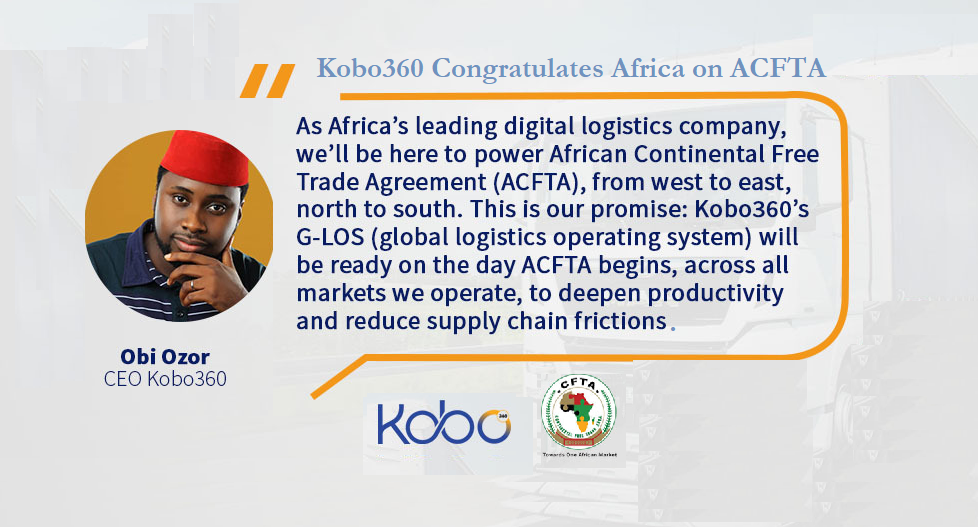
Our Founders – Obi Ozor and Ife Oyedele II, and the Squad Team- take all the glory. But permit the Prof to celebrate.  Everyone is happy here because $30 million from Goldman Sachs into Nigeria is a great validation. But this is just the beginning: the G-LOS is engineered to be a global logistics operating system, out of Lagos. 

And the AfCFTA (Africa’s free trade agreement) is going to harmonize most of the elemental frictions to enable attaining equilibrium faster. The mathematics of Africa supply chain is the calculus of African commerce. Our model is incorporating AfCFTA to be ready on Day 1.

Think Logistics. Think Kobo360.

Nigeria’s eLogistics Pioneer Kobo360 Raises $30 Million Led By Goldman Sachs

Nigeria’s eLogistics Pioneer Kobo360 Raises $30 Million Led By Goldman Sachs

2

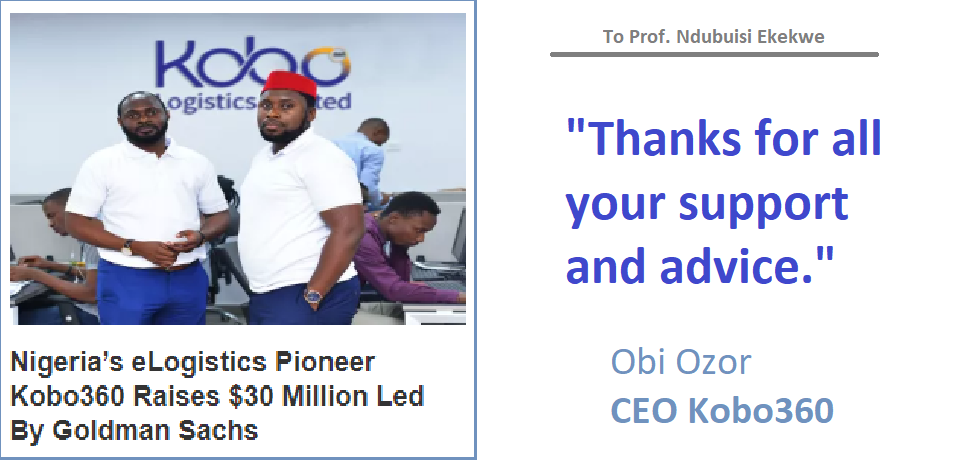
Nigeria’s e-logistics pioneer Kobo360 raises $30 million led by Goldman Sachs. Congratulations to the Squad  for executing the mission at the highest level. As part of this announcement, I wrote a brilliant piece on the sector yesterday for people to understand what Kobo360 is doing to reduce frictions in Africa’s logistics and broad supply chain.

As we celebrate here, the best moment arrived when the CEO of Kobo360, Obi Ozor, dropped this line, this morning to me,  “Thanks for all your support and advice.” I am very proud of what Kobo360 has accomplished and even more optimistic that Kobo360’s mission to build a logistics operating system in Africa will advance our continent in the age of AfCFTA.

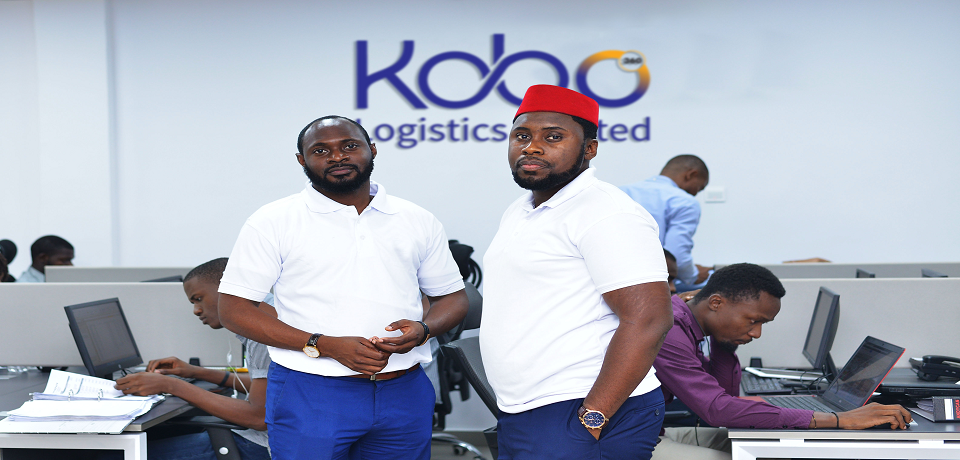
The two Founders – Ife Oyedele and Obi Ozor – are amazing operators.  What they have accomplished in Africa within a really short period is largely unprecedented.

Kobo360 is a tech-enabled digital logistics platform that aggregates end-to-end haulage operations to help cargo owners, truck owners and drivers, and cargo recipients to achieve an efficient supply chain framework. Through an all-in-one robust logistics ecosystem, Kobo uses big data and technology to reduce logistics frictions, empowering rural farmers to earn more by reducing farm wastages and helping manufacturers of all sizes to find new markets. Kobo enables unprecedented efficiency and cost reduction in the supply chain, providing 360-visibility while delivering products of all sizes safely, on time and in full. The Kobo mission is to build the Global Logistics Operating System that will power trade and commerce across Africa and Emerging Markets.

Congratulations to Nigeria. Congratulations to Africa. Congratulations to Kobo360.

How Emerging Technologies Are Transforming Logistics in Africa

The Press Release

August 14 2019. Kobo360, the digital technology platform disrupting African third-party logistics, today announced the completion of a $20M Series A equity round led by Goldman Sachs, with participation from Asia Africa Investment and Consulting Pte. and existing investors including TLcom Capital, Y Combinator, the International Finance Corporation. An additional $10M in local currency working capital financing has been secured from Nigerian commercial banks.

Launched in 2017 by Nigerian entrepreneurs Obi Ozor and Ife Oyedele II, Kobo360’s tech-enabled full truckload offering enables the development of an efficient supply chain for end-to-end long-haul freight operations, connecting and supporting cargo owners, truck owners & drivers, and cargo recipients. The company has moved over 500Mkg of goods, aggregated a fleet of over 10,000 drivers and trucks, and services SMEs and over 80 large enterprises such as Dangote Group, DHL, Unilever, Olam, African Industries, Flour Mills of Nigeria, and Lafarge. Located in key strategic trade hubs in Western and Eastern Africa, the e-logistics company will continue its expansion with the ambition to build a Global Logistics Operating System [G-LOS] powering trade and commerce across Africa and emerging markets.

With the funding, the team will continue to scale the organization, develop the technology offering and accelerate supply growth – planning to add 25,000 drivers to the platform in the coming months to power the recent Africa Free Trade Continental Agreement, expected to catalyze intra-African trade. Kobo360 is also planning to significantly broaden its reach in Africa, entering 10 new countries by the end of 2020 beyond its footprint in Nigeria, Togo, Ghana and Kenya.

Obi Ozor, Co-founder and CEO of Kobo360 said, “Our Series A allows us to invest in growing our talented team that is working hard on the ground to systematically address the inefficiencies within the African logistics sector, and strengthen our already extensive network of clients and truck owners across the continent. We are also focusing on developing the partnership with drivers, ensuring that they are trained to use mobile-enabled technology, so they can convey goods seamlessly and earn more money. We are already seeing drivers running trips on the Kobo360 platform increase their monthly earnings by 40%, as we work together to mobilize logistics across Africa.”

Jules Frebault of Goldman Sachs said, “Kobo360’s on-demand logistics offering has generated impressive traction and we are excited to support Obi, Ife and the team as they harness technology to tackle one of Africa’s most pressing development challenges – increasing market transparency, improving reliability and unlocking efficiencies for all participants in the logistics ecosystem”.

Senior Partner of TLcom Capital, Omobola Johnson said, “We see this Series A round as a means to support an ambitious, laser-focused company who are using technology to actively solve problems for enterprises across the continent, and we look forward to working with them as they continue to scale and transform the African logistics sector.”

Kobo360 is also developing a suite of driver-focused products to support the over 10,000 drivers on the Kobo360 platform. It has launched KoPAY, offering access to up to $5,000 monthly working capital; KoboSAFE, access to an insurance product; and KoboCARE, access to discounted petrol, comprehensive HMO packages and an incentive-based education program for drivers’ families.

Wale Ayeni, who heads venture investing in Africa for the International Finance Corporation, added, “IFC’s continuous investment into Kobo360 stems from the company’s successful track record. Kobo360 is empowering and enhancing the capacity of the vast underserved network of “micro” fleets in Africa to serve the huge unmet long-haul freight needs of large enterprises and SMEs, delivering value to both sides.”

How to Improve Your Spoken English

0

Learning a second language requires the development of the four language skills – listening, speaking, reading and writing. The development of these skills has to follow this order of listing for the learner to be competent in the language. In order words, for you to learn the English language, you first have to develop the listening skills before going over to speaking, reading and then finally writing skills. So a person’s proficiency in a language is actually judged (first) based on his listening and speaking skills. Only those who have more dealings with the user will evaluate his reading and writing skills.

But, sometimes we pay more attention to developing our writing skills in English than we do the other three skills. The reasons for this could be because we write business letters and proposals than we listen or speak to our customers and employers. Whatever the reason may be the result is not impressive because we ended up having a lot of people who are highly proficient in writing the English language but encounter difficulties in speaking it.

Developing an oral proficiency in English is highly necessary in Nigeria. This is because English, though a second language, has taken up a prestigious position in Nigeria and is therefore an elitist language. In Nigeria today, English is considered the language of the upper class; it is used to measure someone’s level of education; and it is necessary for social mobility. Therefore, anybody that speaks it fluently is considered to be well educated and to have good social status.

English is the only language that links the 400 and more Nigerian indigenous languages. This is to say that failure to use the language competently can create a communication barrier between the participants if they happen to have different mother tongue.

Being proficient in speaking English in Nigeria can boost the confidence and self-esteem of the speaker. Good self-esteem and confidence is important as that will boost the speaker’s career success. Besides that, his audience will always find him impressive even on their first meeting.

Alright, let’s go over to some techniques we can apply in developing and improving our speaking skills. Before we continue, I’ll like to state here that language learning is a habit. This means that for you to improve your speaking skills, you have to make these techniques a habit. Some authors may recommend that you give yourself about 30 minutes to one hour every day to practice. But I’ll say that apart from those that will need the use of equipment (such as mirror), practice these techniques as often as possible. In fact make use of any opportunity you have to practice them. Let them be a part of you and you will see the changes in no distant time. And please, don’t put pressure on yourself by setting a time frame. Remember, you are forming a habit that will last a lifetime. So the changes need to be gradual but steady, if you truly work on yourself.

So, here are the techniques:

  1. Be Confident: This is one area that learners have challenges. Some have it deep down them that they aren’t cut out to speak English or that since they missed the opportunity of learning it at childhood, they can’t learn it again. I remember when one of my students approached me that he would love to speak the way I do but that he can’t because he grew up in a rural area. I taught him these techniques and he started practicing them. By the time he graduated, I noticed that he has improved greatly. So, I’ll say, be confident. The language isn’t meant for anyone in particular. Besides, what we speak in Nigeria is a modified version of English that is for all Nigerians alone.
  2. Sharpen Your Listening Skills: This will enable you to understand how some words are pronounced. Of course, if you can’t listen, you can’t speak. So, what do you listen to? Do you listen to English songs, news and films? Are you surrounded by people that speak good English that you can listen to? I hope the answers to these questions are yes. Find your role models today and start emulating them.
  3. Use the Mirror: I love this part so much. You don’t only use this to work on you speaking skills; you can also use it to sharpen your presentation skills. Ok, see how you do it. Stand before a mirror, look at your image, look yourself straight in the eyes and talk to yourself in English for nothing less than five minutes (Sounds crazy, right? Well, that’s the way it is. Lol). So, just have conversation with yourself on any topic for as long as you can. Allow the words to flow. Don’t pause to think. Observe the gestures and the way you move your lips. Do you like this experience? Do it as often as possible, but let it not be less than five minutes in a day. This technique also works on your self confidence.
  4. Record Your Conversation: This really helps a lot. There are a lot of apps for mobile phones that record sounds. Look for them and use them. Record yourself as you are having a self conversation or while having a phone call. You can also record yourself while you were singing or reading aloud (but recording during a conversation is more effective). After recording, listen to yourself. It will help you to evaluate your spoken English. You can also record news and record yourself as you recast it. Don’t worry if you don’t sound exactly like the newscasters, they have special training for that job.
  5. Increase Your Vocabulary: The basic way to expand your vocabulary is by reading. Listening also helps but reading is the best. So read as much as you can. Like one of my lecturers used to say, read everything you can lay your hands on, only be matured enough to sieve through the information contained in the book.
  6. Learn the Sounds and Prosodic Features of English: Every language of the world has sounds as their raw materials. English has 44 phonemes (20 vowels and 24 consonants). You need to learn these sounds so that you can pronounce words correctly. Most learners encounter challenges pronouncing some English words because they substitute the sounds in those words with the ones that exist in their native language(s).

English is also stressed timed language. So learners have to understand its stress patterns and intonations. I believe that there are good schools that train people on spoken English. But as you are searching for them, you can look for good books on English phonetics and phonology that have audio CDs. The Cambridge English Pronouncing Dictionary by Peter Roach and co can help here too.

  1. Use the Tongue-Twisters: Tongue twisters seem to be going into extinction these days. One thing tongue twister does is helping us in contrasting sounds. I always use it in my classes whenever I teach sounds that prove difficult to my students. A good example is the ‘th’ sounds. I also use this technique for those that have the L-R (you know, those that substitute L for R and R for L) and the ch-sh (substituting sh for ch, and vice versa) problem. So, locate books on tongue twisters and practice them a lot.
  2. Focus more on Fluency than Accuracy: This technique always raises eyebrows each time I bring it up. I’m not saying that accuracy isn’t important. Of course, it is. What I’m trying to say here is that when you focus more on saying what is grammatically correct, you will be slowed down. Trust me, your listeners may lose interest before you finish what you have to say. Learn the English grammar but don’t worry about it when you speak, at least not while we are developing your fluency. But if you noticed that you committed a blunder, you can retrace a little and correct it to show that it was a mistake, and not an error. But if correcting it will make the mistake too obvious, please ignore it and continue talking. Let those words flow freely.
  3. Have a Transcription Book: I learnt this technique from a public speaking coach. I started it and found out that I pronounce some words wrongly. So, if you have learnt the English phonemes, get an exercise book and use it for your transcription exercises. Write down words, sentences or passages in their orthographic spellings and then transcribe them. Use a good English dictionary to check for corrections. This exercise is truly very rewarding. By the way, make it a daily affair, just like every other technique.
  4. Speak English More: Of course, practice makes perfect, remember. So, you have been practicing all these in your home, what about outside? Do you speak English more as you work on your speaking skills? Or do you revert to pidgin and your native language(s). Ok, I’m not saying we should throw away our Nigerian languages because of English. What I’m saying here is that you need to practice what you’ve learnt. So, if the crowd you move with now will not provide you with the opportunity to practice English, look for another crowd that will. Just find someone that will encourage you to speak English more often. You can also look for opportunities to engage in public speaking using English. This may sound outrageous but it is worth it.

So, we have seen ways we can develop and improve on our spoken English. Let’s remember that we need this language for these reasons – to boost our career and our social status. Besides, it is still a part of the packaging.