DD
MM
YYYY

PAGES

DD
MM
YYYY

spot_img

PAGES

Home Blog Page 6889

Apple’s Greatest Risk is Washington DC Packaged in Huawei

0

U.S. plans to restrict access of critical components into the hands of Huawei as the trade war with China intensifies, and the battle for the future of 5G technology is waged. Largely, U.S. has many tools through two vital companies in the world of microelectronics: Cadence and Synopsys. More than 99% of the leading chip designers depend on these firms. Without them, it will be hard for Huawei to make its own microchips (to overcome the bans) in ways that foundries can manufacture them effectively. If U.S. blocks Huawei, call that move extremely “severe” but not “existential”, yet, because China will respond. Simply, China can block Chinese factories from offering “labour components” for American firms like Apple, Dell, HP, etc. If that happens, iPhone may be off market!

From Fortune summary: The White House has intensified its campaign against Huawei. President Trump signed an executive order Wednesday that effectively blocks Huawei from the U.S. market. The Trump administration then added the Chinese telco to its “entity list.” As an “entity,” Huawei is unable to purchase components from U.S. companies without approval from Washington. Huawei says it has already stockpiled supplies and eventually will be able to replace U.S. tech with its own. Analysts are skeptical.

The Trump administration officially added Huawei to a trade blacklist on Thursday, enacting restrictions that will make it difficult for the tech giant to do business with American firms, in its latest broadside against the company that U.S. officials have labeled a threat to national security.

The head of Huawei’s HiSilicon chip division on Friday shrugged off concerns about disruptions to supply, saying it has long been preparing for this kind of “extreme scenario”.

Huawei will aim to be technologically “self-reliant” going forward, He Tingbo said in a letter to staff.

This is a tough one at all levels – “The Trump administration on Thursday officially added China’s Huawei Technologies Co Ltd to a trade blacklist, immediately enacting restrictions that will make it extremely difficult for the telecom giant to do business with U.S. companies.”

But China does have a game move available: if you restrict it from component supplies because of the “entity list”, companies like Apple, maker of iPhone, may pay the penalties. Other moves are explained here:

“If Beijing were not to stand in the way of a 3-5% depreciation in the renminbi, fears would grow that the stuttering Chinese economy was exporting deflation to the rest of world, and global markets—and the U.S. stock market in particular—would likely take fright,” Chen writes, arguing that a “sharp correction” in the U.S. markets could convince Trump that making a swift deal is in his best political interest.

[…]

Beijing could subject U.S. companies operating within China to administrative punishments, such as conducting arbitrary audits, enforcing stricter regulations, or slow-walking approvals of necessary permits and licenses. The approach is a nod to the advantage China has over the U.S. when it comes to China-based American businesses. “Operations of U.S. companies in China are a significant portion of the economic revenue that the U.S. as a whole derives from China, but the sales of companies operating abroad isn’t as significant a portion of China’s economic revenues from the U.S. Those mainly come from goods exports,” Anderson says.

Yet, as this happens, countries like Vietnam will benefit as U.S. companies move production from China to avoid the China-US trade paralysis.

As U.S. racks up pressure on China, smaller Asian countries like Vietnam will benefit. Yes, companies will move factories to those other locations to avoid the tariffs imposed on China-made products. There is a huge dislocation taking place in Asia right now. Can Africa benefit? Maybe Ethiopia which has been positioning itself for moments like this

This is going to be a long fight because even those American companies which will restrict supplies to Huawei, most of them use Chinese labour to make their products. This trade war is not asymmetric and that is why it will end at parity – DRAW. Yes, draw because U.S. companies will lose revenue also. CNN puts it at $11 billion.

This week’s escalation of the US campaign against Huawei has rattled investors. Shares in Qualcomm, whose sales to Huawei account for less than 10% of its revenue, closed down 4% on Thursday in New York. Huawei sales make up 15% of optical maker Lumentum’s(LITE) revenue. Its stock plummeted nearly 12%. Shares in other US chipmakers that supply to Huawei — including Qorvo (QRVO), Skyworks Solutions (SWKS), and Xilinx (XLNX) — also ended the day in the red.

Comment on LinkedIn Feed

Both the US and China are playing chess, they know that no side can claim outright win without severe scars and dislocations in its economy, so it’s about gaining more points before final agreement is reached.

Trump saw many things he felt that it was ridiculous to continue to allow them to play out that way, that’s why I like the ‘table shaking’, especially when you have considerable negotiation power. China doesn’t respect anyone, so you must go toe-to-toe with them, if you want to get anything.

The good thing is that when the chess game ends, other smart nations will learn few things from it, so that whenever you are negotiating bilateral or multilateral trade deals, you open your eyes very well.

Most times African nations look lost and clueless on the world stage, with everything appearing so great in their eyes. Trump is teaching everyone who cares to listen that anywhere you have some advantage, always stand your ground and pursue a favourable deal, it doesn’t matter if your partner is frowning face…

The global economy has been so convoluted and entangled to the extent that both the US and China know that none of them can just get all they wish for, it’s all about scoring more points than the other person!
Fintech and Banking Everywhere in Africa, Yet None Is Fixing This Centuries-Old African Friction [Video]

3

Africa has made real progress in the fintech & banking space. Yet, so far, I have not seen any fintech or payment company that has fixed this financial services friction. I return back to it after months of posting it. If you know any firm that has fixed it, let me know. For the continent to thrive, it needs to be part of the equation. Simply, an Africa-wide single bank account.

In this videocast, I discuss the need to build a truly pan-African digital remittance/transfer banking product which is agnostic of location or currency in Africa. None of the products we have today meets that standard. Largely, I envisage a situation where all you need to buy and sell across Africa is one bank account in just one African Union country. With that, you do not have to even think about the specific currency of that account as technology will seamlessly make it possible to access other African markets for payments, transfer etc. The banks or fintech companies must still comply with all regulations related to international transfers, forex etc. The only difference is that customers will not see them as they will be hidden with technology.

Towards Effective Development of State Infrastructures in Nigeria

0

Nigerian states have lower capacities to build critical infrastructures. As the new governors take oath of office, my recommendation is for them, at regional levels, to pool resources and examine projects. It would be another challenging four years on infrastructural development if they do not band together.

Nigeria’s rate of infrastructure development at state level has slowed after sub-division of states as we lost the economies of scale. We merely expanded bureaucracy, exotic cars, security votes and available political jobs while structurally weakening our competitiveness compared when Nigeria was 19 states.

If you look at the numbers – Nigeria built roads, airports, dams, etc faster when the nation had 19 states than when it became 36 states.

Nigerian States. Note: In 27 May 1967 the regions were dissolved and 12 statescreated, subsequently further divided into 19 states and a federal capital territory (3 Feb 1976), 21 states (23 Sep 1987), 30 states (27 Aug 1991), and 36 states(1 Oct 1996). 27 Aug 1991 Abia state created from part of Imo.

The Amazing Ping An and Opportunities for Nigerian Insurers

0

By Nnamdi Odumody

Ping An Insurance is the leading Insurance services provider in China, serving 538 million online customers and 184 million retail customers through its ecosystems of financial services, healthcare, auto services, real estate and smart city solutions. It is the world’s biggest insurer with a market capitalization of $181.4 billion and earned revenues of $144,197 billion in 2018.

Ping An Good Doctor, China’s largest online healthcare services provider, has now expanded its AI-geared “one-minute clinics” across eight major Chinese provinces and cities. With signed service contracts for almost 1,000 units and a growing user reach of over 3 million patients, the company has stocked its 24/7 compact booths with more than 100 categories of cryogenically refrigerated common drugs, purchasable through smart vending machines. Each clinic houses an ‘AI Doctor,’ trained to collect data on patient symptoms and medical history through voice and text input, after which one of Ping An’s human doctors provides remote diagnosis, medical advising, and immediate online prescriptions.

Ping An invests $1billion annually on Research & Development  with 22,000 R&D staff, and has over 4,000 patents even as they invested $22 billion on AI for sales and marketing in 2017.

Applications of Technology

These are some areas it has deployed technologies:

  1. Internally generates higher return for core businesses. Customer segmentation and precision marketing for cross-selling and up-selling 20 percent plus 12 month conversion rate, gaining 67 percent more repeat buyers.
  2. Image Based Auto Insurance Loss Verification Technology for 100,000 plus vehicle types and 500 plus risk factors with 92 percent loss verification accuracy.
  3. AI and Biometric based credit risk management which detects fraud based on micro expression recording 1.18 percent credit card Non Performing Loan rate among the least three in the industry.
  4. Ping An FinCloud (the largest proprietary cloud platform in the Chinese financial services industry) is connected to 70 percent of Ping An’s core business. It externally provides and monetizes technology by One Connect (OneStop financial Cloud Platform). It’s Smart Fast Claim has 7 partner institutions recording 3 billion Rmb leakage reduction in the first quarter of 2017, and 20 billion Rmb potential revenue was generated from risk leakage control.
  5. Intelligent Personal Loan Solution had a billion plus usage in 2017 while intercepting 15 million frauds. Loss from internet fraud is 0.6 percent of Chinese GDP.
  6. Cloud Service Platform for Small & Medium Banks partnered with 400 plus banks. It is compliant to Chinese banking and financial services Regulatory Authorities. Its target market is 600 plus SMB’s which hold 40 percent of bank assets in China.

Ping An in Healthcare

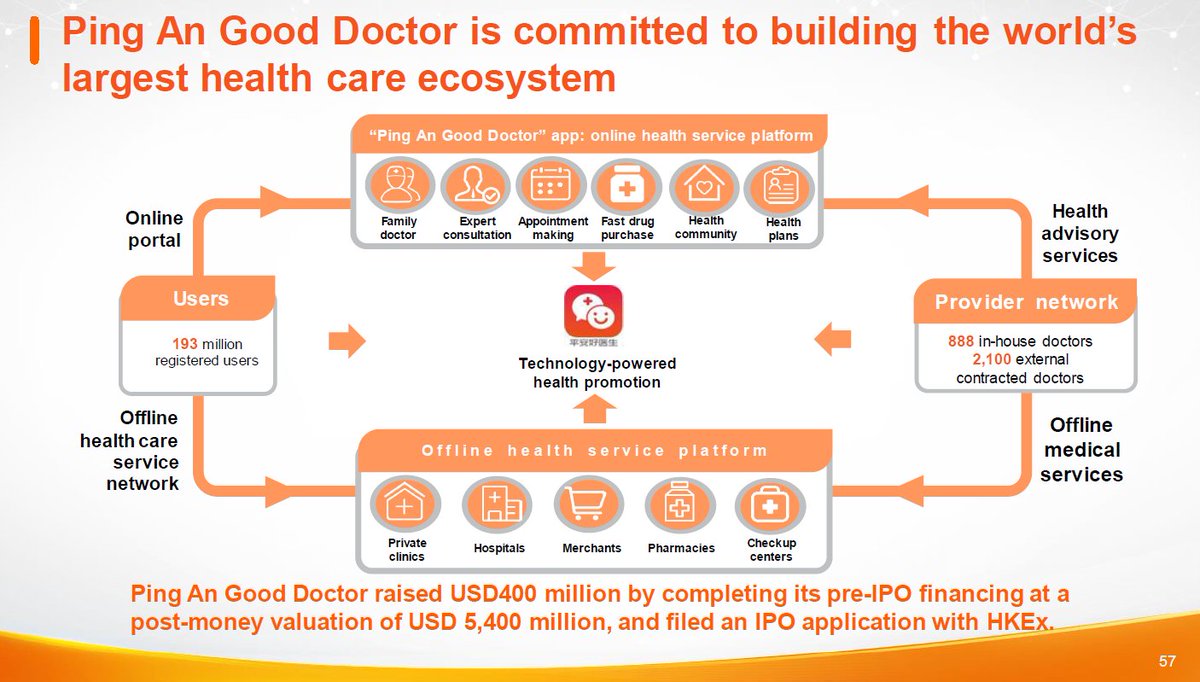
Ping An Healthcare & Technology Company is the leading one stop healthcare ecosystem in China. It combines mobile health plus Artificial Intelligence to provide every family with an e-health profile and everyone with a health care management plan. Ping An Good Doctor which is an online portal has established a comprehensive healthcare ecosystem which covers family doctor services, consumer healthcare services, a health mall as well as health management and wellness interaction.

As at Dec 2018, Good Doctor had 265 million registered users while its monthly active users had reached 54.7 million. It is the largest mobile medical application in China in terms of user scale, employing more than 1,000 medical personnel (Assistant Supervisor Level or above from Class III Grade A Hospitals) in its in-house medical team and contracts with 5,203 renowned external doctors. The in-house medical team empowered by its proprietary AI provides users with 24 hour online consulting services. Good Doctor collaborates with over 3,000 hospitals to provide services such as hospital referrals, appointments and inpatient arrangements. It also partners with more than 2,000 healthcare institutions including physical examination centers, dental clinics, cosmetic surgery institutions and more than 15,000 pharmacy outlets to provide personalized health and wellness services to their users.

By integrating it’s AI empowered medical team, external doctors and offline network, Good Doctor has established a closed loop healthcare ecosystem which enables its users to enjoy personalized healthcare services along its value chain.

All Together

Nigerian Insurance companies should learn from Ping An in order to create new revenue streams by plugging into the opportunities digital transformation provides by redesigning their operating models for the Fourth Industrial Revolution.

This Week, I Became a Shareholder and Board Member of an Amazing Fintech Company

0

This week went great – I became a shareholder and board member of an amazing fintech which is unifying payment in the worlds of bytes (digital) and atoms (offline). You will learn about this company next week. It is one of the fastest growing fintech companies in Africa today. Extremely brilliant young people with a simple mission: attack that 98% of $301 billion.

According to research done by The Fletcher School and Mastercard Center for Inclusive Growth, of the $301 billion of funds flows from consumers to businesses in Nigeria, 98 percent is still based on cash.

Yet, most firms are focusing too much on “clicks” neglecting “bricks”. If 98% of your revenue is coming from bricks today, you cannot neglect the physical. Do not listen to them when they say that today is mobile and online. Sure, the future promises mobile and online, but we have to survive today.

Do not be intimidated with the alarms on online disruption: the glory on the clicks is a promise. But “bricks” is on our hands. You are investing too much for clicks and your management is focusing largely exclusively on clicks. No one cares about the bricks. Unfortunately, the “bricks” customers are noticing. They are not happy in your stores.

Our goal is total unification, and we have a hybrid fintech: attacking that 98% for glory