DD
MM
YYYY

PAGES

DD
MM
YYYY

spot_img

PAGES

Home Blog Page 6917

Nigeria’s NAHCO Should Explore AI-Powered Logistics Robots like SpeedCargo for Efficiency

0

By Nnamdi Odumody

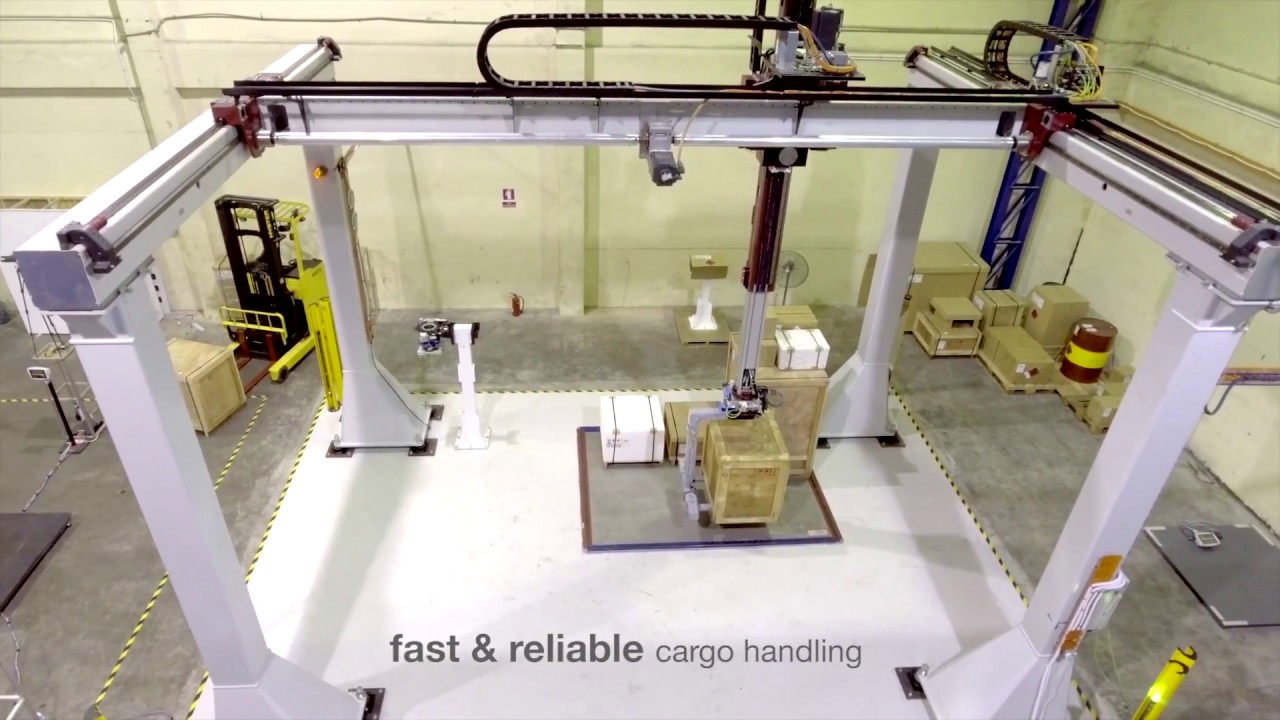
SpeedCargo, the world’s first AI-powered robotic solution for automatic build up and breakdown of aviation cargo pallets, is a product of research collaboration between Technical University of Munich’s CREATE and the National Research Foundation of Singapore.

It addresses the non-standardized cargo shipment category which has high variation in cargo shapes, dimensions, materials and weight. Palletization of such cargo is a labour intensive process and is performed manually worldwide. Deployment of SpeedCargo optimizes yield, enables a seamless flow of data, increases productivity and upgrades job profiles needed within the aviation cargo industry.

It is a turnkey solution using the vital ingredients which define intelligent systems; perception, cognition and action.

Technology

CargoEye: It produces a detailed and accurate digital fingerprint of incoming cargo in real time using the most advanced 3D camera system for acquisition of geometry and image. It goes beyond state of art by capturing non-standardized labels and material information of the cargo in addition to its dimensions, weight and center of mass of a box.

The user interface can be handled by a worker after only single day of training. Cargo Eye can be connected to any database or inventory management system for persistently storing the captured information to be used for planning and handling.

CargoMind: It is an artificial intelligence-based software solution that guarantees optimal packing results at any given time. It ensures that all aviation safety regulations for pallet packing are met while providing the operator a flexible planning tool to maximize profit. In addition, the system is able to re-plan a pallet at any given time within the process to accommodate any last minute modifications; for example a new cargo shipment needs to be accommodated on an existing pallet that has been partially built. CargoMind also enables the structural buildup of the pallet by planning collision-free motion trajectories for the robot.

CargoArm: It is the actuating system for physical and reliable handling of high-mix and high-volume cargo shipments. It is equipped with a gantry robot with a suite of advanced grippers to safely grasp and manipulate different types of shipments (ranging in dimensions, material and weight)

Although the gantry is a huge and heavy machine, it has extremely high precision (0.1mm). Equipped with a plethora of sensors, it can measure and record all important parameters that are of relevance while it is in motion.

The Nigerian Aviation Handling Company (NAHCO) should study advances in technology like SpeedCargo and deploy it in all the cargo sections of the nation’s airports to increase efficiency in their operations, eliminate waste and maximize shareholder value.

In Jeff Bezos’ Letter to Amazon Shareholders: “Failure needs to scale too”

2

The world’s richest man, Amazon’s Jeff Bezos, in his letter to Amazon shareholders, dropped a great line: “As a company grows, everything needs to scale, including the size of your failed experiments”. Yes, the Fire smartphone failed but Echo/Alexa, started about the same time as Fire, found glory. Largely, “If the size of your failures isn’t growing, you’re not going to be inventing at a size that can actually move the needle.” The summary is this: Echo/Alexa has made up for the losses Amazon incurred on Fire. To discover that Echo/Alexa, Amazon went on a mission; along the line, it took a journey via two paths, one clear path in one but getting lost in another, and over time recovered and focused on the right path.

As a company grows, everything needs to scale, including the size of your failed experiments. If the size of your failures isn’t growing, you’re not going to be inventing at a size that can actually move the needle. Amazon will be experimenting at the right scale for a company of our size if we occasionally have multibillion-dollar failures. Of course, we won’t undertake such experiments cavalierly. We will work hard to make them good bets, but not all good bets will ultimately pay out. This kind of large-scale risk taking is part of the service we as a large company can provide to our customers and to society. The good news for shareowners is that a single big winning bet can more than cover the cost of many losers.

Development of the Fire phone and Echo was started around the same time. While the Fire phone was a failure, we were able to take our learnings (as well as the developers) and accelerate our efforts building Echo and Alexa. The vision for Echo and Alexa was inspired by the Star Trek computer. The idea also had origins in two other arenas where we’d been building and wandering for years: machine learning and the cloud. From Amazon’s early days, machine learning was an essential part of our product recommendations, and AWS gave us a front row seat to the capabilities of the cloud. After many years of development, Echo debuted in 2014, powered by Alexa, who lives in the AWS cloud.

Perception Demand in Amazon

Reading the letter to shareholders, one can see some elements of perception demand where Amazon went beyond the needs and expectations of customers to the perception of customers, creating products no one originally asked for, but when customers finally saw them in the market, embraced and bought them.

The Perception Demand Construct is a construct where you work on things which are not really evident to be in demand. Yet you go ahead to create that product. The demand may not be existing but you are confident you can stimulate it. Yes, you do believe that your product can elicit demand and grow the sector when launched. This is different from existing demand which could be met via starting a web hosting company or selling light bulbs where you know people actually need those services.

The following are instances from Jeff Bezos’ letter on perception demand:

  1. Amazon Web Services (AWS): “The biggest needle movers will be things that customers don’t know to ask for. We must invent on their behalf. We have to tap into our own inner imagination about what’s possible. AWS itself – as a whole – is an example. No one asked for AWS. No one. Turns out the world was in fact ready and hungry for an offering like AWS but didn’t know it. We had a hunch, followed our curiosity, took the necessary financial risks, and began building – reworking, experimenting, and iterating countless times as we proceeded…AWS is now a $30 billion annual run rate business and growing fast.”
  2. Echo: ‘No customer was asking for Echo. This was definitely us wandering. Market research doesn’t help. If you had gone to a customer in 2013 and said “Would you like a black, always-on cylinder in your kitchen about the size of a Pringles can that you can talk to and ask questions, that also turns on your lights and plays music?” I guarantee you they’d have looked at you strangely and said “No, thank you.” Since that first-generation Echo, customers have purchased more than 100 million Alexa-enabled devices.’

LinkedIn Comment on Feed

Those with big ideas and large hearts are likely to succeed in places where ordinary folks do not dare to venture. So when we question why 1% of world’s population control so much wealth than the rest of us, we also need to argue about the size of risks each of us has taken; they all add up in one way or another.

Again, when you are out bring about extraordinary thing to the society, opinion poll or customer survey becomes meaningless, because the potential users are yet to think or imagine at that level; so you are the one to experiment, take all the risks, and bring out something the world suddenly realises it needs; it’s for the super few to deliver such to the rest of humanity.

And when it comes to scaling failures, obviously it’s stacked against smaller companies, because you may not have an infinite source of capital to keep failing, meaning that you have to be more nimble and probably laser-focused when making your bets. Where knowledge and capabilities cannot take you, let your imagination bring you within a touching distance, then learn more and finally drop the ball!

Visa Assures Its Future for Possible Cryptocurrency Era with Coinbase Debit Card

0

Coinbase will issue a debit card which is tied to cryptocurrencies like Bitcoin. So, instead of your bank account, Visa will connect to your Coinbase Bitcoin or other cryptocurrency account. In this one feature, Coinbase has solved two key challenges in the crypto community: made cryptos like Bitcoin easily divisible and usable on the streets for things like coffee and bus ticket, and cushion a future for Visa that even if the crypto era arrive, Visa will be protected from disruption. Simply, it has inserted itself into the future of whatever comes in any potential cryptocurrency era. This is a huge moment in the evolution of cryptos.

The bitcoin price, which leaped higher last week to trade around $5,000 per bitcoin, has been called too unstable and volatile to be used as a means of payment, resulting in bitcoin and other cryptocurrencies being used more of a store of value, like gold, than traditional means-of-exchange currency.

Now, major bitcoin and cryptocurrency exchange Coinbase has teamed up with global payments processor Visa to try to change that, launching the Coinbase Card which allows users to “spend crypto as effortlessly as the money in their bank.”

The Visa debit card, which has a £4.95 ($6.50) card issuance fee, can be used to spend Coinbase bitcoin, ethereum, Ripple’s XRP, and litecoin balances “in millions of locations around the world,” by converting the cryptocurrency to fiat when the card is used—the merchant or store gets paid in traditional fiat currency.

Coinbase users can choose which cryptocurrency is used on the card through a new app which supports all crypto assets available to buy and sell on the Coinbase platform. The app also offers instant receipts, transaction summaries, and spending categories, to help people keep track of their spending.

This amazing product from Coinbase fixes what I have called Bitcoin defect. And it will surely help the coin-believers congregate at deeper levels across the world.

Bitcoin has value. Gold, US Dollars, Nigeria Naira, LinkedIn account, smartphones, etc all have values. But having value is not enough to be a functioning currency: you must also be an effective means of payment. …Simply,  owners of Bitcoin are holding it or hoarding it instead of using it as a means of payment. That is the reason why the price has become a domino. When the primary motivation on a currency is to “hold” instead of a means of payment, the equilibrium-value point shifts. Over time, the value becomes speculative. Why? There is scarcity, not out of demand velocity, but exogenous interests.

The Oxford Comma and the Ten-Million Lawsuit

0

By Ademola Adeyoju

The English language is fluid, dynamic, and highly subjective.

If you read that statement carefully, you would realise that I inserted a comma after “dynamic”. Now, most writers would simply write, “The English Language is fluid, dynamic and highly subjective.” But which really is the right way to write?

There have been arguments on whether or not a serial comma[1] should be inserted after the penultimate item in a list of three or more things. Some styles — the APA style, the Chicago Manual of Style, the US Government Printing Office Style Manual, and the Oxford University Press — mandate the use of the Oxford comma, while some others — The Los Angeles Times, The Times, Associated Press Stylebook, and The Canadian Press—recommend against its use. Some other styles preach economy — For instance, The New York Times Style Guide recommends the use of the Oxford comma[2] only when it is necessary: otherwise, the Guide supposes that the use of the Oxford comma is just a clutter that would slow writers — and readers — down.

So, should it be “A, B, and C” or “A, B and C”?

Ordinarily, both are correct. But it is desirable that the Oxford comma be used to eliminate ambiguity. The famous editor of the Black’s Law Dictionary, Bryan Garner, thinks so too. In any case, there are no advantages to omitting the Oxford comma. So why not use it?

The Times once published a humorous description of a Peter Ustinov documentary, which retraces a journey made by Mark Twain a century ago. The Times noted that “the highlights of his global tour include encounters with Nelson Mandela, an 800-year-old demigod and a dildo collector.” Surely, a serial comma inserted after ‘an 800-year-old demigod’ would have infused some clarity into the expression, and make it sound a lot less like Nelson Mandela is an 800-year-old demigod and a dildo collector.

The above incidence affords a classic instance of the importance of the Oxford comma.

Both pro- and anti-Oxford comma factions can be found in all media — book writers and publishers tend to fall in the former group and newspapers in the latter group. But as Warren Clement counsels, do not mind the newspaper writers — they “throw caution to the wind, laugh in the face of doom, and deny employment to the Oxford comma. [They] shall pay one day for [their] recklessness. It will be comma karma”.[3]

Even if journalists and newspapers do not care about the Oxford comma, it should be a compulsory requirement in law and in all writings upon which clarity and interpretation human lives or millions of dollars may hinge. This goes without saying then, that every lawyer, legislator, and draftsman should pay special attention to the Oxford comma when drafting any documents, particularly those that are sensitive.

Emperical evidence shows that most lawyers and draftsmen have absolutely no understanding of the essence and importance of the Oxford comma. Most, if not all, our Statutes suffer from defects, among which the Oxford comma is chief. Yet history has demonstrated that grave consequences may be suffered when the serial comma is ignored.

O’Connor v Oakhurst Dairy

In 2014, a multimillion-dollar case was instituted for lack of a comma. Kevin O’Connor, along with about 75 other drivers filed a class-action lawsuit against Oakhurst Dairy for four years of unpaid overtime wages.[4] According to the Maine state law, workers are not entitled to overtime pay for: “[t]he canning, processing, preserving, freezing, drying, marketing, storing, packing for shipment or distribution of: (1) Agricultural produce; (2) Meat and fish products; and (3) Perishable foods.”

Without a comma after “shipment,” the “packing for shipment or distribution” looks like a single activity. The drivers argued that if a comma had been there, it would have been clear that those who simply distribute goods (as against, say, factory workers who pack for shipment) were also exempted. And since truck drivers do not pack food — either for shipment or distribution (they simply deliver it) — the exemption from overtime pay do not apply to them. They claimed that they were, therefore, entitled to overtime pay.[5]

The dairy company won at the District Court, but on appeal, the United States Court of Appeals For the First Circuit reversed the decision, holding that the Maine law — ambiguous as it is — must be construed narrowly in favour of the truck drivers. “[F]or want of a comma, we have this case,” says Judge David J Barron, who delivered the lead opinion. Eventually, the case was settled out of court for $5 million in 2017: but the lesson was learnt, in a very costly way.

If it has happened before, it may happen again. The Holy Bible says this too in the book of Ecclesiastes.[6]

Less-than-flawless writing is unacceptable in the legal profession, and while it is not true that the Oxford comma is always necessary, it does no harm to take precautions. As Loraine puts it: “The idea that a simple comma could make or break a case should be a wake-up call for everyone. Leave the careless writing and punctuation to the social bloggers. Our clients pay us to be consummate professionals, and we should work every day to earn their trust — Oxford comma included.”[7]

Onwuzulike v State

Addressing the issue of punctuations generally, Honourable Justice Tur of the Court of Appeal of Nigeria held recently in Onwuzulike v State[8] that, “since punctuations are inserted by the draftsman in modern statutes, I do not see any rational reason why the Courts should disregard them in the interpretation of any section, subsection or paragraphs and sub-paragraphs in a statute or rule of Court. “[9] So, as far as everything legal is concerned, “the slightest misstep in punctuating a clause can have massive unintended consequences.”[10] (In 1872, one misplaced comma in a Tariff Act cost the American government and taxpayers more than $2 million — the equivalent of over $40,000,000 in today’s dollars. Again, in 1999, Lockheed Martin, a multi-billion dollar corporation also lost $70 million after one comma typo in an international contract.)

Conclusion

There are two types of people: those who use the Oxford comma and those who want to see the world burn. Join the former’s camp. You should write: “I have read Hamlet, the Holy Bible, and Kama Sutra” unless you intend to create an incestuous relationship between the Holy Bible and the ancient Indian Sanskrit book on sexuality. Even when you use a disjunctive mark (that is, ‘or’), always use the Oxford comma. Better safe than sorry!


[1] A serial comma and the Oxford comma basically describe the same thing, and can be used interchangeably.

[2] The Oxford comma is so-called because the controller of the University Press, Horace Hart, had recommended it in 1893 in a set of rules for use by press employees.

[3] Warren Clements, ‘The case for and against the Oxford comma’ (2011) Available at: https://www.theglobeandmail.com/amp/arts/the-case-for-and-against-the-oxford-comma/article625889 Accessed on 9 March 2019

[4] O’Connor v Oakhurst Dairy, No. 16-1901 (1st Cir. 2017)

[5] For a more elaborate discourse on the issues involved in this case, see Mary Norris, ‘A Few Words About That Ten-Million-Dollar Serial Comma’, (2017) Available at: https://www.newyorker.com/culture/culture-desk/a-few-words-about-that-ten-million-dollar-serial-comma Accessed on 9 March 2019

[6] Ecclesiastes Chapter 1, verse 9, Good News Translation.

[7] Loraine                M. DiSalvo, ‘When Punctuation Sets Precedent: A Lesson for Companies, Everywhere. Available from: https://morgandisalvo.com/wp-content/uploads/2017/03/When-Punctuation-Sets-Precedent-v2.pdf Accessed on 15 March 2018

[8] Onwuzulike V. State (2017) LPELR-41889(CA)

[9] Ibid. (Pp. 129-138, Paras. D-B)

[10] Chris Stokel-Walker, ‘The commas that cost companies millions’, (2018) Available at: http://www.bbc.com/capital/story/20180723-the-commas-that-cost-companies-millions Accessed on 9 March 2019

The Inspiration via Beauty of Arts [Photos]

0

On the 15th of April, World Art Day takes place. Dutch company Delft Imaging Systems shows that art can be used as a means for a better world. The innovative enterprise from Veenendaal has been committed to fighting tuberculosis for years and invented a smart solution to make their mobile clinics more accessible: thirty local artists painted thirty mobile clinics that are able to quickly and efficiently diagnose TB. People are screened in these clinics and can start a treatment the very same day if necessary. 

Green energy


Win-win

Challenge

Early diagnosis

About Deflt Imaging Systems

Delft Imaging Systems (Veenendaal) envisions a world in which everyone can benefit from advances in the field of healthcare. Delft is specifically dedicated to improving people’s quality of life around the world by means of its diagnostic imaging devices, eHealth software and related services. In the battle against TB, Delft Imaging Systems is active in 35 countries with 45 projects by delivering smart solutions, that have supported the screening of more than 3 million people for TB. These kind of innovative systems provide an important link in delivering high quality-health care in vulnerable societies and developing countries. For more information, see www.delft.care.