DD
MM
YYYY

PAGES

DD
MM
YYYY

spot_img

PAGES

Home Blog Page 6942

MPESA Goes to China, Interswitch Should Copy

0

By Nnamdi Odumody

Kenya’s Safaricom has secured a deal which will allow its Mpesa mobile payment service to be used for online shopping on AliExpress, a platform owned by Chinese e-commerce giant Alibaba, as part of a move to expand its most profitable product beyond Kenya.

AliExpress will allow Kenyan shoppers to purchase goods from China through its website using Mpesa in a matter of weeks.

Under the deal, Ant Financial, an affiliate of Alibaba that runs its payment services, and the world’s biggest fintech valued at over $100 billion, and processing over $20 billion annually, will offer Mpesa as one of the payment options with transactions denominated in Kenyan shillings. It will allow Mpesa users to shop on AliExpress without a credit card. The move targets especially micro-traders in the country who source goods and other supplies from manufacturers in China. This latest deal is part of the redesign to transform Mpesa into a global payments platform.

In November, Mpesa signed a deal with Western Union to allow Mpesa users to send money around the world using their cellphones. Mpesa was launched more than a decade ago to offer Kenyans without bank accounts a network to transfer money via mobile phones. It now offers a range of payment services, loans, and savings, to more than 21 million people in Kenya, and has been copied abroad.

M-PESA is a service that allows you to transfer money using a mobile phone. Kenya is the first country in the world to use this service, which is offered by mobile operators Safaricom and Vodafone. M-PESA is available to all Safaricom subscribers (Prepay and Postpay), even if they do not have a bank account. Registration is FREE and available at any M-PESA Agent in Kenya. The M-PESA application is installed on your SIM card and works on all handset models.

Similarly, Interswitch Group, Nigeria’s largest electronic payments provider, should secure strategic partnerships which will see Quickteller being used by Nigerians to send and receive money from Western Union, purchase products from Amazon.com and Alibaba.com in Naira. For the Chinese part, it makes sense now that there is a currency swap arrangement with China. This will help reduce the pressure on imports of Chinese products in U.S. dollars instead of the Renminbi.

Kenya Must Not Separate MPESA From Safaricom; Platforms Thrive On Dominance
MacX MediaTrans Is an Impressive iTunes alternative for Mac to Sync iPhone to Mac

0

This 2019 Valentine Day, I received a special gift: a Mac computer. It came at the right time as I have noticed increasingly that many in my network are going Apple. So, going Apple means homogeneity and interoperability, and it makes sense I have an Apple product, leaving the world of Windows behind. I already owned an iPhone, as I was an early adopter of the latest series. So, I did plan to save to buy a Mac. But thank goodness that it came earlier than planned as a gift from someone special.

I began using this Mac and everything was going smoothly and perfectly until there came a time when I needed to transfer files from the iPhone to my Mac. It took some research works online. But at the end, I noticed software which most are using: MacX MediaTrans. I downloaded it and tried it – it works greatly. It helps you to sync iPhone to Mac, effectively.

MacX MediaTrans enables anyone to sync music, photos and videos between iPhone and Mac flawlessly. In short, you may not even notice it because the level of operational execution and user experience is second to none. This great solution is a clear iTunes alternative for Mac for people that want to explore at deeper levels on the interface and integration of Apple ecosystems, from iPhone to Mac and beyond.

Today, due to MacX MediaTrans, I backup my iPhone data to prevent data loss. The occasional drawbacks noticeable with iTunes are completely solved by this solution. It has become my best best iTunes alternative for Mac and has helped to backup and sync photos, videos, music, ringtones, ebooks, podcast, etc between iPhone and Mac to secure data and free up iPhone space.

MacX MediaTrans delivers fast file transfer speed and it is also easy to use. It makes it possible to sync contents bi-directionally, from iOS devices and Mac and that implies you can move contents from your iPhone to Mac and vice versa. One thing I found very useful was the selectivity which enables the capacity to select only the files you want to transfer without having to transfer all files. By having that feature, MacX MediaTrans delivers faster speed and that means saving of time. It also ensures that you preserve space by having only the things you want moved.

For Music, you can sync and backup music from your iPhone to Mac via this technology. Also, for videos and photos, you can also do the same. The key is the efficiency in the synchronization and backup of contents.

 MacX MediaTrans as iTunes Alternative

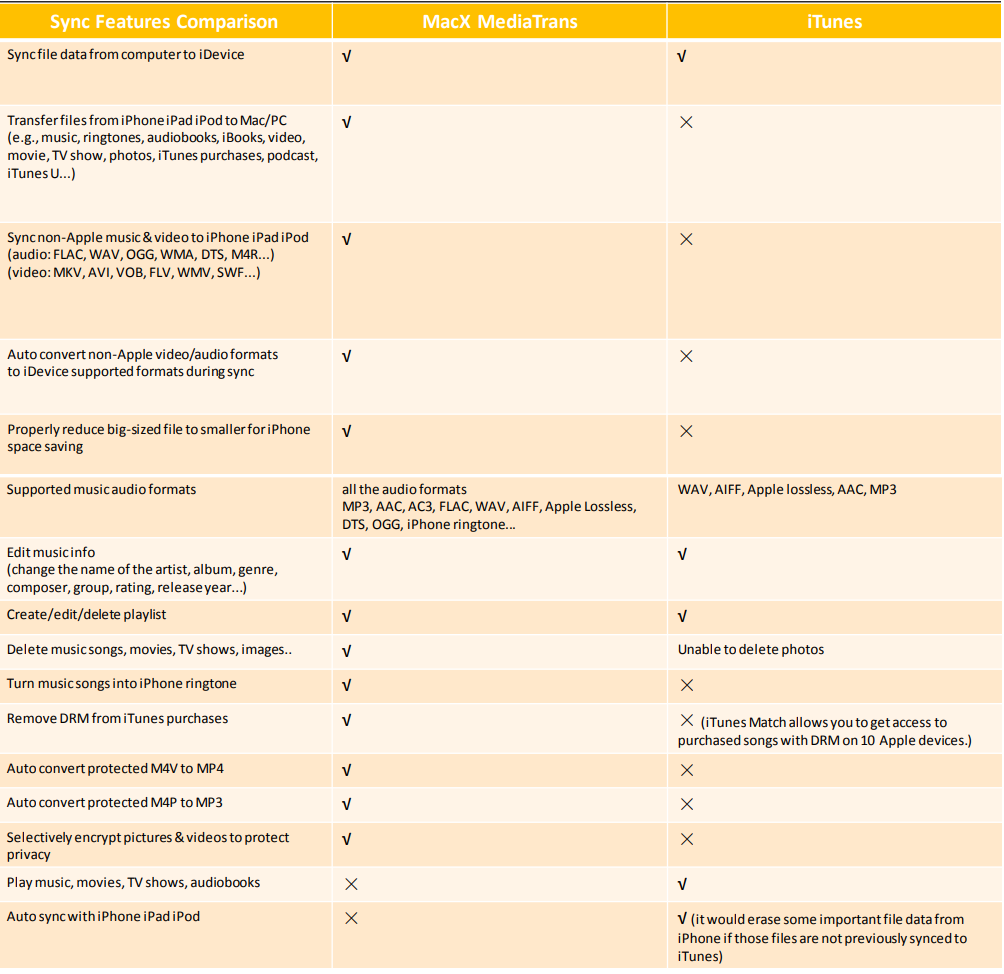
MacX MediaTrans delivers many advantages over iTunes. A key advantage is the capacity to perform selective backups when necessary. That means you can individually backup and restore iPhone photos, music, videos, ringtone, e-books, and other files effortlessly. Also, unlike iTunes, which always erases the raw data after syncing – a bg concern indeed – MacX allows two-way sync between iOS and macOS without erasing any data.

The comparisons below show the advantages of MacX MediaTrans over iTunes in syncing and managing iPhone files, and this helps to understand why MacX MediaTrans is the best alternative to iTunes.

How To Transfer Contents between iPhone and Mac using MacX MediaTrans

  1. Connect your iPhone to a Mac or PC using a USB cable. Then Tap “Trust This Computer” on your iPhone.
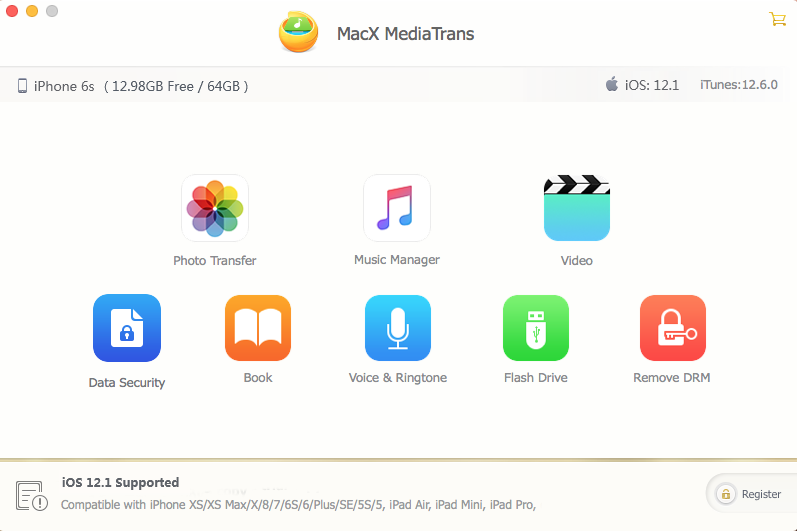
  2. Depending on what kinds of files you’d like to back up, choose the corresponding icon in the main interface. Take photos as an example: click “Photo Transfer” to load all of your photos on your iPhone. (The following steps go the same if you chose “Music Manager” or “Video”).
  3. Select the photos you’d like to back up, or tick the box of “Select All” to make a complete backup of the current category.
  4. Click the “Export” button on the top of the panel, and wait for the file to be generated. As little as 8 seconds are needed to transfer 100 4K images.
  5. You are done – simply easy and no problems.

How to Restore Prior iPhone Backups from Mac/PC to iPhone

Similarly, you can also restore your previous data from Mac to iPhone using MacX MediaTrans.

  1. Once again connect your iPhone to your Mac or PC, and choose the corresponding icon according to your file type. Also click on the “Photo Transfer” icon.
  2. Create a new photo album by clicking the “+” button on the left column. Click the “Add Photo” button to select photos you’ve previously backed up on your computer hard drive. Then click the “Open” button.
  3. Press the “Sync” button to restore your selected photos to your iPhone and then verify the transfer.
  4. Done

All Together

This is a very amazing solution – I totally recommend it to anyone.  Simply download the iPhone manager to backup and sync iPhone files to Mac at one go, without using iTunes.

Key Sections in Jumia SEC Form F-1 on Ecommerce Risks and Challenges in Africa

0

I have read Jumia Form F-1 which it filed with the U.S. SEC as part of the process of becoming a public company in America. What we knew as Africa Internet Holding GmbH transmuted into Jumia Technologies AG in January 2019. Certainly, it is a better branding since most know Jumia and the obscure AIH would have confused many in the market.

 We have historically conducted our business through Africa Internet Holding GmbH and its subsidiaries, and therefore our historical consolidated financial statements present the results of operations of Africa Internet Holding GmbH. On December 17 and 18, 2018, our shareholders resolved upon the change of our legal form into a German stock corporation (Aktiengesellschaft) and the change of our company name to Jumia Technologies AG. The change of our legal form and company name became effective upon registration with the commercial register of the local court (Amtsgericht) in Berlin, Germany, on January 31, 2019.

Here are the major sections for players in the African ecommerce space to read very well. Largely, what Jumia is saying is this: we have incurred significant losses since inception and there is no guarantee that we will achieve profitability in the future. But over the years, because we have consistently raised external capital, we have been moving forward but where we are unable to bring more external capital, there will be huge risks.  Jumia in this section makes it indirectly clear that old Konga investors just gave up on Konga by not injecting fresh capital as that is what everyone is doing. Naspers which founded Kalahari had given financial sustainability as a key reason whenever it closed any of its ecommerce platforms in Africa. The decision to close is based on deciding not to inject new capital into the business.

Explaining further, Jumia notes thus – our markets pose significant operational challenges that require us to expend substantial financial resources and we have no reason to think these challenges will disappear. It then listed a laundry list which mirrors a piece I wrote in Harvard Business Review where I made it clear that winning the ecommerce sector will involve losing tons of money as there is nothing electronic in the sector. Yes, the marginal cost paralysis does not reduce with scale and until we have a solid logistics system, it will be a hard business. You come and lose money, and then you exit. 

Risks Related to Our Business, Operations and Financial Position

We have incurred significant losses since inception and there is no guarantee that we will achieve or sustain profitability in the future.

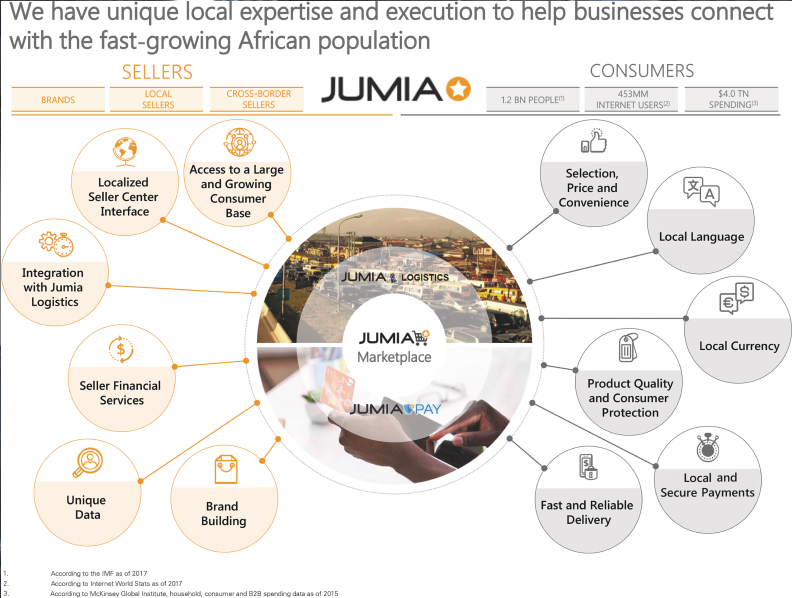
Jumia operates a pan-African e-commerce platform. Our platform consists of our marketplace, which connects businesses with consumers, our logistics service, which enables the shipping and delivery of packages, and our payment service, which facilitates transactions among participants active on our platform. We primarily generate revenue from commissions, where third-party sellers pay us fees based on the goods and services they sell, and from the sale of goods where we act directly as seller. Our revenue is, however, not sufficient to cover our operating expenses. Accordingly, since we were founded in 2012, we have not been profitable on a consolidated basis. We incurred a loss for the year of €165.4 million in 2017 and a loss for the year of €170.4 million in 2018. As of December 31, 2018, we had accumulated losses of €862.0 million.

There is no guarantee that we will generate sufficient revenue in the future to offset the cost of maintaining our platform and maintaining and growing our business. Furthermore, even if we achieve profitability in certain of our more mature markets, where e-commerce is growing rapidly, there is no guarantee that we will be able to break even and achieve profitability in other markets, where e-commerce adoption is slower. We expect that our operating expenses will continue to increase as we intend to expend substantial financial and other resources on acquiring and retaining sellers and consumers, growing and maintaining our technology infrastructure and sales and marketing efforts and conducting general administrative tasks associated with our business, including expenses related to being a public company. These investments may not result in increased revenue growth. If we cannot successfully generate revenue at a rate that exceeds the costs associated with our business, we will not be able to achieve or sustain profitability or generate positive cash flow on a sustained basis and our revenue growth rate may decline.

If we fail to become and remain profitable, this could have a material adverse effect on our business, financial condition, results of operations and prospects.

  • We rely on external financing and may not be able to raise necessary additional capital on economically acceptable terms or at all.
  • Our markets pose significant operational challenges that require us to expend substantial financial resources.We operate in emerging markets in Africa. While we believe that our markets offer opportunities for an e-commerce company, they are also characterized by fragmented and largely underdeveloped logistics, delivery, and digital payment landscapes, which can differ significantly in the consumer markets in which we operate. This underdeveloped infrastructure restricts and complicates the movement of people and goods, which may make our delivery service too expensive or our delivery times too long to effectively compete with offline stores, in particular outside of main urban centers. Underdeveloped infrastructure may also limit our growth prospects by obstructing access to potential consumers. Lack of an established, secure and convenient cashless payment system in many markets also poses significant challenges for sellers. From our experience, we believe that a large percentage of our consumers either do not have a bank account or do not trust online payments, which is why cash on delivery is still the preferred payment method used by our consumers.

    In order to overcome the challenges posed by our markets, we have had to develop significant logistics, delivery and payment infrastructures, which include, for example, the operation of warehouses and drop-off centers, the integration of third-party logistics providers, the establishment of our own delivery and last-mile delivery fleet in certain cities, the design of our independent technology platform and the provision of unconventional payment options. These factors make our operations more complex than those of similar businesses in more developed markets and may place a higher risk on us, for example, due to a higher number of failed orders, the risk of fraud or otherwise. The costs incurred by us to meet these challenges have, and may continue to, put a strain on our financial resources, may be unjustified in light of the benefits they bring us and may make it challenging for us to reach profitability. In particular, there is no guarantee that the markets in which we currently operate will prove to be as attractive as we currently believe them to be, which could have a material adverse effect on our business, financial condition, results of operations and prospects.

Business Lessons from Politics in Creating and Dominating Local Markets

0

By Nnamdi Odumody

All Politics as they say is local. Politicians in Nigeria have mastered this principle, and used it greatly to build dynasties, applying seduction and charisma to maintain cult followership among their followers.

In Lagos State, the Centre Of Excellence, an Africa top-ten economy, and most populated megacity, the ruling All Progressives Governorship Candidate Babajide Sanwo-Olu defeated his main rival of the People’s Democratic Party Jimi Agbaje with 739,445 votes to 206,141. The APC National Leader Bola Tinubu is the Capo Di Tutti who has dominated the politics of Lagos for 20 years since emerging as its governor in 1999, to 2007 when his second tenure ended, surviving an onslaught against the then ruling PDP led Federal Government.

Tinubu devised financial engineering to increase the Internal General Revenue of the state as its federal allocation was seized by the national ruling party for years. Ever since, the former governor has installed his successors who have improved on the state’s revenue generation and infrastructural development till date. His political structure is deeply entrenched across all the nooks and crannies of Lagos State, from the civil service, traditional institution as all the monarchs in the city of aquatic splendor are party loyalists, businessmen, transport union, etc.

His oratory and benevolence which many have hailed as his key selling points, among his supporters, who number in millions, across the state, and who besiege his residence daily for their different needs, have become symbols of leadership. Tinubu’s ability to spot and groom visionary leaders have led to many calling him the next Awolowo, the former Premier of the defunct Western Region of the first Republic who transformed it with various pioneering feats.

Beyond Lagos, Tinubu is revered as the Yoruba’s political kingmaker and has successfully installed his candidates which include the current Vice President of Nigeria Prof Yemi Osinbajo, former Governor Rauf Aregbesola and his successor Alh Gboyega Oyetola of Osun State, Dapo Abiodun who won the recently held Ogun State governorship election against the preferred candidate of the outgoing governor Senator Ibikunle Amosun, among others.

Up northern Nigeria which is conservative but politically conscious in comparison to their southern part, President Muhammadu Buhari draws his key support from millions of youths across the region, who love him for his strict Islamic beliefs, and frugal lifestyle in comparison to other elite that they feel have impoverished them. A key number of governors from the zone used his name as a brand to sell themselves to the electorate and get into power.

In Kano State, Senator Rabiu Kwankwanso who governed the state for two terms created a brand ‘’Kwankwansiya’’ movement across the state with millions of members. With its trademark red cap, the talakawas (masses) see him as a demigod and the second coming of the legendary Mallam Aminu Kano who created the talakawa politics. Kwankwaso ability to understand the needs of the masses and respond was key in helping to deliver millions of votes for President Buhari’s victory in 2015. When he defected back to PDP on the floor of the Senate, the Deputy Governor, a loyalist of his, and majority members of the State House Of Assembly, followed suit.

Across several states of the federation like Delta State where the former Governor James Ibori has established a political structure that made him install his successors, the word on the streets is that it is a one party state and others are just spectators.

Nigerian businesses need to think like politicians by creating and dominating their local markets just like Aliko Dangote who understands the average consumer, and creates products which have made him attain market leadership in most sectors he plays in.

Uber Plans To Exit Self-Driving Business As It Readies for IPO; A Great Strategy

0

Uber plans to exit its self-driving business. That is a good thing because I do think the company should focus on controlling demand and not supply. Under digital aggregation, the companies that thrive and win are those that control demand and not necessarily supply.

 A group of investors including SoftBank are in talks with the ride-sharing company to buy a $1 billion stake (paywall) in its self-driving vehicle unit ahead of its public listing. (QZ Newsletter)

That is so because supply is largely unbounded via the web: simply, making more cars available in the market, is not what will win the future, but controlling those that will use the cars. Uber already has a first-mover advantage via its platform. I do think it should focus on expanding that over spending efforts to add more cars in the world. Cars will always be here, and self-driving will make them super-commoditized. The entities that will win the race of future vehicular mobility are those with platforms like Uber.

Uber is the category-king ride-hailing business in North America. It makes more money than all the competitors in North America combined. But Uber made a very poor strategic decision many years ago: getting into self-driving business.  Sure, Uber’s major cost element is drivers, and removing drivers will improve its margins. But that argument does not account for the fact that Uber is not the right company to bring to fruition the generation-shaping technology leap of autonomous vehicles. Simply, Uber is a cash-poor company to fund and develop self-driving cars.

The saving on labour is marginal for the risk and distraction making cars will bring to Uber operations. Simply, the firm should build the largest demand mobility operating system and then define protocols for car makers to be integrated into it. It is a great call [I wrote in Aug 2018 that Uber should exit self-driving business] that Uber is thinking along this line: the self-driving unit should go; Uber already has a great business model on its aggregation framework.

LinkedIn Comment on Feed

Sometimes when you have plenty money to play around with, you tend to forget what made you wealthy in the first place.

Uber became wealthy without owning any taxi, no significant asset base, and suddenly it felt that by investing and owning autonomous vehicles; its greatness could become grander…

We see same in many businesses: as a start-up, you tend to be nimble, agile, offering unrivalled customer experience. Then when the money becomes plenty, you get entangled and muddled in unnecessary and suffocating bureaucracies; making sure that all the good things you were known for would be forgotten.

Well, when you are poor, there is a tendency to appear humble and gentle, and when you suddenly become rich? You know how most end up misbehaving.

Maybe Uber still have time to rediscover its root, and then shun any form of ‘misbehaviour’ in its business model.

Uber Should Exit Self-Driving Business