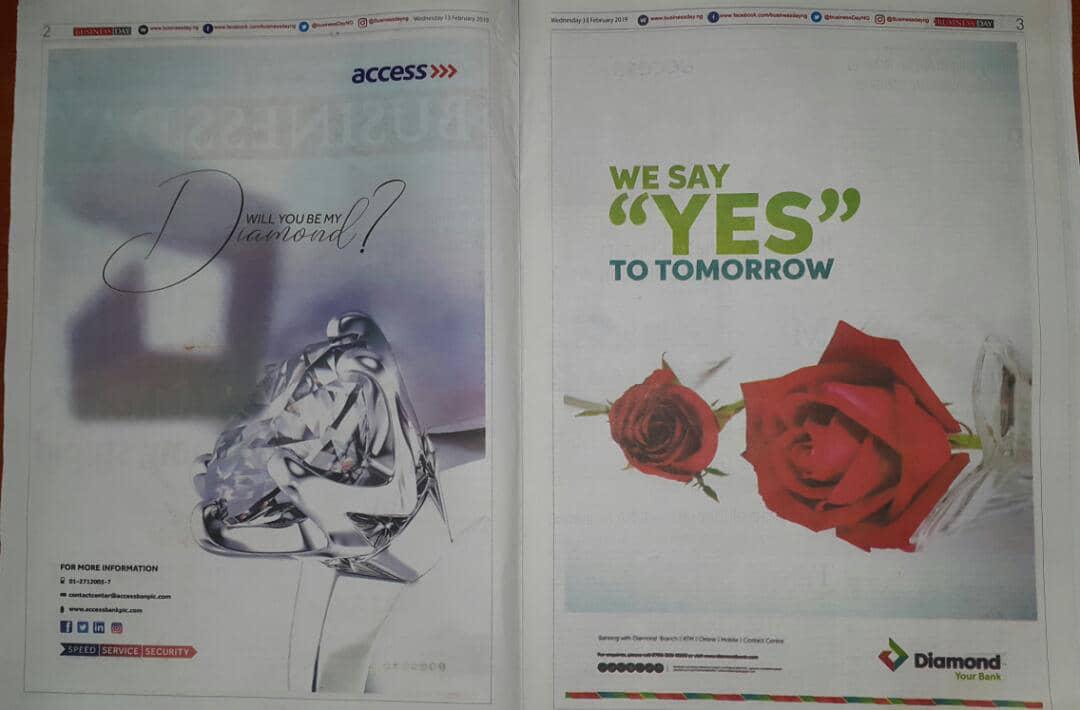
I was so touched that despite all that happened, you are still as emotional as before. The purity of your heart, the excellence in your vision and the emerging generation you shaped are things to celebrate. You gave us DIBS which changed our nation.
Yes, Access sent the Val gift; you said YES. We are living the history. But no matter what, even when they turn off that light behind that sparkled diamond logo, you will not be forgotten, in our hearts.
I came into the relationship with you, not even knowing how to sign a cheque book, fresh from college. In your generosity and matchless training program, designed by a banking legend (the P-G-D), you transformed me to see a world beyond what my eyes could imagine. And you did not stop there, sending more goodies even when I had left to the beautiful America.
I will vote YES, just as you have said YES, on this Val day, to Access Bank, next month. After that vote, I will drop a note to you. I will title it, “Good Night Diamond, You Lived a Great Life – I Appreciate ALL”.
I have been an advocate of a cryptocurrency that will be pegged to the Naira over what we largely have today where entities (usually outside Nigeria) “create” currencies with no regulatory control. So, I am not a fan of Bitcoin because mining equilibrium is not clearly distributed but rather concentrated in the hands of those with technological supremacy. I recommend NairaCoin to be pegged to the Naira as a crypto vehicle for Nigerian commerce for those interested in that new domain.
There is a very deep conversation which is going on LinkedIn since I wrote that the Nigerian government can indeed regulate cryptocurrencies like Bitcoin. As I noted, my preference is for the government to create our own cryptocurrency, NairaCoin, and tie its value to the Naira. I have a reason for that.
[…]
Yet, you can put your blockchain-contract in Naira, but since this is digitized architecture, my suggestion is to simply create a Nigerian cryptocurrency backed by the Central Bank of Nigeria so that Nigeria has its cryptocurrency (NairaCoin) which is tied to the Naira. That will make blockchain contracts more efficient. The NairaCoin will maintain exchange rates with Bitcoin and others, just as paper Naira has with U.S. Dollars and Euro, while making sure that the paper Naira and NairaCoin are always correlated.
That thinking is now new: stablecoins are engineered for that. Yes, you create cryptos and you peg them to a traditional currency like US dollars. What is new is that banks are getting into the game: “JPMorgan Chase is the first major U.S. bank to create its own cryptocurrency… JPM Coin, a dollar-pegged cryptocurrency, or “stablecoin,” intended to help big clients—like corporations, banks, and broker-dealers—settle up international payments, securities transactions, and treasury services…”, Fortune newsletter summarizes.
JPM Coin is a brilliant idea which will enable smooth operation of any blockchain architecture within JPM domain. Unlike the amalgam of many cryptos like Bitcoin, Ethereum, etc, the megabank now has one crypto defined and under its control, so that clients can see certainty and visibility when settling payments, securities and treasuring services.
The lender moves more than $6 trillion around the world every day for corporations in its massive wholesale payments business. In trials set to start in a few months, a tiny fraction of that will happen over something called “JPM Coin,” the digital token created by engineers at the New York-based bank to instantly settle payments between clients.
J.P. Morgan is preparing for a future in which parts of the essential underpinning of global capitalism, from cross-border payments to corporate debt issuance, move to the blockchain. That’s the database technology made famous by its first application, bitcoin. But in order for that future to happen, the bank needed a way to transfer money at the dizzying speed that those smart contracts closed, rather than relying on old technology like wire transfers.
It fixes one major challenge I have with Bitcoin: regulation. To make many things legal, most firms will still put Naira and Dollars in their blockchain-anchored contracts. I have argued that unless Nigeria has recognized cryptos, contracts based on them could be voidable in courts. So, largely, I tell people to ensure the numbers are in Naira, or any traditional global concurrency, because Nigeria is yet to test the validity of crypto-only contracts in court.
Bitcoin is flawed but NairaCoin offers promise in Nigeria
So while the world likes blockchain, making it to work cannot decouple the fact that you need to be sure that any contract therein can stand in courts. If a nation does not recognize Bitcoin, are you at risk on trusting it to set the basis of payment? Possibly, as before the law was updated, email documents were not admissible in Nigerian courts.
Yes, there used to be a time when in Nigeria, banks would not accept scanned documents sent via emails. The same happened in European Union where publishers required hardcopies, not digital (e.g. scanned copies via emails), copyright transfers before they would publish academic papers. Those requirements have since evolved.
But with JPM Coin-inspired model, a bank in Nigeria can have a blockchain system that runs on its crypto for settlement, as its customers can still operate in Naira knowing that the technology will handle the equivalency, even as transaction fees drop, due to productivity gains that blockchain makes possible. Because say Access Coin (for Access Bank), has no value different from Naira, it does not introduce any risk like Bitcoin and cousins.
JPM Coin will unlock new markets for the big bank. Nigerian banks should make a local version for the Nigerian market. Then, entrepreneurs in this space should then pursue the universal local one: NairaCoin fully pegged to the Naira.
As a student, visited the lab where they invented GPS (yes, satellite navigation). The Applied Physics Lab of the Johns Hopkins University is one of the most eminent labs in the world. Without APL, we may not have Intel Corp as Gordon Moore spent time in the lab before he left to co-found Intel. Of course, without Intel, you may not be reading this note, as microprocessors created by Intel largely enabled Bill Gates to invent the Personal Computing (PC) industry via Microsoft. The rest is history: before Windows, computing was largely an enterprise machine, designed for offices and not homes for personal uses.
I had gone to meet a researcher in APL on a paper he wrote about making circuits that could survive extreme radiation expected in the space environment. I had read about matter and antimatter annihilation while in FUTO as an undergraduate student. I was just curious on the possibilities of creating such designs.
(The ways such circuits are designed are totally different from the ways typical circuits used in consumer electronics are engineered. Also the manufacturing process is different. They are extremely reliable and also overly expensive, and never built for huge mass production. Mainly, the markets are mainly military and governments.)
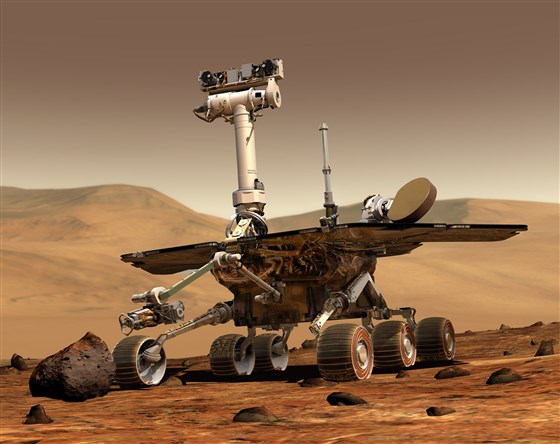
So, when I read today that NASA has officially pronounced Opportunity rover dead, my mind went to that moment. NASA engineers have frozen attempts to communicate with Oppy after more than 1,000 radio signals went unanswered. Oppy did great – discovered water and drove over 45 km, more than any other machine on Mars for the 15 earth years it lived there.
NASA made the announcement Wednesday during an emotional media briefing at the space agency’s Jet Propulsion Laboratory in Pasadena, California. The agency said it had ended its efforts to communicate with Opportunity after sending more than 1,000 radio signals its way, including some just last night.
“I was there yesterday and I was there with the team as these commands went out into the deep sky, and I learned this morning that we had not heard back,” Thomas Zurbuchen, associate administrator of NASA’s Science Mission Directorate, said in the briefing. “Opportunity remains silent.”
But the news is what killed Oppy. It was not radiation which NASA handled by making radiation-hardened circuits and manufacturing systems. It was not energy flash from matter-antimatter annihilation. Oppy died when an unprecedented dust storm covered its solar panels, robbing it of power. That was it – once that happened, it became a piece of sand! Every electronics without power is nothing but sand (yes, silica). I am not sure any NASA model had expected dust to be the killer of Oppy just as the designers of Titanic never expected the iceberg to bring the heralded unsinkable ship to sink.
NB: The debate on LinkedIn posits that Oppy case is not a good example of black swan since it lived well enough beyond the originally expected 90 earth days. Yet, while in business, a 150-year company can still experience black swan if it did not plan for a very rare risk scenario, which eventually happens. Nonetheless, I want to add this update.
Lehman Brothers lived long enough (more than 150 years) before it went into bankruptcy and planned for the thing that killed it, but it did not plan deep enough. My thinking on Oppy was NASA knew there was a dust storm risk but they did not plan for the “unprecedented” one that took the life of Oppy.
It is a sound engineering principle: you have spent $400m to build a machine and covered 99% of the risk. But if the 1% remaining risk happens, you go with it. Of course, you can fix it but doing so will be expensive and complex. Perhaps, it could have made Oppy an Incredible Hulk to rise from a dust storm within hours while battery was still alive!
Yes, possibly, Lehman Brothers knew it could go down if what happened in 2007 should happen but avoiding it would have been extremely challenging. Black Swan does not mean absence of knowing the risk and most times few can fix that risk if presented with options to do so ahead. “Unprecedented” dusk storm is a black swan which rarely occurs (I reasoned) but for Oppy it happened.
Of course I could have gotten it all wrong – that is why I have this update.
After running the piece where Nigeria has spent $107.4 billion, over 15 years, only to deliver mass poverty across the nation, a Tekedia reader (Akintola T. Obafemi who runs Going Global Consultancy, an FMCG consultancy), sent these notes and asked me to share with the community. I want you to pay attention to his #3 which is a very important element as Nigeria votes this Saturday.
So, the trending Premium Times report which noted that in the last 15 years Nigeria has spent $107.4 billion (the equivalent of N15.46 trillion) from the Excess Crude Account (ECA) under the administrations of Olusegun Obasanjo, Umaru Musa Yar Adua, Goodluck Jonathan and incumbent President Muhammadu Buhari while recording mass poverty is nothing new.
Mr. Akintola Notes and Questions
1. Maybe our problem is a scale problem:
Nigeria is such a big country where we need all channels to work for us to progress, however unlike the US and Canada which are way bigger countries, we have not been able to work on a micro level. We run after big issues everytime forgetting those small fixes that’s needed to make everything work.
Who monitors the performance of the electorate starting from local govt counsellors and chairmen?
2. Shouldn’t Nigeria be run like a corporation?
Yes corporation. The same way you would run Fasmicro with targets, KPI’s, business plans, strategy plan and all. Shouldn’t this plan be shared amongst all stakeholders (including the masses) and shouldn’t ineptitude be frowned at and voted out when discovered. I think with only a business corporation model can we make the forward movement we desire. UAE, Malaysia and Singapore are recent countries who have worked this model.
3. Are we not still ripe for true federalism?
Let each state independently govern itself and run to federal purse only when necessary. Generate your own revenue and use it under the watchful eyes of the accountant general and chief justice of the federation. I believe this would help diversify our economy and reduce dependence on oil. The groundnut pyramids of the North would resurface, cocoa house in Ibadan would breath again, the palm oil and copper mines of the East would rise up and then no one would blame oil price plummet for ineffectiveness or austerity measures.
What do you think? Many are postulating that Nigeria can experience digital blackouts (internet will not work, cut off by MTN, Glo, Airtel and 9Mobile) after the presidential election this Saturday.
With less than a week until the Nigerian election, there are mounting fears that access to the internet and social media services could soon be restricted.
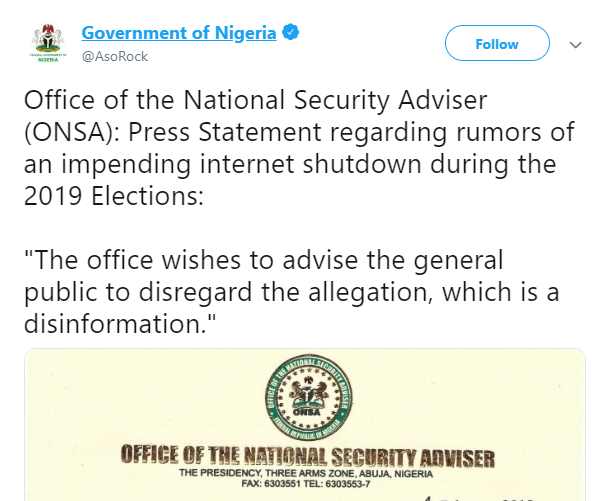
The run-up to the vote, which will be held on February 16th, has been plagued by rumours that there are plans to shutdown the internet while the election takes place.
[…]
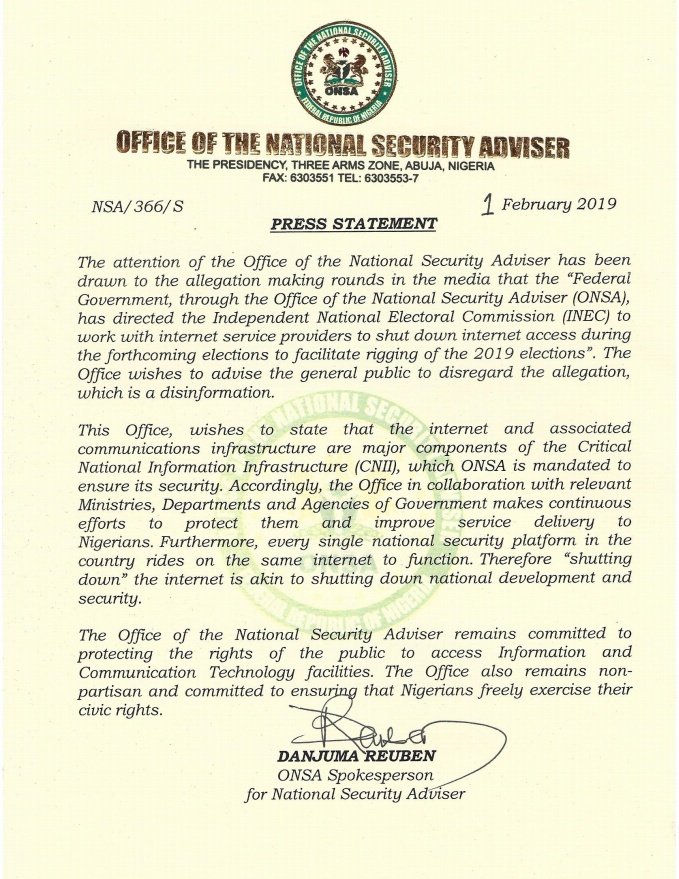
The press release goes on to state that the NSA “remains committed to protecting the rights of the public to access Information and Communication Technology facilities.”
Whether or not this will appease those concerned is unclear. However, with international monitoring and rising domestic political pressure, any attempts to limit internet access in the coming weeks are likely to be met with widespread condemnation.
Honestly, I do not believe it – I think we have gone beyond Cameroon, Congo DRC, Angola, etc on that one. Yet, my colleagues in my office are asking me to approve for contingencies in case Nigeria goes offline.
I do not see digital blackout as a possibility as Nigeria is relatively advanced to do that nonsense they do in some African countries. I believe our government on this one.
Meanwhile, from TC Daily newsletter, we learnt of this link from Quartz on things to do to stay online in case we have internet blackout.
Prof Ndubuisi Ekekwe, I’m surprised that you think Nigeria’s beyond that. I hope you’re correct, but I never put anything past anyone and any country in this day and age. Absolute power corrupts absolutely.
Having said that, my reasons for being marginally optimistic are as follows:
* It’ll require a massive coordinated plan for the mobile operators to simultaneously cut off service to the entire country as there’s no single company that controls everything.
* The telcos like their monies and it’ll require so much money for them to be influenced by the political operators to do such a thing. Fortunately for us, the politicians are busy spending those monies in their bids to rig the elections that I doubt that they’d have the appetite to spend the inordinate amounts that might be required to pay off all the telcos if it were doable.
* Even if one or two telcos are paid off, many people have multiple SIM cards and it may not affect the country as significantly unless the companies involved are MTN and Globacom. Then, we’re in trouble.
It’s not impossible, but it’s highly improbable. So, there’s no need to think that a digital blackout is imminent. Besides, what contingency will you put in place? Satellite phones?