DD
MM
YYYY

PAGES

DD
MM
YYYY

spot_img

PAGES

Home Blog Page 6991

Sorry Amazon, Chinese Firms Will Kickstart the Next Phase of Ecommerce in Africa

0

The ecommerce sector in Africa is evolving. We are now about to end the second phase of the evolution in the continent. The first phase was led by Kalahari and Mocality which came but could not overcome major challenges in the market: they died.

Most of those challenges which I articulated in a Harvard Business Review piece remain. But in this current second phase, we have experienced well capitalized entities like Jumia which remains the continent’s category-king. At the national level, entities like Konga in Nigeria are recognized. Unfortunately, these companies are not close to breakthrough moments because marginal cost challenges abound due to lack of infrastructure including logistics. That explains why I have noted that no one should start an ecommerce business in sub-Saharan Africa (except South Africa) yet unless you have money to play long.

Unless you have a double play in Africa, think again, as you venture right now in ecommerce. Companies like old Konga, DealDey, OLX, etc never had double play. When that happens, the gestation period to profitability via pure ecommerce operations becomes longer, triggering cashflow challenges which lead to failures. Those challenges emanate because we have severe logistics problems which must be fixed to unlock opportunities in the sector.

The third phase which will be the winning phase will begin in 2022. The alignments are everywhere and Chinese entities, not American or European ones, will power them in Africa. Alibaba has 4.2 million African customers, beating any full-scale ecommerce entity operating in Africa at the moment. Konga had less than 200,000 customers while Jumia, the visibly largest one (excluding the emerging Chinese ones) has reported “millions of customers” but it is nowhere close to 4.2 million customers.

Some of China’s largest tech giants are establishing roots in Africa’s still immature e-commerce market, where a mixture of structural limitations and more exciting markets elsewhere have deterred global players.

[..]

E-commerce is far from Africa’s largest earner, but the market is growing, and fast. According to research site Statista, the industry was worth $16.5 billion in 2017 and is poised to hit $29 billion by 2022 as necessary infrastructure, such as mobile phone ownership, and household incomes continue to rise. By 2025, when half of Africans have internet access, this figure could be over $75 billion, say Mckinsey.

[…]

E-commerce and services appear to be the next stage of China’s strategy into the continent. Beginning with strictly state-mandated infrastructure projects, China’s engagement then expanded to include private investment in the telecoms industry by the likes of Huawei and ZTE. If Africa can sustain its growth and development, we could be on the verge of a retail-centred third wave in Afro-China relations.

So, watch out, Chinese firms will unlock the value in ecommerce, beginning 2022. They have the capital to invest to build parallel logistics necessary for ecommerce growth in Africa. Alibaba founder is offering grants totally $10 million to entrepreneurs, and certainly through the relationships will collect data to understand what is working. Once the patterns develop, more capital will be pushed into Africa for the winner-takes-all category champion to emerge.
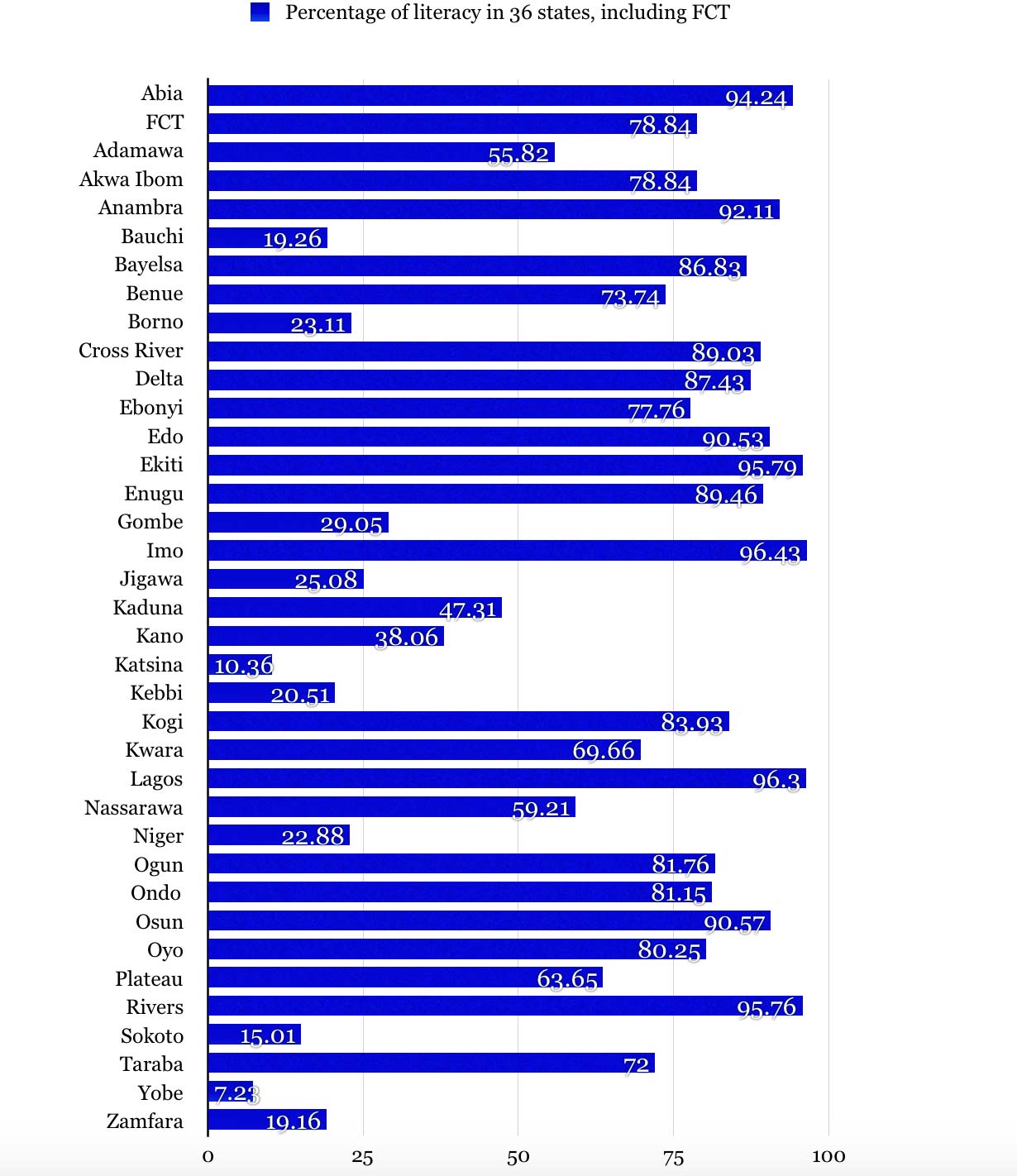
Yobe State’s 7.23% Literacy Rate and Digital Transformation

0

We all hear it – if elected governor, I will digitize all state services! And I will bring the productivity excellence of Silicon Valley by creating digital solutions for the citizens. Simply, if we do those things, citizens will experience higher efficiency in governance.

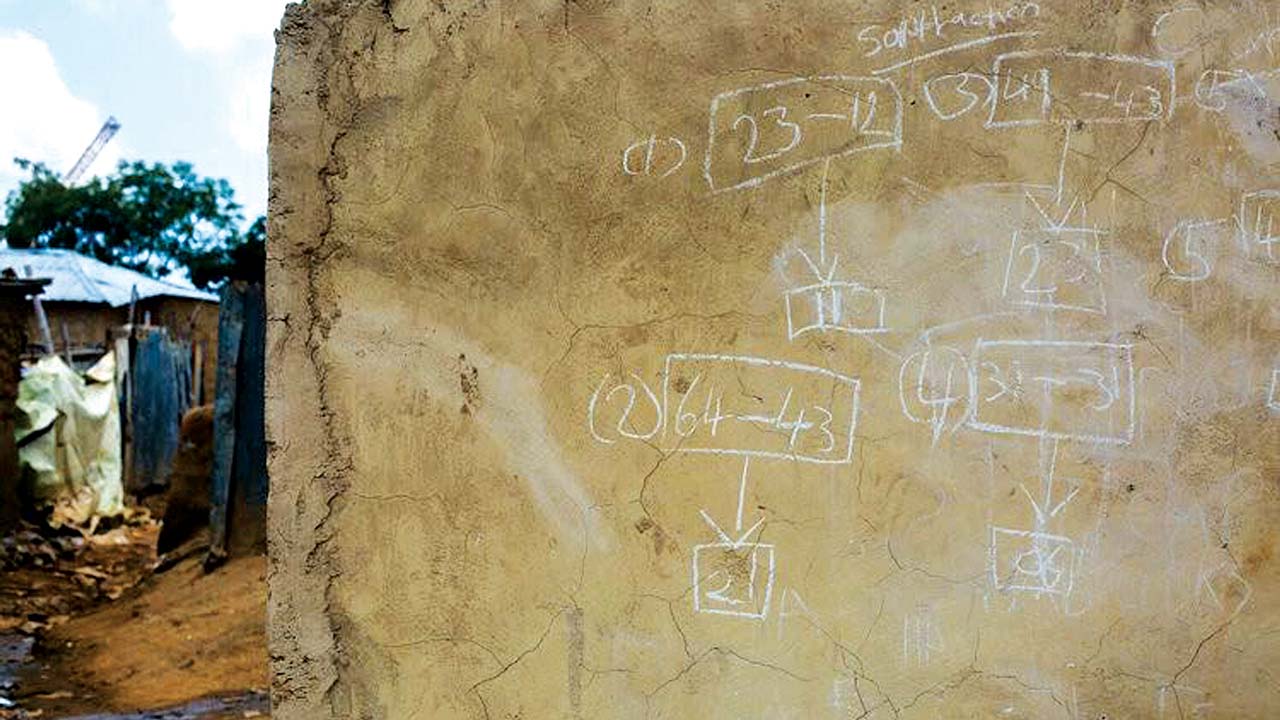
I smile – nothing like that yet. Nigeria has adult literacy rate of 59% (or 41% adult illiteracy rate). If you remove Abia state (my home state with the best in Nigeria at 97%) and the top ten adult literacy states, the rest will crash to adult literacy rate of below 50%. Yobe has literacy rate of 7.23%, according to National Bureau of Statistics.

The data shows that Yobe State has only 7.23 per cent literacy level, the lowest in the country.

The dismal record of Yobe is followed by Zamfara (19.16 per cent); Katsina (10.36 per cent); Sokoto (15.01); Bauchi (19.26); Kebbi (20.51); and Niger (22.88) respectively. Only Taraba is an exception with 72 per cent literacy rate.

In contrast, Imo State has the highest literacy level (96.43 per cent), followed by Lagos (96.30 per cent); Ekiti (95.79 per cent); Rivers (95.76 per cent); Abia (94.24 per cent); Anambra (92.11 per cent); Osun (90.57); Edo (90.53 per cent); Enugu (89.46 per cent); and Cross River (89 per cent).

But that did not stop one of the gubernatorial candidates promising to digitally transform services. Nothing is wrong doing that but that may not be the right policy for a state where more than 92% of adults are not literate. Doing all necessary to increase school enrollment would certainly deliver better results over making apps for people to fill forms instead of completing papers. Simply, that Lagos state wants to offer apps to its citizens does not mean that Zamfara state should do that.

There are fundamental things upon which technology runs upon, and those things include basic level of literacy. Nigeria across most parts should focus more on deepening those capabilities over copying largely pointless flashy policies that deliver only marginal values. Until we can educate the kids, we cannot push any technology policy that is sustainable. Basic education should come before esoteric efforts to digitize government services as you need literate citizens to utilize most of those digital services at least at state level. And unless the digitalization will improve literacy, do not be overly committed to it.

Oby Ezekwesili Drops Out: The Demand-Supply Mechanism of Nigerian Policies

0
Work Space

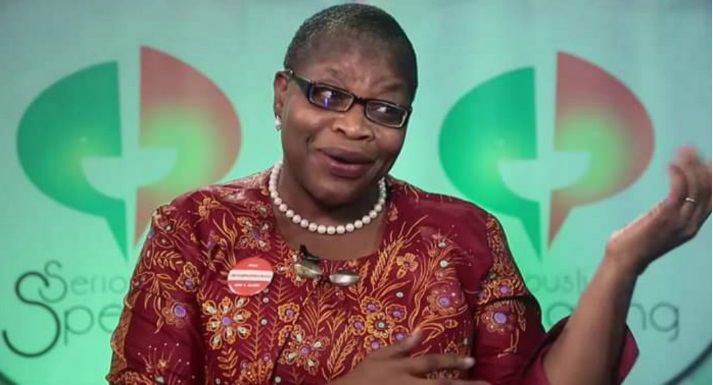
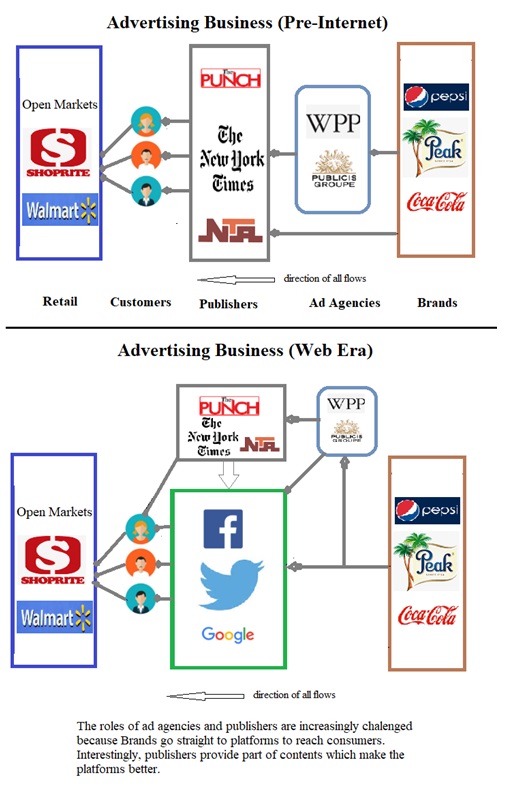
Oby Ezekwesili drops out of the Nigerian presidential race. She never had a chance because the gatekeepers continue to control the supply of votes. Like the old media world before the age of internet, controlling supply (the newspaper) was the most effective way of influencing demand (readers). So, provided that you are the gatekeeper in your local media market, the contents consumed by the readers would be determined by you. Pre-internet, everyone waited for Guardian (and the other national newspapers), and NTA to get a sense of the business of the day in Nigeria.

This capacity to control demand was the reason advertisers moved money through those traditional media as they controlled the means to reach customers. They were indispensable!

Fast forward to this age where controlling demand is the 21st century business model: the firm that controls demand dominates the market. Google, Facebook and Twitter control demand (the users) and the old gatekeepers have been disintermediated. Guardian, NTA and New York Times do not have the old-empire control in the markets. Yes, most times what they write is already known, and the distribution they follow is not exclusive: Internet is unbounded and uncontrolled unlike the old newspaper vendor-based model which they controlled exclusively. Consequently, because of that shift, advertisers are moving to platforms like Google and Facebook because those are the ones controlling the users which are the entities that see adverts and visit shops to spend money.

But today, the game has shifted from control of supply to control of demand for web-anchored consumer firms. And only companies with capabilities to control demand are going to win big. As shown in the table below, most of the greatest internet companies are simply controlling demand and that means controlling how supplies reach users and consumers.

In politics, technology has not reached that element of disruption in Nigeria. Yes, we are still pre-internet in Nigerian politics. The gatekeepers continue to control supply of votes and in the process influence the outcomes of elections. If they do not approve you, you have no chance!

That is why any party that is not APC or PDP has marginal impact: breaking the supply chain with the pyramid scheme that runs from national through state to ward level is hard. No great vision or policy statement can break that because to a large extent it is still decoupled from the web: the demand cannot even read that message without it being processed by the gatekeepers.

So, provided the channels still go through the gatekeepers, anything not of them will be dropped while what belongs to them would be passed from top to bottom. Mrs Ezekwesili faced that challenge and at the end, she could not overcome it.

No – I used traditional media as an analogy to explain why people without control of supply cannot win elections in any politics that is pre-internet. Without internet, Obama would not have won the U.S. Presidency as the Clintons were evidently in control of the supply of votes and money machine. But because of internet, Obama could access votes and money without going through the gatekeepers. Nigerian politics is practically still pre-internet and no entrant, not supported by the gatekeepers, has any chance.

Nonetheless – Madam Oby has contributed her quota.

Andela Raises $100 Million, Hits $700 Million Valuation

0
Work Space

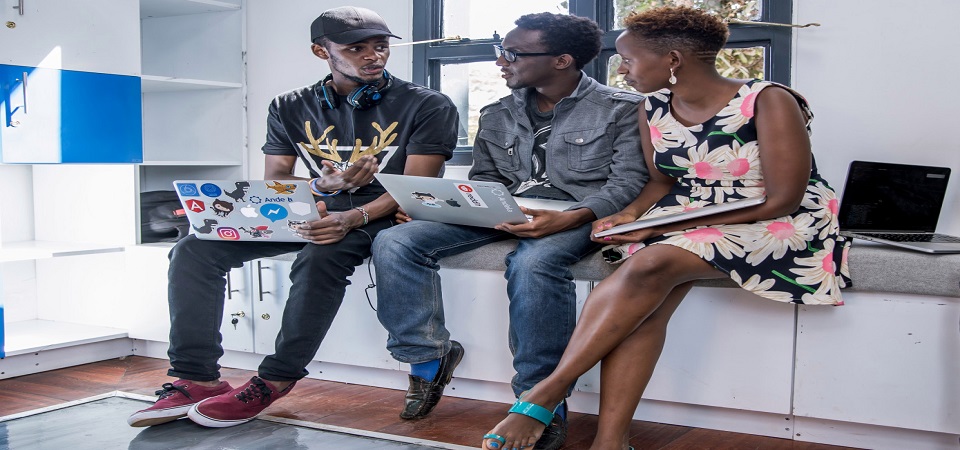
Andela which connects software developers based in Africa with companies in U.S. and Europe has raised $100 million in new funding. But the big news is that Andela is now worth around $700 million!

Andela, the company that connects Africa’s top software developers with technology companies from the U.S. and around the world, has raised $100 million in a new round of funding.

The new financing from Generation Investment Management (the investment fund co-founded by former Vice President Al Gore) puts the valuation of the company at somewhere between $600 million and $700 million, based on data available from PitchBook on the company’s valuation following its previous $40 million funding.

The company has about 200 customers which access 1,100 developers in its portfolio. For these developers, it charges $50,000 to $120,000 per developer and pays the developer 33% of that, keeping the rest for operations, facilities maintenance, training and profits. It has operations in Nigeria, Kenya, Rwanda and Uganda.

Press Release

 Andela, the company building distributed engineering teams with Africa’s top software developers, today announced the completion of a $100M Series D funding. The round was led by Generation Investment Management with participation from existing investors including Chan Zuckerberg Initiative, GV, Spark Capital, and CRE Venture Capital. The most recent financing brings Andela’s total venture funding to $180M.

Andela was founded in 2014 to connect Africa’s engineering talent with the demand for software developers worldwide. In four years, Andela has assessed more than one hundred thousand applicants, hired one thousand software developers, and integrated them into hundreds of companies, such as Safaricom, Percolate, and InVision.

With the Series D funding, Andela will accelerate the development of its technology platform to identify, develop and match talent at scale. By doing so, Andela will provide its customers with the data they need to understand developer performance and better manage distributed teams. The company will also expand its presence across Africa to meet the global demand for high-quality engineering talent.

“It’s increasingly clear that the future of work will be distributed, in part due to the severe shortage of engineering talent,” says Jeremy Johnson, co-founder and CEO of Andela. “Given our access to incredible talent across Africa, as well as what we’ve learned from scaling hundreds of engineering teams around the world, Andela is able to provide the talent and the technology to power high-performing teams and help companies adopt the distributed model faster.”

“Andela has played a major role in catalyzing the growth of technology ecosystems across Africa over the past four years, though the journey has only just begun,” says Seni Sulyman, Vice President of Global Operations at Andela. “To date, we have developed more than one thousand of Africa’s current and future technology leaders. This round of funding will help Andela accelerate our mission to advance human potential by powering today’s teams and investing in tomorrow’s leaders.”

“Generation’s investment in Andela resulted from our deep research into the future of work. We believe Andela is a transformational model to develop software engineers and deploy them at scale into the future enterprise,” says Lilly Wollman, Co-Head of Growth Equity at Generation Investment Management. “The global demand for software engineers far exceeds supply, and that gap is projected to widen. Andela’s leading technology enables firms to effectively build and manage distributed engineering teams. We are great admirers of the outstanding team, mission and culture Andela has built across two continents and five countries.”

With tech campuses in Nigeria, Kenya, Uganda, and Rwanda, Andela has been recognized as “The Best Place to Work in Africa.” In 2018, The Wall Street Journal named Andela as one of the twenty-five technology company to watch, and the year prior, Fast Company ranked Andela as the most innovative company in Africa. In 2019, Andela is projected to double in size, hiring another one thousand software developers and investing heavily in data, engineering, and product development.

The Sheraton Abuja Caps

2

Today, I spent the day in Sheraton Abuja on a Board meeting. As I arrived to the venue, to join my colleagues arriving from around the world, an artwork positioned at the right of the main lobby entrance caught my attention: a Nigerian flag with different types of caps from our diverse ethnic groups.

As I looked at that work, my mind flashed on the hostility in the nation. The creator of the art had fused the caps, making sure they largely touched one another. It was a beauty to behold – a symbol of unity for a nation built to be a force but has been stifled on the sclerosis of imaginations and visions.

Sheraton put it out there to symbolize the makeup of this nation with has latent promises but bound in unborn tomorrow but died yesterday paralyses. As I watched, my mind flashed: who can unite these caps at the physical element where the strength of our diversity becomes a potent force to unleash the molten magma of economic breakthroughs, triggering a hopeful nation that is dynamic, prosperous and equitable?

As those caps joined in artistic unison on the purity of white, enveloped by the energy of green, nothing could be more perfect to behold. Green is the symbol of health; white is the purity of mind. With all sub-nations seated on top of those emblems, Nigeria was engineered for greatness. Yet, stepping out of that Sheraton, looking deep into the horizons, the art fades: Nigeria cannot be capped because there is no triumph yet.

Good people, we must find answers to make those caps blossom. Those are the Nigerian people – young, old, north, south, and ALL.