DD
MM
YYYY

PAGES

DD
MM
YYYY

spot_img

PAGES

Home Blog Page 7

Critics Argue MicroStrategy’s Bitcoin Strategy Resembles a Highly Leveraged Investment Vehicles

0

Many critics argue that Strategy’s Bitcoin strategy resembles a highly leveraged carry trade wrapped inside a public company. The concern is not simply that the firm owns a massive amount of Bitcoin, but that it financed much of that accumulation with debt, preferred shares, and continuous equity issuance tied to the assumption that Bitcoin’s long-term appreciation will outpace the company’s financing costs.

At the center of the debate is the company’s transformation from a traditional software business into what is effectively a leveraged Bitcoin holding vehicle. Under Michael Saylor, the company aggressively borrowed money through convertible notes and other financing structures to buy more Bitcoin.

As Bitcoin appreciated, the strategy appeared brilliant because rising BTC prices increased the value of the treasury faster than the dilution or debt burden grew.

The disaster waiting to happen narrative emerges from what happens if that trend reverses for an extended period. One major concern is leverage amplification. If Bitcoin falls sharply and remains depressed, Strategy still owes interest payments, redemptions, and obligations tied to its financing instruments.

Unlike a spot Bitcoin ETF that simply tracks Bitcoin’s price, Strategy has layered capital structure risk on top of crypto volatility. Critics argue that this transforms normal Bitcoin downside into potentially exponential downside for shareholders. Another issue is dilution risk.

To continue accumulating Bitcoin, the company has repeatedly issued new shares or preferred instruments. Bulls see this as efficient capital formation. Bears see it as a cycle where existing shareholders are continuously diluted to sustain Bitcoin purchases. If investor appetite weakens while Bitcoin stagnates, Strategy could lose its ability to raise cheap capital efficiently.

Strategy’s stock has traded significantly above the value of the Bitcoin it actually holds. Investors were effectively paying a premium for leveraged exposure and for Saylor’s accumulation strategy. Critics warn that if market sentiment changes, that premium could collapse even without Bitcoin crashing.

In that scenario, shareholders could suffer from both falling BTC prices and shrinking valuation multiples simultaneously.

The convertible debt structure adds another layer of complexity. Much of the company’s financing worked well because low interest rates and strong equity performance made refinancing easier. But tighter liquidity conditions or prolonged crypto weakness could make refinancing more expensive.

Skeptics compare this to historical leveraged investment vehicles that looked invincible during bull markets but became fragile when credit conditions tightened. Supporters of Strategy counter that the critics underestimate Bitcoin’s long-term trajectory.

They argue the company intentionally structured much of its debt with long maturities and relatively favorable terms. From this perspective, temporary volatility is irrelevant because the strategy is designed around Bitcoin appreciating over decades, not quarters.

Bulls also point out that Strategy has become one of the most successful corporate treasury transformations in modern financial history. The company’s stock dramatically outperformed many traditional technology firms during Bitcoin bull cycles, and Saylor’s conviction attracted institutional investors seeking indirect Bitcoin exposure before spot ETFs became widely available.

However, the criticism persists because leverage changes the nature of risk. A normal Bitcoin holder can theoretically wait indefinitely through drawdowns.

A leveraged corporate entity cannot ignore financing realities forever. If Bitcoin were to enter a prolonged multi-year bear market combined with restricted access to capital markets, the company could face pressure to sell assets, refinance at unfavorable rates, or dilute shareholders heavily.

That is why opponents describe the strategy as potentially dangerous: it depends not only on Bitcoin succeeding eventually, but on capital markets remaining cooperative long enough for the thesis to play out.


TURBO Presale Review: Why BlockDAG’s First Utility Token Is May 2026’s Biggest 100x Opportunity

0

The crypto market has entered a phase that rewards precision over enthusiasm. Bitcoin is stabilizing between $76,000 and $77,500 after weeks of consolidation, the Altcoin Season Index sits suppressed in the 30-40 range, and Bitcoin dominance holds firm at 58-60%. This is not a market where everything rises together. It is a market where capital rotates surgically into assets with mechanical reasons to perform, and away from anything coasting on borrowed narrative.

Against that backdrop, the most interesting opportunity in the presale market right now isn’t a meme coin or a Layer 2 promising to reinvent Bitcoin. It is TURBO, the first utility token built directly into the BlockDAG ecosystem, a network that has already raised more than $400 million across its own presale and is now preparing to anchor an entire economic flywheel on top of it.

TURBO Is The Utility Layer For A $400M+ Ecosystem

To understand why TURBO matters, the context of BlockDAG itself has to be understood first. BlockDAG has built one of the most successful presales in crypto history, surpassing $400 million in funding while constructing a fully operational EVM-compatible Layer 1 network. Chain ID 1404 is live. The explorer at bdagscan.com is live. BDAG functions as the native gas currency. This is not a network being promised. It is infrastructure that already operates at scale, with a community of buyers, validators, and developers already inside it.

TURBO is the first utility token deploying into that ecosystem. That sequencing matters enormously. Most presale tokens launch into chains that don’t yet exist or barely function. TURBO is launching into a chain that has already demonstrated $400M+ in market demand, with the audit framework, explorer infrastructure, and developer tooling already deployed and tested.

The Tokenomics Are Built For Long-Term Scarcity

The supply architecture is where TURBO separates itself from every other presale in the current cycle. 50 billion tokens were minted at genesis. No future issuance is possible. No minting function exists for the team to trigger later. The supply is fixed, capped, and verifiable.

From that ceiling, the weekly Foundation burn begins immediately. Every seven days, 90% of the burn amount is permanently sent to the burn-destination wallet, with the transaction hash published on the BlockDAG Explorer for anyone to verify. The remaining 10% is distributed to a randomly selected pool of eligible holders. The long-term target is to reduce total supply from 50 billion to 25 billion through this automatic, weekly process.

Buyer balances are never touched. The Foundation burns from its own 22.5 billion token reserve. The supply shrinks around holders, not from within their wallets.

Upcoming Utility: What’s Coming After Launch

TURBO’s anchor use case is casino and gaming utility on the BlockDAG network, covering betting, deposits, VIP access, reward distribution, and high-frequency platform transactions. This is the demand foundation that creates organic token velocity from day one.

Beyond gaming, the phased rollout includes staking for approved rewards, a tiered VIP system offering cashback and reward boosts, a full NFT ecosystem for minting and gated tiers, and application-layer features including entry fees, boost mechanics, and feature unlocks. Each utility activation post-launch becomes a fresh catalyst for the token economy, and every Stage 1 buyer is already positioned ahead of every one of those activations.

Why Stage 1 Pricing Is Critical Right Now

Stage 1 is open at $0.0005. The projected listing price is $0.04. That is an 80x gap, a 7,900% upside between today’s presale entry and the targeted exchange debut.

The example is straightforward. A $1,000 entry at Stage 1 secures 2,000,000 TURBO tokens. At the $0.04 listing target, that position is valued at $80,000. The same $1,000 deployed at Stage 5, assuming the standard price escalation across the 10-round structure, secures dramatically fewer tokens at meaningfully higher cost.

Stage 1 is also intentionally the largest allocation in the entire 10-round presale. Each subsequent round shrinks in available supply and rises in price. The window that exists today is the widest and cheapest the token will ever offer. Once Stage 1 closes, that price disappears, permanently.

The Expert Read

TURBO’s setup combines what most presales offer in isolation but rarely together: a live blockchain ecosystem already proven by $400M+ in BDAG presale demand, a fixed and automatically deflationary supply model, real utility anchored in casino and gaming activity, and a Stage 1 entry that has not yet priced in any of the above.

For investors hunting the next major presale catalyst in May 2026, TURBO is structurally positioned to deliver. Stage 1 is open. The burn is running. The ecosystem is already built. The only variable left is timing, and timing closes round by round.

Join BDAG TURBO Presale Now:

Presale: https://purchase.blockdag.network

Website: https://blockdag.network

Telegram: https://t.me/blockDAGnetworkOfficial

Discord: https://discord.gg/Q7BxghMVyu

Future of AI Will Not Simply be Determined by Who Builds the Smartest Systems, But Who Wins The Unit Economics

0

Artificial intelligence has rapidly evolved from a futuristic concept into the defining technological race of the modern economy. Governments, startups, and trillion-dollar corporations are spending unprecedented amounts of money to dominate the AI era. Discussions about AI often focus on capability: smarter models, faster inference, autonomous agents, and breakthroughs in reasoning.

Yet the next major crisis in artificial intelligence may not be about innovation at all. It may be about affordability. The economics of AI are becoming increasingly unsustainable. Training frontier models now costs hundreds of millions, and some estimates suggest future systems could require billions in compute infrastructure, electricity, and specialized hardware. Only a handful of companies possess the capital needed to compete at the highest level.

This concentration of power creates a dangerous imbalance where innovation becomes gated behind enormous financial barriers. At the center of the issue is compute. Advanced AI systems rely heavily on specialized chips, massive data centers, and continuous energy consumption. Companies like NVIDIA have become some of the most valuable firms in the world because they provide the hardware backbone of the AI economy.

But as demand for AI accelerates, the cost of accessing that infrastructure rises alongside it. Smaller startups, independent researchers, universities, and developing nations are increasingly priced out of meaningful participation.

This affordability crisis extends beyond corporations. Consumers are also beginning to experience the financial burden of AI adoption. Many of the most advanced AI products are shifting toward subscription-heavy business models. Premium AI assistants, enterprise copilots, video generation tools, and coding agents now often require monthly fees that accumulate quickly. What began as democratized access to intelligence risks evolving into a tiered system where only wealthier users gain access to the most capable tools.

The implications are profound. Historically, transformative technologies became more valuable as they became cheaper and more accessible. The internet expanded because connectivity costs fell. Smartphones changed the world because billions could eventually afford them. AI, however, may follow a different trajectory. If the best intelligence remains expensive to train, expensive to run, and expensive to access, then inequality could deepen dramatically.

Businesses face similar pressures. Companies are rushing to integrate AI into operations because competitive survival increasingly depends on it. Yet deploying AI at scale is costly. Enterprises must pay for cloud compute, API access, cybersecurity upgrades, compliance systems, and specialized talent. Smaller firms may struggle to compete against tech giants capable of subsidizing losses for years. This could trigger a wave of market consolidation where only the largest corporations can fully capitalize on AI-driven productivity gains.

There is also a geopolitical dimension. Wealthier countries possess the capital and infrastructure necessary to dominate AI development, while emerging economies risk becoming dependent consumers rather than creators of AI systems.

Nations without advanced semiconductor supply chains or robust energy grids may fall behind in both economic competitiveness and digital sovereignty. Ironically, AI itself could worsen the affordability problem it creates. As automation increases productivity, firms may reduce labor costs while concentrating profits among infrastructure owners and capital holders.

If wealth generated by AI is not distributed broadly, societies may encounter rising unemployment alongside rising costs for access to advanced intelligence systems.

The next phase of the AI race therefore requires more than technological breakthroughs. It demands economic solutions.

Open-source development, cheaper inference methods, energy-efficient hardware, decentralized compute networks, and public investment in digital infrastructure may become essential. Regulators and policymakers will also face pressure to ensure that AI does not evolve into an exclusive utility controlled by a narrow group of corporations.

European Stocks Pause Near War-Era Highs As Fresh U.S. Strikes On Iran Jolt Markets

0

European markets turned cautious on Tuesday as renewed U.S. military strikes in southern Iran interrupted a recent rally driven by hopes that Washington and Tehran were moving closer to a deal that could ease one of the biggest geopolitical shocks to hit global markets this year.

The pan-European STOXX 600 slipped 0.2% by mid-morning trading in Europe, pulling back modestly from levels near its highest point since the U.S.-Israel war on Iran erupted in late February. Investors had spent much of the previous week pricing in a possible de-escalation that could reopen disrupted energy flows through the Strait of Hormuz and reduce inflation pressures tied to surging oil prices.

That optimism weakened after Washington confirmed what it described as defensive strikes in southern Iran, reviving fears that negotiations could still unravel even as diplomatic contacts continue.

U.S. Secretary of State Marco Rubio said on Tuesday that negotiations with Iran may still “take a few days,” underscoring the fragile and uncertain nature of the talks. He also said, “The straits have to be open, they’re ?going to ?be open one way or ?the ?other, so they need to be open,” which has been interpreted as meaning that the U.S. may be planning more strikes.

The mixed reaction across European markets reflected how investors are struggling to price the next phase of the conflict. London’s FTSE 100 rose 0.7%, helped by gains in energy and commodity-linked companies that tend to benefit from higher crude prices, while Germany’s DAX fell 0.7% amid pressure on industrial and export-oriented shares vulnerable to energy shocks and slowing trade flows.

The broader MSCI World Equity Index was little changed on the day but remained up 3.8% for the month, highlighting how global equities have steadily recovered from the sharp selloff triggered by the outbreak of the conflict earlier this year.

Peter Schaffrik, global macro strategist at RBC Capital Markets, said markets were struggling to interpret rapidly shifting political and military signals from Washington.

“It went from agreement is near to everyone needs to sign the Abraham Accords to bombing, so it’s not entirely clear what’s going on there,” Schaffrik said, referring to comments by Donald Trump urging additional countries to join the Abraham Accords while simultaneously warning Iran of possible escalation.

Oil markets again became the clearest barometer of geopolitical anxiety.

Brent crude climbed 3.6% to $99.64 a barrel, moving back toward the psychologically important $100 level after having retreated sharply from late-April highs above $120. U.S. West Texas Intermediate traded at $93.09 a barrel.

Energy markets have swung violently in recent months as traders attempt to gauge the risk of prolonged disruption to Middle Eastern supply routes. The Strait of Hormuz remains central to that calculation because roughly one-fifth of global oil consumption passes through the narrow waterway.

Even with Tuesday’s gains in crude prices, some investors still believe a diplomatic breakthrough remains possible. Brent prices remain well below the peaks seen earlier in the conflict, suggesting markets continue to assign some probability to an eventual reopening of shipping lanes and stabilization in regional exports.

The conflict has become increasingly important for central banks as elevated oil and natural gas prices filter through into transportation, manufacturing, and consumer costs.

Isabel Schnabel told Reuters the European Central Bank should still raise interest rates in June even if negotiations with Iran ultimately succeed, arguing that the war has lasted longer than policymakers initially expected and that higher energy costs are already spreading through the broader economy.

Her comments supported market expectations for tighter monetary policy in Europe. Money markets are now pricing in roughly a 90% probability of a June rate increase by the ECB.

The prospect of prolonged inflationary pressure helped push European government bond yields higher on Tuesday, although benchmark German 10-year yields remained near seven-week lows after falling sharply last week as fears of an extended energy shock briefly eased.

Currency markets were comparatively calm. The dollar index was little changed at 99.081, while the euro slipped slightly to $1.1636. The Japanese yen weakened modestly against the dollar.

Gold prices, which had rallied strongly during the height of the conflict as investors sought safe-haven assets, fell 1.1% to around $4,522 an ounce as some traders rotated back into risk assets and trimmed defensive positions.

The broader market reaction indicates investors are no longer trading solely on fears of a regional war spiraling into a global energy crisis. Instead, markets are increasingly oscillating between expectations of diplomacy and renewed military escalation, producing sharp swings across oil, equities, bonds, and currencies.

West Africa drives global interest in Arafat Day as Muslims seek prayers, fasting guidance

0

Search interest in Arafat Day has surged across the world in the past 24 hours, with countries in West Africa emerging as unlikely leaders in online attention as Muslims seek information on prayers, fasting and the timing of one of Islam’s holiest days.

Analysis of global search behaviour shows a sharp rise in queries linked to the Day of Arafah, the day before Eid al-Adha and the spiritual climax of the annual Hajj pilgrimage to Mecca. But rather than broad theological questions, users appear to be turning online for practical guidance on how to observe the day.

Searches for “arafat day” recorded the highest level of interest, while “arafat 2026” ranked closely behind, suggesting many users are already looking ahead to future observance dates. Queries including “arafat time”, “day of arafat” and “2026 arafat day” also featured prominently, pointing to uncertainty around timing and local observance, often shaped by lunar calendar calculations and moon sightings.

The strongest pattern in search behaviour, however, concerned worship. Terms including “dua arafat”, “dua”, “dua for arafat” and “invocation arafat” ranked among the most searched related queries, indicating that many people were actively preparing for the day through prayer and spiritual reflection.

For Muslims, the Day of Arafah marks the peak of the Hajj pilgrimage, when millions of worshippers gather on the plains of Mount Arafat near Mecca for prayer and repentance. Muslims not undertaking Hajj are encouraged to fast, a practice believed to carry particular spiritual merit, helping explain the prominence of searches related to fasting and supplication.

At the same time, interest in real-time developments around the pilgrimage appears to be growing. Searches for “live arafat”, “mount arafat” and “hajj” suggest users are increasingly following events as they unfold, whether through livestreams, news coverage or religious broadcasts from Saudi Arabia.

Perhaps the most striking finding is geographical. While Saudi Arabia and Gulf states featured in search activity, the strongest concentration of interest came from West Africa.

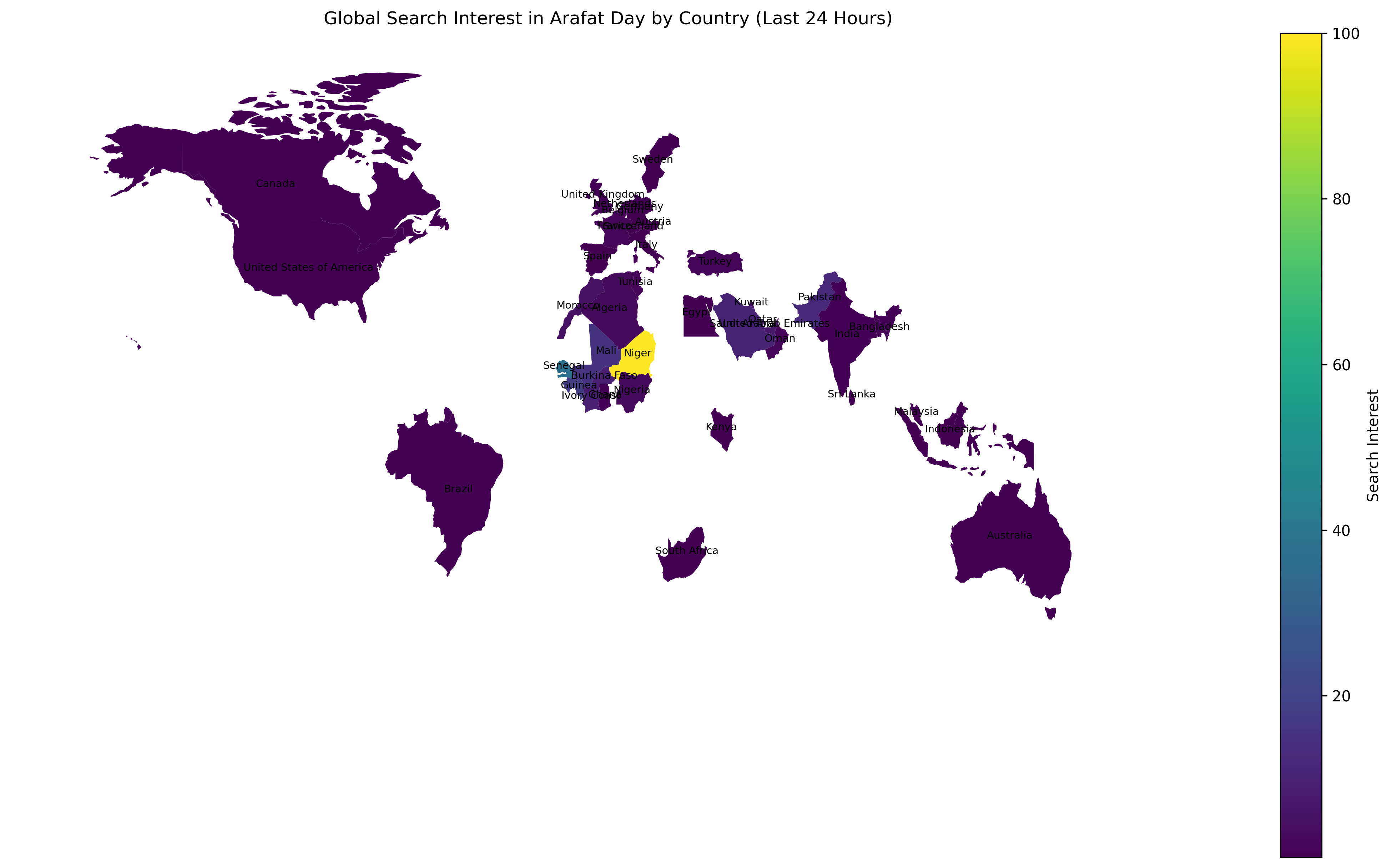
Niger recorded the highest search interest globally in the past 24 hours, followed by Senegal, Guinea and Mali. Mauritius and the Maldives also registered significant activity, while Pakistan, Saudi Arabia, Qatar and the United Arab Emirates showed moderate but notable levels of engagement.

The pattern underlines the growing visibility of Muslim communities in West Africa within global digital trends. In countries such as Niger, Senegal and Mali, religious observance around Eid al-Adha and the Day of Arafah remains deeply embedded in public life, often accompanied by heightened demand for guidance on prayer, fasting and communal observance.

The data also reveals a strong multilingual dimension. French-language searches including “jour de arafat”, “le jour de arafat” and “doua arafat” featured prominently, suggesting significant demand among francophone Muslim communities, particularly in west and north Africa.

Smaller levels of interest were also visible across Europe, including in France, Belgium and the UK, reflecting engagement among Muslim diaspora communities seeking updates on observance and pilgrimage events abroad.

The timing of the surge is unsurprising. Search activity linked to Islamic holy days often intensifies shortly before observance as people seek practical answers to immediate questions: when the day begins, which prayers to recite and whether fasting is recommended.

Yet the latest figures suggest something broader. Rather than simply learning about Arafat Day, users appear to be preparing for it, using search engines as a form of religious infrastructure, a place to find schedules, prayers and a sense of connection to a sacred event taking place hundreds or thousands of miles away.

In an era when religious practice increasingly intersects with digital habits, the rise in Arafat-related searches offers a snapshot of how faith is being navigated online, one prayer, timetable and livestream at a time.