I have received many emails since I shared a post on UN in LinkedIn. Many have asked me to share guidance on career planning. Largely, it is very hard to write about yourself in this way. Nonetheless, to help young graduates who asked, I am sharing some decisions I made earlier.
Getting ready to leave FUTO (Federal University of Technology, Owerri, Nigeria), my undergraduate university, I committed to focus on accumulating capabilities over just making money early. My thesis was that by building capability, I could transition to the top level in the world. For me, it was irrelevant where I was beginning: the most important thing was really what lies ahead.

Ndubuisi Ekekwe receives award from Richard Branson
I defended my undergrad thesis on Friday. On the following Monday I started work. I went straight from hostel to the new job without reaching home. There was no need; I had only a bag to school as I was a squatter. Though usually getting official accommodations on academic awards, the usual temptation to sell, and then squat with willing friends won many times.
My Department Chair (Prof SOE Ogbogu) had accepted a job for me nine months earlier. For this job, I did not interview the employer; it also did not interview me. The week the firm came to FUTO, I was out of school to get advertisers in Aba and Onitsha for my campus newsmagazine – FUTO Bubbles.

I began work in that firm – a pioneer CDMA company. They gave me a flat, a car with driver, and good salary. Then on second day, I asked to meet the Founder, and the CEO. I spoke with them, and they failed my “interview”: they presented a roadmap on how to make money but none to develop the person making that money. I saw a total dislocation on how life could be about money that early with no strategy on acquiring skills (my desire to start master’s program immediately was not permissible). On 3rd day, I resigned. It was easy to do that; I had options – I could return to FUTO as a graduate assistant teacher which the department had already offered. Also, there were other jobs on pipelines.
One of those jobs was to work in a local IT company doing structured office wiring in Shell. I joined that firm for no specific formal wage even though the owner was always giving me money. But I did enjoy the job – I was learning common sense skills which could be easily monetized. Also, I knew that it was temporary since NYSC was coming; the CDMA job was structured that I would serve there. (My suggestion remains to choose where you could make more money in Nigeria provided it can give you space to use that money to develop yourself in a case where the firm has no clear strategy on staff development. But if getting that more money is all you get, if you have other options, re-consider.)
Then NYSC came, and opportunities opened. NYSC Plateau State secretariat needed a contractor to do structured office wiring in the state secretariat. I had registered a company a day out of camp. I applied and won the contract. I bought my first car from that NYSC contract. It was the first time Federal Government of Nigeria was to pay me.
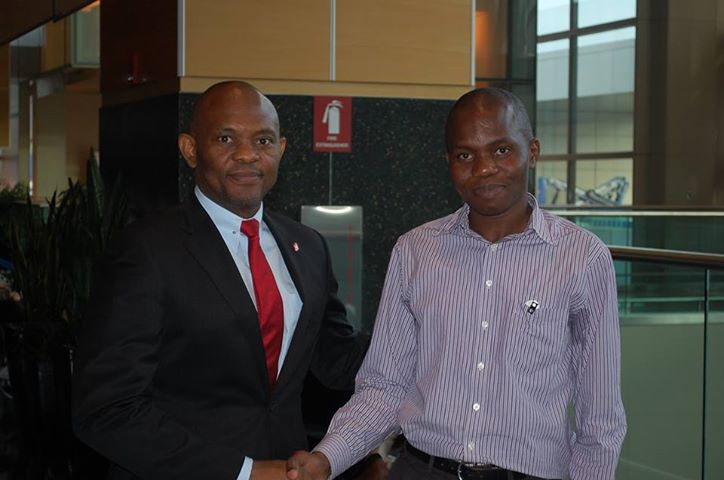
Ndubuisi Ekekwe with former UN Sec GenPost NYSC
I did all possible to stay in Jos after NYSC but without a university offering engineering master’s degree (then), it was not possible. Attempt to visit ATBU Bauchi did not work out as I went on a Friday without any deep knowledge that schools largely close on Fridays for prayers. So, I had to leave Jos. And I left.
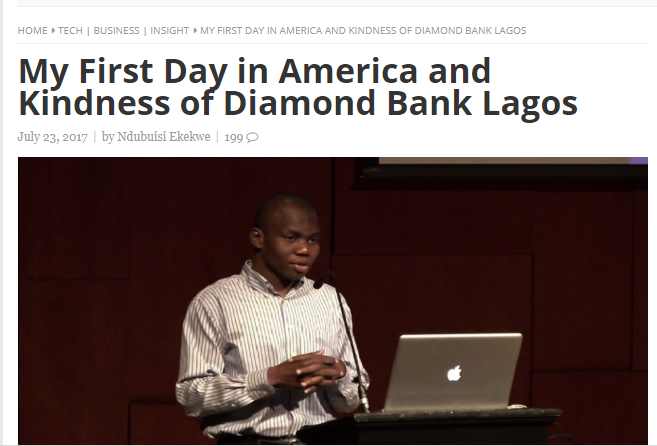
Immediately, the plan was to find a Nigerian firm that could support my plan – provide a good job and allow me to study! I was lucky – I found Diamond Bank. My secondary school classmate who was working as an office assistant had made a case that the bank was great on supporting human development. Yes, even though Diamond Bank paid well, the greatest value was the absolute commitment to develop people. As I had written here, there was no training or certification invoice the bank did not pay.
I enjoyed Diamond Bank; it was a bank with limitless opportunities. They paid every training invoice I sent to them and the bank was awesome. There was no boss; we were all comrades serving Nigerians. In short, I never saw my supervisors as bosses; they were colleagues and they made spending 48 hours at work normal.
When I joined Diamond Bank, a multinational oil company through FUTO wanted me. I explained to my Department Chair that I was not interested. By then, I was already in training school in Apapa branch of the bank. But somehow to avoid burning the bridges with FUTO, I was asked to honor the invitation. The oil company flew me to Trans Amadi (my first time of entering a plane); I went and politely declined the job. The job was to pay more than what Diamond Bank was paying. By then, I had figured out that knowing about finance would be helping in my path in future (I had wanted to own my firm). Also, the banking job was more tradable in future than working in a big oil firm where trading the skills acquired could see more barriers. Besides, the problem was not money as the NYSC contract money was still intact. I later took 6,000 pounds sterling to pay for correspondence doctoral program in UK.
All Together
I am still working on this career. But I have known one thing: while making money is nice, do all necessary to work in a place you can learn. Giving you a fish is great, but teaching you how to fish is PRICELESS.
Finally, always assume that only 10% of Nigerian professionals will stay in their fields after 15 years. Our economy is very small when compared to those jockeying for opportunities at the top. So, as companies begin to weed, triggering career paralyses, it is what you know that will see you through. So, developing skills early will help you instead of packing money only to see that you are out with no tradable skills. A job that gives you skills which can be monetized in a Nigerian economy should always be preferable as you can “sell” those skills later. And then, always pray for favor, because no matter what, grace is all you need.